
Business
‘Rev. Fr. Dr. Camillus Fernando to lead BCI Campus to new heights’


Marking a new chapter in the leadership of the respected BCI, Rev. Fr. Dr. Camillus Fernando was formally installed as the 2nd Rector/Vice Chancellor of the Institution at a ceremony held recently.
The installation service, presided over by His Eminence Malcolm Cardinal Ranjith, Archbishop of Colombo and Founder of BCI, took place on October 12, 2023.
In his inauguration speech, Rev. Fr. Dr. Camillus Fernando expressed his gratitude and a deep sense of responsibility towards BCI. He acknowledged the foundation laid down by His Eminence Malcolm Cardinal Ranjith and emphasized the importance of consistency and progress. He affirmed BCI’s identity as a Catholic University committed to Christ-like service.
The exemplary leadership of Very Rev. Fr. Quintus Fernando, his predecessor, was also acknowledged by him. He further outlined his vision of continuing to build on the existing strong and established foundation that is already in place, with special emphasis on the social mission of BCI and his optimism towards BCI’s contribution to the society in the future.
Rev. Fr. Dr. Camillus Fernando concluded his speech by calling for teamwork and collaboration among the Governing Council, Academic Senate, professors, and staff for the development and progress of BCI to take the institution to new heights. He expressed conviction in the uniqueness of each individual’s contribution and concluded with a heartfelt acknowledgment of his family.
He said, “I plan to give my heart and soul and all my energy to the service of BCI, which enables me to look to the future with optimism. I know how much BCI already does for the world, the country, and the region through academic excellence. I believe that BCI can do even more because I cannot imagine an institution that is better equipped to contribute to the society in real and meaningful ways.”
Rev. Fr. Dr. Camillus Fernando was ordained as a Priest on July 25, 1992. Having served in various capacities spanning multiple decades of service, he is a proficient, highly qualified and well-experienced educator. In addition to serving as a Parish Priest at various locations, he was extensively involved in academic, religious, and editorial positions including being an academic staff member of St. Peter’s College, Colombo, Dean of Philosophy at the National Seminary, Kandy, Rector at Holy Cross College, Kalutara and St. Aloysius Minor Seminary, Colombo.
He was also the Director of the Colombo Catholic Press, editor of several Catholic weekly newspapers, and the media spokesperson of the Archdiocese of Colombo. He also served as the Rector of St. Nicholas’ International School, Colombo and Parish Priest of St. John Dal Bastone Church, Thalangama.
Academically, Fr. Camillus holds a Doctorate in Science of Education from the Urbanian University in Rome, a Master’s Degree in Social Sciences from the University of Kelaniya and a Postgraduate Diploma in Buddhism from the University of Kelaniya. He has published extensively and served as Executive Secretary of the Federation of Asian Bishops’ Conference (FABC) for Evangelization, Bible and Liturgy.
BCI Campus, Negombo was opened in 2015 and focuses on providing affordable, high quality tertiary education with a values-based approach. Under the leadership of Rev. Fr. Dr Camillus Fernando, BCI aims to expand its programmmes and community impact, paving a new era, continuing its commitment to academic excellence and Christ-like service.


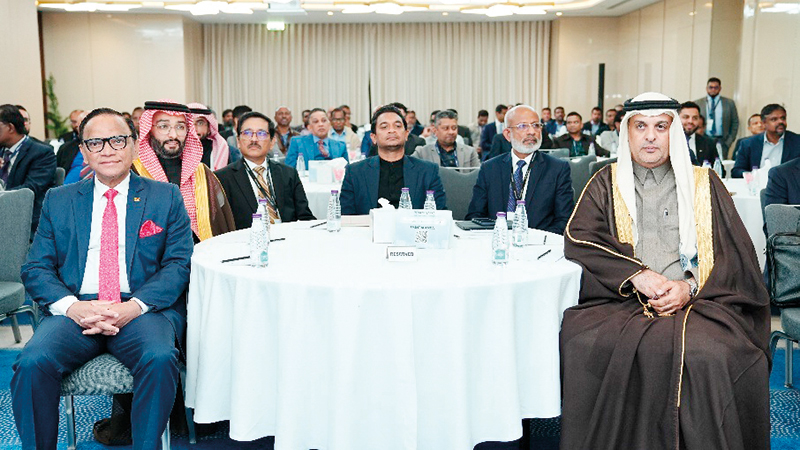
The Securities and Exchange Commission of Sri Lanka (SEC) and the Colombo Stock Exchange (CSE), in association with the Embassy of Sri Lanka to the Kingdom of Saudi Arabia, successfully convened an investor forum on Saturday 24th January 2026 at the Radisson Blu Hotel, Riyadh Convention & Exhibition Center. Alongside the forum, the SEC and CSE facilitated a meeting with the Public Investment Fund (PIF) which is Saudi Arabia’s main sovereign wealth fund.
The forum was organized to engage directly with the vibrant Sri Lankan expatriate community in the Kingdom and international investors, highlighting compelling opportunities within Sri Lanka’s capital market following the country’s successful exit from sovereign default and restoration of macroeconomic stability.
The forum was marked by the presence of several senior level policy officials, market leaders and market regulators including; Dr. P. Nandalal Weerasinghe, Governor of the Central Bank of Sri Lanka (CBSL); Chathuranga Abeysinghe, Deputy Minister of Industry and Entrepreneurship Development; Ameer Ajwad Ambassador of Sri Lanka to the Kingdom of Saudi Arabia.; Senior Prof D.B.P.H. Dissabandara, Chairman of the SEC; Ray Abeywardena, Director of CSE; and Dr. Naveen Gunawardane, Co-Founder and Managing Director of Lynear Wealth Management.
In his welcome address, Ameer Ajwad stated, that a significant opportunity remains in broadening public participation in the capital market of Sri Lanka. As financial literacy and investment awareness among potential investors are limited, the investor forum would serve to bridge the knowledge gap. The forum offered an excellent opportunity for first-time investors, overseas investors, and those seeking to enhance their knowledge, to learn how to invest prudently, manage risk, and build wealth with discipline and confidence. Ambassador invited participants to make full use of the presence of high-level authorities from Sri Lanka’s key financial institutions, such as the Central Bank of Sri Lanka, the SEC, and the CSE, and to explore investment opportunities in Sri Lanka’s capital market, not only as a pathway to financial growth but also as a meaningful contribution to Sri Lanka’s resilience and long-term prosperity.

Agriculture-rich diversified conglomerate CIC Holdings PLC (CSE: CIC) recorded a consolidated revenue of Rs. 70.28 billion for the nine months ended 31 December 2025 (9MFY26), reflecting an increase of 8.69% YoY compared to the corresponding period of the previous year.
The Group’s gross profit increased by 10.11% to Rs. 18.42 billion, with the gross profit margin for the period under review improving to approximately 26%, supported by disciplined pricing and product mix optimisation. Profit after tax (PAT) increased to Rs. 5.97 billion from Rs. 5.70 billion in the corresponding period of the previous year, despite losses incurred in parts of the Group’s agri operations following the impact of Cyclone Ditwah, which disrupted cultivation activity during the Maha season.
The Group’s Crop Solutions sector remained the largest contributor to consolidated revenue, accounting for approximately 44.7% of total revenue, followed by Livestock Solutions at 21% and Health & Personal Care at 20.18%. The remaining sectors, Industrial Solutions and Agri Produce, contributed 8.6% and 6.4% to Group turnover respectively. Health and Personal Care , particularly export-driven product lines, recorded improved performance during the period, alongside continued growth in feeds, poultry, and veterinary care solutions, which supported the Group’s overall operating results.
Despite cyclone-related disruption to cultivation cycles, the Group delivered a strong operating performance, with EBITDA and operating profit (EBIT) both recording year-on-year growth. Operating profit (EBIT) closed at Rs. 9.67 billion, compared to Rs. 8.62 billion in the corresponding period of the previous year, reflecting the strength of the Group’s diversified portfolio and disciplined cost management.
During the period in review, key Group businesses across the five industry sectors, namely Crop Solutions, Agri Produce, Livestock Solutions, Industrial Solutions, and Health & Personal Care, continued to perform resiliently. Crop Solutions revenue increased from Rs. 28.06 billion to Rs. 32.32 billion, while Livestock Solutions revenue grew from Rs. 13.35 billion to Rs. 14.60 billion. Health & Personal Care revenue improved from Rs. 14.29 billion to Rs. 14.46 billion, supported by herbal health product exports and steady domestic demand. Revenue from Agri Produce increased from Rs. 4.35 billion to Rs. 4.64 billion, while Industrial Solutions revenue rose from Rs. 6.07 billion to Rs. 6.28 billion.
Commenting on the performance, CIC Holdings Group CEO Aroshan Seresinhe said, “Despite the disruption caused by Cyclone Ditwah to agricultural activity during the Maha season, the Group remained focused on supporting farming communities through well clean-up operations, field renovation, and the restoration of cultivation activity.

CSE trading reflected a bullish trend yesterday due to positive quarterly corporate earnings coupled with lower Treasury Bill yields, market analysts said.
Further, institutional participation contributed more than 50 percent to the day’s turnover.
Amid those developments both indices moved upwards. The All Share Price Index went up by 63.67 points, while the S and P SL20 rose by 12.58 points.
Turnover stood at Rs 11.1 billion with10 crossings. The top seven crossings were: JKH 189.5 million shares crossed to the tune of Rs 4.2 billion; its shares traded at Rs 22.70, HNB 3.5 million shares crossed for Rs 1.48 billion; its shares traded at Rs 422, Hemas Holdings 11 million shares crossed for Rs 376.2 million; its shares traded at Rs 34 20, Commercial Bank 1.5 million shares crossed for Rs 336.8 million; its shares traded at Rs 224.50, Sampath Bank 600,000 shares crossed for Rs 93.6 million; its shares sold at Rs 156, Laugfs Gas 868,000 shares crossed for Rs 51.6 million; its shares sold at Rs 71 and Sierra Cables 1 million shares crossed for Rs 36.7 million; its shares sold at Rs 36.70.
In the retail market top seven companies that mainly contributed to the turnover were; Ceylon Land Equity Rs 385 million (20 million shares traded), Commercial Bank Rs 373.9 million (1.7 million shares traded), Luminex Rs 247.2 million (26.7 million shares traded), Colombo Dockyard Rs 152 million (one million shares traded), TJ Lanka Rs 152 million (four million shares traded), Easter Merchants Rs 142 million (8.7 million shares traded) and RIL Properties Rs 116.9 million. During the day 441.3 million share volumes changed hands in 44406 transactions.
It is said that manufacturing sector counters, especially JKH, led the market while the banking sector also performed well, especially HNB and Sampath Bank. Further, the capital goods sector too performed well.Yesterday the Central Bank’s US dollar buying rate was Rs 305.78 and selling rate Rs 313.32.
By Hiran H Senewiratne

Sooryavanshi 175 makes India six-time Under-19 world champions

Mighty India meet multicultural USA in polarised World Cup

At least 31 killed, dozens wounded in Islamabad mosque blast

The SSC finally steps out of the sunshine and into the floodlights

SAARC journalists meet in New Delhi

Governor of Gujarat met with Sri Lanka PM to discuss exposition of Devnimori Relics

‘Dates have the highest sugar content to fight Coronavirus’

Sunday Island 27 December – Headlines

#SundayIsland 17th December – Headlines

Sunday Island – 28th March

Sunday Island Headlines – 21 March

Sunday Island – 21st February – Headlines
-

 Business7 days ago
Hayleys Mobility ushering in a new era of premium sustainable mobility
-

 Business4 days ago
SLIM-Kantar People’s Awards 2026 to recognise Sri Lanka’s most trusted brands and personalities
-

 Business7 days ago
Advice Lab unveils new 13,000+ sqft office, marking major expansion in financial services BPO to Australia
-

 Business7 days ago
Arpico NextGen Mattress gains recognition for innovation
-

 Business6 days ago
Altair issues over 100+ title deeds post ownership change
-

 Editorial7 days ago
Govt. provoking TUs
-

 Business6 days ago
Sri Lanka opens first country pavilion at London exhibition
-

 Business5 days ago
All set for Global Synergy Awards 2026 at Waters Edge