
News
Resume work to avoid disrupting youths’ futures – State Minister of Higher Education

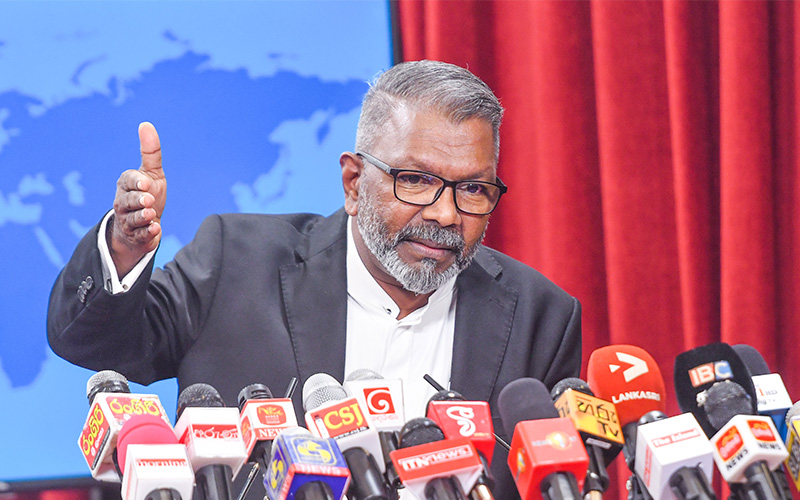
State Minister of Higher Education Dr. Suren Raghavan, urged non-academic staff across all universities to resume work promptly, emphasizing the importance of minimizing disruptions for the youth who are the future leaders of the nation.
Speaking at the press briefing titled “Collective Path to a Stable Country” held at the Presidential Media Centre on Friday (05), he committed to prioritizing the grievances of university non-academic staff, including addressing overtime allowances for April.
These concerns will be forwarded to the Udaya Seneviratne Committee and proposed for inclusion in the 2025 budget, he added.
State Minister Raghavan further explained,
Fourteen thousand six hundred (14,600) non-academic employees from 17 universities and 19 joint post-graduate institutions have been on strike for 65 days, severely disrupting the higher education sector. This has adversely affected the lives of 250,000 young individuals, who are crucial to the future of the nation, by causing confusion and wasting their time.
These youths, who have already faced significant mental strain from the Covid-19 pandemic in 2019, economic crises in 2020, and various challenges in 2021, represent the 18% selected to enter universities despite these hardships. It is a national tragedy that their lives have been further complicated by this strike.
As someone deeply committed to education, I am profoundly saddened that universities in our country remain closed during my tenure, knowing first-hand the value of education. While the Treasury did not approve their requested salary increase, citing similar demands from other sectors, they have assured that these requests will be considered for inclusion in the 2025 budget.
It has been revealed that, the Federation of University Teachers Association (FUTA) is behind this situation. Since 2010, they have continuously increased their salaries and are now attempting to raise the salaries of non-academic employees while imposing various conditions. In their latest letter, they stated that university funds should not be used to resolve this issue. How can they impose such conditions? Universities are funded by public tax money, not their private asset. They cannot be allowed to fall under the control of a professors’ mafia. Their professional goal should be to advance education and secure the future of our children.
The demands of non-academic employees are reasonable. I promise that their requests will be forwarded to the Udaya Seneviratne Committee and included in the 2025 budget through President Ranil Wickremesinghe. Additionally, we are working to pay their two months’ salary and overtime for April. Days not reported to work will be treated as holidays, allowing them to return without any penalties. I urge the non-academic staff of all universities to resume work promptly to avoid further disrupting the lives of the youth who are the future of our country.


The Pakistan Navy Ship (PNS) TAIMUR and ASLAT arrived at the Port of Colombo on a goodwill visit on 12 Apr 26.
The visiting ships were welcomed by the Sri Lanka Navy in
compliance with naval traditions.
The duo of ships is commanded by Captain NIAMAT SAEED KHAN (PNS TAIMUR) and Captain NADIR MATEEN AFRIDI (PNS ASLAT).
Meanwhile, the ships are expected to conduct a Bilateral Naval Exercise LION STAR V with the Sri Lanka Navy in Colombo seas.
Latest News
Heat index likely to increase up to ‘Caution level’ at some places in the Northern, North-central, North-western, Western, Sabaragamuwa, Southern and Eastern provinces and Monaragala district

Warm Weather Advisory
Issued by the Natural Hazards Early Warning Centre at 3.30 p.m. on 11 April 2026, valid for 12 April 2026
The Heat index, the temperature felt on the human body is likely to increase up to ‘Caution level’ at some places in the Northern, North-central, North-western, Western, Sabaragamuwa, Southern and Eastern provinces and Monaragala district.
The Heat Index Forecast is calculated by using relative humidity and maximum temperature and this is the condition that is felt on your body. This is not the forecast of maximum temperature. It is generated by the Department of Meteorology for the next day period and prepared by using global numerical weather prediction model data.

Effect of the heat index on human body is mentioned in the above table and it is prepared on the advice of the Ministry of Health and Indigenous Medical Services.
ACTION REQUIRED
Job sites: Stay hydrated and takes breaks in the shade as often as possible.
Indoors: Check up on the elderly and the sick.
Vehicles: Never leave children unattended.
Outdoors: Limit strenuous outdoor activities, find shade and stay hydrated.
Dress: Wear lightweight and white or light-colored clothing.
Note: In addition, please refer to advisories issued by the Disaster Preparedness & Response Division, Ministry of Health in this regard as well. For further clarifications please contact 011-7446491.
Latest News
Sun directly overhead Cheddikulam, Kebithigollewa, Gomarankadawala and Nilaveli about 12:11 noon. today [12]

On the apparent northward relative motion of the sun, it is going to be directly over the latitudes of Sri Lanka from 05th to 15th of April in this year.
The nearest areas of Sri Lanka over which the sun is overhead today (12th) are Cheddikulam, Kebithigollewa, Gomarankadawala and Nilaveli about 12:11 noon.

PNS TAIMUR & ASLAT arrive in Colombo

Sanju Samson and Jamie Overton deliver first points for Chennai Super Kings

Arya, Prabhsimran and Shreyas help Punjab Kings ace another 200-plus chase

Beauty of Sri Lanka in focus: Global showcase blends art, diplomacy and conservation

Showers expected in the Western, Sabaragamuwa, Central, Southern, North-western and Uva provinces and in Ampara, Batticaloa and Polonnaruwa districts after 1.00 p.m.

Heat index likely to increase up to ‘Caution level’ at some places in the Northern, North-central, North-western, Western, Sabaragamuwa, Southern and Eastern provinces and Monaragala district

‘Dates have the highest sugar content to fight Coronavirus’

Sunday Island 27 December – Headlines

#SundayIsland 17th December – Headlines

Sunday Island – 28th March

Sunday Island Headlines – 21 March

Sunday Island – 21st February – Headlines
-

 News6 days ago
Lankan-origin actress Subashini found dead in India
-

 News4 days ago
AG: Coal procurement full of irregularities
-

 Business3 days ago
Israeli attack on Lebanon triggers local stock market volatility
-

 News22 hours ago
CEB orders temporary shutdown of large rooftop solar systems
-

 Business4 days ago
Hayleys Mobility introduces Premium OMODA C9 PHEV
-

 Business3 days ago
HNB Assurance marks 25 years with strategic transformation to ‘HNB Life’
-

 Sports4 days ago
DS to face St. Anthony’s in ‘Bridges of Brotherhood’ cricket encounter
-

 News6 days ago
UN Regional Director launches SL’s first Country Gender Equality Profile during official visit