
Editorial
Restoring dignity of Parliament


Monday 25th November, 2024
Jaffna District Independent MP Dr. Archuuna Ramanathan has drawn heavy flak for his unparliamentary conduct during the inaugural session of the 10th Parliament last week. He occupied the Opposition Leader’s seat improperly, and resisted a parliamentary worker’s efforts to persuade him to leave it; he declared that he was no respecter of parliamentary traditions. He went so far as to post a video of the incident on social media. The word, ‘Eelam’, he used to give his propaganda stunt a separatist zing, has prompted some civil society groups to call for legal action against him. They are sure to milk the issue dry.
MP Ramanathan has provided a rallying point to some nationalistic groups that are reeling from their humiliating electoral defeats and desperately looking for something to hold on to.
Facing a combative television interview subsequently, MP Ramanathan made a very serious allegation against the Sri Lanka army. He said the army was shielding the much-dreaded Ava group, which terrorises the people in the North. The police must probe this allegation forthwith. The burden of proof is on MP Ramanathan, who should cooperate fully with the police. However, he is not alone in having made such unsubstantiated allegations against the Sri Lankan military. Most TNA MPs did so in Parliament itself as well as elsewhere to the extent of influencing the UNHRC.
MP Ramanthan is also under fire for having praised the slain LTTE leader Velupillai Prabhakaran to high heaven. He in fact deified Prabhakaran. Only hypocrisy of the highest order can drive a person to champion democracy while commemorating those who resorted to savage terror to deprive the people of their democratic rights and destroy tens of thousands of lives and properties worth billions of rupees in the name of some macabre causes.
However, Prabhakaran is not the only dead terror leader who is commemorated. This year’s commemoration of the JVP founder, Rohana Wijeweeera, and other slain party cadres took place the other day. Strangely, there is no one to commemorate the thousands of victims of LTTE and JVP terror!
Prabhakaran and Wijeweera were poles apart anent their ideologies and goals, but their modus operandi was more or less the same—unleashing barbaric terror. So, the argument that it is nothing but duplicitous to allow the commemoration of Wijeweera and ban that of Prabhakaran is not without merit. Terrorism is no means to an end; it is the end and means both, and must therefore be condemned and defeated in all its forms and manifestations.
What MP Ramanathan did during the inauguration of the current Parliament was reprehensible, but one can argue that it pales into insignificance in comparison to what we witnessed during the 52-day government in late 2018, when a group of UPFA MPs loyal to the Rajapaksa family went berserk, unable to muster a parliamentary majority to retain their unconstitutionally-gained hold on power. They even tried to harm the then Speaker Karu Jayasuriya, who did not give in to their terror tactics; one of the protesting UPFA MPs even sat on the Speaker’s chair, which was later toppled; the protesters damaged furniture and microphones in the House, hurled books and water mixed with chilli powder at their opponents and threw chairs at the police personnel, who were called in to protect the Speaker.
The culprits were seen in a live telecast of the stormy session, and a complaint was lodged with the police against them, but they were not prosecuted. Efforts by the media, civil organisations and concerned citizens to have those rowdies face the full force of the law were in vain; the Yahapalana government opted to soft-pedal the issue, after the UNP regained control of Parliament, and the culprits received only a rap on the knuckles. Parliament and political leaders thus created an extremely bad precedent, and it is only natural that the people have lost trust in Parliament, and the JVP almost succeeded in leading a mob to march on it in 2022.
Besides, in previous parliaments, brawls where thugs in the garb of MPs resorted to fisticuffs and traded raw filth were frequent, and they prompted the Speakers to remove schoolchildren from the public gallery.
It is up to Parliament to decide how to handle the issue of MP Ramanthan’s unparliamentary conduct at issue, but the task of restoring the dignity of the legislature requires much more than disciplinary action against one or two MPs. The swamp has to be drained once and for all.
Thankfully, most of those who brought Parliament into disrepute have lost their seats, but the problem is that when power goes to politicians’ heads, they take leave of their senses; whether the new MPs will succumb to the arrogance of power or be guided by their collective moral ‘compass’ remains to be seen.


Monday 11th May, 2026
Tamilaga Vettri Kazhagam (TVK) leader Chandrasekar Joseph Vijay has achieved his chief ministerial dream in Tamil Nadu, with the help of some other parties, including the Congress. His meteoric rise to power was possible mostly due to his popularity as a film star, his unrealistic promises and a massive protest vote fuelled by anti-politics. Winning elections is one thing, but living up to people’s expectations by fulfilling campaign promises is quite another. In politics, a beginner’s luck rarely lasts long. If implemented, the freebies promised by Vijay to garner favour with voters, are estimated to account for more than 50% of Tamil Nadu’s tax revenue. Thus, Vijay has his work cut out to prevent his first chief ministerial term from facing the same fate as his first film, which reportedly became a box office bomb.
The paradigm shift in Tamil Nadu politics has sent the Colombo commentariat into overdrive, with divergent assessments of its implications for Sri Lanka and Indo-Lanka relations. Some commentators are of the view that Vijay’s anti-Sri Lanka utterances were mere campaign rhetoric; Vijay himself will forget them with the passage of time, and even if he wants to pursue his pledges, especially the one to retrieve Katchatheevu, there will be nothing he cannot do, as New Delhi considers the issue long settled. The proponents of this argument have apparently ignored the fact that the Indian Centre is swayed by Tamil Nadu, and New Delhi has even resorted to extreme measures to appease the Tamil Nadu politicians and further its own interests at the expense of Sri Lanka. India trained, armed and funded pro-Eelam terror groups, and rammed the Indo-Lanka Accord down President J. R. Jayewardene’s throat in 1987, paving the way of devolution. India was hoist with its own petard, with the LTTE turning against it, a few years later, and the situation changed.
The current world order is anything but “rules based”. International pacts, accords, covenants, treaties, charters, etc., become worthless when the powerful signatories thereto feel like violating them. The US has violated the UN Charter, perhaps for the umpteenth time, by abducting President of Venezuela Nicolás Maduro and his wife. It has also carried out unprovoked air strikes on Iran, killing its Spiritual Leader and thousands of civilians besides destroying assets worth billions, if not trillions, of dollars.
It has been alleged that at the height of the 2022 uprising here, following the forced resignation of President Gotabaya Rajapaksa, Indian High Commissioner Gopal Baglay pressured Speaker Mahinda Yapa Abeywardene to take over the presidency in violation of the Constitution. Abeywardene told Parliament subsequently that the goal of those who tried to force him to appoint himself the Acting President was to plunge this country into anarchy. Baglay allegedly acted in violation of the Vienna Convention on Diplomatic Relations, which requires diplomats to refrain from interfering with the internal affairs or politics of the host countries. Curiously, this very serious allegation remains unprobed though the grandees of the JVP-NPP government and the SJB-led Opposition wrap themselves in the flag and often declare their commitment to protecting the national interest.
The possibility of the new Tamil Nadu administration escalating the issue of illegal fishing in Sri Lankan waters to such an extent that New Delhi may feel compelled to intervene more assertively, if not aggressively, cannot be ruled out. In 2013, the then Minister of Fisheries and Aquatic Resources Development Dr. Rajitha Senaratne disclosed that certain Tamil Nadu politicians owned trawlers and rented them out on the strict condition that they be used for poaching in Sri Lankan waters. These troublemakers are likely to step up their illegal fishing operations to belittle Sri Lanka’s sovereignty and bring New Delhi and Colombo on a collision course.
Responses to vital bilateral issues should not be grounded solely in suspicions and perceptions if they are to be workable. Tamil Nadu politicians’ hostility towards Sri Lanka is a problem to be managed diplomatically. Foreign relations are layered and dynamic, and diplomacy requires calibrated responses to contentious issues. It is, however, prudent to be cautious.

There seems to be no end to the JVP-NPP government’s volte-face. The ruling party leaders vehemently opposed Emergency regulations while out of power, launching into tirades against the previous governments for abusing Emergency to further their political interests by suppressing the democratic rights of the Opposition and the public. But they are now practising the very opposite of what they preached; they keep on extending the state of Emergency, which was imposed in the aftermath of the landfall of Cyclone Ditwah, six months ago. It also has no qualms about using the Prevention of Terrorism Act, which it promised to do away with.
The government made a mockery of its much-touted commitment to upholding democracy once again on Thursday (07) by extending the state of Emergency. The Opposition never misses an opportunity to condemn the government for doing so, but most of its members are absent when motions seeking parliamentary approval for extending Emergency are put to the vote.
On Thursday, the motion presented by the government to extend Emergency regulations received 145 votes, with only six Opposition MPs being present in the House to vote against it. Seventy-three MPs, including 13 government members, were absent during the crucial vote. That the ayes would have it was a foregone conclusion, but the Opposition MPs should have remained in the House when a division was called on the motion. Last month 60 MPs, representing both sides of the House, were absent when a vote was taken on Emergency. The MPs’ absence during crucial debates and votes amounts to a dereliction of legislative duty and an abdication of parliamentary responsibility.
The Chief Opposition Whip and party whips are responsible for ensuring that the Opposition MPs are present during debates and votes. They only talk nineteen to the dozen in the House. A wag says it is a case of all sizzle and no steak. Shouldn’t these Opposition bigwigs, given to pontification, put their house in order before lecturing the government on how to conduct its affairs?
Our legislators parade their knowledge of Erskine May’s authoritative work, Parliamentary Practice. They however do not follow the principles enunciated by May in his seminal treatise. May has viewed parliamentary attendance not merely as a procedural obligation but also as an essential condition for representative democracy and effective scrutiny. Reflected in his writings is the traditional Westminster belief that Parliament functions properly only when its members are physically present and actively participate in debates, scrutinise government actions, serve on committees and vote.
May’s emphasis is also on the ethical dimension of the MPs’ attendance during debates. The members are expected to be present during the proceedings, listening to dissenting views and responding to questions. He has frowned on the practice of members departing immediately after delivering their speeches in the House. This is something the Sri Lankan Presidents ought to pay attention to. They have the bad habit of haranguing the MPs and hurrying out of the chamber immediately afterwards. They apparently consider it infra dig to remain in the chamber and listen to the Opposition MPs. In Westminster democracies, influenced by May, parliamentary attendance has come to symbolise political responsibility, discipline and commitment to public service. Sadly, the members of the Sri Lankan Parliament do not seem to care much about this cherished tradition.
A parliamentary sitting reportedly costs about Rs. 32.2 million, and it does not make sense to spend so much money if the MPs skip sittings. Those who do not participate in debates and votes in the House make a strong case, albeit unwittingly, for a smaller Parliament.
If Parliament can manage with about 150-170 members, as it does at present, why should the taxpayers be made to pay through the nose to maintain as many as 225 MPs besides 445 provincial council members (including 45 ministers) and more than 8,500 local councillors. No wonder there is a resurgence of anti-politics.
Saturday 9th May, 2026
An exchange of fire between the US and Iran in the Strait of Hormuz sent shockwaves across the world yesterday, and oil prices soared as a result. Thankfully, it was a brief clash. The US has claimed that it foiled Iranian attacks on three of its ships. Iran has said it came under unprovoked attacks. Ceasefires in military conflicts are never free from such shocks, and care needs to be exercised to prevent skirmishes from spiraling out of control. The international community has a pivotal role to play in ensuring that the ceasefire in West Asia lasts, and negotiations continue.
The US-Iran peace negotiations have been stuck in the Hormuz chokepoint, and they will have to progress, leading to a durable truce lest the region should face a protracted conflict. There is nary a country that has not been affected by the West Asia conflict either directly or indirectly.
About 1,500-2,000 ships and 20,000 seafarers are reportedly stranded in and around the Hormuz Strait, and this a very serious issue that the world cannot ignore. The US sought to make a naval intervention to escort commercial vessels through the chokepoint, but subsequently paused its “Project Freedom”, which would have jeopardised the fragile ceasefire.
However, so many ships and their crews must not be kept waiting indefinitely in a sea passage, and international navigation via the Hormuz Strait must resume fast but without any US military intervention, which will only make matters worse.
Many economies are reeling the world over, especially in the Global South, owing to the closure of the Hormuz Strait, through which about 20 percent of global oil supplies and about 30 percent of global fertiliser supplies pass. The impact of the destruction of oil assets in Iran and its neighbours will be felt for decades to come. Even if hostilities cease, it will not be possible to repair the damaged assets any time soon.
The Food and Agriculture Organization of the United Nations (FAO) has repeatedly warned that prolonged disruption of fertiliser shipments through the Strait of Hormuz could trigger serious global food shortages, food inflation and reduced crop yields, as we pointed out in a previous comment. FAO officials have said that the crisis threatens global agrifood systems because up to 30–45% of internationally traded fertilisers and large volumes of energy supplies move through the strait. This alone is proof of the enormity of the problem the conflict has created for the world.
The general consensus is that a way out is to ensure that the ongoing ceasefire and negotiations create conditions for the return of the status quo ante in the Hormuz Strait soon. However, that will be possible only if both the US and Iran soften their stands. Iran has asked the US to end its naval blockade, and this can be considered a fair demand, and if the US complies, Iran will be compelled to reopen the Hormuz chokepoint, paving the way for further de-escalation and helping bring down oil and fertiliser prices. That alone may not help resolve the conflict, which is far more complex than it looks, but the resumption of international navigation through the Hormuz Strait will give a tremendous boost to the peace process, which is said to be in the doldrums, with both sides resorting to brinkmanship.

Philippine VP Sara Duterte impeached for a second time

US and French nationals test positive for hantavirus after leaving ship

Thailand’s divisive ex-PM is out of jail, but is the Thaksin era over?

Andy Flower fined for ‘use of an audible obscenity’ during Mumbai Indians clash

Royal Challengers Bengaluru eliminate Mumbai Indians and go top after tense finish

Car bomb attack and ambush in northwest Pakistan kill at least 21 police

‘Dates have the highest sugar content to fight Coronavirus’

Sunday Island 27 December – Headlines

#SundayIsland 17th December – Headlines

Sunday Island – 28th March

Sunday Island Headlines – 21 March

Sunday Island – 21st February – Headlines
-

 News5 days ago
MIT expert warns of catastrophic consequences of USD 2.5 mn Treasury heist
-
 News7 days ago
CJ urged to inquire into AKD’s remarks on May 25 court verdict
-

 News2 days ago
Lanka Port City officials to meet investors in Dubai
-

 Editorial5 days ago
Clean Sri Lanka and dirty politics
-
 Opinion7 days ago
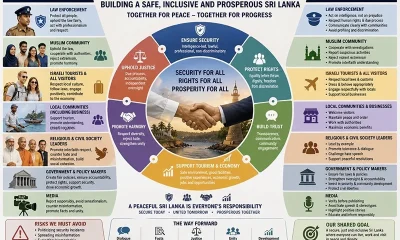
Security, perception, and trust: Sri Lanka’s delicate balancing act
-

 Editorial4 days ago
The Vijay factor
-
 News3 days ago
SLPP expresses concern over death of former SriLankan CEO
-

 News6 days ago
Development Officer bids Rs. 48 mn for CPC’s V8 at auction