
News
Researchers discover new variant of Sri Lankan aquarium fish

by Ifham Nizam
A new variant of a popular Sri Lankan aquarium fish has been discovered by local and foreign researchers.
The freshwater fish, genus Rasbora, (commonly called ‘dandiya’) is one of the most diverse groups of freshwater fishes in tropical Asia.
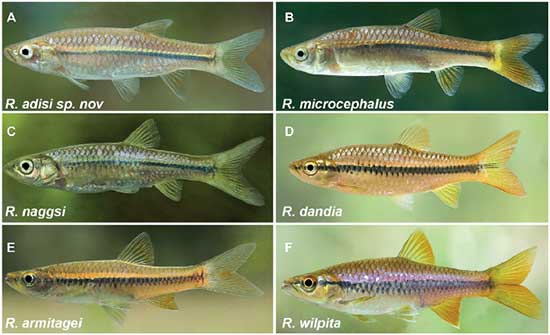
In Sri Lanka, previous studies have shown that there are five species (Rasbora dandia, R. microcephalus, R. wilpita, R. naggsi, and R. armitagei) of which the last three are endemic to the island. This diversity is remarkable when compared with peninsular India, which is about 25 times the size of Sri Lanka but contain only four species of Rasbora.
Biologists earlier believed there were only five varieties of the popular aquarium fish endemic to Sri Lanka. However, with the discovery of the sixth species, Rasbora has gained a new reputation among Sri Lankan freshwater fish breeders, hobbyists and harvesters.
The researchers carried out multiple analysis using “finer geographic sampling and greater sample sizes”, thereby corroborating the validity of six species of Rasbora (scientifically called as ‘Cyprinidae’) in Sri Lanka.
The team of researchers have combed a sampling of 90 sites across Sri Lanka to identify the new species. The team consisting of Hiranya Sudasinghe of Evolutionary Ecology and Systematics Lab, Department of Molecular Biology and Biotechnology, University of Peradeniya, Rohan Pethiyagoda of Ichthyology Section, Australian Museum, Sydney, NSW, Australia, Ranasinghe Hettiarachchige Tharindu Ranasinghe of Butterfly Conservation Society of Sri Lanka, Malwana, Rajeev Raghavan of Department of Fisheries Resource Management, Kerala University of Fisheries and Ocean Studies (KUFOS), Kochi, India, Neelesh Dahanukar of Indian Institute of Science Education and Research (IISER), Pune, India and Madhava Meegaskumbura of Guangxi Key Laboratory of Forest Ecology & Conservation, College of Forestry, Guangxi University, Nanning, China.
Sudasinghe told The Sunday Island that more extensive sampling of Rasbora in India, and analysis based on multiple markers may reveal “a more complex phylogenetic topology” (diversity).
“The Sri Lankan diversification derives from a common ancestor which arrived from India during a sea-level low-stand in the mid-Miocene (15.1 Ma [95% HPD: 11.5–19.8 Ma]), when the present-day island was sub aerially connected to the Indian subcontinent by a broad isthmus”, he added.
Rasbora is generally believed to have arrived in the island from the Indian sub-continent centuries ago when Sri Lanka stood geographically merged with India. In the latest study, researchers confirm this belief.
“Our analysis suggest that Sri Lankan Rasbora derive from a Mid Miocene, India to Sri Lanka dispersal”, he noted, and added that Sri Lankan Rasbora diversity is higher than that of the Indian peninsula.
The Sri Lankan diversity of Rasbora provides an opportunity to understand the evolutionary and phylogenetic relationships of freshwater fishes in the island. Understanding the bio geography, phylogenetic and the evolutionary relationships of species are pivotal in formulating effective assessments of the conservation status of species as well as to draw up species conservation management plans.
However, such studies are still at very early stages when it comes to the freshwater fishes in Sri Lanka.
The first-ever molecular phylogeny of Sri Lankan Rasbora and reassess the taxonomic identities of the five species of Sri Lankan Rasbora based on an island-wide survey. In this study, based on molecular, morphological and statistical analyses using finer geographic sampling, validate the five putative species of Rasbora previously recognized in Sri Lanka.
In addition, a new species of Rasbora was discovered from eastern Sri Lanka. This new species was named Rasbora adisi. The species name “adisi” means mysterious or enigmatic in Sinhala: an allusion to the cryptic nature of this species.
The new species is found in eastern basins in Sri Lanka such as Gal Oya, Menik River and Kumbukkan River and show the closest resemblance to Rasbora naggsi. However, the new species is different from R. naggsi by a combination of morphological characters in addition to been genetically distinct.

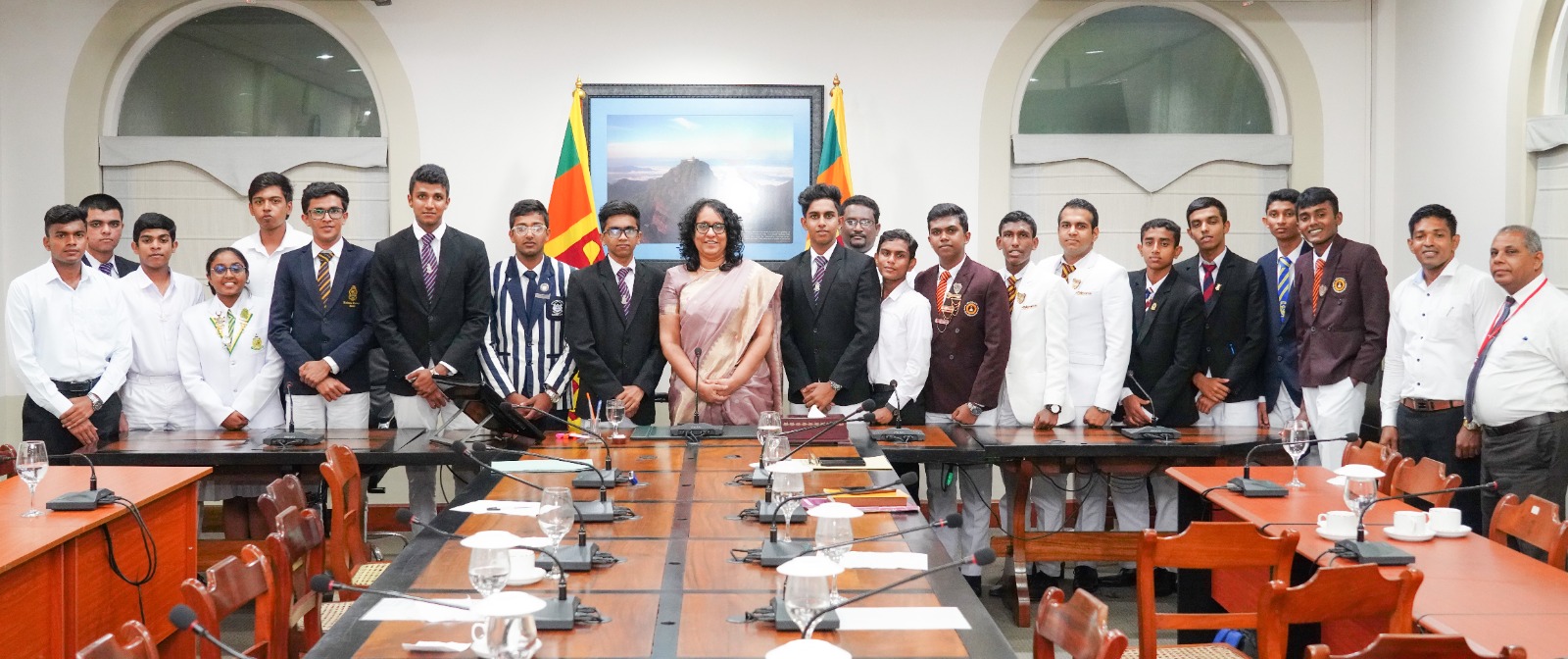
Members of the National Student Parliament met Prime Minister Dr. Harini Amarasuriya on Monday [02nd of February] at Temple Trees.
The representatives of the National Student Parliament, representing schools from across the island, visited the Temple Trees following their visit to the Presidential Secretariat and the Parliament.
Expressing her views on the occasion, Prime Minister Dr. Harini Amarasuriya stated,
“The new education reforms were recently initiated starting from Grade One. Discussions are currently underway to include students entering Grade Six this year into the new education reform process in the future. The education reforms will not be halted, and the government is committed to implementing them in a systematic manner without shortcomings”.
She further noted that the reforms are being carried out under five main pillars, with the government’s key objective being to reduce disparities and provide children with quality education, while also nurturing a socially responsible community enriched with human values such as compassion, love for the environment, and a strong sense of civic responsibility.
The occasion was attended by the Deputy Director of Education Kasun Gunarathne, along with officials from the Ministry of Education and representatives of the National Student Parliament.
[Prime Minister’s Media Division]
Latest News
Mrs. I.J. Aberathne appointed Director General of the Department of Trade and Investment Policy


The Cabinet of Ministers has approved the resolution presented by the President, in his capacity as the Minister of Finance, Planning, and Economic Development, to appoint Mrs. I.J. Aberathne to the post of Director General of the Department of Trade and Investment Policy with immediate effect.
News
Cabinet gives green light to provide equipment for the promotion of Aesthetic Education in schools

Although the teaching of art subjects such as music, dance, art, and drama under aesthetic education continues in the Sri Lankan school system, it has been observed that there is a severe shortage of equipment required for this purpose in many schools. Furthermore, a situation concerning the lack of modern equipment suitable for the needs of the children has also arisen, and it has been reported that most equipment available at present is outdated and dilapidated. It has been observed that this condition has an adverse effect on the quality of the aesthetic education and overall personality development of the children.
Therefore, the Cabinet of Ministers has approved the resolution presented by the Prime Minister in her capacity as the Minister of Education, Higher Education, and Vocational Education to implement a project for supplying aesthetic equipment for the promotion of aesthetic education in schools under an estimated cost of Rs. 1,215 million during the period of 2026 to 2028.

Somali woman executed for murdering a child in a case that sparked outrage

Last over in multi-day cricket to continue despite a wicket after latest amendments to Laws

England will bat first in 3rd ODI

Members of the National Student Parliament meet PM

Sri Lanka aim to overcome disarray and end trophy drought

Mrs. I.J. Aberathne appointed Director General of the Department of Trade and Investment Policy

‘Dates have the highest sugar content to fight Coronavirus’

Sunday Island 27 December – Headlines

#SundayIsland 17th December – Headlines

Sunday Island – 28th March

Sunday Island Headlines – 21 March

Sunday Island – 21st February – Headlines
-
 Opinion5 days ago
Sri Lanka, the Stars,and statesmen
-
 Business6 days ago
Climate risks, poverty, and recovery financing in focus at CEPA policy panel
-

 Business4 days ago
Hayleys Mobility ushering in a new era of premium sustainable mobility
-

 Business20 hours ago
SLIM-Kantar People’s Awards 2026 to recognise Sri Lanka’s most trusted brands and personalities
-

 Business4 days ago
Advice Lab unveils new 13,000+ sqft office, marking major expansion in financial services BPO to Australia
-
 Business4 days ago
Arpico NextGen Mattress gains recognition for innovation
-

 Business3 days ago
Altair issues over 100+ title deeds post ownership change
-

 Business3 days ago
Sri Lanka opens first country pavilion at London exhibition