
Features
Reminiscences of Dangedera village in Galle


Continued from Saturday
There was a colourful Muslim personality in the village known to all and sundry as ‘Cassim Master’. He was very fluent in Sinhala and could read and write the language perfectly.
When the post of the Charity Commissioner in the Galle Municipal Council fell vacant, he applied for it. But on the morning of the interview, Cassim Master was told by someone in the know, that the post was earmarked for a strong supporter of the Mayor.
An angry Cassim Master decided that he would go for the interview anyway. The interview board comprised the Mayor, the Deputy Mayor and the Municipal Commissioner.
 In order to test his Sinhala, the Deputy Mayor asked Cassim Master, the Sinhala term for the Galle Municipal Council.
“Galu Naraka Sabhawa?” said Cassim Maser without batting an eye. (Galle Bad Council).
There was an embarrassed silence, with red faces on the interview board.
And what is the Sinhala term for the Mayor of Galle?” asked His Worship the Mayor?
“Galu Narakadhi pathithuma!” replied Cassim Master blandly. (Galle’s Head of Hell!)
S. S. Kulatilake
The retired District Judge S. S. Kulatilake was the first MP and the first Cabinet Minister from this village. He was an appointed MP and the Minister of Cultural Affairs in the Sirimavo Bandaranaike Government in 1970.
In 1977, D.G. (Dangedera Gamage) Albert Silva from this village was elected as the MP for Galle and later nominated as the MP for Kamburupitiya, far removed from Galle.
A. H. E. Fernando and G. Keerthisinghe from this village were Deputy Mayors of Galle.
Sick of the servility of their veteran leaders, the angry young men of Dangedera found in the young lawyer from the village, – Raja Kulatilaka, a charismatic leader who eventually became the Mayor of Galle.
C. Sittampalam, a member of the Cabinet of D. S. Senanayake, chose a Sinhala bride from this village.
The Mahinda College playground is located inside this village on the north-west. It dates back to 1912. For the ordinary villager it was “Pedi Kumbura.”
Some of those who began playing cricket on this field rose to dizzy heights. On the first day of March 1953, W. B. Bennett, keeping wickets for Mahinda College against the Galle Cricket Club, dismissed all the 10 batsmen of the Galle C.C. in one innings. He caught four and stumped six of his victims. It is now a Guinness World Record!
The Amendra brothers of Mahinda College, nine in all, set up a unique record by at least one of them having represented the school cricket team between the years 1951 and 1973. In the year 1957 five of them made up the school first eleven. For six years, the captaincy was held by five of them. Another two of them were vice-captains. No doubt, it is a rare feat. The Guinness Book only pondered.
Captaining the Mahinda College Cricket Team in 1953, Somasiri Ambawatta created history by scoring a century (103 not out) and taking all 10 Richmond College wickets for 34 runs in the first innings, at the big match. It is a record for school cricket big matches.
The Mahinda College playground also produced D. D. Jayasinghe, the first southerner to play for all Ceylon. It was against New Zealand in October 1937.
Veteran Wambeck the Richmondian sportsman and one time all Ceylon Javelin champion lived in “Field View” abutting this playground.
Every Wesak day, Jayan Aiyya organised a Bakthi Geetha Group of younger teenage girls who went from house to house. They were financially rewarded.
Pacha Kira
Kirineris Aiyya was well-known in the village. Behind his back the village pranksters called him “Pacha Kira” (inveterate liar). Sometimes, he boasted of the days of his youth as a local thug. He chanted lay pirith and was also engaged in chanting manthras (incantations) to cure minor ailments with the oil and the thread so charmed.
Once he outwitted the whole village when he structured on the village school grounds, a “Vangagiriya” (a labyrinth) mentioned in the Vessantara Jathika. The villagers lost their way and it was full of fun.
Simon Aiyya was short in stature and knock-kneed. He was always dressed in a pair of shorts. His hobby was collecting used shearing blades.
Upaska Mahattaya was the leader of the lay pirith group.
She was the epitome of the local Sinhala Mrs. Malaprop. Also being wily in nature she was nicknamed “Gundu Jane”.
Abu Carrim Nana ran a grocery in the village registering brisk business. He carried his money inside his fez.
Leslie de Mel was the propagandist of the Russian Communism in the village. He distributed Russian magazines free.
The “Gasyata Barber” visited the village homes. He performed his ritual under a shady tree. As a sideline he posed as an astrologer.
He was “Jacobite”, who was middle-aged and one who spared no monkeys in the village.
The veda ralahamy served the villagers and was not much concerned with material gains.
Merenchina Aaarchi had her vegetable stall in the dilapidated ambalama building at the Dangedera Junction. Every Wesak she organised with her funds a Dansela (distributing alms) in the village.
Dunthel Mudalali in tweed cloth and white coat was a welcome visitor to the village.
The loud voice “Maalu! Maalu!!” of the fisherman carrying the pingo, still rings in my ears. The vegetable basket woman (some of them were the breadwinners of their families), the women with jam bottles full of curd, the breadman with the huge basket on his head, containing bread and varieties of cake and sweetmeats, the hopper and string hopper vendors who used to hawk their wares from door to door, were there.
During the season, the Maldivian traders roamed the village. They sold Maldive fish and the delicacies like Aros, Bondahaluwa and Diyahakuru (a rice puller, all of which had a ready sale.)
The villagers in turn sold their betel leaves, arecanuts, bamboos and some other items to them.
The villagers called the Maldivians “Kallu” or “Yaalu Minihela”, while their boat was called “Hodiyo”. Sometimes, the pranksters of the village would provoke these traders by asking them “Yalu Minihela! Thamange hodiyata kaluballan dakkanne?” (Friends! Are you taking black dogs to your boat?). This reference to black dogs infuriated them and they ran after the fleeing pranksters. There was a Maldivian princess in a bungalow at a land called Diidiswatta.
World War II
At the time of World War Two, a siren was installed at the Miran Maduwa Junction in the village, to warn people of any impending disasters. There were a number of A. R. P. Wardens (Air Raid Precaution Wardens) who had their designation boards in black letters on a yellow background, to maintain law and order in times of distress and disaster. The pranksters in the village interpreted A.R.P. as Aaappa Roti Pittu or Aaachchige Redde Parippu.
Close to the Siren was an impressive projected cannon installed. (It was only a camouflaged arecanut tree stump).
There was a young coconut plucker. All of a sudden, he went missing from the village. After about six months he surfaced wearing an impressive military uniform and roamed the village.
At this time there were 10 cents, and five cents notes. The five cents note had a perforated edge which could separate three cents and two cents. The one cent coin had the legend “King George the VI Emperor of India”, with his picture.
The village school was closed and bags of rice were stocked there. Rice was in short supply at the time. And to supplement it two varieties of cereals known as Ryesina and Bagiri were made available. Our expert female cooks in the village had a major breakthrough when they produced delicious milk Bagiri which become immensely popular.
Dangedera Bakery
The “Dangedera Bakery” was centrally located in the village. It belonged to the Weerapperuma family. During the war, it catered to the needs to the people who in the mornings, lined up in the Indian file, to buy the bakery products. Mrs. Weerapperuma ably managed it and served the people.
Cruising down the Moragoda river, which abutted the village, in an improvised boat was a most enjoyable pastime. In the process, we were able to eat luscious Kirale fruits from the overhanging branches. Bovitiya, Dan Jambu, Guara and Mango were some other fruits we relished. Sometimes a good-hearted villager living on the bank of the river, would give us “kurumba” (young coconuts) to drink.
Kite flying, archery contests with improvised bows and arrows, catapulting, activating kurum batti machines, marble games, rubber seed and eramudu seed games (the larger ermudu seed was called (bootta), shooting with improvised pistols with seed bullets, spinning tops and chuck gudu, etc., were some of the other enjoyable activities we were engaged in.
Sometimes in the evenings we played softball cricket. Menikpura was a deadly bowler while Hamza was the best bat.
Once in a way, I would drop at my neighbour’s house to listen to gramophone music.
With the advent of the Sinhala New Year, the whole village was in a festive mood. The family members all gathered to celebrate it.
The new year table was laid with milk-rice and sweetmeats like kavum, kokis, asmi, athirasa, mung kavun and the inevitable plantains.
After they partake of the first meal of the new year at the auspicious time dressed in new clothes, followed by the money transactions, the children swing on the rope swings strung up on strong tree branches, reciting rhythmically a variety of swing-songs called (varan). One such was:
Some children indulged in the game called (nonada pollada) – tossing coins head or tail.
A young man in the adjoining village had a maintenance case. To avoid it he went abroad. After many years he came back to his village and got married to a girl from Dangedera. The couple was going for their honeymoon and were coming down the steps to a waiting car, when all of a sudden, a woman with a child and some armed thugs, intercepted them, demanding maintenance for the child, and all hell broke loose!
We were children then, when two of us decided to visit our grandmother. When she saw us, she was aghast, as a rabid dog had run berserk in the area. It was a narrow shave.
One day, the village was all agog with the news that the Nayaka Thera of the village temple Jayawardenarama, – Dangedera Panyasara Thera, was due to deliver a sermon over the radio. The village had only a few families having radio sets. But they made arrangements to accommodate the villagers by laying mats in their gardens.
These are some of the fond memories of the village where I was born.





 The current outbreak of anti-immigrant protests in Durban, South Africa is bound to have taken many a subscriber to value-based politics or political idealism quite by surprise. After all, this is evidence that despite the historic accomplishments of nation-builders of the stature of the late President Nelson Mandela it cannot be taken for granted that identity politics, including racism in its worst forms, is no more in South Africa.
At the time of this writing details are scarce on the substantive root causes of the protests but it could very well be that economic grievances, particularly on the part of the majority community in South Africa, are contributing considerably to the disaffection. Shrinking employment and material prospects are likely to figure majorly among the factors igniting the unrest.
Fortunately, the local authorities in Durban are losing no time in calling for peaceful co-existence among the relevant communities and are pointing to the vital importance of stepping-up national integration processes. Apparently, immigrants in sizable numbers from neighbouring countries are present in Durban. However, international TV footage of the protests quoted some local authorities as saying that the majority of the immigrants in some centres that housed them were not illegal migrants and had the documents that entitle them to be in Durban.
In the Durban protests the world has fresh proof of the socially divisive consequences of the gathering globe-wide economic disaffection, touched off particularly by the continuing crisis in West Asia. Going ahead, the world would need to brace for increasing identity-based unrest of the kind it is just witnessing in South Africa.
Considering that the material lot of ordinary people everywhere could only aggravate progressively, with the US and Iran showing no signs of negotiating an end to their confrontation any time soon, it will be left to the more democratic and progressive sections of the world community to initiate positive measures collectively to bring a measure of relief to the discontented.
The swiftness with which such relief will be provided would depend crucially on the importance those sections taking up these undertakings attach to value-based politics as opposed to Realpolitik of power politics.
Going by these yardsticks, Italy could be considered to be moving in the right direction. Recently Italy came to the fore in initiating the collective named, ‘Rome Coalition for Food Security and Access to Fertilizer’, which has as one of its aims the swift provision of fertilizer to economically weak African countries.
In a recent statement Italian Minister of Foreign Affairs and International Cooperation, Antonio Tajani, said that a principal aim of the project was to ensure that the farmers of Africa gained easy access to fertilizer, considering that food security is a growing concern among some of Africa’s economically vulnerable countries.
The statement went on to mention that some 30 countries hailing from the Mediterranean region, the Middle East, the Balkans as well as the FAO had been invited to join the coalition. The venture is far-seeing in that food security is main among the reasons for social discontent which in turn could degenerate into endemic political turmoil and bloodshed. Separatist violence and geographical fragmentation of countries wouldn’t be too far behind these developments, as Africa itself has often proved.
It is hoped that more G7 countries would take the cue from Italy and do what they could to ease the hardships of economically distressed countries, particularly of the global South. In these efforts they would need to break rank with the US, which is today brutally indifferent to the consequences of its policy of making ‘America First’, come what may.
Going by current developments, the Trump administration seems to be blithely oblivious to the wider, deleterious effects of its policy course in West Asia. Besides rendering Iran militarily and otherwise impotent nothing else seems to matter to Washington, as regards West Asia. This is policy short-sightedness of an extreme kind. After all, right now West Asia could be said to be sitting on the proverbial powder keg.
On the other hand, Iran is not giving the world the impression that it is doing anything constructive to get out of the policy straitjacket that it wove for itself decades ago. Rather than enter into a policy of ‘live and let live’ in relation to Israel in particular and initiate a process of reconciliation with the latter, it has chosen to operate within policy parameters that continue to damn Israel. This has put Israel always on the ‘defensive’ so to speak and prevented the opening up of space for meaningful dialogue.
That said, Israel is obliged to explore the possibilities of entering into a negotiatory process with the Arab-Islamic world that could lead to a de-escalation of tensions and bloodshed. It cannot continue to look at its neighbours through lenses that distort them as archetypal enemies who should be ‘wiped off completely from the face of the earth.’
In other words, the need is urgent for Realpolitik to give way to value-based politicks. Italy is beginning to prove that the latter approach could be pursued with some success. May be the EU and the UK could throw their weight behind these initiatives as well and establish that international politics could be refashioned on the basis of humane, civilized norms. The UN would need to be fully supportive of these moves and prove an organizational nucleus of the operations that follow.
In fact the time is ripe for people of conscience to collectively stand up on the side of peace and say ‘No’ to war and violence. Organizations such as the ICRC, the WHO and Medicines Sans Frontiers have already taken up this call. Referring to the widespread destruction of health facilities and their dehumanizing results these organizations have said, among other things, that ‘This is not a failure of the law. It is a failure of political will.’
True, ‘failure of political will’ among those powers that matter accounts for the runaway, uncontrollable nature of war and destruction in contemporary times, but more fundamentally it is a failure of the human conscience. It could very well be that the phenomenal levels to which violence and war have been unleashed today have had the effect of deadening consciences. This is a matter for urgent study and wide discussion.

 I would describe Indunil Kaushalya Dissanayaka as innovative and creative, and she operates under the name of Cuteefly.
Indunil always comes up with something novel to celebrate special occasions, and she does it with candles … and that’s her profession.
She was in the spotlight when she created a happening scene, with candles, for Christmas, Sinhala and Tamil New Year, and Valentine’s Day.
As lanterns light up Sri Lanka for Vesak, the Colombo-based candle maker is quietly turning wax and wick into little pieces of the festival.
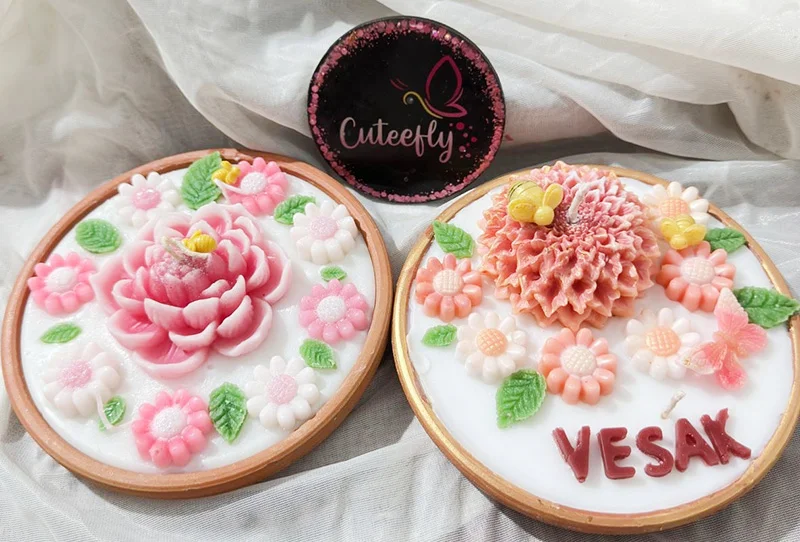
Candles reflecting Vesak themes
Her candles reflect Vesak themes – light, peace, remembrance, giving, etc., to enable you to fill your Vesak celebration with devotion and beauty.
Among her Vesak creations is a lotus-shaped soy candle, scented with sandalwood, lavender, etc., meant to burn during this Vesak Poya Day.

Indunil Kaushalya Dissanayaka: Customers
praise her for her creativity
These handcrafted Vesak candles are perfect for offering at the temple, she says.
What makes her creations so novel is that they come in different shapes, scents, themes, and all are handmade.
What’s more, her customers have heaped praise on her for her creativity.
According to Indunil, her creations are perfect as a thoughtful gift … to bring beauty, unity, and light into every moment.
Says Indunil: “Our beautifully handcrafted Unity candles are designed with premium detail and love, making them perfect for celebrations, gifts, and meaningful occasions.”
Cuteefly, says Indunil, is available online.
Readers could contact Indunil on 0778506066 for more details.
He Facebook Page is: Cuteefly.

Handmade with love

 Yes, dark spots do crop up on the skin, especially with sun exposure and, of course, as the skin ages.
However, these tips should be of immense benefit to those who are faced with dark spots.
* Lemon and Honey Glow Mask:
You will need 01 teaspoon lemon juice and 01 teaspoon honey.
Mix the lemon juice and honey well and then apply this mixture, only on the dark spots.
Leave for 10–15 minutes and then rinse with cool water.
Benefits:
Lemon helps brighten pigmentation.
Honey moisturises and heals skin.
Gives a natural glow.
* Aloe Vera Gel Treatment:
All you need is fresh aloe vera gel.
Apply the gel apply on dark spots, before going to bed.
Leave overnight and wash in the morning.
Benefits:
Reduces acne marks and pigmentation.
Soothes irritated skin.
Helps skin repair naturally.
* Turmeric and Yoghurt Paste:
You will need 01 teaspoon yoghurt and a pinch of turmeric
Mix the yoghurt and turmeric into a smooth paste and apply on affected areas.
Leave for 15 minutes and then wash gently with lukewarm water.
Benefits:
Turmeric brightens skin naturally.
Yoghurt removes dead skin cells.
Helps fade dark spots gradually.
Use these packs 02-03 times a week as results are generally seen over time.
You can also try this out: Mix a ripe papaya into a smooth paste and apply to the face, or directly on to the dark spots. Leave for 15-20 minutes and then wash with lukewarm water.

Let us all build a society valued with peace and harmony, guided by unity and solidarity beyond all differences – PM

Showers will occur at times in the Western, Sabaragamuwa and North-western provinces and in Galle, Matara, Kandy and Nuwara-Eliya districts

Rajitha calls for combined lists, denounces those unwilling to join as traitors

20 lawmakers, four officials visiting China

More Japanese funds for demining operations in the north

Clingendael Institute delegation visits Pathfinder Foundation

‘Dates have the highest sugar content to fight Coronavirus’

Sunday Island 27 December – Headlines

#SundayIsland 17th December – Headlines

Sunday Island – 28th March

Sunday Island Headlines – 21 March

Sunday Island – 21st February – Headlines
-

 Business6 days ago
Historic launch of CCWE Fashion Week & International Summit 2026
-

 News4 days ago
All-New GRAVITE launches at LKR 6.99 Mn
-

 Features4 days ago
The NPP’s pivot to the past
-
 News3 days ago
Police probe underway to ascertain links between criminals deported from UAE and local politicians
-
 News2 days ago
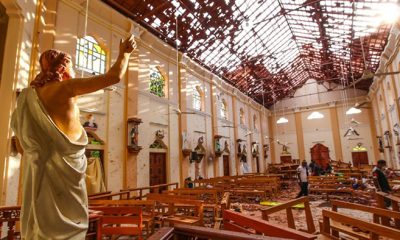
Easter Sunday carnage: Court told Maulana’s statement cannot be accepted without cross-examination
-

 Opinion6 days ago
The need to reform Buddhist ecclesiastical order
-

 Features4 days ago
End of Peacekeeping
-

 News3 days ago
Dickoya double murder suspect arrested