
Opinion
Remembering Dr. Samuel Mathew: A Heart that Healed Countless Lives

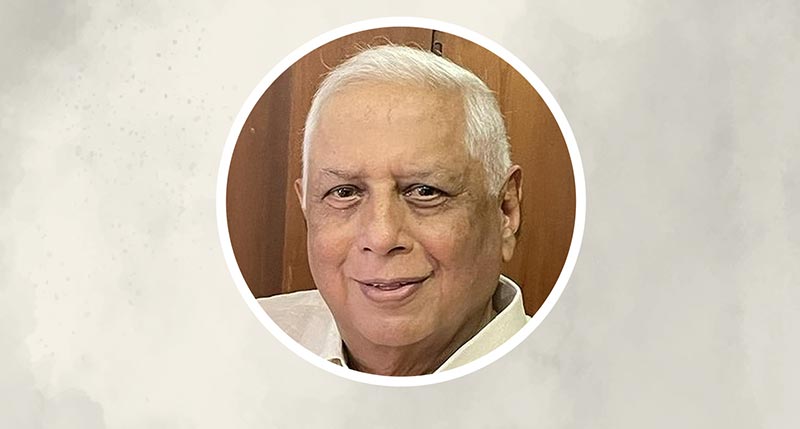
It is with a deeply heavy heart that I express my sincere condolences on the passing of Dr. Samuel Mathew Kalarickal on the 20th of April 2024. Born in 1948, Dr. Samuel was not only a pioneer of interventional cardiology in India but a giant in South Asian healthcare whose influence extended far beyond national borders.
A Beacon of Excellence and Compassion
Known as the “Father of Angioplasty” in India, Dr. Samuel introduced life-saving coronary interventions when they were still rare. His leadership at Apollo Hospitals and Kokilaben Dhirubhai Ambani Hospital brought cardiac care to global standards. But beyond the accolades, it was his humility, compassion, and unwavering dedication to patients that truly set him apart.
A Lasting Impact on Sri Lanka
Dr. Samuel played a pivotal role in shaping modern cardiac care in Sri Lanka. In the 1990s and early 2000s, many Sri Lankan patients sought his expertise in India, trusting him with their lives. He treated them with care and dignity, leaving lasting impressions on families across the island.
He also trained and mentored numerous Sri Lankan cardiologists, generously sharing knowledge of advanced procedures and technologies. His efforts helped uplift cardiac care back home and empowered many of us to bring those skills to our own communities.
A Mentor Who Lit the Path
To me, Dr. Samuel was more than a mentor—he was a fatherly figure. I fondly recall our time at the 2011 Coimbatore meeting, where he urged me to form the Sri Lanka STEMI Forum. His guidance helped us create national strategies and treatment models for heart attack care—an initiative that continues to save lives today.
A Legacy That Lives On
Dr. Samuel leaves behind more than medical breakthroughs. He leaves behind a legacy of service, inspiration, and heart. His memory will live on in every life he touched, every doctor he guided, and every patient he healed.
You will be remembered always, Sir—not just for what you did, but for who you were.
May your soul find eternal peace.
– Dr Gotabhaya Ranasinghe

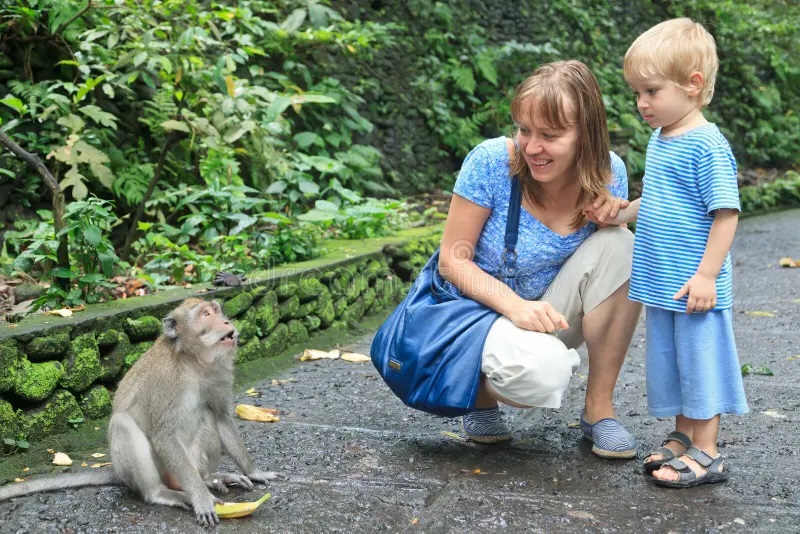
Being wildlife enthusiasts and bird watchers we took a river “safari” during a recent family trip to Bentota. We were dismayed to see that it seems to be the standard practice to feed the monkeys, I think they were the purple faced langurs, that were encountered on the river banks. Each boat that passed by stopped with boxed fruit, coconut and other odds and ends to feed them.
We managed to stop our guy from doing so but faced derision and laughter that we shouldn’t be afraid of monkeys. We tried to explain to him that this is a plague affecting Sri Lanka; elephants being fed on road sides and even in national parks, monkeys being fed from hotel balconies and apparently during river boat rides, birds being fed on hotel terraces etc.
This was met with further mockery and amused dismissal. An effort to make them understand that this was their livelihood that they were destroying it in this manner sailed over their heads. They even have a picture of a baby crocodile on the shoulders of a tourist on their billboard.
We need to consider the following:
Educate such tour operators about the importance of not interfering with the environment and the behaviour of wild animals.
Include education and training in the hotel school, and in schools in tourist resort towns about their duty and responsibility to the environment and the ecosystem on which we all depend.
If it is not already the case such operators should have licenses that should be revoked and fined if found to be engaging in such destructive acts.
Tamara Nanayakkara
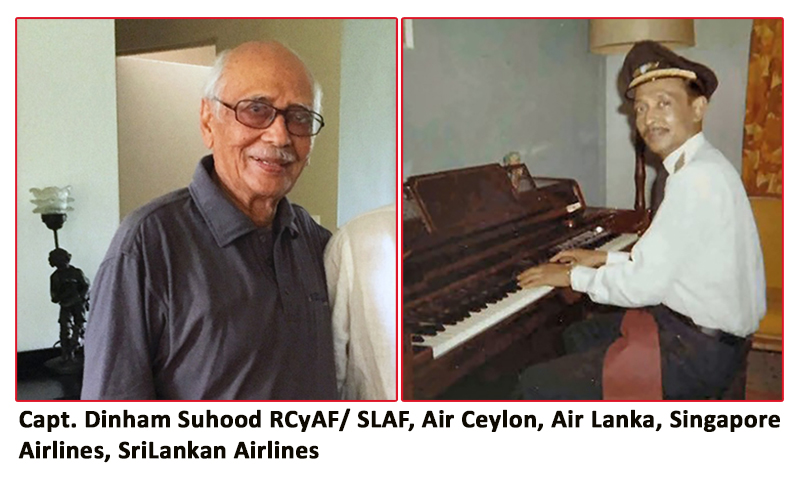
A few days ago, we heard the sad news of the passing on of Capt. Dinham Suhood. Born in 1929, he was the last surviving Air Ceylon Captain from the ‘old guard’.
He studied at St Joseph’s College, Colombo 10. He had his flying training in 1949 in Sydney, Australia and then joined Air Ceylon in late 1957. There he flew the DC3 (Dakota), HS748 (Avro), Nord 262 and the HS 121 (Trident).
I remember how he lent his large collection of ‘Airfix’ plastic aircraft models built to scale at S. Thomas’ College, exhibitions. That really inspired us schoolboys.
In 1971 he flew for a Singaporean Millionaire, a BAC One-Eleven and then later joined Air Siam where he flew Boeing B707 and the B747 before retiring and migrating to Australia in 1975.
Some of my captains had flown with him as First Officers. He was reputed to have been a true professional and always helpful to his colleagues.
He was an accomplished pianist and good dancer.
He passed on a few days short of his 97th birthday, after a brief illness.
May his soul rest in peace!
To fly west my friend is a test we must all take for a final check
Capt. Gihan A Fernando
RCyAF/ SLAF, Air Ceylon, Air Lanka, Singapore Airlines, SriLankan Airlines

The cause of global warming, they claim, is due to ever increasing levels of CO2. This is a by-product of burning fossil fuels like oil and gas, and of course coal. Environmentalists and other ‘green’ activists are worried about rising world atmospheric levels of CO2. Now they want to stop the whole world from burning fossil fuels, especially people who use cars powered by petrol and diesel oil, because burning petrol and oil are a major source of CO2 pollution. They are bringing forward the fateful day when oil and gas are scarce and can no longer be found and we have no choice but to travel by electricity-driven cars – or go by foot. They say we must save energy now, by walking and save the planet’s atmosphere.
THE DEMON COAL
But it is coal, above all, that is hated most by the ‘green’ lobby. It is coal that is first on their list for targeting above all the other fossil fuels. The eminently logical reason is that coal is the dirtiest polluter of all. In addition to adding CO2 to the atmosphere, it pollutes the air we breathe with fine particles of ash and poisonous chemicals which also make us ill. And some claim that coal-fired power stations produce more harmful radiation than an atomic reactor.
STOP THE COAL!
Halting the use of coal for generating electricity is a priority for them. It is an action high on the Green party list.
However, no-one talks of what we can use to fill the energy gap left by coal. Some experts publicly claim that unfortunately, energy from wind or solar panels, will not be enough and cannot satisfy our demand for instant power at all times of the day or night at a reasonable price.
THE ALTERNATIVES
It seems to be a taboo to talk about energy from nuclear power, but this is misguided. Going nuclear offers tried and tested alternatives to coal. The West has got generating energy from uranium down to a fine art, but it does involve some potentially dangerous problems, which are overcome by powerful engineering designs which then must be operated safely. But an additional factor when using URANIUM is that it produces long term radioactive waste. Relocating and storage of this waste is expensive and is a big problem.
Russia in November 2020, very kindly offered to help us with this continuous generating problem by offering standard Uranium modules for generating power. They offered to handle all aspects of the fuel cycle and its disposal. In hindsight this would have been an unbelievable bargain. It can be assumed that we could have also used Russian expertise in solving the power distribution flows throughout the grid.
THORIUM
But thankfully we are blessed with a second nuclear choice – that of the mildly radioactive THORIUM, a much cheaper and safer solution to our energy needs.
News last month (January 2026) told us of how China has built a container ship that can run on Thorium for ten years without refuelling. They must have solved the corrosion problem of the main fluoride mixing container walls. China has rare earths and can use AI computers to solve their metallurgical problems – fast!
Nevertheless, Russia can equally offer Sri Lanka Thorium- powered generating stations. Here the benefits are even more obviously evident. Thorium can be a quite cheap source of energy using locally mined material plus, so importantly, the radioactive waste remains dangerous for only a few hundred years, unlike uranium waste.
Because they are relatively small, only the size of a semi-detached house, such thorium generating stations can be located near the point of use, reducing the need for UNSIGHTLY towers and power grid distribution lines.
The design and supply of standard Thorium reactor machines may be more expensive but can be obtained from Russia itself, or China – our friends in our time of need.
Priyantha Hettige

Krishnamurthi, van Schalkwyk keep USA alive

Pakistan bowl; no handshakes between captains at toss

May the blessings of Lord Shiva bring peace, good health, and spiritual fulfillment to your homes and to our beloved country – PM

West Indies brush aside Nepal to reach Super Eights

India vs Pakistan match is a godsend for T20 World Cup hosts Sri Lanka

Imran Khan to be moved to hospital amid rising health concerns

‘Dates have the highest sugar content to fight Coronavirus’

Sunday Island 27 December – Headlines

#SundayIsland 17th December – Headlines

Sunday Island – 28th March

Sunday Island Headlines – 21 March

Sunday Island – 21st February – Headlines
-
 Life style17 hours ago
Marriot new GM Suranga
-
 Business5 days ago
Autodoc 360 relocates to reinforce commitment to premium auto care
-
 Midweek Review5 days ago
A question of national pride
-
 Opinion4 days ago
Will computers ever be intelligent?
-
 Features17 hours ago
The Rise of Takaichi
-
 Midweek Review5 days ago
Theatre and Anthropocentrism in the age of Climate Emergency
-

 Editorial7 days ago
The JRJ syndrome
-
 Features17 hours ago
Wetlands of Sri Lanka: