
News
Registrars of Courts among four most corrupt institutions

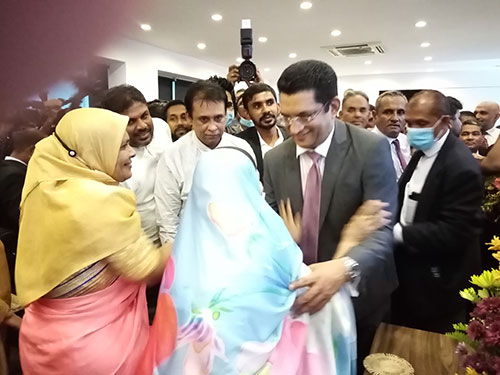
A smiling Sabry holds his mother after addressing the media at the Justice Ministry (pic by Shamindra Ferdinando)
By Shamindra Ferdinando
Justice Minister Ali Sabry, PC, yesterday (17) said that four state institutions––the Police, Prisons, Government Analyst’s Department and the Registrars of Courts––were so corrupt that the country faced a daunting challenge to rectify the situation.
Addressing a gathering immediately after assuming duties at the Justice Ministry, Sabry explained how those responsible violated the rule of law.
Referring to recent explosive reportage of the Police Narcotics Bureau (PNB) dealing in heroin, Minister Sabry briefly discussed how law enforcement authorities, Prisons, the Government Analyst’s Department and the Registrar of Courts contributed to unprecedented deterioration of law and order.
Among those present on the occasion were President’s Counsels Romesh de Silva, Gamini Marapana, Kalinga Indatissa and U.R. de Silva.
Separate Registrars are assigned to Magistrate courts, High Courts, Court of Appeal and the Supreme Court.
Minister Sabry said that according to a survey, Registrars of Courts were among the most corrupt in the country and he would examine the situation before announcing a plan on how to tackle the situation. He sought the support of all stakeholders, including the Bar Association of Sri Lanka (BASL) to address contentious issues.
The minister said he knew how the people suffered untold hardships due to law’s delays. Continuing system failures ruined lives, the minister said, pointing out how child abuse affected the community.
At the onset of his brief address, Minister Sabry apologised profusely for having the meeting in a small room which could hardly accommodate those present. In spite of display of notices restricting the gathering of people due to continuing threat posed by covid-19 epidemic, over 100 were allowed in with most of those present not wearing face masks. Minister Sabry had to fight his way to the podium to address the gathering with Ministerial Security Division (MSD) being helpless.
Pleading that he wouldn’t do anything inimical to the Constitution and the people, Minister Sabry thanked President Gotabaya Rajapaksa and Prime Minister Mahinda Rajapaksa for giving him the challenging responsibility. The new minister vowed to overcome what he called daunting challenges.
The Minister quoted the Rajapaksa brothers as having told him to do the needful as he knew what the shortcomings and problems were.
Minister Sabry emphasised that his responsibility would be to implement policy decisions of the government and the cabinet of ministers.
Delivering an anusasana at the onset of yesterday’s programme, scholar Ven Medagoda Abeytissa Thera said that President Gotabaya Rajapaksa accommodated Sabry in the cabinet of ministers, in spite of serious protests as he had confidence in him. It would be Minister Sabry’s duty and responsibility to maintain President Gotabaya Rajapaksa’s faith in him.
The Ven. Thera said that there was no point in hiding the fact that opposition political elements instigated protests against the top the justice portfolio being assigned to Sabry.
The Ven. Thera appreciated the role played by Sabry as a civil society activist in helping the then Opposition movement led by the Joint Opposition to turn the tables on the then government.
Referring to a recent statement attributed to Minister Sabry that the 19th Amendment enacted in early 2015 would be amended to suit the new government’s requirements, Ven. Abeytissa stressed that President Rajapaksa and the SLPP (Sri Lanka Podujana Peramuna) had received mandates in 2019 and 2020 to introduce a new Constitution. The scholar monk emphasized that there should be one law for everyone. Therefore, now in his capacity as the Justice Minister, it would be his responsibility to fulfill the aspirations of the public.
Referring to the 2019 Easter Sunday carnage, Ven Abeytissa said that it would be the Justice Minister’s obligation to take measures to prevent the birth of more Zahran Hashims.
Commenting on the enactment of the 19th Amendment by the previous government, Ven. Abeytissa advised the Justice Minister to follow a policy of transparency in that regard.
Ven. Kamburugamuwe Vajira Thera warned of dire consequences unless the required far-reaching constitutional changes were introduced within a month or two. The Thera said that if the government failed to use its two-thirds majority immediately, it would have to regret its failure.



… successive governments sat on PCoI report handed over in Feb. 2021
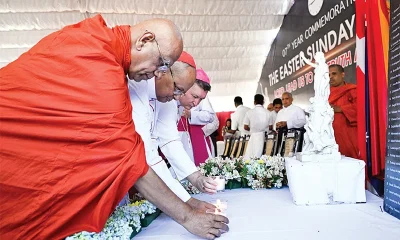
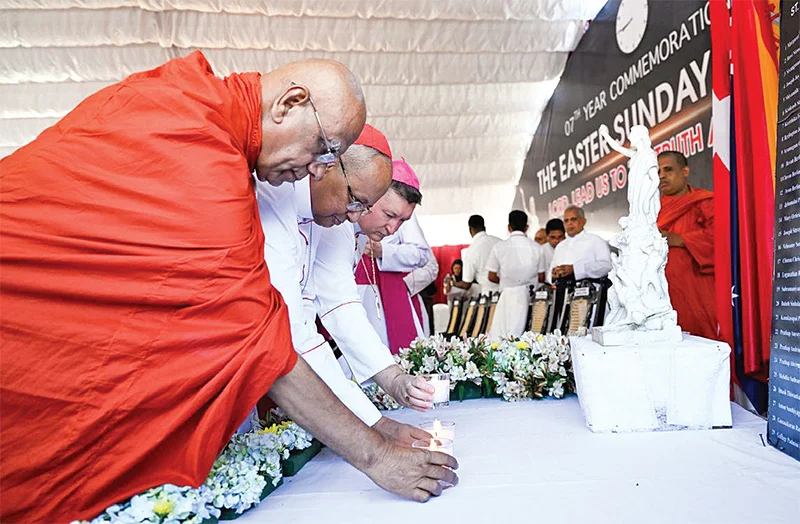
His Eminence Malcolm Cardinal Ranjith yesterday (21) alleged that those who were in power from 2019 to September 2024 sabotaged investigations into the Easter Sunday carnage (2019).
Addressing the Seventh Year Commemoration of the Easter Sunday suicide attacks, at St. Anthony’s Church Kochchikade, Colombo, the Archbishop of Colombo said that unlike the present leaders of the country, almost all the power holders, since the 2019 April attacks, including former Presidents, Heads of the Police and the AG’s department officials, instead of sincerely finding out as to who and what was behind the horrific crime, tried their best to confuse the public, muddle up the investigations and appointing all kinds of committees, with highly suspect investigators, in order to come out with conclusions crafted by them, and tried to sabotage the truth from emerging.
In spite of the change of government, in September 2024, certain officials of the “deep state” were seeking to obstruct the smooth flow of ongoing investigations.
Regardless of the Presidential Commission of Inquiry (PCOI) giving clear directives to the Attorney General and to that department to take clear legal and disciplinary actions against some of the political figures, officials of the security establishment and organisations for criminal neglect of duty, very little has so far been done on this matter by them.
The PCoI handed over its report to President Gotabaya Rajapaksa in February 2021.
The Catholic leader emphasised the need to investigate possible links between the Easter Sunday massacre and attacks, targeting the Muslim community, on the night of 5th May and, once again, on 11th, 12th and 13th May, starting from the Nattandiya-Madampe area, through Kotaramulla to Minuwangoda. The Cardinal said: “This may have a link to the main attacks on 21st April 2019. One must also verify as to whether anyone in the security establishment prevented those responsible from controlling these attacks as and when they began.”
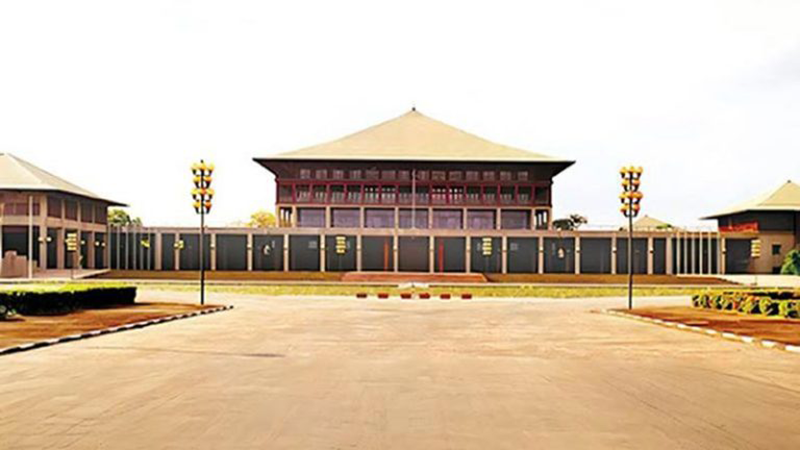
The Commission to Investigate Allegations of Bribery or Corruption (CIABOC) has directed the Secretary General of Parliament Kushani Rohanadeera to cancel an internal transfer of a senior official.
Sources said that the CIABOC intervened as the female official to be transferred is a key witness in the ongoing investigation into the conduct of suspended Deputy Secretary General of Parliament Chaminda Kularatne. The CIABOC has asked the Secretary General to delay the transfer until the conclusion of its investigation.
CIABOC initiated the investigation following a complaint against Kularatne, who himself complained against Speaker Dr. Jagath Wickremaratne over corruption and irregularities.
The female official’s transfer was to take effect on 20 April.

The United Nations has urged Sri Lanka to deliver concrete results after long-running investigations into the 2019 Easter Sunday suicide bombings that killed 279 people, including 45 foreigners.
The UN’s top envoy to the country, Marc-Andre Franche, said survivors and families of victims were still waiting for answers, despite multiple probes and renewed political pledges following the formation of a new government in September 2024.
“Public commitments by the government to pursue justice are important and must be welcomed,” he said, as the nation marked seven years since the bombings on Tuesday.
“But what matters now is results,” he said at a remembrance service in Colombo.

Abhishek’s 135 not out blows Delhi Capitals away

Trump announces Iran ceasefire extension but says blockade remains

Showers above 75 mm are likely at some places in the Western, Sabaragamuwa, Central, Uva and Southern provinces and in Ampara and Kurunegala districts

Cardinal: Presidents, IGPs and AG sabotaged Easter carnage probes before 2024 regime change

CIABOC asks Parliament not to transfer witness in case against Deputy Secy General

UN wants Sri Lanka to deliver concrete results in Easter Sunday bombing probe

‘Dates have the highest sugar content to fight Coronavirus’

Sunday Island 27 December – Headlines

#SundayIsland 17th December – Headlines

Sunday Island – 28th March

Sunday Island Headlines – 21 March

Sunday Island – 21st February – Headlines
-
 News1 day ago
Rs 13 bn NDB fraud: Int’l forensic audit ordered
-

 Business4 days ago
Harnessing nature’s wisdom: Experts highlight “Resist–Align” path to resilience
-

 News7 days ago
PNS TAIMUR & ASLAT set sail from Colombo
-

 News4 days ago
Gratiaen Trust announces longlist for the 33rd Annual Gratiaen Prize
-

 News3 days ago
From Nuwara Eliya to Dubai: Isha Holdings markets Agri products abroad
-

 Opinion2 days ago
Shutting roof top solar panels – a crime
-
 News4 days ago
Heroin haul transported on 50-million-rupee contract
-

 Latest News6 days ago
Singapore Zoo’s first Sri Lankan leopard cubs make their public debut