
Editorial
Regime changes and scandals


Thursday 30th January, 2025
It has almost become a pattern in Sri Lanka that regime changes are followed by scandals, which undermine public trust in the new governments. The UNP-led Yahapalana administration, which came to power in January 2015, promising good governance, facilitated a Treasury bond scam within a few weeks of its formation and benefited therefrom. The UNP, which had been struggling to pay water and electricity bills at its headquarters, Sirikotha, while it was out of power, came into a fortune and outspent its rivals in the run-up to the parliamentary polls that followed! No sooner had the SLPP formed a government in 2020 than it committed a sugar tax fraud, which enabled some of its financiers, especially the main sponsor of Viyathmaga (an association of self-proclaimed intellectuals backing the SLPP) to make huge profits to the tune of billions of rupees by importing sugar with a nominal special commodity levy thereon. They and their political bosses laughed all the way to the bank.
People voted overwhelmingly for a system change last year only to be disappointed. The JVP-NPP government stands accused of having secured the release of as many as 323 red-flagged freight containers without Customs inspection from the Colombo Port. The Customs Trade Union Alliance has expressed shock at the green-channelling of those containers that required mandatory Customs inspection.
The Opposition says those containers, released allegedly at the behest of an influential minister, were imported by an NPP financier. The government has said it takes full responsibility for the release of the containers. First of all, it must disclose what those boxes contained. Did they carry weapons, narcotics, clinical waste or automobiles? How would the self-righteous JVP leaders have reacted if so many containers had been released via the green channel while they were in the opposition? They would have taken to the streets, demanding the resignation of the Minister of Ports and Shipping or the entire government.
The Colombo Port has become a major entry point for narcotics, and therefore the government must reveal who ordered the release of the aforesaid containers without inspection, as we argued in a previous editorial comment. In 2013, more than 131 kilos of heroin were found in a shipping container which a coordinating secretary to the then Prime Minister D. M. Jayaratne sought to have cleared on a priority basis by sending a letter to the Customs to that effect. In July 2017, a consignment of cocaine weighing 218 kilos was detected in a container carrying sugar, at the Ratmalana Economic Centre. There have been many other instances where Customs checks yielded huge amounts of dangerous drugs concealed in freight containers. Besides, a private company had to ship back 263 containers filled with hospital waste listed as used mattresses, carpets and rugs; they had been imported from the UK in 2017 and 2019. During the UNP-led UNF government (2001-2004), some LTTE leaders were allowed to go abroad via the BIA without any checks for ‘peace talks’, and they were also allowed to bring in huge bags full of undeclared goods sans Customs inspection when they returned. It is believed that they brought warlike equipment. The UNP and SJB politicians who are now crying blue murder about the release of the aforesaid red-flagged containers were in the UNF government, which advanced its political agenda at the expense of national security in the early 2000s. However, that does not mean they should not crank up pressure on the NPP government to disclose who ordered the release of the containers at issue and what they carried. In fact, that is all the more reason why they must amp up their efforts to get to the bottom of the container controversy; they ought to atone for their past sins.
The need for a high-level probe into the green-channelling of the red-flagged containers cannot be overemphasised. It is hoped that the Opposition, civil society organisations, trade unions and the media will join forces to frustrate the government’s efforts to sweep the issue under the rug.
It is being argued in some quarters that there are sufficient grounds for a no-faith motion against the minister who ordered the release of the containers in question. The NPP has a two-thirds parliamentary majority and can easily torpedo a no-confidence motion, but one may recall that the SLPP government also abused its parliamentary majority to defeat a no-confidence motion against the then Minister Keheliya Rambukwella over the procurement of fake immunoglobulin, but it could not save him; it only dug its own political grave.



The World Bank’s annual income reclassification, which takes effect every July 1, has placed Sri Lanka, Vietnam, the Philippines, Jordan and the Pacific state of Micronesia in the upper-middle income bracket.
Sri Lanka’s elevation to the upper-middle income status has gladdened many a heart. It is no mean achievement for a country emerging from a crippling economic crisis that led to foreign currency reserves woes, shortages, queues, prolonged power cuts, a steep rise in inflation, and unprecedented political upheavals. However, one should not lose sight of the fact that although the reclassification is a marker of resilience, Sri Lanka only narrowly crossed the threshold, according to economic analysts.
Sri Lanka will now face some challenges. The upper-middle income status generally indicates economic progress and can help improve investor confidence, which Sri Lanka perhaps needs more than anything else to rebuild its forex reserves and be ready to resume foreign debt repayment in earnest. However, a higher income category could reduce Sri Lanka’s access to concessional loans, grants and some forms of international assistance. Commercial borrowing generally carries higher interest rates and shorter repayment periods than concessional development loans.
Trade preference schemes such as the EU’s GSP and GSP+ have stood developing countries, such as Sri Lanka, in good stead. These trade concessions are based on specific eligibility criteria, not income classification alone, but moving into higher income categories can eventually affect eligibility under some preferential trade arrangements, as some economists have pointed out. There’s the rub.
The biggest challenge for Sri Lanka is to ensure that its economy will become more productive, competitive and resilient so that it can lessen its dependence on international assistance, with the help of sustainable growth and investment, as countries like Vietnam have done.
Policymakers should reflect on the state of the economy and ordinary Sri Lankans’ lot, which has not improved despite the country’s income classification upgrade. Such categorisations based on credible data may be technically sound and useful in making economic decisions, but they cannot be considered realistic and reliable yardsticks where the wealth distribution is concerned.
The upper-middle income status usually masks inequality. There are economic tools to gauge income inequality, which affects social stability, poverty levels, and access to education and healthcare, but they too have limitations. It is imperative that the issue of income inequality be addressed as a matter of national priority.
Sri Lanka faced an economic crisis in 2022, despite a previous income classification upgrade, mainly because it did not get its macroeconomic fundamentals right, and acted in a reckless manner. True, the Easter Sunday terror attacks and the Covid-19 epidemic took a heavy toll on the economy, but Sri Lanka would have been able to overcome their impact if its economic imperatives had not been subjugated to the political agenda of the government in power at that time.
If action had been taken to prevent a sharp drop in state revenue by keeping taxes at a realistic level and rationalising pandemic relief while seeking IMF assistance at the first signs of trouble, the economy may have been able to withstand internal and external shocks without going into a tailspin.
Sri Lanka should emulate Vietnam, whose income classification upgrade follows a different track and is a story of growth. Vietnam’s gross national income per capita exceeded the USD 4,636 threshold because of manufacturing export growth. Its GDP expanded at approximately 8 percent in 2025, driven by electronics and consumer goods assembly. Vietnam has reportedly set an ambitious goal of achieving the coveted high-income status by 2045. Sri Lanka, too, should raise the bar for itself and work towards achieving its economic goals.

Saturday 4th July, 2026
The Police Department has its fair share of rogue elements who have brought the law enforcement authorities into disrepute and make them get bad press. But the police are not short of personnel who even go above and beyond the call of duty to nab lawbreakers and ensure public safety. Sadly, their good work often goes unappreciated.
Unit 2 of the Western Range (North) has done the police proud. On 28 June, its men and officers raided a house in Malabe, where illicit liquor was bottled, and arrested six suspects with as many as 18,000 bottles of illicit liquor.
The bottles of counterfeit arrack complete with security stickers and ready for distribution were virtually indistinguishable from the genuine products, according to investigators. Nobody knows how many bottles of counterfeit arrack had been produced there and how injurious the illicit brew is to health.
Under interrogation, the suspects revealed that the illicit brew had been distributed in the Eastern Province. On Thursday, the police team that conducted the Malabe raid rushed to Batticaloa, where they seized a large number of bottles of illicit liquor transported from Malabe. The police officers who took part in the raid deserve praise.
While the police were busy packing the bottles of illicit brew taken into custody and doing necessary paperwork, a group of Excise officers materialised, and claimed that the police had made a documentation error. Their intervention led to a recount of the bottles of counterfeit liquor in custody, but the allegation turned out to be baseless. Obviously, the Excise Department personnel did not take kindly to the police raid.
One of the police officers told the Excise officers some home truths, one being that the police were doing what the Excise Department should have done. One cannot but agree with him.
The police had to move in as the Excise officers had failed to carry out their duties and functions. The latter should have been able to trace the untested brew transported and sold illegally in liquor outlets in the East. It is possible that the Malabe brew, as it were, was distributed in other parts of the country as well.
Illicit liquor has claimed many lives in this country during the past several years and therefore the brew, seized in Malabe and in some parts of the Eastern Province, must be tested urgently to see if it contains harmful substances. One may recall that in January 2026, six people died in Wennappuwa after consuming arrack purchased from a licensed liquor outlet. Such tragedies occur due to contamination, counterfeit infiltration and supply-chain frauds.
As for the police raids in Malabe and the East, there is reason to believe that so many bottles of illicit liquor could not have been distributed and sold in licensed outlets, unbeknownst to the Excise Department personnel, who are paid with public funds to keep a watchful eye on liquor retailers, among others, and act on any transgressions. That the police had to do their job is an indictment of the Excise officers, especially those under whose nose the illicit brew was sold in the East.
A member of the police team which conducted the raid in the East has asked how the security stickers meant for the legally produced bottles of liquor got into the wrong hands. A thorough investigation should be conducted to ascertain whether Excise officers were involved in the liquor racket and why they confronted the police in the East instead of cooperating.
Friday 3rd July, 2026
The JVP-NPP government has decided to allow the Emergency regulations to lapse, according to media reports. This is something welcome, but it should have been done months ago. Better late than never. The government has apparently made a virtue of necessity. It incurred public opprobrium and came under heavy pressure to end the protracted state of Emergency, which was declared in the aftermath of the landfall of Cyclone Ditwah towards the end of last year to facilitate disaster management and relief operations.
It is said that Sri Lanka has been under emergency rule for more than three decades since Independence, with the longest, uninterrupted periods occurring during the two JVP uprisings and the Ealam war. There is no political party that did not misuse Emergency regulations to further its interests while in power. Politicians realise the need to protect civil liberties and protest only when they lose power and become victims of the Emergency regulations, which grant governments sweeping powers of arrest and detention.
The JVP-NPP government ought to carry out its promise to abolish the PTA (Prevention of Terrorism Act), which has been abused by successive governments to suppress democratic dissent. President Anura Kumara Dissanayake has recently pledged to do so before the end of this year. It is obvious that the government is planning to replace the PTA with the proposed PSTA (Protection of the State from Terrorism Act), which is as draconian as the PTA.
The PTA and the proposed PSTA are Tweedledum and Tweedledee for all intents and purposes. Various human rights groups, civil society organisations, political activists, the UN and the media have pointed out that the PSTA cannot be accepted as an alternative to the PTA. They have echoed the view of the Office of the High Commissioner for Human Rights that the PSTA has not defined terrorism properly, and this fact runs counter to international law. An overly broad definition allows the PSTA to be misused. The PSTA seeks to empower senior police officers to issue detention orders and authorise pre-charge detention for renewable periods of up to two months for a total of up to one year. It has been pointed out by international human rights organisations, such as Amnesty International, that the PSTA seeks to retain untrammelled executive powers; the presidential powers are so extensive that the sole avenue for appeal against Proscription Orders lies with the Executive itself so much so that they undermine the International Covenant on Civil and Political Rights. The government ought to discard the proposed PSTA and introduce an anti-terror law that conforms to international best practices.
Similarly, it behoves the government to fulfill its solemn pledge to discontinue the culture of performative arrests, politically determined detentions, and vilification campaigns against suspects. The police arrest suspects even before conducting investigations, much less ascertaining credible evidence, and have the latter detained or remanded for long periods. Thereafter, the police and the Attorney General’s Department slow-walk the legal process. The current practice of looking for evidence after making arrests must end, as it is antithetical to democracy. A stay in overcrowded, squalid Sri Lankan remand prisons is tantamount to punishment in itself. The condition of detention cells in the CID headquarters is even worse, we are told. Hence, no person should be detained or remanded without credible evidence.
Cabinet Spokesman Dr. Nalinda Jayatissa recently sought to justify the detention of former State Intelligence Service Director Maj. Gen. (Retd.) Suresh Sallay in one of the filthy, tiny cells at the CID headquarters. He stated that those cells had been used to detain suspects for a long time, and Sallay could not be given preferential treatment. However, the JVP/NPP came to power, promising to break the so-called 76-year curse, didn’t it?
Previous governments did nothing about the hellholes that prisons and the CID detention cells are, and some of them and their supporters are now languishing in those places. It will be in the present-day leaders’ own interests to do away with the existing draconian laws and improve the conditions of remand prisons and detention facilities, for the boot will be on the other foot after the next regime change.
Mbappe draws level with Messi as France beat Paraguay to set up Morocco tie

Ticket prices plunge for USA-Belgium World Cup last-16 match

Ounahi fires Morocco into World Cup quarterfinals with 3-0 win over Canada

Huge crowds mourn Khamenei, Trump vows calm during funeral

Showers in the Sabaragamuwa,Western and North-western provinces and in Kandy, Nuwara-Eliya, Galle and Matara districts

Bethell’s takedown of Bishnoi takes England 1-0 up

‘Dates have the highest sugar content to fight Coronavirus’

Sunday Island 27 December – Headlines

#SundayIsland 17th December – Headlines

Sunday Island – 28th March

Sunday Island Headlines – 21 March

Sunday Island – 21st February – Headlines
-
 News6 days ago
LAWASIA warns against ad hoc initiative to increase judges’ retirement ages
-
 Features5 days ago
Climate action to bring South Asia together
-
 News5 days ago
Chamuditha to seek removal of injunction on Youtube programme
-

 News1 day ago
Freedom 250: US Embassy celebrates America’s 250th Independence Day through magic of American cinema
-
 News2 days ago
CIABOC to question Harak Kata on Rs. 200 mn bribery allegation
-
 News2 days ago
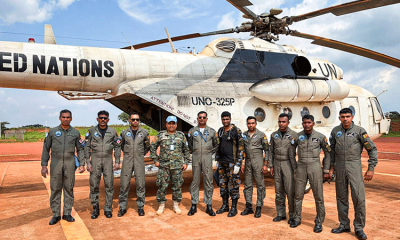
SLAF conducts successful rescue mission under UN command in Central African Republic
-
 Midweek Review4 days ago
H’tota port’s strategic status remains focal point of geopolitical scrutiny
-
 News5 days ago
CPRP alleges another death in custody, seeks protection for witness