
Features
‘Reflections on the Continuing Crises of Post-War Sri Lanka’


The Institute of International Studies(IIS) recently published a volume, ‘Reflections on The Continuing Crises of Post-War Sr Lanka’ edited by Professors Amal Jayawardena and Gamini Keerwella. Delivering the keynote address, at its launch on 24 April, at the BMICH, former Foreign Secretary, H. M. G. S. Palihakkara reflected on the context and substance of the publication with particular reference to the challenge before the NPP government to convert the voter support it received into a public policy consensus essential to addressing multiple issues of statecraft at hand.
Excerpts:
We are at a juncture of profound change happening nationally as well as internationally – changes that seem to engender a mixed bag of imponderables and great worry, even danger. While many contend that these changes upend globalised advancement, portend uncertainty and unpredictability, some good is seen by others in that certain disruptions could lead to pathways for course corrections. While this obviously divisive and controversial discourse goes on, what is clear and present is that it’s a world where affairs within and between states are in flux. Some of our neighbourhood commentators put it as a ‘world adrift’ or a world ‘getting unhinged’. The description of this volatility and prescriptions for handling the vortex of churning issues may defy objective analysis but the stark reality is that it represents an unprecedented and defining challenge to the post World War international system or the so-called ‘rules -based order’.
Head winds and tail winds of this flux have begun to manifest with different intensity in different countries constraining their space and capacity to grow sustainably and live securely. For some, the situation may morph into existential issues. Sri Lanka’s case lies somewhere in between it looks, but there is no denying that all will be profoundly affected-especially so for countries like us that are struggling to transit from crisis-recovery stability to a sustainable growth scenario. They are obliged to do this while juggling as prudently as possible, attendant geopolitical conundrums thrown up by the competing interests of power players, leading to difficult and often futile attempt to balance the unbalanceable!
At the national level, a new government of former ‘armed struggle fame’ has assumed office promising constructive change, clean and accountable governance based on the idea of reconciliation and equal citizenship for all. This was a hitherto unseen national common ground crafted by the voters(north-south-east-west) – voters fatigued with corrupt stereo-types. They did so, asking the new government to deliver on this attractive and perhaps the most inclusive post conflict mandate yet.
But the government seems to remain somewhat overwhelmed with this exciting but daunting agenda of public policy making and governance. Challenges include dovetailing the currently apparent economic stability into a growth conducive one; preventing a double jeopardy of economic crisis pain morphing into reform pain; doing all that without falling prey to grinding strategic matrixes of our ‘geopolitical friends’; dealing with some of our closest friends who come bearing gifts like distress money and un-solicited power play advice; how to negotiate with them without simply signing onto their wish lists that seek to requisition our sovereign assets thus leaving little or no room to negotiate even as unequals, let alone as sovereign equals!
To add to these woes of the new government, the incumbency factor seems to be setting in as evidenced by some ham-handed handling of delicate issues both domestic and international.
In this fraught setting, the government has boldly, and one must say correctly, decided to go for local polls. This is obviously not a regime change election but it certainly is a regime test one. The losers at the last elections both big and small, seem to have found common cause in firing the first salvos of the government ‘toppling game’ even as they know very well there is no constitutional way to do regime change for the next five years. The Government, on its part has not done itself any favours by scoring rather heavy in clumsiness index. Waffling continues uncomfortably on several fronts critical to public policy issues of national and international significance.
So this is a daunting inventory of domestic things to do in an international system that has turned volatile- a system in which an oxymoronic situation had long persisted because the alleged ‘ rules-based order‘ continued to be confronted by the reality of power-based practice. As we all know, when in contention, power usually trumps the rules. It happens so often it has become quite a ‘convenient truth’! The crudest and what could even be the most dangerous form of this contradiction is peaking now thanks to the phenomenon known as the Trump Two.
The book ‘Reflections on the Continuing Crises of Post-War Sri Lanka.’, helps us introspect in a context where the country is striving -in fact struggling- to recover from multiple self-made crises and become a self-caring nation under a new but un-tested Government-obviously, a timely thing to do.
Well researched and well sourced work in this volume explore an array of considerations both in empirical and conceptual terms as to how and why , after ending the armed conflict, conflicts by other means have continued spawning multiple crises- occurring in almost regular succession-and in diverse domains e.g. governance, socio-economic, ethnic and religious harmony, political, security, foreign policy and so on.
The purpose here is a comment in the form of my take on what this volume presents to the policy community-both political and bureaucratic:
First, it gives out a yet another alarming read-out of the cost of successive leadership failures in this country- failure to ensure constitutional governance, sustainable and equitable economic growth, reconciliation, accountability, the rule of law and so on. It reminds me of a meeting thirteen years ago, which I had the honour to chair in this very Hall at the BCIS, remembering the late legal legend, HL de Silva.
There my observation was that:
” The diminishing respect for the rule of law diminishes us all. Such erosion will allow impunity to raise its ugly head. Usually, impunity signals the onset of decay. It impairs civilised life and democracy. And it undermines the investment climate. Conversely, the upholding of the rule of law manifestly strengthens sovereignty, pre-empts external calls for intrusive accountability, deters threats to territorial integrity of the nation and facilitates the enjoyment of fruits of citizenship and democracy by all’. http://www.island.lk/index.php?page_cat=article-details&page=article-details&code_title=52289)
It is ironic but highly appropriate that the authors felt compelled to flag these same ‘reflections’ more than a decade later signifying the extent of the ‘unfinished business’ before us.
Secondly, it brings into sharp relief, the absence in this country of a culture of consensus or common ground in the business of public policy making. This contrast has remained conspicuous because the conscientious voters of this land have repeatedly braved political violence, insurgent violence and terrorist violence to grant that mandate to the elected government to do consensual work towards preventing crises and deterring conflict.
That did not happen of course. The consensual culture wished for by the voters died of political asphyxiation. This was due to the kind of parochialism our rulers have been obsessed with. There was decay in multiple fields – the economy, accountability, rule of law, national security, human security, foreign policy and so on. What is more, the contrary took root and polarisation rolled on fuelled both by those elected to power as well as by those thrown out of power. The former did so to remain in power and the latter to topple and recapture. The economy suffered. Investors ran away. The voters found they have nowhere to run.
This continues to date, even after the voters have once again shown that consensus is possible in this country. There was a country-wide consensual momentum to vote into power the current govt. who promised change to bring about accountability, the rule of law, transparent and corruption free governance and equal citizenship for all plus economic reforms. Rejecting the most, if not all corrupt stereo types and ignoring the usual ethnic and religious divides, voters rallied round a high octane call for that change. But the Govt. seems to be going about exploiting that momentum, if they are going about it at all, in the clumsiest way possible thus losing traction in turning that voter’s consensus into a public policy consensus. And not to be out-done, the losers- big and small- have got back on the usual track to begin the govt toppling game. So, the fact that the responsibility of building common ground lies not only with the government but also with the Opposition has become an inconvenient truth.
A ray of hope emerged when there was an all-party initiative to handle the unfolding ‘Tariff war’. But it looked more like a proforma reaction to a tariff drama by a bull-dozing President of a misfiring superpower, than a genuine domestic compulsion to initiate a consensual process enabling us to negotiate with our foreign interlocutors from a position of policy cohesion and bargaining strength.
This is in contrast to other countries including in South Asia that had the vision and wisdom to go consensual on critical national issues while not ruling out the option of politicians to go parochial on non-critical issues so that they can still mis-lead voters to win elections!
Faced with a looming economic crisis, the Congress – BJP agreement on economic reforms in India under PM Manmohan Singh’s watch in the 1990s paved the way for the robust growth of the Indian economic and geopolitical power today; In Bangladesh, an unprecedented bipartisan understanding on energy esp. its policy on exploiting newly discovered LNG deposits as well as a degree of self-rule to their hill tribe rebels and agreement in Nepal on mainstreaming their rebels are such contrasting examples of public policy consensus in our own sub-region.
They understood that weaponizing national issues for electoral gain can gravely undermine the welfare of the succeeding generation.
So besides these contrasting and rewarding examples and experiences in our own sub region, what is so magical about common ground and why do we have to do it?
We need a consensual economic reform programme that cannot and should not be weaponised for the purpose of regime change undermining stability and predictability , even going beyond the important gauntlet of 2028, when Sri Lanka has to resume the enormous burden of debt repayment,
Going by the Govt’s track record so far, the opposition can count on the Govt. to provide enough vulnerabilities on the non-critical list to exploit and attempt regime change! So it is irrational and irresponsible for the opposition to use imaginary or real faults so early in the game to upend the hard earned macro-economic and social stability as we prepare for the 2028 threshold.
On the geopolitical , foreign relations and governance front, one can do without the disruptive, destabilising and even dangerous contentions like the on-going one advocating that Sri Lanka should formally ‘align and economically integrate’ with its giant neighbour. That country is clearly a party to the principal geo-strategic rivalry in the Indo Pacific that is growing in complexity and intensity. Such a huge change of course for Sri Lanka could invite dangerous target practice by other power players. It would also be naïve to believe that the only way forward for Sri Lanka is a piggy back with India for a ride to economic prosperity on a trickle down basis..
It is a cogent point that it could amount to a ‘strategic capture in connectivity clothing’; that no such template has worked elsewhere in the world and Sri Lanka could thus become a non-self-governing territory where our sovereign assets may be parcelled out to strategic players jostling for power.
Both sides of this contention have overlooked the middle path imperative available for Sri Lanka. That is assiduously working to allay ill-founded or well-founded Indian security fears in a verifiable way using many bilateral tools available including the so called ‘national technical means’ while pressing ahead with equal vigour to deepen and widen ‘negotiated’ economic cooperation in identified areas – not structural integration- with our friendly neighbour. This is the way for Sri Lanka to exploit the competitive and comparative advantage it has with a robustly growing India that can benefit both countries. This is the must do thing. Any asymmetry dictated aligning or integration by momentum or wish list signing without negotiating is ‘the must avoid thing. There are many reasons for this avoidance but the latest and the most explosive one comes from Bangladesh. As a blow back to an asymmetry driven integration and autocratisation of the Hasina regime, Indo-Bangla relations exploded while Bangladesh itself imploded.
There are varying degrees of indo centric trouble in all South Asian countries except may be in Bhutan so much so that some Indian analysts themselves have characterised India’s ‘neighbourhood first policy’ as a ‘neighbourhood lost policy’.
We of course cannot afford such polemical luxury but we do need a domestic consensus to do two things:
‘Assure India about their security fears through bilateral technical means and ‘negotiate’ with India on deep-going economic cooperation. This middle path imperative backed by a bipartisan or consensual common ground will demonstrate our policy consistency and predictability towards India while providing benefits achieved by negotiated mutuality – not solely dictated by asymmetry. To be successful, this needs a domestic consensus here- across the isles of quarrelling members of the legislature- the kind of common ground the late Minister Kadirgamar strenuously worked for- the kind of acts of contrition and consensus that LLRC proposed some decades ago in order to advance post-conflict peace building.
Whether this already is a foregone conclusion or still an open question available to negotiate will become clearer when two crops of indo Lanka MOUs concluded by the former Government as well as the present one, cease to be unseen documents.
Such common understanding is needed not only to pilot our relations with our close and distant friends like India and China but also to deal with a host of other governance and foreign relations issues like accountability and reconciliation which remain externalised because the lack of a domestic understanding to deal with them has made them migrate abroad and morph into diplomatic issues entailing multiple challenges. Some past Govts unsuccessfully tried to address these challenges by actively encouraging international consensus on some of these. They did so, while being unable or unwilling to develop a national consensus on these sensitive matters despite the voters here providing robust mandates to do so. Without a national common ground, external prescriptions by themselves cannot deliver justice to victims. Every unpunished crime has an economic cost in both national and international terms. Most, if not all these failures are principally due to the paucity of a shared understanding here.
Consensus is not something you find in a cupboard! It has to be nurtured. Consensus happens not when you make everybody absolutely happy. It happens when you equitably distribute managed unhappiness among everybody. To some it is a fine art. To others it is a hard-nosed science. Perhaps it is a hybrid . Whatever it is, our voters have done it and found it. The NPP’s resounding election victory was the result. So the winner Government must mould that voters’ consensus into a public policy consensus. They can lose sometime but not too much time as windows may start closing. Policy makers – or ‘pain makers’ as some call them- must make haste slowly. If not, down the road, our succeeding generations may be compelled to launch another valuable book of reflections like this .
My friend Professor Jayadeva Uyangoda in his probing scrutiny about the causes and effects of our crises aptly refers to what he calls ‘a crucial political point’ about the “relationship between the state and society becoming violent and the capacity of the liberal parliamentary democracy to restore peace between the State and society becoming severely limited”. If our policy people don’t get the hybrid our voters have found, it is most likely that the next ‘reflection book’ might say ’peace restoration’ is still work in progress. Hopefully, it will not say restoration has regressed!
On that note of mild happiness, I would like to thank you for your patience.

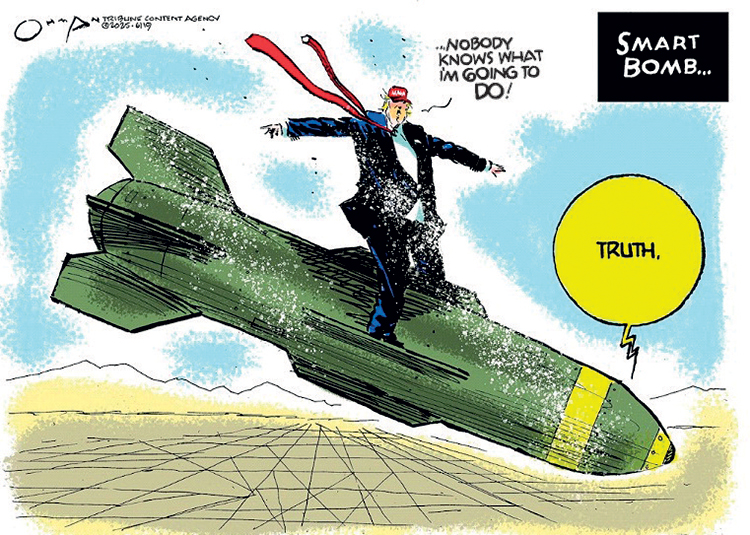
Flight of Insanity
Now in its third week and still no end sight, Trump’s Iran’s war is showing a tedious pattern of tragic-comic episodes. The human tragedy continues under relentless aerial assaults in Iran and under both aerial and ground assaults in Lebanon. Israel, now in a hurry to destroy as much it can of its enemy assets before Trump lapses into war withdrawals, is picking its spots at will; three of its latest scalps could not have come at higher echelons of the Iranian regime. Within two days, Israeli has targeted and killed Ali Larijani, the powerful, versatile and experienced secretary of the Supreme National Security Council; Gholamreza Soleimani, head of the Basij paramilitary force; and Iran’s Intelligence Minister Esmail Khatib.
Yet there is no indication if the continuing hollowing out of Iran’s decision making apparatus will produce the intended effect of encouraging the people of Iran to come out on the streets and topple the regime. People cannot pour on to the streets, even if they want to, until the American and Israeli bombing stops. That may not happen till the US military finishes its list of asset targets in Iran and Israel finishes off the list of Iranian leaders who are tagged on by Mossad’s network of Iranian moles. They are so widespread that last year after setting up a special task force to expose the internal informants, the National Security Council found out that the person whom they had selected to lead the task force was himself a spy! Disaffected citizens are also becoming informal informants. 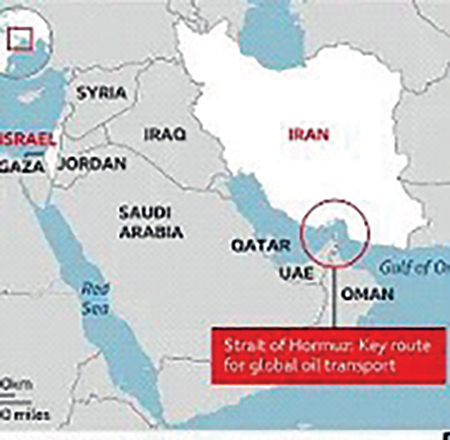
The comical side of the war is provided by President Trump in the daily press court that he holds at the White House, taking full advantage of the presidential system in which the chief officer is not required to present himself to and take questions from the country’s elected lawmakers. There has never been and there likely will never be another presidential spectacle like Donald J. Trump. It is shocking although not surprising to find out daily as to how much he doesn’t know about the war that he started or where it is heading. The ghost of Donald Rumsfeld, the Defence Secretary of the Iraq war and the coiner of the ‘unknown unknowns’ phrase, would tell you that Trump is the epitome of one of the known knowns, the predictable bully. For all his misjudgements and bad calls over the Iraq war 23 years ago, Rumsfeld now looks like a giant of a professional in comparison to Pete Hegseth, the bigmouthed charlatan who parades as Donald Trump’s Secretary of War.
Asymmetric Advantage
For its part, Iran appears to be reaping the worst and the best of an asymmetric warfare. Iran is getting pummelled in all the metrics of conventional warfare and there should be nothing surprising about it. It is rather silly for the American and Israeli military spokespeople to crow about their aerial strikes and their successes. On the other hand, the US and Israeli forces combined have not been able to answer Iran’s ability to establish areas of war where Iran sets the term and scores at its choosing. Quite astonishingly, President Trump has said that Iran was not supposed to attack its neighbours and no one apparently told him that such attacks might happen.
“Nobody. Nobody. No, no, no. The greatest experts—nobody thought they were going to hit,“ Trump responded to a leading question by a Fox News reporter whether the President was “surprised nobody briefed you ahead of time” about the likelihood of Iranian retaliation against America’s Gulf allies. Prevarication is second nature to President Trump and it is the same explanation for the Administration’s strategic gaffe over the Strait of Hormuz.
Iran has imposed a blockade over the narrow waterway between the Persian Gulf and the Gulf of Oman that provides vital passage for about 20% of the world’s oil shipments. Again, no one told him that Iran might do this. That is also because Trump has gotten rid of all the people in government capable of providing advice and is surrounding himself with sidekicks who will not challenge him on his misrepresentation of facts. As well, by keeping Congress out of the loop the President and the Administration tossed away the opportunity to deliberate before deciding to go to war.
True to form, Trump trots out another bizarre argument that the US does not have any shipment through the Strait of Hormuz and, therefore, it is up to countries, including China, that depend on the Hormuz route to come to his party in the Persian Gulf. The US would be there to help them out and he went on to invite his erstwhile allies and fellow NATO members to join the US and help the world keep the Strait of Hormuz open for its oil shipments.
Trump’s calls have been all but spurned. No US president has suffered such a rebuff. Other presidents did their consultations with allies before starting a war, not after. “This war started without any consultations,” said Germany’s Defence Minister Boris Pistorius. He then queried incredulously: “What does Donald Trump expect from a handful of European frigates in the Strait of Hormuz that the mighty US Navy cannot manage alone?” Iran has let it be known that it will block passage only to its enemies and allow others to cross the strait by arrangement. Chinese, Indian and Pakistani ships have been allowed to navigate through the strait. The UN and NATO countries are reportedly considering new initiatives to ensure safe passage through the Strait, but details are unclear.
While the official American endgame is unclear, scholars and academics have started weighing in and calling Trump’s misadventure for what it is. Three such contributions this week have caught the media’s attention. Muhanad Seloom writing online in Al Jazeera, has presented an unsolicited yet by far the strongest case for Trump, arguing that “the US-Israeli strategy is working” because Trump’s war against Iran is accomplishing a “systematic, phased degradation of a threat that previous administrations allowed to grow for four decades.” A former State Department staffer and now a Doha and Exeter academic, Seloom seems overly sanguine about the impending demise of the Iranian regime and underplays the political implications of the war’s externalities and unintended consequences for the Trump presidency in America.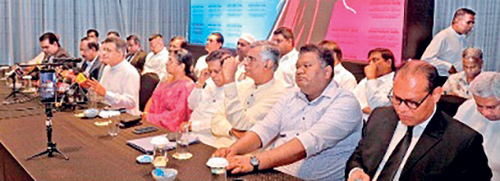
The comprehensive degradation of virtually all of Iran’s hard assets is not in question. What is in question is whether the asset degradation is translating into a regime change. The additional questions are whether the obvious success in asset degradation is enough to save President Trumps political bacon in the midterm elections in November, or will it stop Iran from controlling the Strait of Hormuz and impacting the global oil flows. Firm negative answers to these questions have been provided by two American scholars. Nate Swanson, also a former State Department staffer turned academic researcher and who was also a member of Trump’s recent negotiating team with Iran, has additionally highlighted the martyrdom significance of the killing of Ayatollah Khamenei both within Iran and in the entire Shia crescent extending from Lebanon to Karachi.
Robert Pape, University of Chicago Historian, who has studied and modelled Iranian scenarios to advise past US Administrations, has compared President Trump’s situation in Iran to President Johnson’s quagmire in Vietnam in 1968. Pape’s thesis is that asymmetric conflicts inherently keep escalating and there is no winning way out for a superpower over a lesser power. The main difference between Vietnam and Iran is that Vietnam did not trigger global oil and economic crises. Iran has triggered an oil crisis and the IMF is warning to expect higher inflation and lower growth as a result of the war. “Think of the unthinkable and prepare for it,” is the advice given to world’s policy makers by IMF Managing Director Kristalina Georgieva to a symposium in Japan, earlier this month.
Global Oil Crisis
The blockade of the Strait of Hormuz has created a crisis of uneven supplies and high prices the likes of which have not been seen since the 1973 oil embargo by Arab countries in the wake of the Yom Kippur War that saw the price of oil increasing four fold from $3 to $12 a barrel. The International Energy Agency (IEA), which came into being as the western response to the 1973 Arab oil embargo, has warned that the market is now experiencing “the most significant supply disruption in its history.”
According to Historians, denying or disrupting oil flows has been an effective tool in modern warfare. The oft cited examples before the 1973 oil embargo are the British oil blockade of Germany in World War 1, and the stopping of Germans accessing the Caucasus oilfields by the Soviet Union’s Red Army in World War II. The irony of the current crisis is that until now the world was getting to be more energy efficient and less oil dependent as a result of the technological, socioeconomic and behavioural changes that were unleashed by the 1973 oil embargo. Post Cold War globalization streamlined global oil flows even as the turn towards cheaper and renewable energy sources increased the use of alternative energy sources.
What was becoming a global energy complacency, according to Jason Bordoff and Meghan O’Sullivan, American academics and National Security advisers to former Presidents Obama and Bush, suffered its first disruptive shock with the Russian invasion of Ukraine in February 2022. Market reaction was immediate with crude oil prices increasing by over 50% and exceeding $135 per barrel. Russia cut its natural gas supply to Europe by half leaving western Europe the worst affected region by the crisis. In contrast, Asia is the worst affected continent by the current crisis although market reaction was not immediate apparently because the US was deemed a far more reliable actor than Russia. It is a different story now.
The present crisis is expected to ratchet up crude oil prices to as high as $150 to $200 a barrel in current dollars from what was below $75 before Trump started the war. Futures trading before the war projected $62 per barrel in 2027. Now, lower prices are not anticipated until after the end of this decade. The daily price has been yo-yoing above and below $100 in harmony with Trump’s musings about the course of the war and the time for its ending. The current market uncertainty stems from the growing realization that the Trump Administration was not clear about why it was starting the war and now it does not know how or when to bring it to an end. The Hormuz crisis has made the prospects all the bleaker.
Sri Lanka’s Options
In the unfolding uncertainty, the only certainty is that Sri Lanka’s options are limited. The challenges facing the country and the government involve both politics and economics. For the country, even the political options are limited – perhaps as limited as the economic options available to the government in the short term. The incessant political critics of the government start with extrapolating Aragalaya and end with anticipating another government collapse like the Gotabaya Rajapaksa government. But anyone looking for political alternatives to the NPP government should look at the press photograph showing a recent news conference of opposition party leaders announcing the formation of “a common opposition platform to resist the government’s anti-democratic actions.” Missing an action and absconding per usual, like Julia Roberts in Runway Bride, is once again Sajith Premadasa, the accredited Leader of the Opposition.
Talk about democratic priorities when the economic engine and the energy generators will soon have no oil or diesel to run on. Among the assembled, there is no one equipped enough to head a government ministry with the possible exception of Champika Ranawaka. And it is rich to talk about constitutional dictatorship for a group that was associated with the extended one-party government from 1977 to 1994, and a second group the tried to perpetuate a one-family government between 2005 and 2022. It is virtually imperative to argue that for the sake of the country the NPP government must successfully navigate through the impending crisis. Whether the government will be able to live up to what is now a necessity, not just expectation, we will soon find out.
There is no minimizing or underestimating the magnitude of the crisis. Crude oil and petroleum products account for nearly 20% of the total import bill. Rising oil prices will impact the balance of payment and forex reserves, and could potentially siphon off the currently accumulated $7+ billion forex balance. Rupee devaluation and inflation are likely, but not necessarily to the absurd levels reached during the ultimate Rajapaksa regime. Economic growth will slow and the $1.5 to $2.0 billion FDI targets may not materialize. The current arrangement for debt repayment may have to be revisited, even as relief measures will need to be undertaken to soften the rising price effects throughout the economy and among the less privileged sections of society. Restricting consumption has already been started and the country may have to brace for further restrictions and even power cuts.
In the short term, renegotiating the current EFF (Extended Fund Facility) terms with the IMF will be unavoidable. Equally important are long term measures. The low storage capacity for oil and petroleum has made price fluctuations inevitable. The government has announced storage capacity expansion in Kolonnawa and fast tracking the construction of a jet-fuel pipeline from Muthurajawela to Katunayake – to facilitate the Bandaranaike International Airport (BIA) becoming a regional aviation hub. The current shipping problems present a new opportunity for the utilization of the expanded terminal facilities to increase transhipment operations at the Colombo harbour.
At long last, after 78 years, there is some action to upgrade the storied 99 oil tanks in Trincomalee. But the bulk of the upgrading depends on the trilateral agreement between Sri Lanka, India and the United Arab Emirates to create an energy hub in Trincomalee. This might run into delays because of the current situation involving the UAE. Already delayed is the construction of the $3.7b Sinopec Oil refinery in Hambantota, the MOU for which was signed more than an year ago. The NPP government has been adept in keeping good relationships with both India and China. Now is the time to try to expedite the deliverables on their commitments.
Another not so long term necessity is to expand electricity generation through renewable sources and minimize its dependence on thermal generation based on imported oil, not to mention coal. Thermal power contributes to just under 50% of energy output at about 80% of total generation costs. In contrast, just over 50% of the output is generated by renewable sources, including hydro, at 20% of the total cost.
The contribution of hydropower is weather dependent and its uncertainty has long been the pretext for persisting with thermal power and not encouraging the development of solar and wind energy sources. There is no more urgent time to stop this persistence than now in light of the oil crisis. The government must cut through the cobwebs of vested thermal power interests and make clean energy a central part of its Clean Sri Lanka initiative. China is in the forefront of renewable energy technology and expansion and has timed the unveiling of its new five year renewable energy expansion plan to coincide with the current oil crisis. Many countries are emulating China and Sri Lanka should join them.

Singer Sri Lanka, the nation’s foremost retailer of consumer durables, celebrates a truly historic milestone at the SLIM-KANTAR People’s Awards 2026, securing a prestigious triple victory while marking 20 consecutive years as the People’s Brand of the Year, an achievement made possible by the enduring trust and loyalty of Sri Lankan consumers.
This year, SINGER was honoured with yet another triple win with People’s Brand of the Year, Youth Brand of the Year and People’s Durables Brand of the Year at the awards ceremony. This remarkable recognition reflects the deep and lasting relationship the brand has built with Sri Lankans across generations, standing as a symbol of trust in homes across the island.
Reaching this 20-year milestone is not just a testament to brand strength, but a celebration of the millions of customers who have continuously chosen SINGER as a part of their everyday lives. For two decades, Sri Lankans have placed their confidence in the brand, welcoming it into their homes, their families, and their aspirations.
Expressing his appreciation, Janmesh Antony, Director – Marketing of Singer Sri Lanka PLC, stated:
“Winning these awards reflects our commitment to quality, innovation, and staying closely connected to our customers. Being recognised as Durables brand, Youth brand, and as the People’s Brand of the Year highlights our ability to resonate across generations. As we celebrate 20 years as the People’s Brand, our deepest gratitude goes to our customers, this milestone truly belongs to them. It also reflects the dedication of our teams, who continuously strive to serve them better every day. Winning Youth Brand of the Year further reinforces our focus on staying relevant and meaningfully connected with the next generation.”
Commenting on the milestone, Mahesh Wijewardene, Group Managing Director of Singer Sri Lanka PLC, added:
“This recognition is a tribute to the millions of Sri Lankans who have stood by us over the years. Being named the People’s Brand of the Year for the 20th consecutive time is both humbling and inspiring. It reflects the deep trust our customers place in us, and we are truly grateful for the role we play in their everyday lives. This milestone strengthens our commitment to continue delivering value, innovation, and service excellence, always with our customers at the heart of everything we do.”
Over the years, SINGER has grown alongside the people of Sri Lanka, evolving from a trusted household name into a future-ready retail powerhouse. By continuously innovating its product portfolio and enhancing service excellence, the brand has remained closely aligned with the changing needs and aspirations of its customers.
Guided by a deep-rooted customer-first philosophy, an extensive islandwide retail network, and dependable after-sales service, Singer continues to set benchmarks not only in the consumer durables sector but across the nation. By elevating everyday living and bringing greater convenience, comfort, and ease into Sri Lankan homes, the brand has become a trusted partner in shaping modern lifestyles. Its growing connection with younger audiences further reflects its ability to seamlessly blend legacy with contemporary aspirations.
As Singer Sri Lanka celebrates this milestone, the company remains profoundly grateful for the trust placed in it by generations of Sri Lankans. With a continued commitment to enriching lives through innovation and making everyday living more effortless and accessible, Singer looks ahead to growing alongside its customers, strengthening its place as one of the most trusted, loved, and enduring brands in the country.
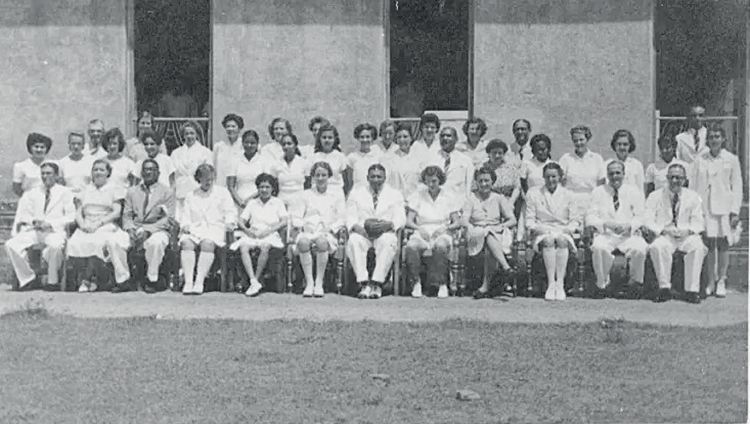
Early last year [probably 2004] I received a call from Michael Ludgrove the then head of the rare book section at Christies Auction house requesting help to decipher the names of Ceylonese cricketers who had signed a cricket bat in the 1930’s following a combined India-Ceylon match against the visiting MCC. This led to my keeping an eye out for unusual items on Ceylon cricket.
A few months later a set of autographs came up for sale. They were of the visiting English women cricketers who played a match in Colombo, against the Ceylon women in the first “Test” of its kind. I was lucky to trace two of the test cricketers from the Ceylon team who now live in Victoria, Beverly Roberts (Juriansz) and Enid (Gilly) Fernando. Incidentally Gilly is called Gilly after AER Gilligan the Australian Cricketer and answers to no other name.
The visiting English team were on their way to Australia on the SS Orion. The Colombo Cricket Club were the hosts and the match was played at the Oval on the November 1, 1948. The match attracted a crowd of around 5,000 many of whom had not seen women play cricket before. Among the distinguished guests were the Governor General, the Bishop of Brisbane, the Assistant Bishop of Colombo -the Reverend Lakdasa de Mel, the Yuvaraj and Yuvaranee of Kutch and Sir Richard Aluwihare.
The well known cricket writer, SP Foenander, provided the broadcast commentary.
The English team consisted of: Molly Hyde (Capt.), Miss Rheinberger, Nacy Joy, Grace Morgan, Mary Duggan, Betty Birch, Dorothy McEroy, Mary Johnson, Megan Lowe, Nancy Wheelan,
The Ceylon team consisted of Miss O Turner (Capt.), Miss Enid (Gilly) Fernando, Miss C Hutton, Miss S Gaddum, Shirley Thomas, Marienne Adihetty, Beverley Roberts, Pat Weinman, Leela Abeykoon, Binthan Noordeen
Reserves: Mrs D H Swan & Mrs E G Joseph. Umpires: W S Findall and H E W De Zylva.
There is on record a previous match, played by a visiting English women’s cricket team in Colombo. However, they played against a team consisting mainly of wives of European Planters and no Ceylonese were included.
Beverley Roberts, 16 years old Leela Abeykoon and Phyllis De Silva were from St John’s Panadura which was the first girl’s school to play cricket. Their coach was G C Roberts (older brother of Michael Roberts). Marienne Adihetty was from Galle and her brother played for Richmond College. Binthan Noordeen was from Ladies College. She is the granddaughter of M.C. Amoo one of the best Malay cricketers of former days, who took a team from Ceylon to Bombay in 1910. Binthan was a teacher at Ladies College at the time and also excelled in hockey, netball and tennis. Pat Weinman is the daughter of Jeff Weinman, a former Nondescripts cricketer.
The team was mainly coached by S. Saravanamuttu with others such as S J Campbell helping. The arrangements were made by the Board of Control of Cricket headed by P Saravanamuttu. Though the match itself was one sided with the Ceylon women cricketers beaten decisively, the Ceylon team impressed the visitors by their gallant display, after less than two months of practice as a team. The English team won the toss and batted first. Molly Slide the captain scored a century in a fine display of batting. The captain of the Ceylon team Mrs Hutton took six wickets for 43.
(Michael Roberts Thuppahi blog)
Dr. Srilal Fernando in Melbourne, reproducing an essay that appeared originally in The CEYLANKAN, a quarterly produced by the Ceylon Research Society in Australia.

Trump says US will ‘obliterate’ Iran’s power plants if Strait of Hormuz not open before 48-hour deadline

Showers may occur at several places in the Western, Sabaragamuwa and Southern provinces and in Nuwara-Eliya district after 1.00 pm.

PM Harini leads panel to protect public services

Sajith slams President over war conduct and economic missteps

Johnston Fernando, sons held in Lanka Sathosa lorry misuse case

Gura: The unsung hero

‘Dates have the highest sugar content to fight Coronavirus’

Sunday Island 27 December – Headlines

#SundayIsland 17th December – Headlines

Sunday Island – 28th March

Sunday Island Headlines – 21 March

Sunday Island – 21st February – Headlines
-

 Business6 days ago
Browns EV launches fast-charging BAW E7 Pro at Rs. 5.8 million
-

 News4 days ago
CIABOC questions Ex-President GR on house for CJ’s maid
-

 News5 days ago
Sri Lankan marine scientist Asha de Vos honoured at UNGA opening
-

 Features6 days ago
Achievements of the Hunduwa!
-

 News5 days ago
Australian HC debunks misleading travel risk claims for Sri Lanka
-

 Latest News6 days ago
Wednesdays declared a government holiday with effect from 18th March
-

 News3 days ago
Bailey Bridge inaugurated at Chilaw
-

 News3 days ago
Pay hike demand: CEB workers climb down from 40 % to 15–20%