
Opinion
Realities of Canada’s efforts to prevent child conscription


Letter to PM Justin Trudeau
Right Honourable Prime Minister,
Canada’s efforts to prevent the recruitment and use of children in armed conflict is greatly appreciated. Your statement on the 12th of February 2021, reaffirming Canada’s commitment to draw attention to this inhumane practice with the longstanding intent of ending such conscription, along with nearly 100 UN Member States endorsing the Vancouver Principles on ‘Peacekeeping and the Prevention of the Recruitment and Use of Child Soldiers’, is most commendable.
The late Honourable Lakshman Kadirgamar, Sri Lanka’s former distinguished Minister of Foreign Affairs, too devoted a great deal of time in campaigning for the same laudable objectives, and also canvassing international support towards the aims envisioned in the Vancouver Principles, and peace in Sri Lanka. He was unfortunately gunned down on August 12, 2005, by a sniper belonging to the Liberation Tigers of Tamil Eelam (LTTE), which group was designated as an international terrorist movement by the UNSC in September 2001, as he was emerging from the swimming pool at his residence in Colombo.
The LTTE was one such organization that abducted and conscripted children, several of whom were as young as 10 years, over a long period, that came to the attention of UNICEF that recorded a total in excess of 7634 such child soldiers. After a short period of training, they were unleashed on remote villages in the north and east of Sri Lanka settled by Sinhalese farming communities, who were set upon in the middle of the night to be hacked and shot to death while they slept, to make them combat ready. The last such village that was attacked was Gonagala in the Ampara district in the year 2000, where 62 persons were put to death, with the lucky ones escaping to the jungle to be rescued later by Sri Lanka’s security forces. Despite the LTTE signing a pledge with UNICEF’s Special Rapporteur, Olara Otunnu in 1998, and thereafter making repeated promises to the UN officials, they continued to conscript underage children to their fighting forces. They would abduct them on their way to school or homeward bound children after school hours, and by instilling fear and making threats to the parents. Subsequently, they forced each family to release a child for their separatist war effort.
These child soldiers were given combat training and were equipped with an AK47 automatic weapon and a cyanide capsule strung around their neck, to be bitten into in the event of their being captured. They were used as stormtroopers in the LTTE’s unceasing waves military strategy, adopted in battles against the Sri Lanka Army, with many of them becoming casualties in combat. Their bodies were laid to rest in the special cemeteries set up to bury the LTTE’s martyrs, with no mention of their dates of birth, and only the date of death being recorded on the gravestones in order to hide the fact that they had conscripted under age children below 15 years, which was a war crime. Some of the children so conscripted were brainwashed to become suicide bombers, with the LTTE holding the world record, having exploded around 377 human bombs.
Those responsible for the disruption of schooling and family living and care for Tamil children in Sri Lanka, are present in Canada as well, and raised funds for the terrorist war engaged in by the LTTE through extortion of Tamil expats and Tamil owned businesses, drug and human smuggling, passport fraud, and numerous other illicit activities. Following the military defeat of the LTTE in May 2009, and ending of the three- decade long separatist terrorist war in Sri Lanka, these LTTE activists in Canada, have donned the cloak of human rights activists to spread their fabricated stories, doctored videos, and unsubstantiated wild allegations of IHL violations and war crimes, supposed to have been committed by the Sri Lankan security forces during the last phase of the armed conflict January 1 to May 18, 2009. It is a shame that these allegations have been swallowed by the powerful countries in the west that continue to harass Sri Lanka at the UNHCR and other fora, based on these unproven alleged violations, citing Ban ki-Moon’s one sided three- member panel report headed by Marzuki Darussman, which has been locked away for 20 years till the year 2031.
Unlike these bogus allegations emanating from born again pro-LTTE Human Rights activists, Sri Lanka rescued about 300,000 Tamil civilians held by the LTTE as a human shield, in the final battleground at Mullivaikkal on the northeast coast; sheltered them in welfare camps in Vavuniya where they were fed, provided with education, vocational training, psychiatric help, etc., until the land area of almost 1,000 sq. km was cleared of landmines, houses and infrastructure restored, and made safe for resettlement in their former villages. Among those who surrendered were nearly 12,600 former LTTE fighters, including the remaining 594 child soldiers who were rehabilitated with new livelihood skills and released to their families and society, where they could be gainfully employed under the restorative justice principles adopted in their case.
A new 12-minute video documentary has been produced under the title ‘Truth Behind Dare’ using video clips provided by the rehabilitated ex-LTTE fighters which shows the military training given to the children who were abducted and conscripted as soldiers for armed warfare, most of whom perished in battle. Some scenes show parents handing over their children to the LTTE terror organization as part of their propaganda to claim willingness of the civilian population to give up their children for the separatist cause; which obviously fails as the parents faces shows the immense pain they suffer at the time, as the alternative is violence being directed at them and their children still risking being abducted on their way to or from school.
Other scenes show Adele Balasingham, the Australian nurse who was married to the LTTE’s ideologist, in military attire, participating in a Passing Out Parade of women cadres most likely trained by her, who were being garlanded with the signature ‘Cyanide Necklace’ for committing suicide in the event of capture. Adele Balasingham today resides freely in the UK, probably supported with the tainted funds raised by the LTTE, with no questions asked about her being part of a designated international terrorist movement.
The LINK to this revealing video is given here: <https://www.youtube.com/watch?v=Fpz8Cl_-YpM&feature=youtu.be> .
Please watch the video to learn the facts behind the rigged version that is propagated by the pro-LTTE organizations, which have been sold to the western powers who seek to punish Sri Lanka for geopolitical reasons best known to them.
MAHINDA GUNASEKERA
Toronto, Canada


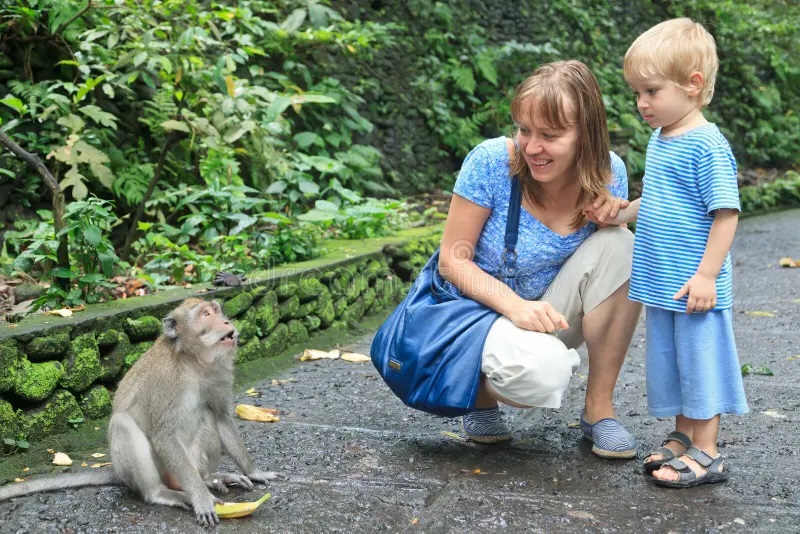
Being wildlife enthusiasts and bird watchers we took a river “safari” during a recent family trip to Bentota. We were dismayed to see that it seems to be the standard practice to feed the monkeys, I think they were the purple faced langurs, that were encountered on the river banks. Each boat that passed by stopped with boxed fruit, coconut and other odds and ends to feed them.
We managed to stop our guy from doing so but faced derision and laughter that we shouldn’t be afraid of monkeys. We tried to explain to him that this is a plague affecting Sri Lanka; elephants being fed on road sides and even in national parks, monkeys being fed from hotel balconies and apparently during river boat rides, birds being fed on hotel terraces etc.
This was met with further mockery and amused dismissal. An effort to make them understand that this was their livelihood that they were destroying it in this manner sailed over their heads. They even have a picture of a baby crocodile on the shoulders of a tourist on their billboard.
We need to consider the following:
Educate such tour operators about the importance of not interfering with the environment and the behaviour of wild animals.
Include education and training in the hotel school, and in schools in tourist resort towns about their duty and responsibility to the environment and the ecosystem on which we all depend.
If it is not already the case such operators should have licenses that should be revoked and fined if found to be engaging in such destructive acts.
Tamara Nanayakkara
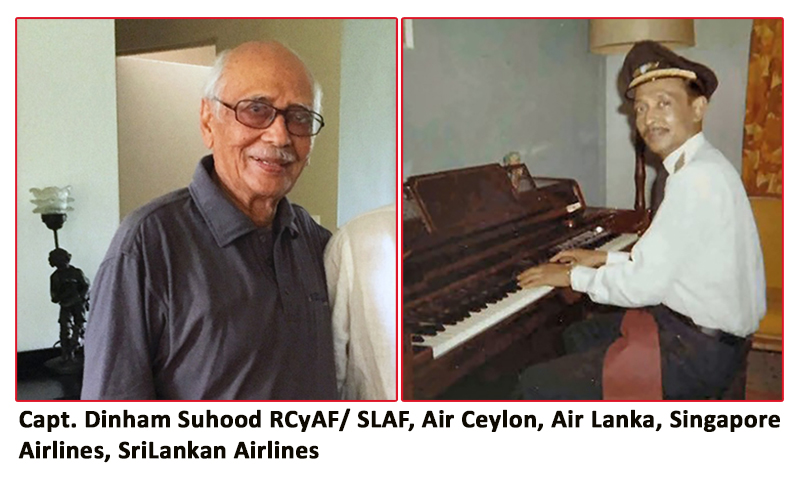
A few days ago, we heard the sad news of the passing on of Capt. Dinham Suhood. Born in 1929, he was the last surviving Air Ceylon Captain from the ‘old guard’.
He studied at St Joseph’s College, Colombo 10. He had his flying training in 1949 in Sydney, Australia and then joined Air Ceylon in late 1957. There he flew the DC3 (Dakota), HS748 (Avro), Nord 262 and the HS 121 (Trident).
I remember how he lent his large collection of ‘Airfix’ plastic aircraft models built to scale at S. Thomas’ College, exhibitions. That really inspired us schoolboys.
In 1971 he flew for a Singaporean Millionaire, a BAC One-Eleven and then later joined Air Siam where he flew Boeing B707 and the B747 before retiring and migrating to Australia in 1975.
Some of my captains had flown with him as First Officers. He was reputed to have been a true professional and always helpful to his colleagues.
He was an accomplished pianist and good dancer.
He passed on a few days short of his 97th birthday, after a brief illness.
May his soul rest in peace!
To fly west my friend is a test we must all take for a final check
Capt. Gihan A Fernando
RCyAF/ SLAF, Air Ceylon, Air Lanka, Singapore Airlines, SriLankan Airlines

The cause of global warming, they claim, is due to ever increasing levels of CO2. This is a by-product of burning fossil fuels like oil and gas, and of course coal. Environmentalists and other ‘green’ activists are worried about rising world atmospheric levels of CO2. Now they want to stop the whole world from burning fossil fuels, especially people who use cars powered by petrol and diesel oil, because burning petrol and oil are a major source of CO2 pollution. They are bringing forward the fateful day when oil and gas are scarce and can no longer be found and we have no choice but to travel by electricity-driven cars – or go by foot. They say we must save energy now, by walking and save the planet’s atmosphere.
THE DEMON COAL
But it is coal, above all, that is hated most by the ‘green’ lobby. It is coal that is first on their list for targeting above all the other fossil fuels. The eminently logical reason is that coal is the dirtiest polluter of all. In addition to adding CO2 to the atmosphere, it pollutes the air we breathe with fine particles of ash and poisonous chemicals which also make us ill. And some claim that coal-fired power stations produce more harmful radiation than an atomic reactor.
STOP THE COAL!
Halting the use of coal for generating electricity is a priority for them. It is an action high on the Green party list.
However, no-one talks of what we can use to fill the energy gap left by coal. Some experts publicly claim that unfortunately, energy from wind or solar panels, will not be enough and cannot satisfy our demand for instant power at all times of the day or night at a reasonable price.
THE ALTERNATIVES
It seems to be a taboo to talk about energy from nuclear power, but this is misguided. Going nuclear offers tried and tested alternatives to coal. The West has got generating energy from uranium down to a fine art, but it does involve some potentially dangerous problems, which are overcome by powerful engineering designs which then must be operated safely. But an additional factor when using URANIUM is that it produces long term radioactive waste. Relocating and storage of this waste is expensive and is a big problem.
Russia in November 2020, very kindly offered to help us with this continuous generating problem by offering standard Uranium modules for generating power. They offered to handle all aspects of the fuel cycle and its disposal. In hindsight this would have been an unbelievable bargain. It can be assumed that we could have also used Russian expertise in solving the power distribution flows throughout the grid.
THORIUM
But thankfully we are blessed with a second nuclear choice – that of the mildly radioactive THORIUM, a much cheaper and safer solution to our energy needs.
News last month (January 2026) told us of how China has built a container ship that can run on Thorium for ten years without refuelling. They must have solved the corrosion problem of the main fluoride mixing container walls. China has rare earths and can use AI computers to solve their metallurgical problems – fast!
Nevertheless, Russia can equally offer Sri Lanka Thorium- powered generating stations. Here the benefits are even more obviously evident. Thorium can be a quite cheap source of energy using locally mined material plus, so importantly, the radioactive waste remains dangerous for only a few hundred years, unlike uranium waste.
Because they are relatively small, only the size of a semi-detached house, such thorium generating stations can be located near the point of use, reducing the need for UNSIGHTLY towers and power grid distribution lines.
The design and supply of standard Thorium reactor machines may be more expensive but can be obtained from Russia itself, or China – our friends in our time of need.
Priyantha Hettige

West Indies brush aside Nepal to reach Super Eights

India vs Pakistan match is a godsend for T20 World Cup hosts Sri Lanka

Imran Khan to be moved to hospital amid rising health concerns

Fairly heavy showers are likely at some places in the Rathnapura, Kalutara, Galle and Matara districts

India vs Pakistan is finally here. Over to cricket now

“We Are Building a Stable, Transparent and Resilient Sri Lanka Ready for Sustainable Investment Partnerships” – PM

‘Dates have the highest sugar content to fight Coronavirus’

Sunday Island 27 December – Headlines

#SundayIsland 17th December – Headlines

Sunday Island – 28th March

Sunday Island Headlines – 21 March

Sunday Island – 21st February – Headlines
-

 Business4 days ago
Autodoc 360 relocates to reinforce commitment to premium auto care
-

 Midweek Review4 days ago
A question of national pride
-
 Opinion3 days ago
Will computers ever be intelligent?
-
 Midweek Review4 days ago
Theatre and Anthropocentrism in the age of Climate Emergency
-

 Editorial6 days ago
The JRJ syndrome
-

 Features10 hours ago
The Rise of Takaichi
-
 Opinion4 days ago
The Walk for Peace in America a Sri Lankan initiative: A startling truth hidden by govt.
-
 Opinion5 days ago
Beyond 4–5% recovery: Why Sri Lanka needs a real growth strategy