
Business
Real question is not whether SL should go to IMF or not: Verité Research

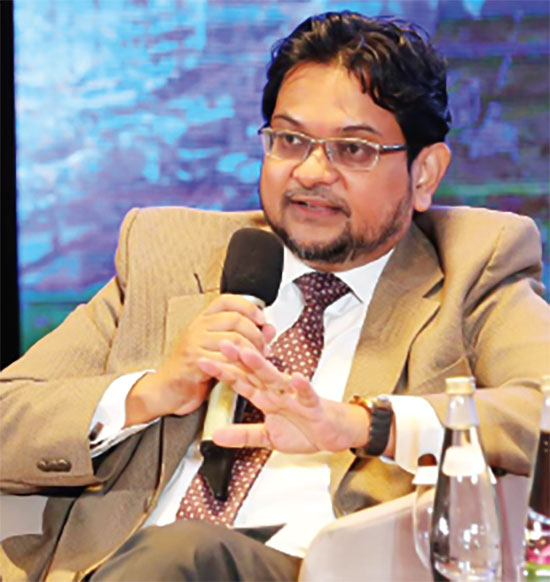
‘ Sri Lanka makes the mistake of letting IMF write a plan for the country’
by Sanath Nanayakkare
The real question is not whether Sri Lanka should go to the IMF or not. What is important is going to the IMF with confidence after having analysed the fiscal situation, with a convincing plan, Executive Director of Verité Research Dr. Nishan de Mel said in Colombo recently.
He made this remark at a CEOs Forum hosted by CA Sri Lanka to provide clarity on the current debt situation, whilst also helping the business community gain a better understanding on the government’s strategy and way forward to navigate through the ongoing situation.
State Minister of Money and Capital Market and State Enterprise Reforms Ajith Nivard Cabraal, was the guest speaker and the panel session brought together eminent speakers comprising of Governor of the Central Bank of Sri Lanka Professor W. D. Lakshman, Chairman of the Ceylon Chamber of Commerce Vish Govindasamy, [Executive Director of Verité Research (Pvt) Ltd Dr. Nishan de Mel], and Managing Director of Fitch Rating Agency Maninda Wickramasinghe.
Dr. Nishan de Mel further said: “For instance, when you go to a bank with a business idea to take out a loan, the bank says, ‘give me your plan’. But if you get the credit officer to write the plan for you it won’t be appropriate. The mistake Sri Lanka makes is letting the IMF write that plan for the country because the country doesn’t have one. The crux of the matter is; the credit officer shouldn’t write the plan. The country should present the plan and convince the credit officer that the plan has the potential to work out – a plan backed by an analysis that can win the confidence of the lender. That’s the structured way to obtain an IMF facility for Sri Lanka. I do hope that we can take that path.”
“The Central Bank may have a different approach to analyzsng the situation – I think publishing that analysis would be very valid because that is a test of some scrutiny and others would be able to look at it – that is a way to give confidence. I completely accept that there is no one way to analyse the situation and determine the approaches we can take, but it is important to make the chosen approach public.”
“The government and the Central Bank of Sri Lanka (CBSL) are on the right path with regard to reducing the ratio of foreign debt to domestic debt, but the greater reliance placed on domestic financing too quickly would be like running a marathon too fast as it could burn out the accelerated shift.”
“On the other hand, we might not have the option of being too slow on this aspect as rating agencies are downgrading and the markets are observing. Amid this we have to build confidence. These are very concerning which is why I say it is not too late for Sri Lanka to realign its strategy to get out of the problem and to keep its debt sustainable while making sure we won’t run into a liquidity crisis.”
“Verité’s own analysis shows that there are four steps that can make debt repayment more sustainable and a fifth step to avoid a reserve crisis which people are worried about.”
“Number 1; the interest rates on local debt can be no higher than inflation which I think we have probably achieved. The Central Bank has had a larger tolerance for inflation and it will end up in 6.5% range, and interest rates on local debt have been brought down which is an important part of the function. I t will take some time for all the government debt to reflect that lower rate, but that in reality is the right path. However, it’s a cost to society because inflation is costly in terms of real returns from your bank balances or investments.”
“Secondly, interest rates on foreign denominated loans can’t be higher than GDP growth There also Sri Lanka is well placed because even though we talk about having a large amount of commercial debt, the history of concessional debt is so high that our weighted average interest rate on foreign denominated debt is still only 3.9%, and going forward with a growth of about 4%, we can maintain that. Being able to maintain the interest on that percentage rate for foreign denominated loans is favourable for Sri Lanka.”
“Then there are two other conditions that Sri Lanka needs to do more about. One is the primary deficit- that is the deficit after paying interest- which should be less than 60% of GDP growth – that means if the GDP growth is 5%, primary deficit can’t be more than 3%. If we are expecting a lower GDP growth this time; say a growth of 3.3%, then the primary deficit can’t be more than 3%. So we really have to control that and bring it down. And it is very important to report those numbers correctly to give the markets that confidence. This still allows for a budget deficit in the high single digits because our total interest on debt is over 6% of GDP. This is not drastic, but it says that deficit has to be in the mid single digits. If we want to maintain the deficit, we need to be able to manage the upper single digits with a doable plan.”
The fourth is that depreciation of the currency can be no higher than inflation, and that brings us to the fifth step because currency depreciation today is not based on the fundamental mismatch in global crisis vs Sri Lankan crisis. From 2015 to 2019, one of the major important adjustments made was, to bring it to what you call the real exchange rate. Sri Lanka’s exchange rate until 2015 was significantly over valued. Even though depreciation hurt, the adjustment brought stability. That was an important alignment. That alignment is still sort of in place but today because of the uncertainty about the reserves, you see a speculative exchange rate- and that simply puts pressure on depreciation.”, he said.


For decades, environmental crime in Sri Lanka has been cheap.
Polluters paid fines that barely registered on balance sheets, violations dragged through courts and the real costs — poisoned waterways, degraded land, public health damage — were quietly transferred to the public. That arithmetic, long tolerated, is now being challenged by a proposed overhaul of the country’s environmental penalty regime.
At the centre of this shift is the Central Environmental Authority (CEA), which is seeking to modernise the National Environmental Act, raising penalties, tightening enforcement and reframing environmental compliance as an economic — not merely regulatory — issue.
“Environmental protection can no longer be treated as a peripheral concern. It is directly linked to national productivity, public health expenditure and investor confidence, CEA Director General Kapila Mahesh Rajapaksha told The Island Financial Review. “The revised penalty framework is intended to ensure that the cost of non-compliance is no longer cheaper than compliance itself.”
Under the existing law, many pollution-related offences attract fines so modest that they have functioned less as deterrents than as operating expenses. In economic terms, they created a perverse incentive: pollute first, litigate later, pay little — if at all.
The proposed amendments aim to reverse this logic. Draft provisions increase fines for air, water and noise pollution to levels running into hundreds of thousands — and potentially up to Rs. 1 million — per offence, with additional daily penalties for continuing violations. Some offences are also set to become cognisable, enabling faster enforcement action.
“This is about correcting a market failure, Rajapaksha said. “When environmental damage is not properly priced, the economy absorbs hidden losses — through healthcare costs, disaster mitigation, water treatment and loss of livelihoods.”
Those losses are not theoretical. Pollution-linked illnesses increase public healthcare spending. Industrial contamination damages agricultural output. Environmental degradation weakens tourism and raises disaster-response costs — all while eroding Sri Lanka’s natural capital.
Economists increasingly argue that weak environmental enforcement has acted as an implicit subsidy to polluting industries, distorting competition and discouraging investment in cleaner technologies.
The new penalty regime, by contrast, signals a shift towards cost internalisation — forcing businesses to account for environmental risk as part of their operating model.
The reforms arrive at a time when global capital is becoming more selective. Environmental, Social and Governance (ESG) benchmarks are now embedded in lending, insurance and trade access. Countries perceived as weak on enforcement face higher financing costs and shrinking market access.
“A transparent and credible environmental regulatory system actually reduces investment risk, Rajapaksha noted. “Serious investors want predictability — not regulatory arbitrage that collapses under public pressure or litigation.”
For Sri Lanka, the implications are significant. Stronger enforcement could help align the country with international supply-chain standards, particularly in manufacturing, agribusiness and tourism — sectors where environmental compliance increasingly determines competitiveness.
Business groups are expected to raise concerns about compliance costs, particularly for small and medium-scale enterprises. The CEA insists the objective is not to shut down industry but to shift behaviour.
“This is not an anti-growth agenda, Rajapaksha said. “It is about ensuring growth does not cannibalise the very resources it depends on.”
In the longer term, stricter penalties may stimulate demand for environmental services — monitoring, waste management, clean technology, compliance auditing — creating new economic activity and skilled employment.
Yet legislation alone will not suffice. Sri Lanka’s environmental laws have historically suffered from weak enforcement, delayed prosecutions and institutional bottlenecks. Without consistent application, higher penalties risk remaining symbolic.
The CEA says reforms will be accompanied by improved monitoring, digitalised approval systems and closer coordination with enforcement agencies.
By Ifham Nizam

Milinda Moragoda, Founder of the Pathfinder Foundation, who was in New Delhi to participate at the 4th India-Japan Forum, met with Gautam Adani, Chairman of Adani Group.
Adani Group recently announced that they will invest US$75 billion in the energy transition over the next 5 years. They will also be investing $5 billion in Google’s AI data center in India.Milinda Moragoda,
Milinda Moragoda, was invited by India’s Ministry of External Affairs and the Ananta Centre to participate in the 4th India–Japan Forum, held recently in New Delhi. In his presentation, he proposed that India consider taking the lead in a post-disaster reconstruction and recovery initiative for Sri Lanka, with Japan serving as a strategic partner in this effort. The forum itself covered a broad range of issues related to India–Japan cooperation, including economic security, semiconductors, trade, nuclear power, digitalization, strategic minerals, and investment.
The India-Japan Forum provides a platform for Indian and Japanese leaders to shape the future of bilateral and strategic partnerships through deliberation and collaboration. The forum is convened by the Ministry of External Affairs, Government of India, and the Anantha Centre.

HNB Assurance enters 2026 with renewed purpose and clear ambition as it moves into a defining phase of its 10 in 5 strategic journey. With the final leg toward achieving a 10% life insurance market share by 2026 now in focus, the company is gearing up for a year of transformation, innovation, and accelerated growth.
Closing 2025 on a strong note, HNB Assurance delivered outstanding results, continuously achieving growth above the industry average while strengthening its people, partnerships and brand. Industry awards, other achievements, and continued customer trust reflect the company’s strong performance and ongoing commitment to providing meaningful protection solutions for all Sri Lankans.
Commenting on the year ahead, Lasitha Wimalarathne, Executive Director / Chief Executive Officer of HNB Assurance, stated, “Guided by our 2026 theme, ‘Reimagine. Reinvent. Redefine.’, we are setting our sights beyond convention. Our aim is to reimagine what is possible for the life insurance industry, for our customers, and for the communities we serve, while laying a strong foundation for the next 25 years as a trusted life insurance partner in Sri Lanka. This year, we also celebrate 25 years of HNB Assurance, a milestone that is special in itself and a testament to the trust and support of our customers, partners and people. For us, success is not defined solely by financial performance. It is measured by the trust we earn, the promises we honor, the lives we protect, and the positive impact we create for all our stakeholders. Our ambition is clear, to be a top-tier life insurance company that sets benchmarks in customer experience, professionalism and people development.”
For HNB Assurance looking back at a year of progress and recognition, the collective efforts of the team have created a strong momentum for the year ahead.
“The progress we have made gives us strong confidence as we enter the final phase of our 10 in 5 journey. Being recognized as the Best Life Insurance Company at the Global Brand Awards 2025, receiving the National-level Silver Award for Local Market Reach and the Insurance Sector Gold Award at the National Business Excellence Awards, and being named Best Life Bancassurance Provider in Sri Lanka for the fifth consecutive year by the Global Banking and Finance Review, UK, reflect the consistency of our performance, the strength of our strategy, along with the passion, and commitment of our people.”

Warning for deep depression over South-east Bay of Bengal Sea area

It’s 4-1 to Australia after Carey and Green complete stuttering chase at SCG

US seizes two ‘shadow fleet’ tankers linked to Venezuelan oil

Showers above 100 mm are likely at some places in the Eastern and Uva provinces and showers about 50-75 mm in other areas

Easter Sunday attacks: Govt. says wife of Katuwapitiya Church bomber alive

Indian Army Chief here

‘Dates have the highest sugar content to fight Coronavirus’

Sunday Island 27 December – Headlines

#SundayIsland 17th December – Headlines

Sunday Island – 28th March

Sunday Island Headlines – 21 March

Sunday Island – 21st February – Headlines
-

 News2 days ago
Interception of SL fishing craft by Seychelles: Trawler owners demand international investigation
-
 News2 days ago
Broad support emerges for Faiszer’s sweeping proposals on long- delayed divorce and personal law reforms
-

 News3 days ago
Private airline crew member nabbed with contraband gold
-

 News1 day ago
Prez seeks Harsha’s help to address CC’s concerns over appointment of AG
-

 News1 day ago
Govt. exploring possibility of converting EPF benefits into private sector pensions
-

 News5 days ago
Health Minister sends letter of demand for one billion rupees in damages
-

 Features2 days ago
Educational reforms under the NPP government
-

 Features3 days ago
Pharmaceuticals, deaths, and work ethics