
News
Ray Jayawardhana named 16th Provost of Johns Hopkins University

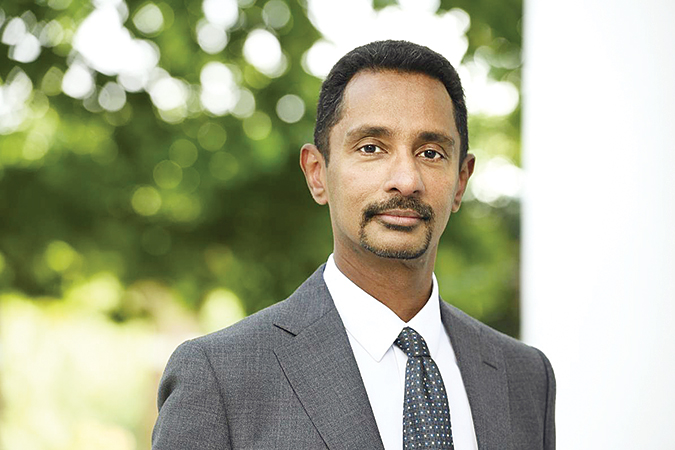
Renowned astrophysicist and accomplished academic leader joins JHU from Cornell, where he has served as dean of the College of Arts and Sciences since 2018Ray Jayawardhana, an accomplished academic leader, renowned and widely published scientist, and award-winning author who presently serves as dean of Cornell University’s College of Arts and Sciences, has been selected as Johns Hopkins University’s 16th provost.
Jayawardhana has led Cornell’s largest and most academically diverse college since 2018, overseeing enhancements to the student experience and the recruitment of 130 new faculty members, increasing the school’s scholarly distinction and impact in the process. He stood out among a strong group of candidates identified during a comprehensive national search.
The executive committee of the university’s board of trustees approved Jayawardhana’s appointment last week. His first day at Johns Hopkins will be Oct. 15.
“Dr. Jayawardhana is a visionary and collaborative leader who is driven by the same passionate pursuit of excellence and discovery that has been the hallmark of our institution since its founding,” JHU President Ron Daniels wrote in a message to the Hopkins community announcing Jayawardhana’s appointment.
“Dr. Jayawardhana’s record of accomplishments, his standards for excellence and integrity, and his commitment to driving collaboration across divisions and disciplines make him the ideal person to serve as Johns Hopkins University’s next provost.”
At Cornell, Jayawardhana has focused on four strategic priorities—faculty renewal and support, research and creative excellence, academic innovation and student experience, and public engagement and impact. During his tenure as dean, the College of Arts and Sciences has adopted a new undergraduate curriculum, introduced first-year advising seminars, implemented a selective and prestigious program that pairs liberal arts pursuits with the study of technology and data, and promoted active learning approaches. He also advanced opportunity and access through a wide range of academic and student programs, established a set of coveted postdoctoral fellowships for outstanding emerging scholars, and elevated public and media engagement dramatically. During his tenure, the college raised more than $300 million in philanthropic support.
Jayawardhana was instrumental in launching enhanced, cross-college departments of sociology, psychology, and economics. He also partnered with deans and faculty across the university to develop and lead signature initiatives in three critical areas of inquiry—climate, artificial intelligence, and quantum research.
As provost at Johns Hopkins, he will serve as the university’s chief academic officer, working closely with President Daniels and with leaders from across JHU on interdisciplinary initiatives, academic policies and procedures, and key priorities that support the university’s research and education missions.
“Johns Hopkins is on a remarkable trajectory, with bold ambitions and tremendous momentum,” Jayawardhana said. “I am excited to join this exceptionally dynamic community, and partner with President Daniels and others to help advance the university’s excellence and impact.”
Prior to joining Cornell’s faculty, Jayawardhana served as dean of science and professor of physics and astronomy at York University in Canada. This followed a decade on the faculty at the University of Toronto, where he served as a Canada Research Chair, professor of astronomy and astrophysics, and senior advisor to the president for science engagement.
A native of Sri Lanka, Jayawardhana earned a bachelor of science degree in astronomy and physics from Yale University and a PhD in astronomy from Harvard. He is the winner of numerous awards and accolades, including a Guggenheim Fellowship, a Rutherford Medal in Physics from the Royal Society of Canada, and a Carl Sagan Medal from the American Astronomical Society’s Division of Planetary Sciences. Asteroid (4668) Rayjay is named after him.
His research focuses on the diversity, origins, and evolution of planetary systems. His group uses large telescopes on the ground and in space to characterize planets outside our solar system, with an eye toward investigating the prospects for life elsewhere in the universe. He is a core science team member for the Near Infrared Imager and Slitless Spectrograph (NIRISS) instrument on the James Webb Space Telescope, and has authored more than 150 refereed papers in scientific journals.
Jayawardhana is also an acclaimed writer whose articles have appeared in The Economist, The New York Times, and The Wall Street Journal, among other publications. He is the author of four books, including Strange New Worlds, an insider’s account of the search for life on other planets; Neutrino Hunters, a tale of the chase for the so-called ghost particle that won the Canadian Science Writers Association’s Book Award in 2014; and Child of the Universe, a children’s book published in 2020 meant to spark the same fascination with our universe that inspired him as a child.
The book aims to convey “the deep and enduring links—both physical and poetic—between the universe and us, and to nurture a sense of wonder about the great beyond,” Jayawardhana writes in his author’s note.
An avid traveler, Jayawardhana has visited more than 55 countries and all seven continents. His travels, for research and writing, have included visits to mountaintop observatories in Chile and Hawaii, a meteorite collecting expedition in Antarctica, a parabolic flight with the European Space Agency, a solar eclipse chase in western Mongolia, and a descent into a South African mine with geobiologists.
He succeeds Sunil Kumar, who served as JHU’s provost from September 2016 through April 2023 and recently became the president of Tufts University. Professor Stephen Gange of the Bloomberg School of Public Health has led the provost’s office on an interim basis since Kumar’s departure.


Latest News
Sun directly overhead Chilaw, Bingiriya, Halmillawewa, Panduwasnuwara, Gokarella, Kawudupelella, Koppaveli and Kirankulam about 12:12 noon. today (09)


On the apparent northward relative motion of the sun, it is going to be directly over the latitudes of Sri Lanka from the 05th to 15th of April this year.
The nearest areas of Sri Lanka over which the sun is overhead today (09th) are Chilaw, Bingiriya, Halmillawewa, Panduwasnuwara, Gokarella, Kawudupelella, Koppaveli and Kirankulam about 12:12 noon.
Latest News
Heat Index at Caution Level in the Western, Sabaragamuwa, Southern, Eastern, North-western, Northern and North-central provinces and in Monaragala district

Warm Weather Advisory
Issued by the Natural Hazards Early Warning Centre
Issued at 4.30 p.m. on 08 April 2026, valid for 09 April 2026.
The Heat index, the temperature felt on human body is likely to increase up to ‘Caution level’ at some places in the Western, Sabaragamuwa, Southern, Eastern, North-western, Northern and North-central provinces and in Monaragala district.
The Heat Index Forecast is calculated by using relative humidity and maximum temperature and this is the condition that is felt on your body. This is not the forecast of maximum temperature. It is generated by the Department of Meteorology for the next day period and prepared by using global numerical weather prediction model data.

Effect of the heat index on human body is mentioned in the above table and it is prepared on the advice of the Ministry of Health and Indigenous Medical Services.
ACTION REQUIRED
Job sites: Stay hydrated and takes breaks in the shade as often as possible.
Indoors: Check up on the elderly and the sick.
Vehicles: Never leave children unattended.
Outdoors: Limit strenuous outdoor activities, find shade and stay hydrated.
Dress: Wear lightweight and white or light-colored clothing.
Note:
In addition, please refer to advisories issued by the Disaster Preparedness & Response Division, Ministry
of Health in this regard as well. For further clarifications please contact 011-7446491.


The Auditor General has warned that delays in coal procurement and continued reliance on suppliers of questionable standards could disrupt the supply of electricity.
The special audit report on coal imports was presented to Parliament on Tuesday (07) by Bimal Ratnayake, Leader of the House, at the commencement of proceedings.
However, Opposition MPs complained to Speaker Dr Jagath Wickramaratne that copies of the report had not been distributed to Members of Parliament. Responding to the complaint, the Speaker said it was the responsibility of the Parliamentary Secretariat to ensure the report was provided to MPs.
The special audit, requested by the Committee on Public Enterprises (COPE), examined the coal procurement process of the Lanka Coal Company for the Lakvijaya Power Plant and purchases planned for the 2025/2026 season.
The audit revealed several irregularities in the tender process. It found that the laboratory issuing quality reports at the loading port for the controversial supplier Trident Company had its licence cancelled. The report also disclosed that at the time advertisements were published calling for tenders,the company had not completed its registration but was awarded the tender. In addition, three other suppliers who had not confirmed their registration were allowed to submit bids.
Coal shipments for the Lakvijaya Power Plant are tested at both loading and unloading ports. According to the audit, Mitra SK South Africa had been appointed to conduct testing at the loading port, but due to the absence of accreditation the task was assigned to PT Mitra SK Analisa Testama Samarinda, an Indonesian firm whose licence had been cancelled on December 29, 2025. Auditor General S. Jayarathne has noted that the audit could not confirm whether the licence had been renewed by March 31, 2026, and that all 12 shipment reports issued at the loading port lacked accreditation.
The report has further pointed to discrepancies between loading port laboratory reports and data recorded at the plant’s main control unit. Despite the availability of alternative verification methods, the Lanka Coal Company failed to use them to confirm the accuracy of the reports.
The audit also highlighted that no coal shipments were brought to Sri Lanka between November 13 and December 30, 2025, despite the need to secure maximum stocks during that period.
As a result of the shortage, an emergency procurement was carried out on March 18 this year, selecting Taranjot Resource Pvt Ltd. as the supplier. However, the Auditor General revealed that this company had failed within the previous 36 months to supply coal with the required calorific value of 5,900 or above to the Lakvijaya Power Plant.
The report warns that delays in coal imports and dependence on suppliers with questionable standards could adversely affect the continuous supply of electricity from the plant.
The National Audit Office of Sri Lanka has further estimated that the use of substandard coal has caused losses amounting to nearly Rs. 2.24 billion.
According to the report, losses incurred from individual shipments included more than Rs. 160 million from the first vessel (consignment No. 456), over Rs. 90 million from the second vessel (No. 457), more than Rs. 310 million from the third vessel (No. 458), and over Rs. 150 million from the fourth vessel (No. 459). Additional losses included nearly Rs. 180 million from the fifth vessel (No. 460), about Rs. 30 million from the sixth vessel (No. 461), over Rs. 240 million from the seventh vessel (No. 462), more than Rs. 390 million from the eighth vessel (No. 463) and over Rs. 390 million from the tenth vessel (No. 464).
The report has also noted that because the available coal stocks cannot generate electricity at the plant’s full capacity of 300 megawatts, additional power may have to be obtained from alternative sources. The estimated additional energy requirement for this purpose is 76,354,087 kilowatt-hours, the report has pointed out.
By Saman Indrajith

BCCI curbs movement of benched IPL players in latest rules

Prasidh trumps Miller in last-ball finish as Gujarat Titans clinch thriller

Greece to ban social media for under-15s from next year

Showers will occur at a few places in the Western, Sabaragamuwa and North-western provinces and in Galle, Matara, Kandy, Nuwara-Eliya and Mannar districts after 2.00 p.m.

Sun directly overhead Chilaw, Bingiriya, Halmillawewa, Panduwasnuwara, Gokarella, Kawudupelella, Koppaveli and Kirankulam about 12:12 noon. today (09)

Heat Index at Caution Level in the Western, Sabaragamuwa, Southern, Eastern, North-western, Northern and North-central provinces and in Monaragala district

‘Dates have the highest sugar content to fight Coronavirus’

Sunday Island 27 December – Headlines

#SundayIsland 17th December – Headlines

Sunday Island – 28th March

Sunday Island Headlines – 21 March

Sunday Island – 21st February – Headlines
-

 Features4 days ago
Ranjith Siyambalapitiya turns custodian of a rare living collection
-

 News4 days ago
Global ‘Walk for Peace’ to be held in Lanka
-

 News2 days ago
Lankan-origin actress Subashini found dead in India
-
 Opinion6 days ago
Hidden truth of Sri Lanka’s debt story: The untold narrative behind the report
-

 Features4 days ago
Beyond the Blue Skies: A Tribute to Captain Elmo Jayawardena
-

 Features4 days ago
Aspects of Ceylon/Sri Lanka Foreign Relations – 1948 to 1976
-

 Features6 days ago
The Ramadan War
-

 Editorial5 days ago
Brouhaha over a book