
News
Ranil says UNP can garner IMF support for immediate economic take-off

by Sanath Nanayakkare
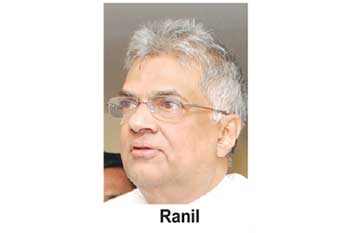
A future UNP government could garner the support of the International Monetary Fund (IMF) to raise funds to honour the country’s debt repayment commitments, without causing any disruption to the economy, UNP leader Ranil Wickremesinghe said, at Mattegoda, last Saturday (01).
“The IMF has helped the UNP governments in the past to resolve balance of payment issues and effectively restore Sri Lanka’s economy during dire times, including the Easter Sunday bomb attacks. I am confident that the international lender will provide its much needed support to a UNP government, with loans on affordable terms because it knows that we do not compromise our sound economic policies and revenue-based fiscal consolidation programmes.”
The UNP leader said: “Our priority will be mitigating the negative impact of Covid-19 on diverse segments of the economy; from three-wheeler drivers to wage-earning workforce to self-employed people and small and medium entrepreneurs. The Covid-19 public health crisis has weighed heavily on economic activity, employment and inflation and poses considerable risks to the economic outlook in the near-to-medium term. The level of economic activity has drastically slowed down as consumers fear for their future. Due to the Covid-19 pandemic, about five million people have lost their jobs and a similar number of jobs are at risk. Thousands of people have experienced pay-cuts and reduction of their allowances. Employers are not hireing job seekers. Many people can’t pay their house rents, utility bills and payback their loans.
“Hence today everyone is thinking about their financial problems more than the parliamentary election because that’s very important to them. When I was Prime Minister I adopted a revenue-based fiscal consolidation strategy to increase government income at the risk of growing public displeasure. At that time, the government earned Rs 150,000 million as revenue. In July 2020, it declined to Rs. 50,000 million. Our public servants’ pensions alone require Rs. 90,000 million and the government had to borrow to meet pension payments among other things. How long can we go on like this?
“During the Yahapalana government, we struck a certain balance between our income and expenditure and obtained support from bilateral and multilateral lending agencies for economic development. In 2018/19 we were able to have a surplus in our primary account.
“Today, the country’s stressed external liquidity position remains a credit weakness. Sri Lanka has not been able to get IMF funds despite having made three requests to them. Pakistan and Bangladesh have received funds from the IMF, and there should be no reason why Sri Lanka can’t access their funds. The UNP has presented a new three-year economic framework to face the challenges in the future which would boost confidence of the international lending agencies in our macroeconomic prudence and post-pandemic recovery path going forward. International funding will help strengthen the rupee. More exports and foreign remittances will bring in more money into the country. Through that strategy we will put more money into consumers’ wallets and increase their spending power. If current liquidity issues continue, the exchange rate of the rupee will hover around Rs. 195-Rs. 200 by October. In such a context, there will be more severe import controls and smartphones, electric and electronic goods will not be available in the market. Commodity prices will go up and life will be more difficult six months from now. Our new economic programme is capable of addressing such fiscal and external challenges. I urge you to consider the looming threats of these issues as you go to cast your vote on August 5.”

Latest News
Cabinet approves establishment of Activity-Based Learning Centers at Regional Level for Commerce Education

The importance of establishing learning centers at regional level has been identified in order to achieve multiple objectives, including the development of teachers, utilization as a hub for new technology and resource sharing, enhancement of vocational and higher education opportunities, efficient utilization of limited physical and human resources, integration of new technologies with subject-specific knowledge,
sharing of limited resources to ensure equitable access to education, and development of skills in line with regional potential, thereby contributing to the qualitative development of commerce education.
Accordingly, the project to establish 100 activity-based learning centers for the enhancement of commerce education has been included in the Public Investment Programme as a major investment project in general education, with an estimated total cost of Rs. 289 million, to be implemented during the period 2026–2028.
Having considered the proposal submitted by the Prime Minister, in her capacity as the Minister of Education, Higher Education and Vocational Education, Cabinet approval was granted to establish and operationalize 25 regional centres covering all 25 districts.
Latest News
M/s. Resources Development Consultants (Pvt) Ltd appointed to prepare Feasibility Study and detailed plans for the extension of the Kelani Valley Railway Line from Avissawella to Ratnapura
Approval was granted at the Cabinet Meeting held on 21-10-2025 to carry out a feasibility study and prepare detailed plans for the extension of the Kelani Valley Railway Line from Avissawella to Ratnapura.
The calling of expressions for this purpose has been conducted under the national Competitive Procurement Procedure, and 8 bidders have submitted their Expression of Interest in that respect.
Following the evaluation of technical proposals submitted by the short-listed bidders, and financial proposals of the 4 eligible institutions have been opened. Subsequent to the evaluation of the aforementioned financial proposals, the Consultant Procurement Committee has recommended awarding
the consultancy for the feasibility study and preparation of detailed plans for the extension of the Kelani Valley Railway Line from Avissawella to Ratnapura to M/s. Resources Development Consultants (Pvt) Ltd at a total cost of Rs. 356.22 million (exclusive of taxes).
Accordingly, the Cabinet of Ministers has approved the resolution furnished by the Minister of Transport, Highways and Urban Development to award the said procurement in line with the above recommendation.
Latest News
Import and Export (Control) Regulations No. 01 of 2026, issued under the Imports and Exports (Control) Act, No. 1 of 1969, to be submitted for concurrence of the Parliament
The Special Import Licence Regulations No. 01 of 2023, published in Extraordinary Gazette No. 2312/77 dated 01-01-2023, prohibit the importation of retreaded tires, including those used for aircraft.
However, the Ministry of Ports and Civil Aviation has made a request that an exemption be granted to permit the importation of retreaded aircraft tires classified under HS Code 4012.13 for Sri Lankan Airlines.
Taking into consideration essential operational and safety requirements, it has been decided to permit the importation of retreaded aircraft tires classified under HS Code 4012.13, subject to the recommendation of the Ministry of Ports and Civil Aviation, provided that such tires comply with the requirements specified by internationally recognized aviation authorities and are imported by Sri Lankan airline operators engaged in international air services under a duly executed supply agreement between the airline and a certified international supplier.
Accordingly, the Cabinet of Ministers has approved the resolution furnished by the President, in his capacity as the Minister of Finance, Planning and Economic Development, to submit the Import and Export (Control) Regulations No. 01 of 2026, published in Extraordinary Gazette No. 2481/02 dated 23-03-2026 under the provisions of the Imports and Exports (Control) Act, No. 1 of 1969, for the concurrence of the Parliament.

IRGC seizes two vessels in Strait of Hormuz amid US blockade

Cabinet approves establishment of Activity-Based Learning Centers at Regional Level for Commerce Education
M/s. Resources Development Consultants (Pvt) Ltd appointed to prepare Feasibility Study and detailed plans for the extension of the Kelani Valley Railway Line from Avissawella to Ratnapura
Import and Export (Control) Regulations No. 01 of 2026, issued under the Imports and Exports (Control) Act, No. 1 of 1969, to be submitted for concurrence of the Parliament

Cabinet nod to establish ‘Sri Lanka Industrial Transformation and Innovation Authority ‘
Iraj Chaminda Pathiraja appointed Controller General of Immigration and Emigration

‘Dates have the highest sugar content to fight Coronavirus’

Sunday Island 27 December – Headlines

#SundayIsland 17th December – Headlines

Sunday Island – 28th March

Sunday Island Headlines – 21 March

Sunday Island – 21st February – Headlines
-
 News2 days ago
Rs 13 bn NDB fraud: Int’l forensic audit ordered
-

 Business5 days ago
Harnessing nature’s wisdom: Experts highlight “Resist–Align” path to resilience
-

 News5 days ago
Gratiaen Trust announces longlist for the 33rd Annual Gratiaen Prize
-

 Opinion3 days ago
Shutting roof top solar panels – a crime
-

 News4 days ago
From Nuwara Eliya to Dubai: Isha Holdings markets Agri products abroad
-

 Latest News6 days ago
Singapore Zoo’s first Sri Lankan leopard cubs make their public debut
-
 News5 days ago
Heroin haul transported on 50-million-rupee contract
-

 News3 days ago
Church calls for Deputy Defence Minister’s removal, establishment of Independent Prosecutor’s Office