
Latest News
Rabada sets up South Africa’s first Test win in Asia since 2014


South Africa have moved up to fourth place on the World Test Championship table after a seven-wicket win over Bangladesh in Mirpur. They chased a target of 106 in 22 overs to seal victory before lunch on the fourth day after Kagiso Rabada finished the match with nine wickets.
This was their first Test win in the subcontinent in 15 matches, dating back a decade to when they beat Sri Lanka in Galle in 2014.
Aggression and intent was the tone of final exchanges South Africa hit 15 fours and two sixes, and ticked along at a shave under five runs an over. They lost three of their top four in pursuit but the batters were largely comfortable on unfamiliar surfaces and new No. 3, Tristan Stubbs, who was unbeaten on 30, impressed with his ability to adapt.
With a small total to defend, Bangladesh opened the bowling with their sole seamer Hasan Mahmud and their most successful bowler of the first innings, left-arm spinner Taijul Islam. His first ball was a full toss, which Aiden Markram slashed through extra cover and the take down of Taijul had begun. Three balls later, Markram drove Taijul through the covers and in his next over, Tony de Zorzi took two boundaries off him.
Hasan was more threatening upfront and drew an edge from de Zorzi, which fell short of second slip and Taijul thought he had a breakthrough when he had Markram given out lbw in the eighth over, on 13. Markram missed a sweep and was hit on the pad but reviewed straight away and replays showed he had under edged the ball.
South Africa were undeterred by the incident and de Zorzi finished the over by sweeping Taijul past square leg for four more. The opening pair put on 42 inside 10 overs before Taijul finally had some success. He bowled Markram through the gate, with South Africa still 65 runs away.
De Zorzi and Stubbs shared a stand of 29 in 32 balls and had settled well but de Zorzi became a little too ambitious. He advanced on Taijul to try and hit him out of the ground but dragged the ball to Hasan at long-on. Again, there was no slow-down. Stubbs took 10 runs off the rest of the over.
David Bedingham was done by a good delivery from Taijul that turned away and took the edge and was dismissed with victory nine runs away. Taijul finished with match figures of 8 for 165, after a first-innings five-for.
Earlier, South Africa needed just 4.5 overs to bowl Bangladesh out and keep their target to just over 100 after the hosts’ lower-middle order forced the match into a fourth day. Bangladesh’s lead grew to 81 on the third evening when they faced the second new ball for five overs as South Africa were forced to use spinners in fading light. That changed on the fourth morning. The second new ball was available and taken and it had an almost immediate impact.
Rabada opened proceedings and his third ball seamed in to Nayeem Hasan and struck him on the front pad. Nayeem’s wicket gave Rabada a 15th Test five-for to cap off a memorable game in which he also took his 300th wicket.
Mehidy moved into the 90s with a boundary off Wiaan Mulder but was tested by Rabada, who teased the outside edge and induced an aerial flick that was dropped by Tony de Zorzi. Bangladesh’s 300 came up when Taijul Islam hit Mulder through gully but his fun didn’t last long. Two balls later, he feathered one to second slip to leave Mehidy with the last batter.
He was in a rush to get to his hundred and was on 97 when tried to ramp Rabada, but the length was not quite right and he steered the ball to slip instead. Rabada finished with 6 for 46. Bangladesh had added 24 runs to their overnight score and even if they felt they had something to bowl at, South Africa soon showed that was not enough.
South Africa have played Tests in Bangladesh just twice in the last 16 years and both matches of their 2015 series were washed out. The last time they won a Test in the country was in 2008, when they won both matches by an innings. The second match in this series starts next Tuesday in Chattogram. Thereafter, South Africa have four home Tests, two each against Sri Lanka and Pakistan. If they win at least four of their remaining five matches, they will be in with a good chance of getting to the WTC final.
Brief scores:
South Africa 308 (Kyle Verreynne 114, Viaan Mulder 54; Taijul Islam 5-122, Hasan Mahmud 3-66) and 106 for 3 (Toni De Zorzi 41, Tristan Stubbs 30*, Taijul Islam 3-43) beat Bangladesh 106 (MahamudulHasa Joy 30; Wiaan Mulder 3-22, Kagiso Rabada 3-26, Keshav Maharaj 3-34) and 307 (Mehidy Hasan Miraz 97, Jaker Ali 58; Kagiso Rabada 6-46) by 7 wickets
[Cricinfo]

Latest News
Heat Index at Caution Level in the Western, Sabaragamuwa, Southern and North-western provinces and in Anuradhapura, Mannar and Vavuniya districts
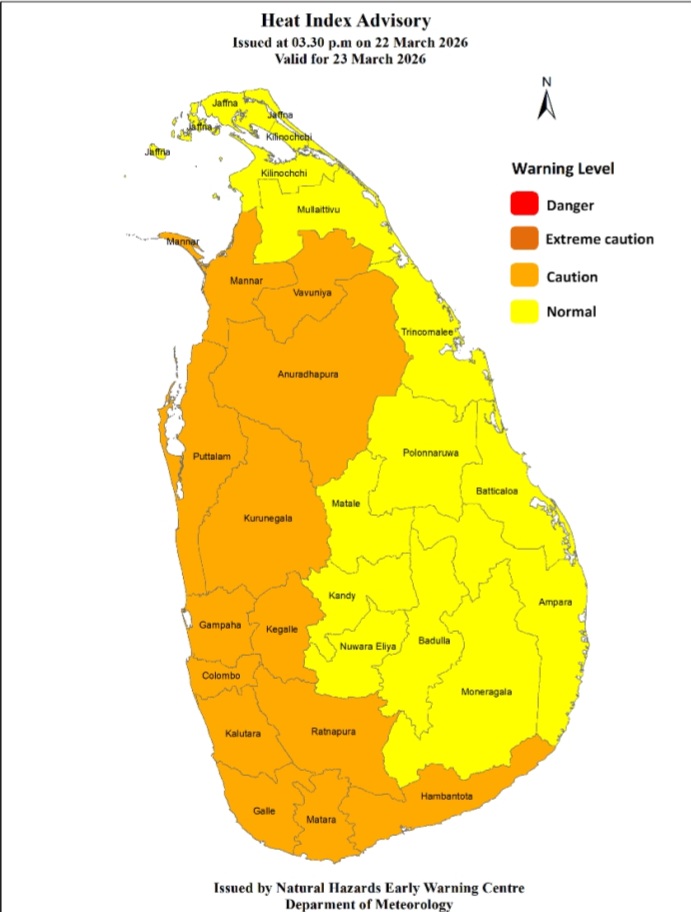
Warm Weather Advisory
Issued by the Natural Hazards Early Warning Centre of the Department of Meteorology
at 3.30 p.m. on 22 March 2026, valid for 23 March 2026.
The Heat index, the temperature felt on human body is likely to increase up to ‘Caution level’ at some places in the Western, Sabaragamuwa, Southern and North-western provinces and in
Anuradhapura, Mannar and Vavuniya districts.
The Heat Index Forecast is calculated by using relative humidity and maximum temperature and this is the condition that is felt on your body. This is not the forecast of maximum temperature. It is generated by the Department of Meteorology for the next day period and prepared by using global numerical weather prediction model data.

Effect of the heat index on human body is mentioned in the above table and it is prepared on the advice of the Ministry of Health and Indigenous Medical Services.
ACTION REQUIRED
Job sites: Stay hydrated and takes breaks in the shade as often as possible.
Indoors: Check up on the elderly and the sick.
Vehicles: Never leave children unattended.
Outdoors: Limit strenuous outdoor activities, find shade and stay hydrated.
Dress: Wear lightweight and white or light-colored clothing.
Note:
In addition, please refer to advisories issued by the Disaster Preparedness & Response Division, Ministry of Health in this regard as well. For further clarifications please contact 011-7446491.
Latest News
Trump says US will ‘obliterate’ Iran’s power plants if Strait of Hormuz not open before 48-hour deadline

President Donald Trump says the US will “obliterate” Iranian power plants if the Strait of Hormuz is not open within 48 hours – the waterway is vital for global oil shipping.
Iran warns it will retaliate against all US-linked energy infrastructure in the Middle East if its power plants are attacked.
Trump also says he has achieved his war aims “weeks ahead of schedule”, adding: “Iran wants to make a deal. I don’t”
More than 100 people have been injured after strikes on southern Israel. The target appears to have been a nuclear facility 13km away from the city of Dimona
Meanwhile, Israel says it launched a wave of strikes on the Iranian capital. It follows an attack on Iran’s Natanz nuclear facility, Tehran says
An attempted Iranian strike on the joint UK-US base on Diego Gracia happened late on Thursday night into Friday morning, the BBC understands. Foreign Secretary Yvette Cooper says the UK won’t be drawn into wider conflict
[BBC]

Three weeks after the joint US-Israeli war against Iran began, the conflict has reached a fuzzy state of mixed messages and uncertainty, with Donald Trump’s public comments often seemingly contradicted by realities on the ground.
The war is “very complete, pretty much”, Trump has said, but new American ground forces – including a Marine expeditionary unit – are moving into the region. It is “winding down”, but US and Israeli bombing and missile strikes on Iranian targets continue unabated.
Opening the Strait of Hormuz, the geographic choke point through which 20% of the world’s oil export travels, is a “simple military manoeuvre”, but for now only Iranian-approved ships are transiting the waters.
The Iranian military is “gone”, but drones and missiles are still striking targets in the region and targets have extended as far as the joint US-UK base on Diego Garcia.
In a Friday evening Truth Social post published while he was flying from Washington to his Florida resort for the weekend, the US president provided a numbered list of American military objectives for the Iran war, which he said the US was “getting really close” to fulfilling.
The items, comprising his most detailed statement on the subject since the war began, included degrading or destroying Iran’s military, its defence infrastructure and its nuclear weapons programme, as well as protecting American allies in the region.
Not included was the goal of securing the Strait of Hormuz, which Trump said should be the responsibility of other nations that are more dependent on oil exports from the Gulf. The president has frequently noted that the US is a net exporter of energy and does not rely on oil from the Middle East – although such a view glosses over the global nature of the fossil fuel market, where price fluctuations directly impact the price at American gas pumps.
Trump’s Truth Social post also made no call for Iranian regime change. Gone are any references to approving the nation’s next leader or “unconditional surrender”, which Trump had insisted on in the early days of the war.
In Trump’s latest outline of his objectives, it is possible that the US could end its operation with Iran’s current anti-American leadership in power, its oil exports still flowing and its ability to assert some measure of control over the Strait of Hormuz intact.
If that is an unappealing resolution to a war that the president and his aides have said began with the 1979 Iran Revolution and that they would finish, there is an alternative route that involves the US ground forces presently on the way to the Middle East region.
Just over a week ago, US media reported that a Marine expeditionary unit, with about 2,500 combat soldiers and supporting ships and aircraft, had been dispatched from Japan to the Middle East, which it should reach in the coming days. Another Marine force of similar size recently departed its base in California with its arrival expected in mid-April.
Military analysts have suggested that the US could be planning to capture Kharg Island. an 3-sq-km (8-sq-mile) slice of land that contains Iran’s primary oil export terminal. Doing so could, in theory, cut off the nation’s oil shipments, depriving the nation of much-needed revenue and forcing it to make greater concessions to the Americans in exchange for an end to hostilities.
Trump on Friday said that he wasn’t sending ground troops to Iran, but added: “If I were, I certainly wouldn’t tell you”. Clarity, it seems, is not his intention.
The threat of such a move prompted Iran’s state media to report on Saturday that any attack on Kharg Island would lead Iran to cause “insecurity” in the Red Sea, another key global shipping transit point, and “set fire” to energy facilities throughout the region.
Iran’s warning underscores the dangers that would accompany a US escalation that further exposes American military forces to Iranian reprisals.
Earlier this week, US media reported that the Trump administration was preparing to ask Congress for $200bn (£150bn) in emergency funding for the ongoing Iranian military operation. Such a request would suggest that, far from winding down, the White House is preparing for a long, expensive fight.
The initial reaction from Congress, including from Trump’s Republican allies, was cautious at best.
“We’re talking about boots on the ground. We’re talking about that kind of extended activity,” said Republican Congressman Chip Roy of Texas.
“They have got a whole lot more briefing and a whole lot more explaining to do on how we’re going to pay for it, and what’s the mission here.”
The so-called “fog of war” doesn’t just cloud the thinking of military planners, it also affects the perception of politicians and the public.
The Iran war, it seems, is at a pivot. But which direction it takes from here is a puzzle.
(BBC)

Heat Index at Caution Level in the Western, Sabaragamuwa, Southern and North-western provinces and in Anuradhapura, Mannar and Vavuniya districts

Showers may occur at several places in the Western and Sabaragamuwa provinces and in Galle, Matara and Nuwara-Eliya districts after 2.00 pm.

Fuel price hikes trigger transport disruptions and calls for fare increases

Prof. Peiris honoured by International Institute of Rehabilitation

CMC resumes parking fees

Substandard coal deepens energy crisis, warns former CEB Chief

‘Dates have the highest sugar content to fight Coronavirus’

Sunday Island 27 December – Headlines

#SundayIsland 17th December – Headlines

Sunday Island – 28th March

Sunday Island Headlines – 21 March

Sunday Island – 21st February – Headlines
-

 News5 days ago
CIABOC questions Ex-President GR on house for CJ’s maid
-

 News6 days ago
Sri Lankan marine scientist Asha de Vos honoured at UNGA opening
-

 News6 days ago
Australian HC debunks misleading travel risk claims for Sri Lanka
-

 News4 days ago
Bailey Bridge inaugurated at Chilaw
-

 Latest News7 days ago
Wednesdays declared a government holiday with effect from 18th March
-

 News4 days ago
Pay hike demand: CEB workers climb down from 40 % to 15–20%
-

 News3 days ago
CIABOC tells court Kapila gave Rs 60 mn to MR and Rs. 20 mn to Priyankara
-

 Editorial5 days ago
Couple QR-based quota with odd-even rationing