
News
Public urged not to be deceived by TNA’s opposition to ONUR law


FNO says Geneva Road Map progressing rapidly, consequences catastrophic
By Shamindra Ferdinando
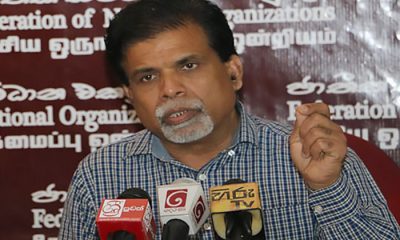
Secretary to the Federation of National Organizations (FNO) Dr. Wasantha Bandara yesterday (10) urged the public not to be deceived by Tamil political parties’ refusal to back the Office for National Unity and Reconciliation (ONUR) Bill.
Parliament adopted the new law on Tuesday with 48 MPs voting for the Bill, while seven opposed.
Dr. Bandara alleged that was a joint government and Tamil parties’ strategy to hoodwink the people. Pointing out that some members of the Tamil National Alliance (TNA) and All Ceylon Tamil Congress (ACTC) aka Ahila Ilankai Thamil Congress (AITC), had been among those who voted against the Bill, Dr. Bandara found fault with the Sri Lanka Podujana Peramuna (SLPP) and Samagi Jana Balawegaya (SJB) MPs for failing to take a stand against the separatist agenda.
The enactment of the new law is meant to give legal teeth to the Office for National Unity and Reconciliation (ONUR) that had been established during yahapalana administration in terms of the Geneva dictates, Dr. Bandara said.
The FNO dismissed concerns expressed by a section of the civil society regarding ONUR Bill as mere propaganda. “They are always looking for an opportunity to appease their sponsors.”
Dr. Gunadasa Amarasekera’s effort on behalf of the FNO to convince the members of Parliament to oppose the Bill had been in vain, Dr. Bandara said. Asked whether the FNO intended to step up the campaign against what the grouping called Geneva Road Map, Dr. Bandara said that three of the offices that had been mentioned in the Geneva Road Map were set up beginning with the Office on Missing Persons (OMP) on Aug 2016, followed by Office of Reparations in Oct 2018.
Dr. Bandara said that with the enactment on the ONUR law, the government was in a position to appoint a Commission for Truth, Unity and Reconciliation through an Act of Parliament. According to him, once the Parliament enacted that law, the war-winning military and the then political leadership would have to face the consequences.
Dr. Bandara said that in addition to the Bills that had been enacted and the proposed law to set up a Truth, Unity and Reconciliation Commission, Sri Lanka approved three other Bills in line with the Geneva Road Map.
The FNO spokesperson said that regardless of continuing political uncertainty President Wickremesinghe had proceeded with the Geneva Road Map.
Responding to The Island queries, Dr. Bandara said that the President was most likely to present the relevant Act soon. Had President Gotabaya Rajapaksa heeded our warnings, the Geneva Road Map could have been averted, Dr. Bandara said, disclosing that he, on behalf of the FNO on January 11 last year, explained the Western strategy to undermine the government. Interested parties targeted the then Army Commander General Shavendra Silva and Defence Secretary Kamal Gunaratne to unsettle the military ahead of the US-backed public protest campaign to oust that government, Dr. Bandara said.


… reminds AKD led over 560 protests during Yahapalanaya
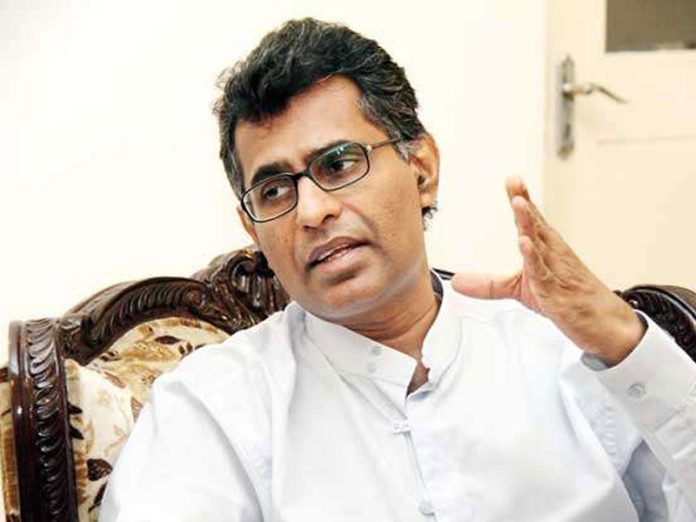
Former Yahapalana Minister and United Republican Front (URF) leader Patali Champika Ranawaka yesterday (19) alleged that the JVP, which carried out over 560 protests during the 2015-2019 period, was now bent on preventing the Opposition from exercising its democratic right to protest.
Recalling the declaration made by the JVP at the height of the violent protest campaign in July 2022 that it would set the Parliament ablaze, the former parliamentarian lashed out at the JVP-led administration for using the police excessively to curb political opposition. Ranawaka said this while addressing the media at the former President Ranil Wickremesinghe’s Flower Road Office .
Commenting on the protest campaign launched by the Maha Sangha, demanding presidential pardon for General Secretary of the Bodu Bala Sena (BBS) Ven. Galagotaatte Gnanasara, the ex-Colombo District lawmaker alleged that President Anura Kumara Dissanayake used a combination of police, investigative units and JVP cadres to break up the monks’ protest. The government went to the extent of compelling the JVP/NPP-run Colombo Municipal Council (CMC) to deprive the peaceful protesters of basic toilet facilities, he alleged.
The government’s actions proved that only those with prior approval from JVP Pelawatte headquarters could launch protests in Colombo, its suburbs or in the provinces. The police have become a political tool in the hands of the JVP, the ex-Minister said. (SF)

By SK Samaranayake
Six people were killed and seven others injured when a speeding bulker lorry carrying cement and concrete ploughed into several vehicles and a shop on the Kandy-Jaffna A9 road at Kurugoda, Akurana, yesterday (19).
Four of the victims, two women and two men, died on the spot in the accident which occurred around 10.30 am, according to Alawathugoda Police.
Police said the bulker, travelling at high speed from the Matale direction, collided with three three-wheelers, two motorcycles and two lorries before veering off the road and crashing into a commercial establishment.
Five of the injured were rushed to the National Hospital of Kandy, where hospital sources said two remained in critical condition.
The bodies of the four victims were placed at the Akurana Hospital, where two others, who suffered minor injuries, were also receiving treatment.
The driver of the bulker was arrested by the Alawathugoda Police Traffic Division and is to be produced before court.
Investigations are being conducted under the supervision of Central Province Senior DIG Lalith Pathinayake.

By Shamindra Ferdinando
owledging that there had been an administrative lapse on the part of the President’s Office in 2019 when Maithripala Sirisena granted presidential pardon to Ven. Gnanasara Thera, Convener of Janathawadi Joint Opposition Prof. G.L. Peiris yesterday (19) urged President Anura Kumara Dissanayake to rectify whatever those shortcomings and release the General Secretary of Bodu Bala Sena.
Addressing the media at the former President Ranil Wickrekmesinghe’s Flower Road Office, Prof. Peiris emphasized that it was not fair to hold Ven. Gnanasara accountable for lapse or technical fault of others at the Presidential Secretariat during President Sirisena’s tenure.
Prof. Peiris was flanked by UNP Chairman Wajira Abeywardena and United Republican Front (URF) leader Patali Champika Ranawaka.
The fresh appeal was made on behalf of Ven. Gnanasara in the wake of President Dissanayake and JVP heavyweight Anura Kumara Dissanayake ruling out fresh presidential pardon for the monk. Minister Lal Kantha declared that the government couldn’t under any circumstances meet the continuing monks’ protest demanding Ven. Gnanasara’s release. President Dissanayake dismissed repeated appeals for Ven. Gnanasara’s release when he addressed the NPP really in Badulla.
Sirisena granted presidential pardon in May 2019 even before he completed a year of his six-year term of rigorous imprisonment for contempt of court during proceedings of the media personality Prageeth Ekneligoda’s 2010 January disappearance in the Homagama Magistrate’s court.
At the onset of the regular weekly briefing, Prof. Peiris said that he would report to the Commission to Investigate Allegations of Bribery or Corruption (CIABOC) today (20) morning as requested by the commission. “The CIABOC wanted to record my statement regarding a meeting I chaired at the ministry after the conclusion of the war in 2009 pertaining to an ongoing investigation.”
Commenting further on the imprisonment of Ven. Gnanasara, the former parliamentarian said that President Sirisena intervened following a spate of requests made on behalf of BBS General Secretary by the Mahanayakes, Anunayakes and other Maha Sangha.
The Supreme Court on 10 September, 2026 rescinded the presidential pardon granted in late May 2019.

Heavy showers about 100 mm are likely at some places in the Northern, North-central, Central, Eastern, North-western and Uva provinces

Molineux, Dunkley enter WPL 2027 auction with top base price of INR 50 lakh

Ranawaka accuses govt. of using JVP cadres and police to suppress political opponents

Six killed as speeding bulker crashes into vehicles, shop in Akurana

Prof. Peiris, summoned by CIABOC, appeals for Ven. Gnanasara’s release

Tusker Agbo found safe and in good health

‘Dates have the highest sugar content to fight Coronavirus’

Sunday Island 27 December – Headlines

#SundayIsland 17th December – Headlines

Sunday Island – 28th March

Sunday Island Headlines – 21 March

Sunday Island – 21st February – Headlines
-

 Latest News7 days ago
Nissanka’s return headlines Sri Lanka’s Test squad against Pakistan
-

 News6 days ago
Sri Lanka, India caught in US-Iran ship crisis
-

 Features2 days ago
Kotahena:A Small Enclave, An Extraordinary Legacy
-
 Latest News7 days ago
Imran Khan’s PTI braces to fight federal takeover of Khyber Pakhtunkhwa
-
 News3 days ago
Asgiri Mahanayake calls for immediate release of Gnanasara Thera
-

 Latest News6 days ago
Missiles intercepted near Riyadh after Saudi coalition hits Yemen fuel depot
-
 Latest News6 days ago
Kusal Mendis’ unbeaten 87 hands Sri Lanka consolation win
-
 Latest News7 days ago
Former Zimbabwe player and umpire Sarah Dambanevana dies aged 36