
News
Proposed law will turn Port City into a province of China – JVP

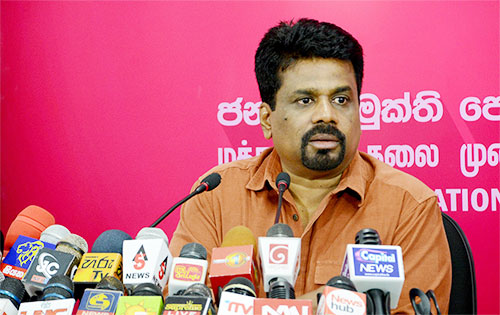
JVP leader Anura Kumara Dissanayake addressing the press yesterday
By Saman Indrajith
The JVP yesterday warned that Colombo Port City area was going to be another province of China if Parliament passed the proposed legislation for a Colombo Port City Commission, providing for sweeping tax breaks, tax-free salaries and to be an offshore financial centre.
Addressing the media at the party headquarters in Pelawatte, JVP leader Anura Kumara Dissanayake said that the draft bill, titled Colombo Port City Commission Bill, presented to Parliament by the government sought to exempt the Port City from the administrative control of any existing local government body. “Local government bodies consisting of people’s representatives have the administrative control of their respective local government areas. But the Port City is going to be under a Commission,appointed by the President. The members of that commission are going to enjoy immunity and none of them could be brought before a court of law of this country. The Commission is to be given special financial powers to maintain a separate fund
“Usually, the government’s revenue goes to the Consolidated Fund and approval of Parliament is needed for withdrawals from the Fund, but the Post City Commission is to be given powers to maintain a separate fund, separate independent of the Consolidated Fund. The proposed Commission is also expected to have powers to grant tax exemption. It is Parliament which has such powers. The financial affairs of the Port City will not come under the auditing of the Auditor General. It is proposed to hand over that task to private auditing firms. None of these instiutions are answerable to Parliament. It has been proposed to pay the salaries of workers in the Port City in foreign currency. It could be Yuan. The government with a two-thirds majority could rush this legislation through the House.”


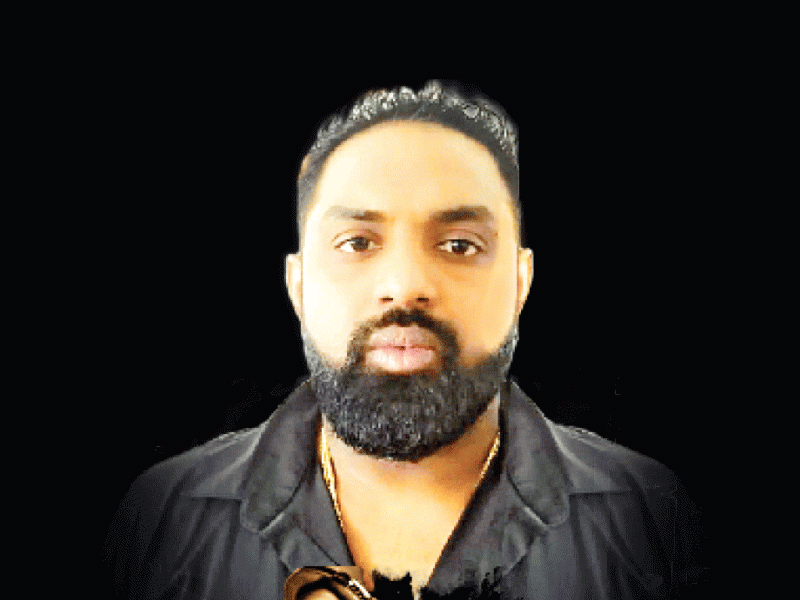
He is the only detainee at old Tangalle prison
The Commission to Investigate Allegations of Bribery or Corruption (CIABOC) probing bribery allegations pertaining to the recent arrest of attorney-at-law Rakitha Rajapakshe, former SJB Horana organiser Charitha Abeysinghe and another person is expected to question drug dealer Nadun Chintaka Wickremaratne alias Harak Kata being held under the Prevention of Terrorism Act (PTA).
The CIABOC arrested Rakitha and Charitha Kumara Wasantha Abeysinghe and former Director of Airport and Aviation Services Warushahanndige Aruna Sri Chathuranga on 25 June over the Rs 200 mn bribery allegation. Produced before the Colombo Chief Magistrate court on the same day, they were remanded until 3 July.
Sources familiar with the case told The Island that Wickremaratne arrested in Madagascar on 1 March 2023 was brought to Sri Lanka on 14 March 2023, and after preliminary investigations he was detained at the old Tangalle prison. Wickremeratne has been accused of running a major narcotics smuggling operation.
Wickremaratne’s lawyer Udul Premaratne, having visited Wickremeratne, sought the intervention of the Human Rights Commission of Sri Lanka to ensure the latter’s safety.
As many as 90 police (terrorist Investigation Department) and the Special Task Force (STF) have been assigned to the Tangalle old prison where Wickremaratne remains the sole detainee.
The CIABOC, in a statement posted in Sinhala on its website on 25 June said that arrested persons received the money after having initially asked for Rs 500 mn and then reduced it to Rs 200 mn. The Rs 120 mn allegedly received has been described as an advance.
Sources said investigators would question Wickremaratne over his wife’s claim that she had paid Rs. 120 million.
In terms of the PTA, the detention orders can be issued only by the Defence Minister. At the time Wickremaratne was brought to Colombo, Ranil Wickremesinghe held the defence portfolio. According to legal sources, when the President also held the defence portfolio, the responsibility for issuing the detention orders was relegated to the Defence Secretary.
Maj. Gen. Kamal Gunaratne who served as the Defence Secretary during that period.
Sources said that Wickremaratne’s wife was yet to come back and his parents and a brother were believed to be the only visitors except for lawyers. One of the crucial issues was how Wickremaratne had communicated with his wife living abroad, sources said.
By Shamindra Ferdinando
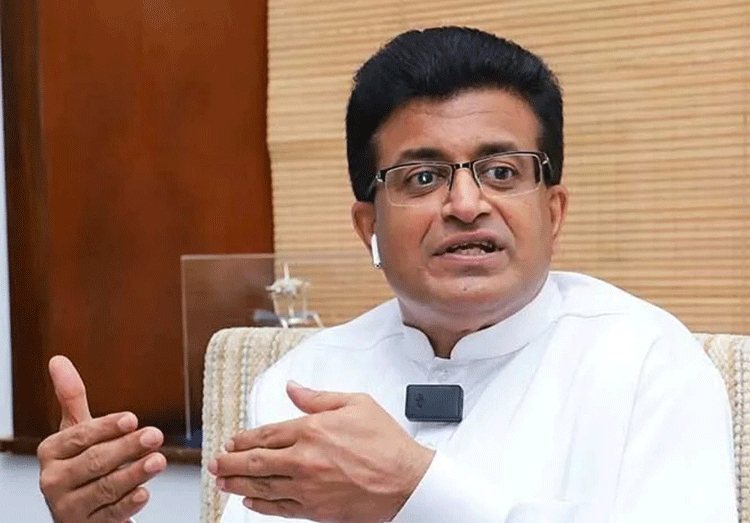
Pivithuru Hela Urumaya (PHU) leader and former Petroleum Minister Udaya Gammanpila yesterday (2) claimed that the price of a litre of Octane 92 petrol and auto diesel could be reduced by Rs 141 and Rs 126, respectively.
The former Energy Minister said that Rs 20 per litre price reduction declared by the Ceylon Petroleum Corporation (CPC) in respect of Octane 92 petrol and Rs 25 drop in litre of auto diesel price proved that the government fleeced the public.
Earlier, Samagi Trade Union Alliance convenor Ananda Palitha claimed that the price of litre of Octane 92 petrol and auto diesel could be reduced by Rs 115.
A litre of Octane 92 is sold at Rs 414 and a litre of auto diesel at Rs 382.
Pointing out that the CPC hadn’t reduced Octane 95 petrol and Super Diesel at least nominally, the former parliamentarian said that the CPC could reduce them by Rs 155 and Rs 149, respectively. A litre of petrol Octane 95 is sold at Rs 495 and a litre of Super Diesel at Rs 478.Gammanpila pointed out that the government had sharply increased prices when the Iran war entered the 12th day having claimed that that it had stocks for 35 days. (SF)
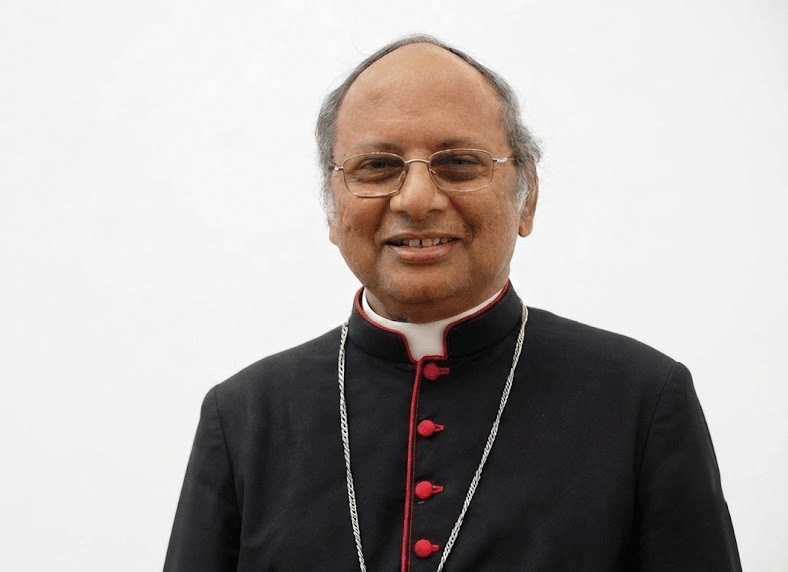
Denying social media claims that Archbishop of Colombo Malcolm Cardinal Ranjith used the 2019 Easter Sunday attack to have his term extended, the Catholic Bishops’ Conference in Sri Lanka (CBCSL) has declared its confidence in him.
The CBCSL emphasised that only His Holiness the Pope has the full authority to decide the date on which the retirement of a Bishop will officially take effect.
The text of the statement issued by the CBCSL: “From recent times, we have been observing that some people have been attempting, especially through social media, to spread false information and opinions that are defamatory of His Eminence Malcolm Cardinal Ranjith, the Archbishop of Colombo, and some priests. The main reason for this is to undermine the efforts of His Eminence the Cardinal and the Sri Lankan Catholic Church to uncover the truth behind the barbaric attacks that took place seven years ago on Easter Sunday, April 21, 2019, and to secure justice for the victims.
Chief among this false propaganda is the claim that His Eminence the Cardinal is using the Easter Sunday attack to extend his tenure. We wish to state that it is completely false propaganda, and we strongly condemn it.
When a Bishop of a Catholic Diocese in any part of the world reaches the age of 75, he is obliged by canon law to submit his letter of retirement to His Holiness the Pope. However, the retirement will officially take effect only after His Holiness approves it. Therefore, as it has been in the past, on certain occasions, the tenure of Bishops could be extended further. (Canon Law 401).
Accordingly, only His Holiness the Pope has the full authority to decide the date on which the retirement of a Bishop will officially take effect.
His Eminence Malcolm Cardinal Ranjith, the Archbishop of Colombo, upon reaching the age of seventy-five, has submitted the letter of retirement to His Holiness the Pope; however, he is obliged to fulfil the responsibilities of his Office until the approval for retirement is granted by His Holiness.
Therefore, the propaganda that His Eminence the Cardinal is using the Easter Sunday bomb attacks to extend his term is completely false, as well as a despicable attempt to mislead the public by distorting the truth.
The Catholic Church’s method of implementing the laws of the Church (Canon Law) vis-a-vis the power struggles that exist in the political world can never be compared. The power of ordinary civil law has always been linked to governance, while the authority of the Catholic Church is linked with the ‘service’ of God.
His Eminence Malcolm Cardinal Ranjith has rendered a great service to the Universal Catholic Church and the local Catholic Church, and he has stood with the sincere intention of bringing truth and justice to the victims of the Easter Sunday Bomb attack. The CBCSL and all the Catholics of the Sri Lankan Church appreciate the untiring efforts of His Eminence, and we would also like to emphasize by this that we all extend our fullest support to him.”

Showers will occur in the Western, Sabaragamuwa and North-western provinces and in Galle, Matara, Kandy, Nuwara-Eliya and Anuradhapura districts

CIABOC to question Harak Kata on Rs. 200 mn bribery allegation

Petrol, diesel prices could be reduced by Rs. 141 and Rs 126 per litre: Udaya

CBCSL: Only the Pope has authority to decide the retirement of Archbishop of Colombo

WHO declares cruise-linked hantavirus outbreak officially over

SLAF conducts successful rescue mission under UN command in Central African Republic

‘Dates have the highest sugar content to fight Coronavirus’

Sunday Island 27 December – Headlines

#SundayIsland 17th December – Headlines

Sunday Island – 28th March

Sunday Island Headlines – 21 March

Sunday Island – 21st February – Headlines
-
 News4 days ago
LAWASIA warns against ad hoc initiative to increase judges’ retirement ages
-
 News6 days ago
Another 1,132 Sri Lankan Personnel to be deployed for United Nations Peacekeeping Missions
-
 News3 days ago
Chamuditha to seek removal of injunction on Youtube programme
-

 Business6 days ago
Month-end profit-takings drive stock trading; indices up
-
 Features5 days ago
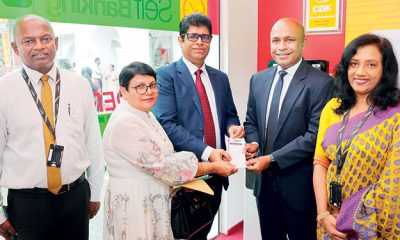
People’s Bank expands digital banking network with 125th cheque deposit kiosk
-
 Features3 days ago
Climate action to bring South Asia together
-

 News6 days ago
FSP complains of irregularities in a Guinness World Record event held in Sri Lanka
-
 News3 days ago
CPRP alleges another death in custody, seeks protection for witness