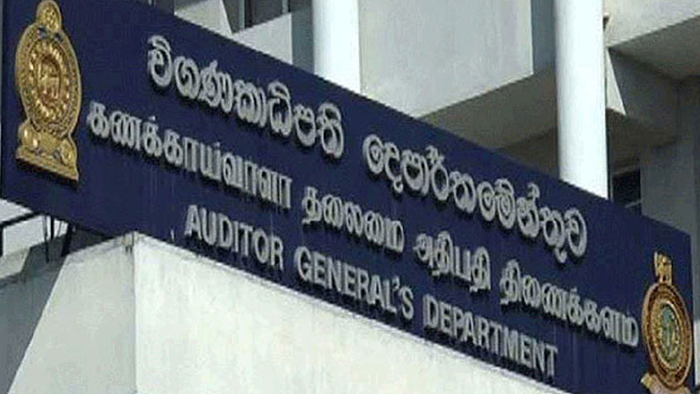
The March 12 Movement yesterday warned that the continued failure to appoint a permanent Auditor General is undermining Sri Lanka’s constitutional framework, democratic governance, and the independence of the country’s public audit system.
In a statement, the movement noted that public financial auditing is a key mechanism through which the sovereignty of the people is exercised, with Sri Lanka’s auditing tradition dating back to the late 17th century. Under Article 154 of the Constitution, the Auditor General is vested with authority to audit public sector accounts, making the office central to financial discipline and accountability, it said.
Full text of the statement: Public financial auditing is one of the central institutional practices through which the sovereignty of the people of Sri Lanka can be most effectively utilised. The Sri Lankan experience in this field dates back to the fourth quarter of the 17th century. The Auditor General is the person vested with the necessary authority to audit the accounts of the public sector, today. This authority is determined by Article 154 of the Second Constitution of the Republic of Sri Lanka. Accordingly, public financial audit and financial discipline constitute one of the central factors that determine the progress of every sector in the country. Therefore, an appropriate framework to streamline the audit process was created by the 19th Amendment to the Constitution, which came into force on 15 May 2015. The “Audit Service Commission” is the central institution in the process that was reconstructed. In terms of Article 153A (1) of the Second Constitution of the Republic of Sri Lanka, the Auditor General is also the ex-officio Chairman of the Audit Commission as well. Consequently, the said Commission, too, has been deprived of a Chairman by now. Therefore, the delay in filling the vacancy of the Auditor General will have a serious impact on the independence of the entire audit service.
Chulantha Wickramaratne, former Auditor General of the country, retired on April 8th of 2025 and, since then, the ‘National Audit Office’ has been functioning without a specifically appointed Auditor General. The most worrying concern in the chain of events leading to this situation is the disagreement that has arisen between the Executive President and the Constituent Council. The appointment of the Auditor General is a shared authority and responsibility of both the Executive President and the Constituent Council. The President nominates a suitable person for the post of Auditor General but it requires the majority approval of the Constituent Council. However, on four occasions to date, only an acting head has been nominated instead of a permanent Auditor General. The nomination that was made in this way on the last occasion also did not receive the consent of five members of the Constituent Council, which is the minimum majority required to validate the appointment. In this backdrop, the March 12 Movement has also drawn its attention to various criticisms and arguments that have emerged in society in this connection. One such argument is that the National People’s Power Government is apparently marking time until the end of the official term of the current Constituent Council waiting for the new Constituent Council to be elected and commenced its work.
The uncertain background that has emerged under this situation, will no longer auger well for the protection of the spirit or values of a democratic government except suppressing the aspirations of citizens. Therefore, the March 12 Movement makes the following demands to the relevant responsible parties:
01, The Executive President and the Constituent Council should take immediate steps to fill the vacancy of the post of Auditor General, who is the primary auditor of the state institutions of the Republic of Sri Lanka. It is a matter of great regret that the relevant authorities do not seem to understand or ignore the intense need for an Auditor General, particularly at a crucial time when the post-Ditwah cyclone recovery process is underway.
02. The spirit of modern governance involves institutions that are close to each other not acting as antagonists on crucial issues, but rather exercising their power as equal mechanisms in a single system for the benefit of the state through a proper communication system. Therefore, at this critical juncture, the Executive President and the Constituent Council should decide to take an appropriate decision, without delay, through proper discussion. It is an inalienable responsibility and accountability of both institutions.
03. Sri Lanka signed the Lima Declaration adopted by the International Organisation of Supreme Audit Institutions (INTOSAI) in 1977. Therefore, we have a strong international commitment regarding the appointment of the Auditor General. Moreover, the Government of Sri Lanka should pay special attention to the Mexico Declaration of 2007, which Sri Lanka has signed and ratified, as well as the criteria presented by the United Nations in 2009 in relation to that Declaration. These declarations have emphasised the legal practice related to public financial management and the institutional form of it.
04. The immediate harm that can be caused by the political authority experimenting with appointing an acting person instead of a permanent Auditor General to fill the vacant position and not perceiving the appointment with prudence is that the public will tend to doubt the validity of this prestigious institution while challenging its independence. The March 12 Movement has focused its attention on the partial inactivation of this foremost institution that should make recommendations on the audit of the entirety of the state apparatus with continuous efficiency and through accurate methods is yet another beginning of the politicization of state institutions that had engulfed the entire country for some time.
05. The adverse atmosphere developed in this process will certainly tend to enervate and disappoint the civil society. We wish to remind the pledge the National People’s Power Government made repeatedly during the pre-election period that its one and only policy will be to handle public finances through more standardised and advanced governance practices. Therefore, the March 12 Movement earnestly requests the leaders and cadres of the National People’s Power Government to make it their unconditional political commitment to continue to safeguard the expectations of the voters who have placed their trust in them.