
News
Professor P V J Jayasekera

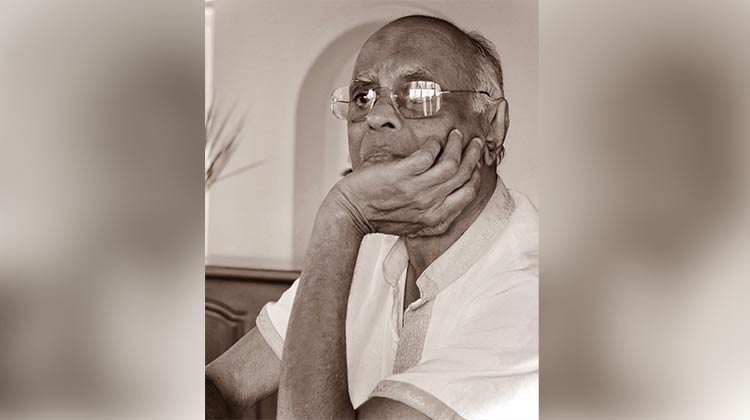
Latterly when Karunapala would ring me, or I him, I would ask: “How are you?” and he would invariably reply: “Still vertical” which brought a laugh from me and his usual chuckle. That has ended. He died on Thursday July 11 after two days of a fatal heart condition. Though heavily sedated, he indicated he knew his sons were present with him in the private hospital in Kandy; they being told of their Appachi’s medical condition and arriving within 36 hours from Vancouver, Canada and Scottsdale, USA
Prof P V J Jayasekera, known to us as Karunapala, married my eldest sister’s eldest daughter Sriyangani and integrated himself well with our extended family. He had met my niece when she was an undergraduate at the University of Peradeniya, liked her, and approached her when she took to teaching after graduation. With her consent, he sought approval for his joining the family from her parents. They were married in the mid-1960s.
He was from a much respected family in Galle and had his secondary schooling at Richmond College, Galle, where he was outstanding in studies and sports and was awarded the Darrel Medal for Best All Round Performance. His BA degree he earned from the University of Peradeniya and his Masters from the University of Manitoba, Canada, as Ceylon’s first Commonwealth scholar to a Canadian University.
He married when a lecturer at the University of Peradeniya. The couple moved soon after to Britain with him joining the School of Oriental and African Studies of the University of London, now known as SOAS. Having received his doctorate, specializing in history, my niece and he returned to Sri Lanka.
He joined the teaching faculty of the Vidyodaya University and within a year or two moved to the History Department, University of Peradeniya, as senior lecturer. At this time Sriyangani and he built their house in Anniewatte, designed by Archt. Minnette de Silva, with a spectacular view of hills, vales and the Mahaweli.
They had two sons, Harsha and Channa. My family of siblings is very close knit and thus I saw the two boys grow up when spending weekends with my sister in Anniewatte, Kandy, and visiting the young family, hiking up their hill. Harsha was quiet and spent much of his day in his computer lab in the attic of their house; while Channa was gregarious and loved company, even that of athammas.
Sriyanganie joined the staff of Trinity College as librarian. To her is due the credit of creating the TCK Archives, which was the second in a Sri Lankan school. She found priceless documents like a plan for the Chapel lying around. Fortuitously, Lakshman Kadirgamar, PC, had just returned from the UK and would spend time in his old school and its library. Sriyangani told him of her archives idea and he got the money and it was created excellently. This was the early 1990s just before he joined politics.
Harsha moved to the States and carved himself a career in IT and software development, founding a website that at that time received approximately 1% of internet traffic and has since branched into different areas of consumer internet technology. He graduated from the University of British Columbia. He is now comfortably settled in Vancouver with wife and son. Sriyangani moved to California in 1999 to teach in a Montessori school with the sole purpose of facilitating Channa’s higher education. Her hopes and Karunapala’s aspiration were fully realized. Channa followed medical studies at Duke University, Durham, N Carolina, and further trained at Stanford Univ. Father of an eight year son, he is transplant hepatologist (liver) at Mayo Clinic, mentioned thus by him almost in passing but my son tells me it is a most prestigious post he holds, young as he is.
Karunapala was a true academic. I use this term ‘true’ as the higher echelons – principally political – of this country are awash with Doctors of Phil and Professors. He moved as is due from junior to senior lecturer to Doctor to Professor Jayasekera. Very many are the students who have praised him unreservedly for his intellect and more so for the help he gave them. His sons said they were told this by so many who were present at the funeral held within 24 hours: students and young academics, expressing gratitude to their lecturer/mentor. He was an academic as evidenced in his publications among which I mention only one recently published research tome: 570 paged Confrontations with Colonialism: Resistance, Revivalism and Reform under British Rule in Sri Lanka 1796- 1920 Vol 1, 2017. The second volume will soon be published.
Personal narratives
For me, the human person rather than the academic is significant. But Karunapala dominated as a ‘learned man’ in our extended family and we respected him as such. When a family discussion on politics, history, heritage, international relations bordered on the contentious, we would say, particularly my brother, “let’s ask Karu,” whether present or not.
So when I decided to research and write about noteworthy women of Kandy, I sought his advice. Certainly and gladly given, he said, but his reply to my first draft of introduction was: What is this? To him research was research, not haphazard or scrappy. I was writing no thesis, but correct research methodology could not be compromised. Sriyangani saved me: “You send me drafts and I will edit. You know Karunapala!” But he wrote me my first chapter on the Kandyans, acknowledged as such in my book.
My nephew-in-law combined well with my fun seeking husband, and thus the many family trips done with my brother and two sisters and their families. Once on the spur of the moment we decided to go to Jaffna. A friend offered the use of a house in Chunnakam, but hordes of howling dogs prevented sleep. Karunapala got us the use of a house owned by a prominent college in Jaffna. Good and spacious but haunted both day and night. We weathered them. Best remembered were the holidays in a sprawling bungalow on the Nilaweli beach with plenty of fresh toddy and a barbeque using a sea resurrected metal doormat, organized by him.
Karunapala was a highly responsible minded man. Being one of the younger in his family of successful brothers and nephews, he helped my sister and brother-in-law immensely in advising them and guiding their younger children in studies, careers, marriages. Thus the immense care and affection given him as he lived alone in his beautifully maintained home in Kandy by his youngest sister-in-law Dhammika, and her sister–in-law Daphne, a specialist doctor. His relatives were always at hand to see to his welfare. Also must-be-mentioned Mutthulingam – his Man Friday and cook, who served him devotedly for many decades.
Karunapala mourned his wife’s premature death in August 2008 but opted to stay on in Kandy, and lived till 91 a truly quality life. He had been an outstanding academic, a great help to people, a caring husband, a devoted and latterly proud father and grandfather. We, his in-laws, appreciated and respected him.
He was mindful, deeply concerned about his students and others, good in every way and a humane person. Thus his sojourn in samsara will surely be short.
NPW

News
AgriConnect Sri Lanka’ to be launched on 30 October to Modernise the Agricultural Sector Through Digitalisation

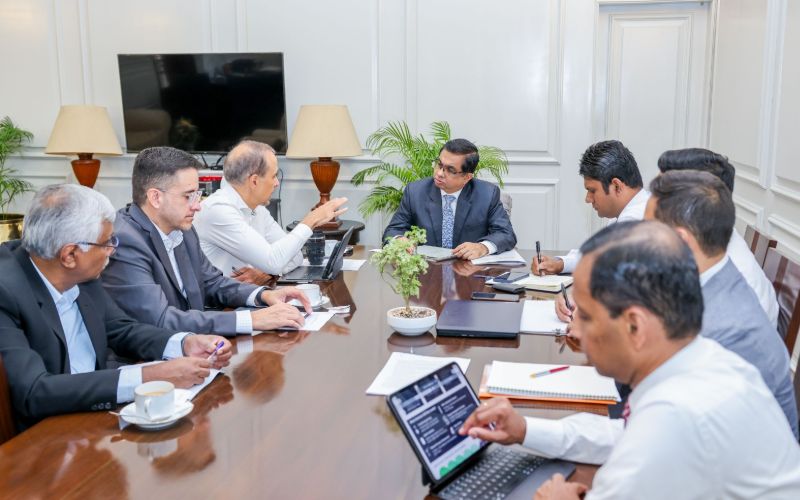
A discussion on the official launch of the ‘AgriConnect Sri Lanka’ programme was held at the Presidential Secretariat on Tuesday (13) morning between Secretary to the President Dr. Nandika Sanath Kumanayake and a delegation led by Gevorg Sargsyan, World Bank Group Manager for Sri Lanka and the Maldives.
The discussion focused on the official launch of the ‘AgriConnect Sri Lanka’ programme, scheduled to take place on 30 October at TRACE Expert City.
The World Bank delegation provided a comprehensive briefing on the programme and emphasised that Sri Lanka is set to become the first country in South Asia to join this global initiative of the World Bank Group, marking a significant milestone.
Victor Anthonypillai, Senior Country Officer of the International Finance Corporation (IFC), Tomas Ricardo Rosada Villamar Practice Manager at the World Bank, Felipe F. Dizon, Senior Economist and Athula Senaratne, Senior Agriculture Specialist, also attended the meeting. The Presidential Secretariat was represented by Senior Assistant Secretary to the President Dr Danushka Perera and Assistant Secretary to the President R. A. Ruwanpathirana.
President’s Media Division (PMD)
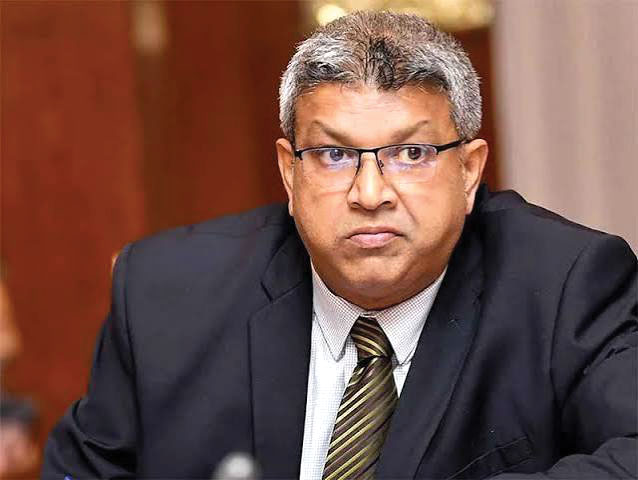
Appointment of committee eyewash, says UNP
The government is considering changes to prison regulations pertaining to the treatment of Buddhist monks serving jail terms, including their right to wear monastic robes when taken outside prison.
Justice and National Integration Minister Harshana Nanayakkara announced the proposed changes yesterday (14) following the submission of an interim report by a committee appointed to review the rules and procedures governing prisons.
The report was handed over to Secretary to the President Dr Nandika Sanath Kumanayake at the Presidential Secretariat.
One of the key recommendations is to amend Prison Standing Order 356 by introducing a new provision, 356(A). The proposed revision would require prison authorities to consult the Department of Buddhist Affairs on the removal of a monk’s robes upon admission to prison. The Commissioner of Prisons would be allowed 10 days to notify the department and take the necessary steps.
A separate amendment to Departmental Order 550 would allow Buddhist monks to wear their robes whenever they are taken outside prison, unless their respective Nikaya formally requests that the privilege be withdrawn.
The committee has also recommended extending similar arrangements, with suitable modifications, to members of other religious clergy who are imprisoned.
The proposals follow concerns raised over the treatment of Ven. Galagoda Aththe Gnanasara Thera after he was taken into custody. President Anura Kumara Dissanayake subsequently held discussions with representatives of the three main Buddhist Nikayas and appointed the committee to examine the existing legal framework.
Nanayakkara said the interim report had been forwarded to the Acting Commissioner General of Prisons, along with instructions to revise the relevant standing orders in accordance with its recommendations.
The proposed amendments have yet to be confirmed as formally implemented.
Meanwhile, the UNP yesterday criticised the government’s decision to appoint a committee to make recommendations on the attire to be worn by imprisoned Buddhist monks and other religious leaders when taken outside prison, describing the move as unnecessary.
In a statement issued yesterday (14), the UNP said the procedures governing the matter were already clearly set out in the Department of Prisons’ Standing Orders, making the appointment of a separate committee unwarranted.
The party cited remarks by Professor G.L. Peiris, Convenor of the Janathawadi Joint Opposition, who had described the committee’s appointment as a
“complete eyewash” and questioned the need for such a move.
Referring to Standing Order 550 of the Prisons Department, the UNP said convicted prisoners appearing before court for legal proceedings should not be required to wear prison uniforms.
It further stated that the regulations allowed prisoners to wear civilian clothing consistent with what they wore before imprisonment, including attire appropriate to their cultural and religious backgrounds.
The UNP accused the government of unnecessarily prolonging the issue by appointing a committee, despite the existence of regulations governing prisoners’ attire.
The party also called on the government to seek forgiveness from the Mahanayake Thera and the Sangha Council of the Kotte Sri Kalyani Samagri Dharma Maha Sangha Sabha of the Siyam Maha Nikaya over the decision concerning the religious attire of Ven. Galagoda Aththe Gnanasara Thera.
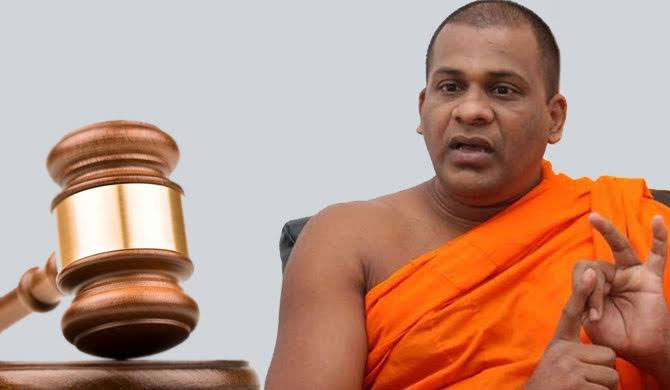
Court of Appeal President Justice Rohantha Abeysuriya yesterday withdrew from the bench hearing petitions challenging the decision by prison authorities to require Ven. Galagoda Aththe Gnanasara Thera to wear prison attire following his imprisonment.
The decision was announced when the petitions seeking to invalidate the prison authorities’ decision were taken up for consideration on October 14.
Following his withdrawal, a three-judge bench was appointed to hear the petitions.
The petitions relate to the prison authorities’ decision to require Gnanasara Thera to wear prison attire after he was taken into custody to serve the remainder of his sentence for contempt of court.
In September this year, the Supreme Court annulled the presidential pardon granted to Gnanasara Thera by former President Maithripala Sirisena in May 2019.
Following the ruling, the Court of Appeal directed the Commissioner General of Prisons to take the necessary steps to enforce the remainder of the monk’s prison sentence.
Gnanasara Thera had originally been sentenced to six years’ imprisonment for contempt of court but had served only around nine months before receiving the presidential pardon in 2019.

AgriConnect Sri Lanka’ to be launched on 30 October to Modernise the Agricultural Sector Through Digitalisation

57th Annual Saints’ Quadrangular Tournament on Saturday and Sunday

Showers or thundershowers will occur at most parts of the island

Prison rules to be revised over monks’ attire

AC President recuses himself from hearing prison attire case pertaining to Gnanasara Thera

Court orders steps to obtain INTERPOL Red Notice against Basil

‘Dates have the highest sugar content to fight Coronavirus’

Sunday Island 27 December – Headlines

#SundayIsland 17th December – Headlines

Sunday Island – 28th March

Sunday Island Headlines – 21 March

Sunday Island – 21st February – Headlines
-

 News7 days ago
NDB fraud Rs 60mn more than reported
-

 News7 days ago
Removing monk’s robes matter for Sangha to decide: Mahanayake Theras
-

 News5 days ago
Sri Lanka escalates anti-graft drive with Shiranthi’s jailing
-

 News6 days ago
NPP govt. reminded of its responsibilities as US warship leaves Colombo
-

 Latest News6 days ago
Farhan, Sadaqat help Pakistan ace 183 chase to go 1-0 up
-
 News7 days ago
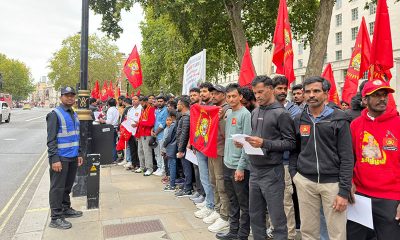
BHC, Colombo: “LTTE remains a proscribed org. in the UK”
-

 Latest News4 days ago
Farhan and Sadaqat help Pakistan seal series in style
-

 News5 days ago
Iranian ships stranded, Lanka fears US sanctions