
News
Prof. Marambe: 360,000 MT of paddy lost to recent floods


Repercussions on prices to be felt by next March or April
Recent heavy rains have completely destroyed approximately 80,000 hectares of paddy, and the government must not only compensate affected farmers but also encourage them to return to farming, according to Senior Professor Buddhi Marambe from the Department of Crop Science, University of Peradeniya.
Prof. Marambe, during a recent televised interview, highlighted the grave implications for Sri Lanka’s rice supply if immediate action is not taken.
“We estimate an average yield of 4.5 metric tonnes per hectare. With 80,000 hectares of paddy destroyed, this equates to a loss of around 360,000 metric tonnes of paddy. Such a loss could severely impact rice prices by March or April 2025. It is vital to resume farming in these areas as much as possible, in addition to providing compensation to the farmers,” he said.
Prof. Marambe pointed out that one of the key challenges in restarting farming is the shortage of seed paddy. “The private sector does not have sufficient seed paddy, and the government’s stock is limited. However, the Ministry of Agriculture is making efforts to collect seed paddy from farmers who have surplus and redistribute it to those who have lost their fields,” he said.
Sri Lanka consumes approximately 112.3 kilogrammes of rice annually, translating to about 200,000 metric tonnes per month or 2.4 million metric tonnes per year, he explained. Additionally, around 350,000 metric tonnes of paddy is used annually as animal feed, with a further 50,000 metric tonnes allocated for beer production.
“Poultry farmers prefer corn for feed as it enhances the yellow colour of egg yolks. However, Sri Lanka’s corn harvest has also suffered a significant blow, with a 50 percent drop due to fertiliser shortages, though it is slowly recovering,” Prof. Marambe said.
Discussing rice production, Prof. Marambe revealed discrepancies in conversion rates from paddy to rice. “According to the Ministry of Agriculture, 100 kilogrammes of paddy yields 68 kilogrammes of rice, a 68 percent conversion rate. The National Institute of Post-Harvest Management reports a conversion rate of 62 to 65 kilogrammes. Large-scale millers claim a rate of around 62.5 percent, while small and medium-scale millers estimate between 52 and 62 percent,” he said.
Sri Lankan farmers produce approximately 4.6 million metric tonnes of paddy annually, which, based on a 68 percent conversion rate, would result in about 3 million metric tonnes of rice.
“This should mean we have a surplus. However, if we use the lower conversion rate of 52 percent reported by small-scale millers, it suggests we may not produce enough rice for domestic consumption. This discrepancy raises serious concerns, and I understand the Ministry of Agriculture is working to address the issue,” Prof. Marambe said. (RK)

Latest News
Advisory for Severe Lightning for the Western and Sabaragamuwa provinces and Galle and Matara districts


Advisory for Severe Lightning
Issued by the Natural Hazards Early Warning Centre at 12.00 noon 07 February 2026 valid for the period until 11.00 p.m. 07 February 2026
Thundershowers accompanied with severe lightning are likely to occur at some places in the Western and Sabaragamuwa province and in Galle and Matara districts.
There may be temporary localized strong winds during thundershowers.
The general public is kindly requested to take adequate precautions to minimize damages caused by lightning activity.
ACTION REQUIRED:
The Department of Meteorology advises that people should:
Seek shelter, preferably indoors and never under trees.
Avoid open areas such as paddy fields, tea plantations and open water bodies during thunderstorms.
Avoid using wired telephones and connected electric appliances during thunderstorms.
Avoid using open vehicles, such as bicycles, tractors and boats etc.
Beware of fallen trees and power lines.
For emergency assistance contact the local disaster management authorities.

The Indian Naval Ship (INS) GHARIAL which made a port call in Colombo, departed the island on 06 Feb 26.
The Sri Lanka Navy bade a customary farewell to the departing ship at the Port of Colombo, following naval traditions.
During the ship’s port call, the crew took a sightseeing tour of key attractions in Colombo.
The visit also featured the handover of ten temporary Bailey Bridges, which were brought by INS GHARIAL, in coordination with the High Commission of India in Sri Lanka.
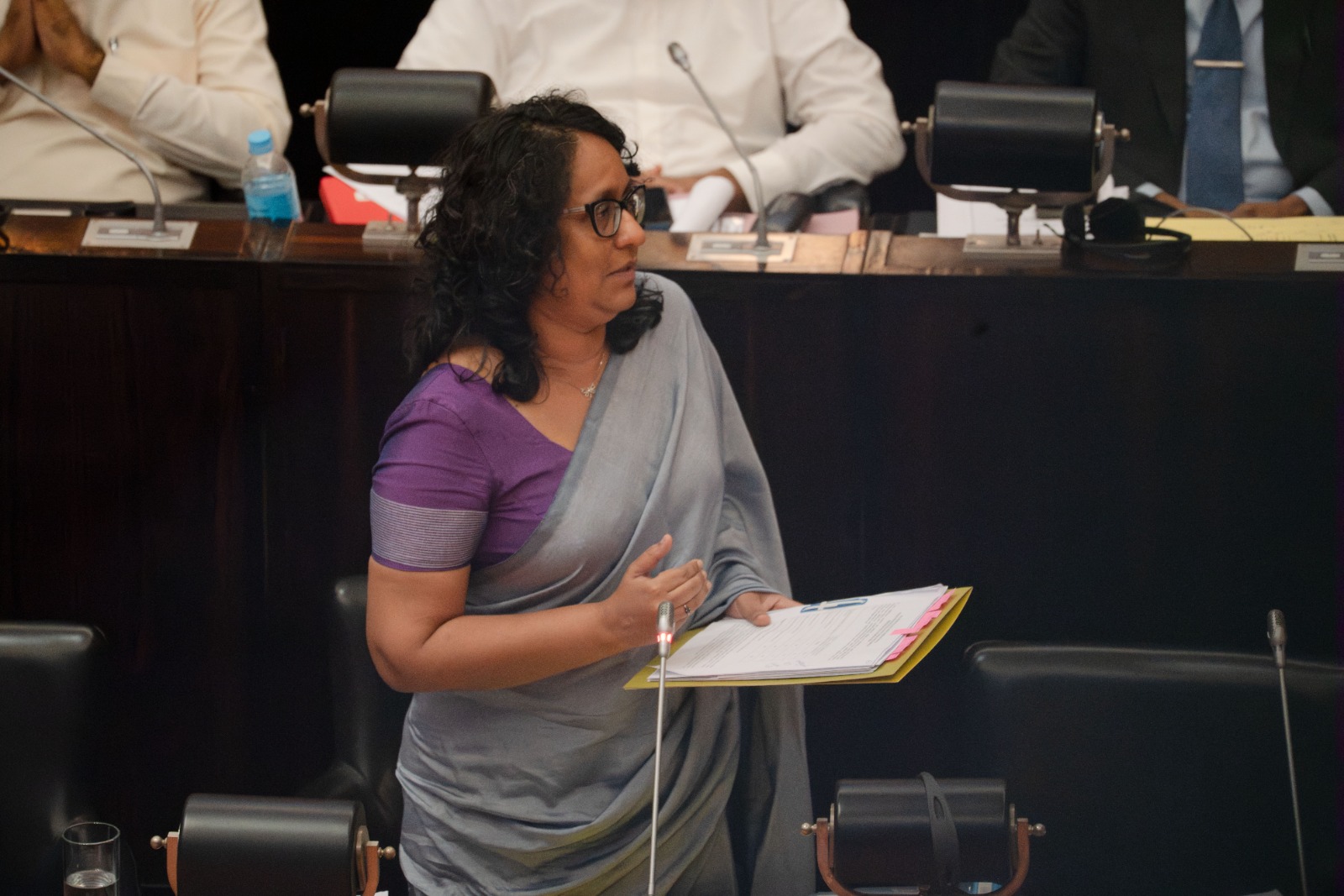
Prime Minister Dr. Harini Amarasuriya stated that the Ministry of Education has already commenced the distribution of Smart Boards required for the new education reforms, and that the collection of funds from parents at school level for this purpose must be stopped immediately. She further emphasized that no decision has been taken to curtail free education or to close the Jayewardenepura Faculty of Dental Sciences.
The Prime Minister made these remarks in response to a question raised in Parliament on Thursday [05th February] by the Leader of the Opposition, Sajith Premadasa.
Elaborating further, the Prime Minister stated,
“Although the Leader of the Opposition has not traditionally upheld free education as a policy, I appreciate your stance on the matter at this juncture. However, I urge that questions should not be raised based on social media content or unverified rumours in Parliament. No decision has been taken to curtail free education or to close the Jayawardenepura Faculty of Dental Sciences. The Medical Faculty of the Wickramarachchi University of Indigenous Medicine had commenced operations without regulatory approval and had introduced course work, resulting in students being placed in a vulnerable situation. Necessary action is currently being taken based on the recommendations of a report submitted by an expert committee appointed to examine the issue. This this is not a political decision, but one guided by expert opinion”.
“Arrangements are underway to distribute the required Smart Boards to schools during this year, and there is no need to collect funds from parents for this purpose. If any such collections are taking place, they must be stopped immediately. The Secretary to the Ministry of Education has already issued a directive instructing schools not to collect funds from parents”.
“The subject Information Technology will not be taught as a separate subject for Grades 1 to 5. However, recognizing the need to prepare students for a globally advancing technological world, discussions have been initiated based on expert advice on how to provide age-appropriate technological awareness to students. Decisions will be made after carefully considering child protection concerns and expert recommendations. The curriculum-related decisions will not be made politically, but by subject experts.
Based on the requests made by the universities and higher education institutions recruitment for essential academic vacancies is currently being carried out under the Cabinet approval. Although thirty years have passed since the establishment of the teacher service, further measures are required to enhance its quality. Existing issues relating to teacher promotions, considering the practical difficulties in evaluation processes and non-compliance with service minute provisions are being addressed alongside other challenges. The government is presently focused on formulating a systematic plan to ensure quality education.”
Responding to a question raised by the Member of Parliament Kader Mastan, the Prime Minister stated,
“Several programmes have been introduced based on government policy decisions to fulfill the basic needs of schoolchildren. These include the provision of school textbooks, uniforms, and the “Suraksha” health insurance scheme. Additionally, voucher schemes have been introduced to support the purchase of sanitary products for girls in Grades 6 to 13. Midday meals are also being provided for primary school students, and financial assistance is extended to students who pass the Grade 5 Scholarship Examination but do not receive bursaries. The Ministry of Education is in the process of gathering further information with the intention of expanding these programmes”.
The Prime Minister also announced that the 2025 G.C.E. Ordinary Level Examination is scheduled to be held from February 17 to 26. Although this period coincides with the observance of Ramadan, relevant authorities have confirmed that it will not pose an obstacle to the conduct of the examination. Furthermore, it has been decided to hold the Grade 5 Scholarship Examination and the G.C.E. Advanced Level Examination before August each year, and the G.C.E. Ordinary Level Examination in December. From 2026 onwards, efforts will be made to conduct examinations in accordance with this revised annual examination calendar.
[Prime Minister’s Media Division]

US wants Russia and Ukraine to end war by June, says Zelensky

Hetmyer heroics, Shepherd hat-trick headline West Indies’ opening day win over Scotland

USA bowl, India pick Siraj with Bumrah out unwell

Colorado funeral home director sentenced to 40 years for corpse abuse

Scotland opt to field against West Indies

Faheem Ashraf drags unconvincing Pakistan over the line after big scare

‘Dates have the highest sugar content to fight Coronavirus’

Sunday Island 27 December – Headlines

#SundayIsland 17th December – Headlines

Sunday Island – 28th March

Sunday Island Headlines – 21 March

Sunday Island – 21st February – Headlines
-

 Business5 days ago
SLIM-Kantar People’s Awards 2026 to recognise Sri Lanka’s most trusted brands and personalities
-

 Business20 hours ago
Zone24x7 enters 2026 with strong momentum, reinforcing its role as an enterprise AI and automation partner
-

 Business7 days ago
Altair issues over 100+ title deeds post ownership change
-

 Business7 days ago
Sri Lanka opens first country pavilion at London exhibition
-

 Business6 days ago
All set for Global Synergy Awards 2026 at Waters Edge
-
 Business5 days ago
API-first card issuing and processing platform for Pan Asia Bank
-
 Business7 days ago
ESOFT UNI Kandy leads the charge in promoting rugby among private universities
-

 Editorial3 days ago
All’s not well that ends well?