
News
Price of chicken drops by Rs 100

By Rathindra Kuruwita
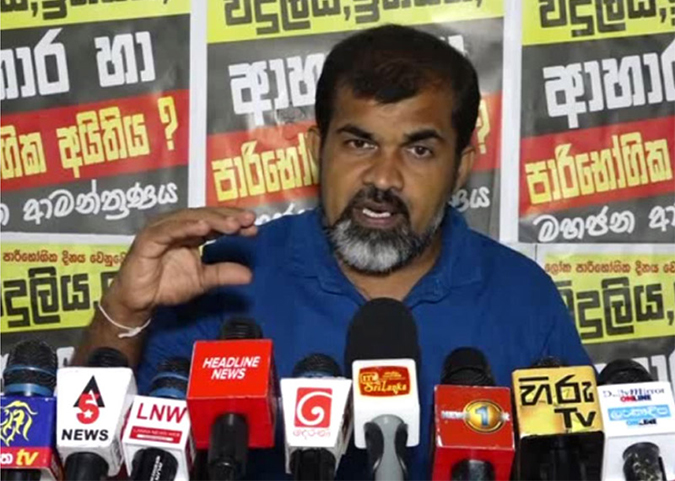
The price of chicken had been reduced by 100 rupees since midnight Thursday, and thus the price of food containing chicken must also drop, Consumer Rights Activist Asela Sampath told The Island yesterday (22).
“On Wednesday, the price of a kilo of chicken was between 1200 and 1350 rupees. Yesterday, the price dropped to around 1,140 rupees. We are happy that the price has dropped, and now it’s time for restaurants to reduce the price of food items with chicken,” he said.
Sampath added that the price of some varieties of fish has also dropped.
“The prices have dropped, but are people who eat chicken or fish products from eateries benefiting? The government must also look ino this,” he said.



Internet Media Action (IMA) has strongly condemned the government’s attempt, through the gazette “Protection of the State from Terrorism Bill” (PSTA) (22 September 2026), to restrict citizens’ freedom of expression (FOE), media freedom and digital rights in an extremely repressive manner.
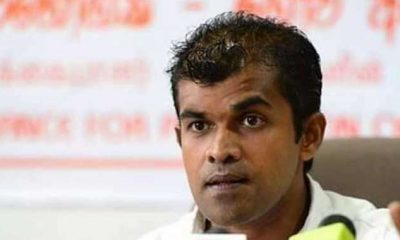
IMA’s convener Sampath Samarakoon, issued the following statement: “Under local and international pressure, the government has moved to amend certain provisions of the original draft, such as Clause 55 (powers of interception of communications and Decryption). However, the gazetted bill has not changed the government’s fundamentally repressive nature. It is clear that the proposed PSTA Bill is a new digital dictatorship that polishes the repressive shackles of the old PTA with digital technology and imposes them on democratic space.
Although Clause 11 claims to provide some protection for legitimate media reporting, the fear of arrest and the practical difficulty of having to prove that one acted “in good faith” create a serious risk of pushing the whole of society into a state of “digital self-censorship,” in which people restrict their own expression.
Serious threats to freedom of expression and the media:
= Digital space and the interpretation of “protest as terrorism” (Clause 3): “Unlawfully compelling the government” and “seriously disrupting communication systems” are included as terrorist offences.
This creates a risk that online campaigns, online petitions and hashtag rallies organized through social media against government policies could be charged as terrorist acts. (For example, in 2022 the #GotaGoHome hashtag led the movement in the digital space, alongside the physical public uprising across the country, including Galle Face in Colombo.)
= Restrictions on creativity and satire (Clause 9): Using vague and broad wording such as “indirectly inciting,” the bill allows rigorous imprisonment of up to 15 years if posters, memes, political satire, Reels/TikTok videos and symbolic creations widely used on social media are identified as relevant offences.
= Prohibition of sharing, retweeting and posting links (Clause 10 and 59): Sharing, retweeting or forwarding a document or post, or including links (URLs) to it, could be defined as “circulating terrorist publications.” In such cases, the President is empowered to directly censor online publications through gazette notifications.
= Abolition of confidentiality of media sources (Clause 15): By making failure to provide information an offence punishable by 7 years’ imprisonment, the bill removes the right of investigative journalists and citizen journalists to protect the confidentiality of the sources (whistleblowers) who provide them with information.
= Restrictions on reporting and photography (Clause 61 and 74): The bill enables the Defense Secretary to declare “prohibited places” for 72 hours and restrict taking photographs/videos there, and to define the movements and investigations of the security forces as “classified information,” thereby obstructing media reporting.
Accordingly, we stress that this PSTA (Bill), which is contrary to international human rights standards and civil rights, cannot be fixed through mere piecemeal amendments. We also reiterate our strong objection to the National People’s Power (NPP) government’s betrayal of its election pledge to repeal the Prevention of Terrorism Act (PTA) in its entirety, by instead advancing an even more repressive bill (PSTA) that gravely endangers civil rights.”
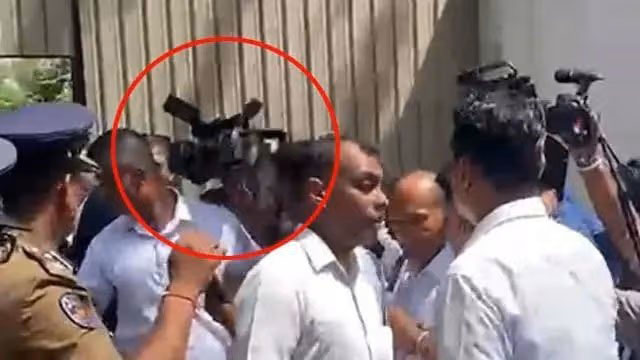
Police yesterday arrested a cameraman attached to a private media organisation in connection with the alleged assault of a security officer attached to former President Ranil Wickremesinghe.
The incident occurred on Wednesday (30) as Wickremesinghe was leaving the Colombo Fort Magistrate’s Court following proceedings in a case concerning the alleged misuse of public funds. Footage recorded by other journalists at the scene reportedly shows the cameraman striking the security officer on the head with his camera. The security officer was subsequently admitted to hospital for treatment after lodging a complaint with the police. The cameraman was arrested yesterday after reporting to the Kompannavidiya Police to give a statement, accompanied by a lawyer.
Sri Lanka asylum seeker held by Britain for almost five years has died in Eswatini, a month after being transferred to the southern African country and a week before his visa was due to expire, Tamil Guardian reported.
The man, aged 36 and identified only as KP under a court anonymity order, was found dead on 13 September at a guesthouse in Eswatini. He had attempted to take his own life several times during his years in British custody.
In October 2021 he was rescued by the Royal Navy when the fishing vessel he was travelling on got into difficulty near Diego Garcia, the British Indian Ocean Territory island that hosts a joint United Kingdom and United States military base.
He was one of a group of Tamils held on the island in a fenced tent camp, where he remained for years. The territory’s administration granted him international protection in 2024, meaning he could not be returned to Sri Lanka. Britain nonetheless refused him entry to the United Kingdom on account of criminal convictions, among them sexual assault, assault on a security officer and arson, the last connected to an attempt to take his own life by self-immolation.
A British court dismissed his legal challenge to that exclusion in 2025, citing public safety.
KP spent eight months confined in a laundry room on the island and a fortnight in a police cell without natural light. The United Nations refugee agency expressed deep concern about his conditions. After suicide attempts he was medically evacuated to Bahrain in 2024.
He was then moved to the Maldives, and about a month before his death to Eswatini, under what is reported to be an arrangement between the British government and Eswatini permitting permanent resettlement.

Media action group flays NPP over new anti-terrorism law

Cameraman arrested for assaulting Ranil’s security officer

Colombo Port drug bust: The plot thickens

Lankan refused asylum in UK dies in Africa

Why spill water and reject sunlight while burning imported fuel?

ADB approves $100 million loan to boost skills development and jobs for youth in Sri Lanka

‘Dates have the highest sugar content to fight Coronavirus’

Sunday Island 27 December – Headlines

#SundayIsland 17th December – Headlines

Sunday Island – 28th March

Sunday Island Headlines – 21 March

Sunday Island – 21st February – Headlines
-

 Editorial6 days ago
Birth of a bad law
-

 News4 days ago
Police remove Thileepan statue in Jaffna
-

 News6 days ago
TIN mandatory for key transactions from Nov. 1
-

 Features4 days ago
The 22nd Amendment, constitutional recovery and illiberal slippage
-

 Features4 days ago
Of foreigners as CEOs of Lankan ventures
-

 News4 days ago
Sajith rejects Jt. Opp. protest sabotage claim; SJB TU chief demands remedial action
-

 Features3 days ago
Thailand’s biggest new global star …
-

 Latest News2 days ago
Gold winner Tharanga gets brand-new Honda Vezel from SLAAJ