
Latest News
President Wickremesinghe warns of climate crisis and unveils ambitious plans

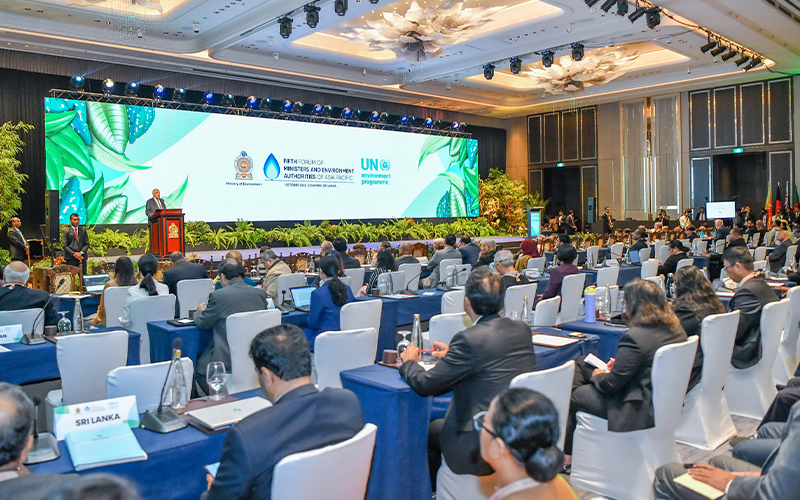
President Ranil Wickremesinghe addressed the 5th Forum of Ministers & Environment Authorities of the Asia Pacific at the Shangri La Hotel in Colombo today (05), delivering a passionate speech that emphasized three crucial points: the urgency of the climate crisis, Sri Lanka’s ambitious climate plans and the dire state of global biodiversity.
President Wickremesinghe opened his speech by drawing attention to the pressing climate concerns facing the world today. He cited the alarming estimate from the Intergovernmental Panel on Climate Change (IPCC), stating that global warming is projected to reach a dangerous 1.5 degrees Celsius between 2030 and 2052. “Humanity is facing an existential threat,” he declared. He highlighted the interlinked crises of climate change, biodiversity loss and pollution, emphasizing the devastating impact on individuals and communities worldwide.
The President then turned to Sri Lanka’s commitment to addressing these challenges. He pledged to accelerate nature-based solutions, including renewable energy, through Sri Lanka’s Climate Prosperity Plan, which was launched at COP 27. “Sri Lanka is in the process of renewing the National Biodiversity Strategic Action Plan 2016 to 2022 to achieve the objectives of the Kunming-Montreal Global Diversity Framework,” he announced. Additionally, he unveiled an ambitious Net Zero 2050 roadmap for Sri Lanka, set to be launched at COP 28.
President Wickremesinghe stressed that despite Sri Lanka’s minor global emissions contribution (0.03%), the country is dedicated to significant reductions. Sri Lanka aims to achieve a 14.5% reduction in greenhouse gas emissions by 2030, generate 70% of its electricity from renewable sources, attain a 32% forest cover, phase out coal power by 2042, and reach net-zero emissions by 2050.
The President also expressed deep concern over the state of global biodiversity. He lamented that the world has already lost 8% of known animal species, with 22% at risk of extinction due to habitat destruction and invasive species. “We are now losing biodiversity up to 10,000 times faster than it was disappearing 100 years ago,” he warned.
In conclusion, President Wickremesinghe’s speech outlined the urgent need for climate action, Sri Lanka’s commitment to sustainability and the critical biodiversity challenges the world faces. The President’s call for collective action and his unveiling of ambitious climate plans underscored the gravity of the global situation.“Countries unwilling to do their part to stop the climate crisis are guilty of committing genocide,” he concluded.
Following is the full speech delivered by President Ranil Wickremesinghe at the 5th Forum of Ministers & Environment Authorities of the Asia Pacific;
“I join our Minister of Environment in welcoming you to Sri Lanka. Humanity is facing an existential threat. The interlinked and cascading effects of climate change, biodiversity loss, and pollution—the triple planetary crisis—are demanding a heavy toll on individuals, communities and threatening life on our planet. We are putting extreme pressure on the planet. The triple planetary crisis is already exceeding the planetary boundaries. The world has already lost 8% of known animal species and 22% are at risk of extinction due to the destruction of their natural habitats and the introduction of invasive species. We are now losing biodiversity up to 10,000 times faster than it was disappearing 100 years ago. Declines in nature and biodiversity at the current trajectory will undermine the progress towards 35 out of 44 targets of the SDGs related to poverty, hunger, health, weather, cities, climates, oceans and land. In terms of change, the Intergovernmental Panel on Climate Change estimates that global warming is likely to reach 1.5 degrees Celsius between 2030 and 2052.
The other day, I read a blog by a young scientist, a member of the Union of Concerned Scientists. Her name is Sanjali De Silva. This is what she said: “People of Sri Lanka feel the impact of climate change every day. Those effects are overwhelmingly caused by the self-serving command and irresponsible action of the fossil fuel industry and the nations unwilling to do their part to stop the climate paradigm. My people of Sri Lanka and my family deserve better.” I agree wholeheartedly with her. Sri Lanka, her country and mine, has constantly been placed among the top risk of extreme weather events by the Climate Risk Index annually released by German Watch. Although Sri Lanka’s emissions are globally negligible, amounting to merely 0.03%, we, in our ambitious NDCs, have set targets for 2030 to achieve a 14.5% reduction of GHG emissions, a 70% electricity generation through renewable sources, 32% forest cover, weaning off coal power by 2042 and reaching net zero by 2050.
The Climate Prosperity Plan of Sri Lanka, launched at COP 27, aims at rapid augmentation of nature-based solutions, including renewable energy. The Net Zero 2050 roadmap for Sri Lanka will be launched at COP 28. Sri Lanka is in the process of renewing the National Biodiversity Strategic Action Plan 2016 to 2022 to achieve the objectives of the Kunming-Montreal Global Diversity Framework. Since Sri Lanka is one of the 36 global biodiversity hotspots, I have instructed the Ministry of Environment to formulate a national policy on living entities to conserve pristine ecosystems. Sri Lanka has formulated the national policy on waste management, covering nine categories of general and hazardous waste. The national policy on chemical management was formulated to streamline chemical management in the country. Sri Lanka formulated the national policy on sustainable consumption and production in 2019. The Green Procurement Policy and the Green Labelling Framework will come into effect this year. My government will enact a new Climate Change Act and a National Environment Act to address the triple planetary crisis in the context of new knowledge and practices. We are starting our transition to a green economy. But there is a cost. The Climate Prosperity Plan, which spans from 2023 to 2042, will require 26.5 billion U.S. dollars. The implementation of the Net Zero 2050 roadmap will require over 100 billion U.S. dollars. The list is not over. Where are we going to source these resources from? We cannot source all this money from within our country. The problem is not confined to Sri Lanka.
Developing countries require financing up to 5.9 trillion U.S. dollars to fulfill their NDCs up to 2030. A further 4 trillion U.S. dollars is required per annum for clean energy technology to achieve net zero emissions by 2050. At COP 27, there was an agreement to provide the lost and damaged funding for vulnerable countries hit by climate disaster. The Sharm El Sheikh Implementation Plan, a transitional committee was established. The meetings of the committee and the discussions at the recent sessions of the UN during the UN General Assembly have not resolved key questions.
a. Who will contribute? Is it the developed nations? EU, UK, Norway, among others, say all countries are liable to pay.
b. The question of criteria. Who will receive the funds?
c. Where to house the fund? At the World Bank or UNFCC?
d. Where do you find the money for the fund? Is it re-channelling existing funds or new additional funds? Delegates, these discussions are getting nowhere and it’s unlikely that these issues will be resolved by the time of COP 28.
The ability of global leaders to cooperate and provide a coordinated response to existential challenges such as climate change is missing in a scenario dominated by great power rivalries, geopolitical interests and in many cases domestic policy. For instance, it is not feasible to expect robust leadership of the United States in the global fight against climate change next year. The US will be caught up in an acrimonious election year and must first overcome domestic debates between climate deniers and those who are serious about addressing the issue. The Ukraine war will tie down Europe. The Indo-Pacific will witness further escalation of tension. Numerous global fora have attempted to address the issue of climate change. The Bridgetown Initiative, Paris Pact for People and Planet, and numerous initiatives by the UN Secretary-General. The issues and potential solutions have been well articulated at these events. What is missing is the money on the table, leadership and action.
Therefore, we in Asia-Pacific and others in the global south will need to galvanize an alternative leadership mechanism. What is crucial is that geopolitics and great power rivalries take a second place when it comes to addressing climate issues such as climate change and global environmental degradation. We need a climate justice forum to ensure that the countries least responsible for climate change do not bear a disproportionate share of the loss. We need to raise our collective voice and say, let’s get done with this. While the debate on the loss and damage fund continues, we should insist on the following: The money on the table is negligible, but let’s at least start with the 100 billion SDI initiatives available to the IMF and convert that into actions and positive outcomes. The developed economies should be held accountable for meeting their net zero targets at least by 2040. If they fail to stay in line with these targets, such countries should be required to compensate the rest of the world. These funds can help with the financing requirements for climate mitigation, adaptation and climate prosperity of developing nations. The global ambitions regarding finance of combating climate change have so far been woefully inadequate. It is also not just public funds that can resolve the magnitude of the issue at hand.
The Bridgetown initiative has clearly articulated the need for using the balance sheets of the NDBs to provide guarantees and leverage private funds to be channelled towards addressing climate change issues in developing nations. Additional volumes of concessionary financing at scale through the NDB are also a crucial requirement. Climate-related investments provide long-term returns, which cannot be financed by fragmented short-term high-cost private financing. The prevailing situation where global monetary tightening is pushing up market-linked lending rates of NDBs and the IMF is also an opportune moment to consider options of capping such rates or other means to avoid further fiscal burdens on borrowing nations. All three initiatives above would have been on the agenda in a serious manner long time ago had there been a greater voice of developing nations and the global south in the decision-making authorities of these global financial institutions. We must also press ahead with Kenya’s call for debt relief for low-income countries.
Parallel to these settings, we must finalize the loss and damage funds. In my view, all developed countries must contribute to the fund. We must also call for voluntary contributions by the developing countries, especially those exceeding the 2050 target. The Vanuatu Resolution has taken the issue of climate change before the International Court of Justice. This is the start of a process of recognizing climate justice as a human right. It is the core of the right to life. All other rights flow from the right to life. Countries unwilling to do their part to stop the climate crisis are guilty of committing genocide.”


An estimated 550,000 people took part in demonstrations across France today to protest against teaching conditions in schools, rising fuel prices and the cost of living.
Marches were largely peaceful and took place in several major French cities, including Paris, where 110,000 people attended.
“We just want to study, we just want a future” one student taking part in the protest in the capital told BBC News, while another said they were ” just trying to make things change”.
But French Interior Minister Laurent Nunez said some groups “at the margins of these protests” caused the situation to “degenerate”.
According to the French Prime Minister Sébastien Lecornu, 1200 people were arrested. Officials also reported looting in cities such as Marseille, where masked 8ntruders also entered the city hall. In Lyon, the tourist office was set on fire and shops were damaged.
French President Emmanuel Macron said any vandals and looters would be “prosecuted and punished”, while Jean-Luc Mélenchon, the leader of left-wing party La France Insoumise, said demonstrations had been calmly mobilised.
Meanwhile, firefighters are continuing to battle a blaze at Limoges City Hall after a reported break-in and arson inside the 19th-century building during protests there.
(BBC)

A large fire near a Canadian military base in Alberta has killed and injured some people, the defence minister said, without confirming the number of casualties.
The Canadian Armed Forces were working with local authorities to manage the fire and were looking into what caused it, David McGuinty said, describing the situation as “very, very active and delicate”.
Canada’s Prime Minister Mark Carney said on X that a “serious incident creating a major fire” had occurred, adding his “thoughts are with all the brave women and men affected”.
Canadian Forces Base Wainwright, where the fire broke out, is one of the country’s busiest military training bases.
The blaze “spread rapidly due to high winds” and had torn through the fences of the base, the Municipal District of Wainwright said.
McGuinty told reporters he “cannot recall an incident like this in recent memory”.
It is unclear when the fire broke out, but the district first posted about the incident at about 17:30 local time.
Local authorities have urged residents to avoid the area and give all emergency vehicles right of way.
(BBC)

The Asian Youth Games gold medallist who has run sub four minutes previously returned a time of 3:55.97 seconds to become the first athlete in his age category at these championships to run the distance under four minutes.
Achintha who has a personal best of 3:53.05 from last year was representing Prince College Ratnapura today.
In another impressive 1,500 m feat Tharushi Abhisheka of Lyceum International School, Wattala established a new meet record in the Under-20 Girls’ 1,500m as she returned a time of 4:34.59 seconds to win.
By the end of the second day of the meet seven new meet records had been established.
D. V. C. de Soysa (of Galewela Central College) Under-16 Boys’ Discus Throw – 55.83m.
D. G. Lahiru Achintha (of Ratnapura Kumara Vidyalaya) Under-18 Boys’ 1,500m – 3:55.97 secs.
W. P. Nethula Induwara (Rahula College, Matara) Under-14 Boys’ 100m – 11.70 seconds
K. V. R. Gayesha (Ira Handa Kotuwa Wewa Maha Vidyalaya, Polonnaruwa) Under-16 Girls’ High Jump – 1.70m
H. M. D. S. Herath (Maris Stella College, Thimbirigaskatuwa) Under-20 Boys’ Long Jump – 7.65m
P. M. Amaya Semindi (Vijitha Central College, Dikwella) Under-14 Girls’ High Jump – 1.58m

Record 1,600 students take Russian Classical Ballet examination in Sri Lanka

Half a million people join protests in France, but some turn violent

Deadly fire breaks out at Canada military base

Showers or thundershowers will occur in most parts of the island after 1.00 p.m.

Buddhist hierarchy demands prison perks for monk convicts

Debate on NCM against Speaker postponed indefinitely

‘Dates have the highest sugar content to fight Coronavirus’

Sunday Island 27 December – Headlines

#SundayIsland 17th December – Headlines

Sunday Island – 28th March

Sunday Island Headlines – 21 March

Sunday Island – 21st February – Headlines
-

 Latest News5 days ago
Nissanka’s return headlines Sri Lanka’s Test squad against Pakistan
-

 Latest News6 days ago
Farhan and Sadaqat help Pakistan seal series in style
-

 Features6 days ago
Intake 16: 45 years of duty and honour
-

 News6 days ago
Malwathu Chapter issues statement on talks with President over Gnanasara Thera’s robes
-

 News6 days ago
CP alleges NPP has taken the blame for illegal US sanctions on Iranian vessels
-

 Opinion6 days ago
How long can Sri Lanka remain silent on its demographic crisis?
-

 News4 days ago
Sri Lanka, India caught in US-Iran ship crisis
-

 Latest News4 days ago
Kusal Mendis’ unbeaten 87 hands Sri Lanka consolation win