
Features
President Rajapaksa and his 13A dilemmas

by Rajan Philips
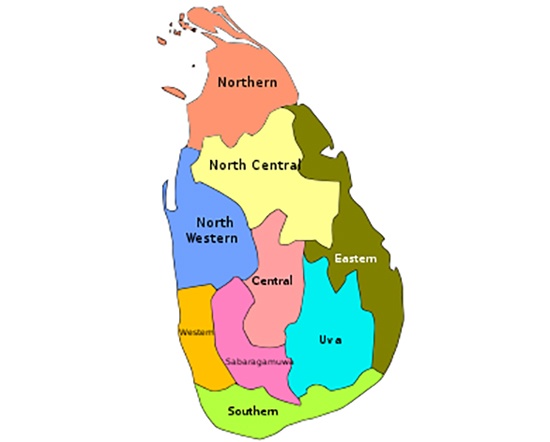
It was said of Prime Minister SWRD Bandaranaike that “it was a grim irony that he should be called upon, at the moment of his greatest political triumph, to articulate the strong opposition of the Sinhalese to any attempt to establish a federal constitution.” Sixty-five years later, it could be said in reverse that it is a grimmer irony for President Gotabaya Rajapaksa to be unfairlyput on the spot by his most ardent supporters and their insistent calls for abolishing the Provincial Council system, in total disregard of the realities of political and geopolitical consequences of such abolishing, not to mention the extraordinary Covid-19 challenges that he has to deal with now. The irony is to be noted because Mr. Rajapaksa was among the first to raise the call for abolishing the PCs as far back as 10 years ago, when even the mere thought of becoming Sri Lanka’s president may not have crossed his mind as an American citizen.
The PCs are not the only dilemma that President Rajapaksa has to wrestle with. He is grappling with quite a few of them. While almost all other presidential dilemmas are connected to Covid-19, the dilemma over 13A and the Provincial Councils is antecedent to Covid-19, but like everything else in Sri Lanka and elsewhere, is complicated by it. Hence the lingering question, why bother with a new constitution now? And especially for this President, whose credentials are totally those of a practical doer, and not at all the characteristics of a constitutional visionary? The answer might be that it is the ‘constitutional cabal’ that is running the constitutional show, like every other cabal running every other government show.
‘Sapatha’ and Overreach
The immediate cause for the abolishment calls is the apparent decision of the government, or the Prime Minister, to go ahead with the long postponed (by the Wickremesinghe-TNA-JVP threesome) elections to the currently defunct Provincial Councils, which were established under the 13th Amendment. The sources of these calls are also a classic case of multiple political tails trying to wag the country’s presidential executive and his brother prime minister. A government minister, indeed, the Minister for Public Security and the State Minister for Provincial Councils, has, in ancient Mahabharata “sapatha kara kiyanawa” style, made a solemn pledge to the members of the Civil Defence Force that he would put an end to the system of Provincial Councils. The Experts Committee tasked with preparing a draft for the new Rajapaksa constitution, is also reported to have expressed concern over holding PC elections before their draft is done and a new constitution is in place.
It is not clear if there is unanimity in the committee over this concern, or if some committee members are speaking publicly for the whole committee. There was an earlier news report that the Experts Committee took an internal vote and decided by majority on a matter that is apparently fundamental to preparing the draft constitution. That an expert committee on the constitution would take an internal vote to decide on a fundamental question without referring it to its political masters in the government (with the parliament helplessly sidelined in the whole exercise) is an extraordinary overreach. If this is any indication, even the draft constitution that the committee would likely produce (presumably by a majority vote) may turnout to be extraordinary and tendentious.
Does the matter that the committee had to vote on have anything to do the 13th Amendment? We do not know. But we know that the more powerful members of the committee are not amused by the government’s apparent decision to go ahead with PC elections. And that is some gall for a committee appointed by the country’s Head of State to publicly tell the government if or when it should conduct elections to any elected body. For now, there is more than Expert Committee amusement or gall that has been put on display. Real midweek fury against the Provincial Councils has been unleashed by Prof. GH Peiris, who is also a prominent member of the Experts Committee.
Facts and Fabrications
Anyone looking to get refreshed on the materially relevant historical background to the constitutional voids that were unnecessarily created in 1972 and in 1978 – and their partial filling by the 13th Amendment (in 1987) and the Provincial Councils it created, could re-read Chapter 36 in KM de Silva’s (1981) “A History of Sri Lanka.” Even its first few pages will do. My opening quote on SWRD Bandaranaike in today’s article is from page 513 of de Silva’s book, in Chapter 36: “The Triumph of Linguistic Nationalism”. The quote might suggest that the historian was having his academic tongue in his political cheek, but it reads far superior to anything that a geographer seems to be able to politically offer 40 years later. And this is not because Sri Lanka has too much history and too little geography.
Yet, no one can do worse than CA Chandraprema’s attempt to rewrite history, as he did in his hagiographic monograph, “Gota’s War.” We can anticipate versions of it to be undiplomatically broadcast from Geneva from March onward. The one thing about the history of Sri Lanka’s national question or conflict is that it is a well studied (even “over studied”, as AJ Wilson used to say) subject, and almost everyone who is of consequence either in Sri Lanka or abroad is well versed, in it and knows to discern between facts and fabrications. More than historical writings, Sri Lanka’s stubborn facts always give the fabricator’s, if not the government’s, game away. Just as it is impossible to hide a whole pumpkin in a plate of rice. Peremptorily abolishing the Provincial Council system will be one more stubborn fact that will fetch no credit for Sri Lanka.
Sri Lankans who have lived through and politically experienced the tumults and wars after 1977 need no lesson from old history, colonial, or pre-colonial. Some of us–Burghers, Muslims, Sinhalese, and Tamils rising above our ethnic strictures, happened to be involved in efforts to respond to these events within the framework of the Movement for Inter-Racial Justice and Equality (MIRJE).1983 is now considered a watershed moment in Sri Lanka’s modern history, one that is totally negative and even calamitous, and quite different from 1956 which bore both positive and negative fruits. However, 1983 had its annual forerunners. Riots broke out in 1977, after a twenty-year hiatus and within months of the UNP’s bigger than landslide election victory. For the first time, plantation Tamils were targeted in communal rioting. In 1978, the UNP used its massive majority in parliament to elevate one of its MPs, Prime Minister JR Jayewardene, as the country’s first executive president. 1979 was the year of the Emergency in Jaffna, when President Jayewardene ordered Brigadier (Bull) Weeratunga (not DIG/IGP Rudra Rajasingham) to “eliminate the menace of terrorism in all its forms from the island and more specially from the Jaffna District.” Two years later, in 1981, tea plantation districts were targeted again in the south, while off-duty policemen burnt down the Public Library in Jaffna. In 1982, President Jayewardene upended parliamentary democracy in Sri Lanka through the chicanery of a referendum. One year later, what was catastrophic became calamitous, as the Palestinians are known to say.
1983 implicated Sri Lanka not only geopolitically with India, but also internationally with practically every western country where Tamils leaving Sri Lanka found a foothold. The Sixth Amendment that was passed during the dark and difficult days of August 1983, erased the elected TULF off the political map and handed over the keys to Tamil politics to armed militants. Sarath Silva said as much in his 2005 ruling as Chief Justice, in the course of denying President Kumaratunga’s plea to stay in office a year longer.
The commonplace argument is that 13A and the Provincial Councils were foisted on Sri Lanka by India’s machinations taking advantage of an old, weak, and beleaguered President Jayewardene. While this argument might be politically potent, it is bereft of any analytical insight or credibility, and it flies in the face of events and the alignments of political forces within Sri Lanka before and after 1983. The notion that India’s role in Sri Lanka was triggered by the fury of Indira Gandhi after she was apparently scorned by JR Jayewardene is cheap table talk and should not be a serious political consideration. And in 2020 it is utterly inappropriate to speak of any woman, let alone a woman political leader and Prime Minister, being scorned, leaving aside the not uncommon misattribution to Shakespeare of the line (“Heav’n has no rage, like love to hatred turn’d, Nor hell a fury like a woman scorned”) that was satirically written by William Congreve (1670-1729) in his play, The Mourning Bride.
Indian Involvement and Sri Lanka’s Failure
I make no suggestion that India’s involvement, or interference, in Sri Lanka was entirely, or even primarily, motivated by neighbourly altruism. There were of course machinations, but they were mostly of the raw bureaucratic kind, thanks to the Research and Analysis Wing (RAW), India’s wannabe CIA. And whether it was Indian involvement or interference, it did not arise out of nothing and would not have transpired the way it did and to the extent it did, without compelling circumstances in Sri Lanka. The Sri Lankan political circumstances after 1977, and more so after 1983, provided both the pretext and the context for India to get involved in Sri Lanka’s internal affairs. And no one, not even India, could have anticipated that things would get ugly and totally out of control as they did over several years. It is still the sorest point among many Sinhalese that India peremptorily prevented the Sri Lankan military onslaught on the LTTE in June 1987 with its controversial air drop of food supplies in Jaffna. The contention is that were it not for this highhanded intervention, the war would have been over by and large in 1987 itself. This is debatable because the LTTE was then primarily a guerrilla organization and may have survived the onslaught to live and fight another day. It was only years later that the LTTE would build up its so called conventional fighting force and convert itself from being a fighting-fit guerrilla force to a flabby national army, and getting drunk in the process with its own myth of invincibility. And in this saga of ironies, India that initially aided and armed Tamil militant groups on the beaches of Tamil Nadu, would later preside over the disarming of every militant group bar the LTTE, engage its army in an unfinished and unsuccessful fight against the LTTE, and finally – 22 years after the infamous ‘parippu drop’ – end up aiding and assisting the government of Sri Lanka to vanquish the LTTE once and for all. It was not only the Central Government in Delhi that went through these about-turns, but also the state and government leaders in Tamil Nadu who were complicit at every step along the way. And there is no shortage among Sri Lankan Tamils who believe that the Tamils were shortchanged in the Indo-Sri Lanka Accord and the 13th Amendment, and especially by the provisions of the Provincial Councils Act that the two gave rise to.
As for JR Jayewardene, although his detractors among the Sinhalese may never concede this, he must have felt entitled to a little last laugh in getting India to clean up the militant mess which in his mind was mostly of India’s making. To his justifiable credit, however, he conceded in the end that India was the only external agency, and not any western country or international agency, that would help him put his Sri Lankan house in order after national politics has unravelled beyond restoration by any domestic initiative alone. This very point was well articulated in a public statement, at the time of the Indo-Sri Lanka Accord, by more than a score of left and liberal Sinhalese intellectuals, activists, and academics. I do not have the statement at hand, but suffice it to say that the anti-13A lobby is not entitled to claim exclusive monopoly over Sinhalese political thinking, then or now.
As well, the 13th Amendment is not the only controversial initiative, constitutionally or otherwise, that JR Jayewardene implemented and presided over aided by his tyrannical majority in parliament. His entire 1978 constitutional project has been controversial from the time of its inauguration. In fact, the 13th Amendment has had greater support among non-UNP Sinhalese, than the 1978 Constitution ever did. Abolishing the executive presidency has been the winning battle cry in every election from 1994, until 2019. At none of these elections, including, I believe, the 2019 and 2020 elections, did any of the main contenders for power promised to abolish the Provincial Council system.
On the contrary, Chandrika Kumaratunga and her People’s Alliance movement used Provincial Council elections to launch their campaign against and eventually oust the UNP from power after its seventeen year rule. Mahinda Rajapaksa cleverly and consistently used PC elections to consolidate his electoral fiefdom. Again, as political indicators go, the 2014 PC election in Uva signalled the people’s regime fatigue after 10 years of Rajapaksa rule and 20 years of SLFP-dominated governments. Lacking Chandrika Kumaratunga’s charisma and Mahinda Rajapaksa’s cleverness, the beleaguered yahapalanaya folk shuttered up the Provincial Councils and postponed their elections indefinitely. Their dillydallying has created the current dilemma for President Rajapaksa.
There is no dispute that the implementation of the Provincial Councils system has not turned out to be an appealing success. But this is not due to any systemic or structural shortcomings, but entirely due to the failure of political leadership. The blame for the worst leadership failure should fall squarely on the shoulders of Maithripala Sirisena and Ranil Wickremesinghe in general, and particularly on the TNA and CV Wigneswaran for what they have done and what they failed to do with the Northern Provincial Council after its first and only election in 2013.
There is no question that the PC system needs changes and reforms, regardless of when the next elections are held. And unlike any other institution in Sri Lanka, the PC system has a handbook of reform recommendations in the comprehensive symposium complied, in 2010, by the late Ranjith Amarasinghe, Asoka Gunawardena, Jayampathy Wickramaratne, and AM Navaratna-Bandara. There have been plenty of other suggestions, most recently by Austin Fernando and Nirmala Chandrahasan.
In his December 25 article in The Island, Fernando recounts that the current government includes many past champions of the PC system, including former Provincial Chief Ministers and Governors. Will they speak out now, or stay silent as the current abolishment clamour grows? The current voices of abolition have been around from the time the PCs were introduced in 1987-88. But for over 30 years they have not gotten anywhere close to influencing, or dictating to, the policy of any Sri Lankan government on the 13th Amendment and the Provincial Councils. Until now. And that is President Gotabaya Rajapaksa’s main dilemma.

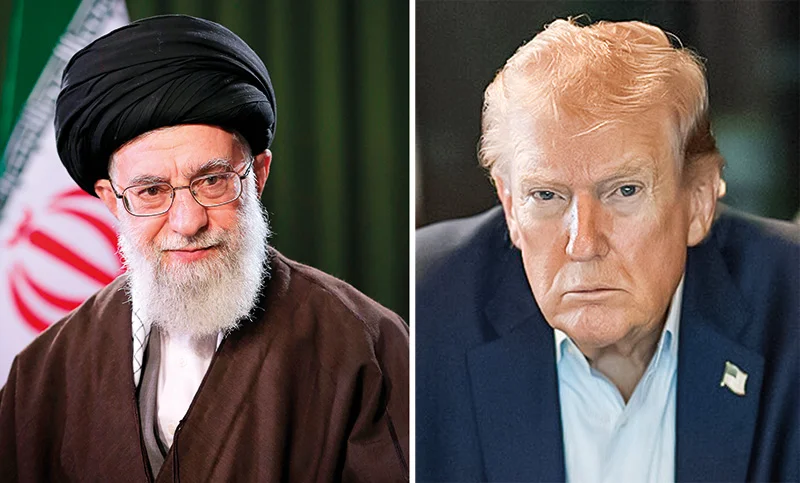
 It was Iran’s first spiritual head of state, the late Ayatollah Khomeini, who singled out and castigated the US as the ‘Great Satan’ in the revolutionary turmoil of the late seventies of the last century that ushered in the Islamic Republic of Iran. The core issue driving the long-running confrontation between Islamic Iran and the West has been religious identity and the seasoned observer cannot be faulted for seeing the explosive emergence of the current war in the Middle East as having the elements of a religious conflict.
The current crisis in the Middle East which was triggered off by the recent killing of Iranian spiritual head of state Ayatollah Ali Khamenei in a combined US-Israel military strike is multi-dimensional and highly complex in nature but when the history of relations between Islamic Iran and the West, read the US, is focused on the religious substratum in the conflict cannot be glossed over.
In fact it is not by accident that US President Donald Trump resorts to Biblical language when describing Iran in his denunciations of the latter. Iran, from Trump’s viewpoint, is a primordial source of ‘evil’ and if the Middle East has collapsed into a full-blown regional war today it is because of the ‘evil’ influence and doings of Iran; so runs Trump’s narrative. It is a language that stands on par with that used by the architects of the Iranian revolution in the crucial seventies decade.
In other words, it is a conflict between ‘good’ and ‘evil’ and who is ‘good’ and who is ‘evil’ in the confrontation is determined mainly by the observer’s partialities and loyalties which may not be entirely political in kind. It should not be forgotten that one of President Trump’s support bases is the Christian Right in the US and in the rest of the West and the Trump administration’s policy outlook and actions should not be divorced from the needs of this segment of supporters to be fully made sense of.
The reasons for the strong policy tie-up between Rightist administrations in the US in particular and Israel could be better comprehended when the above religious backdrop is taken into consideration. Israel is the principal actor in the ‘Old Testament’ of the Bible and is seen as ‘the Chosen People of God’ and this characterization of Israel ought to explain the partialities of the Republican Right in particular towards Israel. Among other things, this partiality accounts for the strong defence of Israel by the US.
For the purposes of clarity it needs to be mentioned here that the Bible consists of two parts, an ‘Old’ and ‘New Testament’ , and that the ‘New Testament’ or ‘Message’ embodies the teachings of Jesus Christ and the latter teachings are seen as completing and in a sense giving greater substance to the ‘Old Testament’. However, Judaism is based mainly on ‘Old Testament’ teachings and Judaism is distinct from Christianity.
To be sure, the above theological explanation does not exhaust all the reasons for the war in the Middle East but the observer will be allowing an important dimension to the war to slip past if its importance is underestimated.
It is not sufficiently realized that the Iranian Islamic Revolution of 1979 utterly changed international politics and re-wrote as it were the basic parameters that must be brought to bear in understanding it. So important is the Islamic factor in contemporary world politics that it helped define to a considerable degree the new international political order that came into existence with the collapsing of the Cold War and the disintegration of the USSR .
Since the latter developments ‘political Islam’ could be seen as a chief shaping influence of international politics. For example, it accounts considerably for the 9/11 calamity that led to the emergence of fresh polarities in world politics and ushered in political terrorism of a most destructive kind that is today disquietingly visible the world over.
It does not follow from the foregoing that Islam, correctly understood, inspires terrorism of any kind. Islam proclaims peace but some of its adherents with political aims interpret the religion in misleading, divisive ways that run contrary to the peaceful intents of the faith. This is a matter of the first importance that sincere adherents of the faith need to address.
However, there is no denying that the Islamic Revolution in Iran of 1979 has been over the past decades a great shaper of international politics and needs to be seen as such by those sections that are desirous of changing the course of the world for the better. The revolution’s importance is such that it led to US political scientist Dr. Samuel P. Huntingdon to formulate his historic thesis that a ‘Clash of Civilizations’ is upon the world currently.
If the above thesis is to be adopted in comprehending the principal trends in contemporary world politics it could be said that Islam, misleadingly interpreted by some, is pitting a good part of the Southern hemisphere against the West, which is also misleadingly seen by some, as homogeneously Christian in orientation. Whereas, the truth is otherwise. The West is not necessarily entirely synonymous with Christianity, correctly understood.
Right now, what is immediately needed in the Middle East is a ceasefire, followed up by a negotiated peace based on humanistic principles. Turning ‘Spears into Ploughshares’ is a long gestation project but the warring sides should pay considerable attention to former Iranian President Mohammad Khatami’s memorable thesis that the world needs to transition from a ‘Clash of Civilizations’ to a ‘Dialogue of Civilizations’. Hopefully, there would emerge from the main divides leaders who could courageously take up the latter challenge.
It ought to be plain to see that the current regional war in the Middle East is jeopardising the best interests of the totality of publics. Those Americans who are for peace need to not only stand up and be counted but bring pressure on the Trump administration to make peace and not continue on the present destructive course that will render the world a far more dangerous place than it is now.
In the Middle East region a durable peace could be ushered if only the just needs of all sides to the conflict are constructively considered. The Palestinians and Arabs have their needs, so does Israel. It cannot be stressed enough that unless and until the security needs of the latter are met there could be no enduring peace in the Middle East.
The two input gateways of communication, sight and sound, are quite well developed at birth. In fact, the auditory system becomes functional around 24 weeks in the womb, and the normal newborn can hear quite well after birth. However, the newborn’s vision is a little blurry at birth, and the baby sees the world in shades of grey, while being able only to focus on things 20 to 30 cm (8–12 inches) away. Coincidentally, this is perhaps the exact distance to a mother’s face during breastfeeding. By 2-3 months, there are colour vision capabilities and the ability to track. By 5-8 months, there is depth perception, and by 12 months, there is adult clarity of vision.
By the time a child turns five, his or her brain has already reached 90% of its adult size. This astonishing physical growth is not just happening on its own; it is, to a certain extent, fuelled by experience, and the most vital experience a young child can have is communication with his or her parents.
Modern developmental neuroscience has shifted our understanding of how children learn. We used to think babies were passive sponges, slowly absorbing the world. We now know they are active characters from day one, constantly seeking interaction to build the architecture of their minds. This architecture is not built by apps, vocabulary flashcards, or educational television. It is built through simple, loving, back-and-forth interactions with anyone they come across, but mostly their parents.
The Foundation: Serve and Return (0–12 Months)
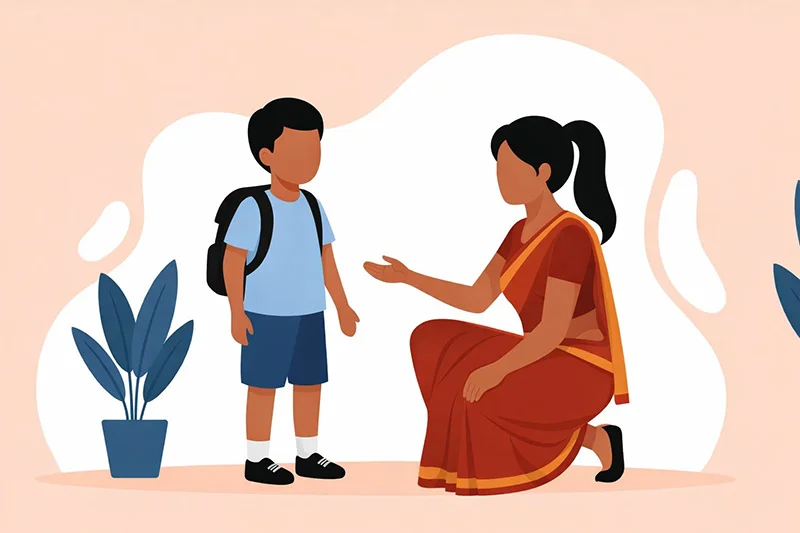
Communication with an infant from birth to one year of age begins long before they speak their first word. In the first year, the goal is to master a phenomenon called Serve and Return. This is a basic scenario picked up from the game of tennis. At the start of each game of a set in tennis, a player serves, and the opponent returns the serve. Just imagine a tennis match, where a baby “serves” by making a sound, making eye contact, reaching for a toy, or crying. The job of anyone in the vicinity, who very often are the parents of the baby, is to “return” the ball. If they babble, you babble back. If they point at a cat, you look and say, “Yes, that’s a furry cat!” This simple act does two things. The first is Brain Building, which creates and strengthens neural pathways in the language and emotional centres of the brain. The other is Emotional Security, a thing which teaches a baby that he or she has some help in the learning processes. The baby absorbs the notion that when he or she signals a need, his or her world will respond. This forms the basis of a secure attachment. Scientists have advocated that during this stage, people, especially the parents of a baby, should embrace what is called ‘parentese’. It is the use of a somewhat high-pitched, exaggerated voice. Research has shown that babies pay more attention to parentese than to regular adult speech, helping them to map the sounds of their native language more quickly.
The Language Explosion: Toddlers (1–3 Years)
When a child starts speaking words, the game changes considerably and quite profoundly. This period is defined by a rapid increase in his or her vocabulary and the beginning of grammar. It is very important to narrate everything. The people around, especially the parents, need to become kind of sports commentators for your life. While dressing them, one could say, “First we put on the red sock. After that, we put the other red sock on your left foot.” What we are doing by this is to give them the labels for the world they see.
It is also important to expand, but not truly correct, whatever the child says. If a toddler points to a car and says “Car!”, don’t just say “Yes.” Expand on it: “Yes, that is a big, fast, red car!” You are adding a new vocabulary and grammatical structure through a natural process. If the child says “Me go,” respond with, “Yes, you are going!” rather than correcting and saying “No…, you should say ‘I am going’.”
Toddlers love reading the same book, even one hundred times. While it may be tedious for those around the baby, it is important to realise that such repetition is vital for their learning. They are predicting what comes next, which is a core cognitive skill.
The Preschooler: Building Stories and Logic (3–5 Years)
By age three, the focus shifts from “what” to “why.” Preschoolers are beginning to understand complex emotions, time, and causality. This is the age at which it is best to ask questions which require thought and understanding. Such indirect open-ended questions would sound like “What was the best part of the park today?” or “How do you think that character in the story is feeling?“
A preschooler’s world is full of “big feelings” they cannot yet manage. When they are upset because they cannot have a cookie, avoid saying “Don’t cry over nothing.” Instead, name the emotion: “Don’t cry, you can have a cookie after dinner“. This teaches them emotional literacy. Parents and others around in the home could share stories about when they were little, or make up fantasy tales together. Storytelling teaches sequential logic (beginning, middle, end) and strengthens their imagination.
The Absolute Master Class: Learning Through Play
If communication is the fuel for brain development, play is the engine. For a child under five, play is not a break from learning; play is learning. It is how they explore physics (stacking blocks), mathematics (sorting shapes), social dynamics (sharing toys), and language (pretend play). We can boost their development exponentially by weaving communication into their play.
When a child is playing with blocks, dough, or puzzles, they are building fine motor skills and spatial awareness. It is also useful to use three-dimensional words: “Can you put the blue block on top of the red one?” “The puzzle piece is next to your knee.” One could also ask them to describe the texture: “Is the dough soft or hard?“
Pretend play, such as acting as a doctor, an engineer, a chef, or a superhero, is one of the most cognitively demanding things a child can do. It requires them to understand symbolic thought and to take on another person’s perspective. Join their world as a supporting character, not the director. If they are the doctor, ask, “Doctor, my teddy bear’s tummy hurts. What should I do?” This encourages them to use vocabulary relevant to the scenario and practice complex social problem-solving.
Playing with water, sand, slime, or safe food products allows children to process sensory information. This is the perfect time for descriptive vocabulary. Use contrasting words: wet/dry, hot/cold, sticky/smooth, loud/quiet.
A few special words for parents. You do not need an expensive degree or specialised toys to build your child’s brain. The most powerful tool you have is your own responsiveness. Modern science tells us that the basic recipe for a thriving child is simple: Look at them when they signal you. Respond with warmth and words. Narrate their world and Join their play.
You are not just talking to your child; you are building his or her future, even via just one conversation at a time. So, go on talking to your child and even make him or her a real-life chatterbox.
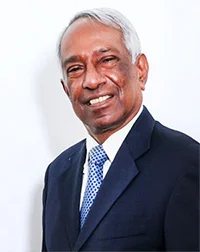 Dr B. J. C. Perera
MBBS(Cey), DCH(Cey), DCH(Eng), MD(Paediatrics), MRCP(UK), FRCP(Edin), FRCP(Lond), FRCPCH(UK), FSLCPaed, FCCP, Hony. FRCPCH(UK), Hony. FCGP(SL)
Specialist Consultant Paediatrician and Honorary Senior Fellow, Postgraduate Institute of Medicine, University of Colombo, Sri Lanka.

 Tourism is very much in the news these days and it’s certainly a good sign to see lots of foreigners checking out Sri Lanka.
With this in mind, Ruki’s Model Academy & Agency recently had a spectacular event to select Mrs. Tourism Sri Lanka in order to promote Sri Lanka in the international scene.
Nimesha Premachandra was crowned Mrs. Tourism Sri Lanka 2026.
She says she owes her success to Ruki (Rukmal Senanayake), the National Director and model trainer, and personality and advocacy trainer Tharaka Gurukanda.
Nimesha is a school teacher by profession, an actress and TV presenter by passion, and an entrepreneur by spirit.
She believes in balancing grace with purpose, and using her platform to inspire women, while promoting the beauty and culture of Sri Lanka to the world. And this is how our Chit-Chat went:
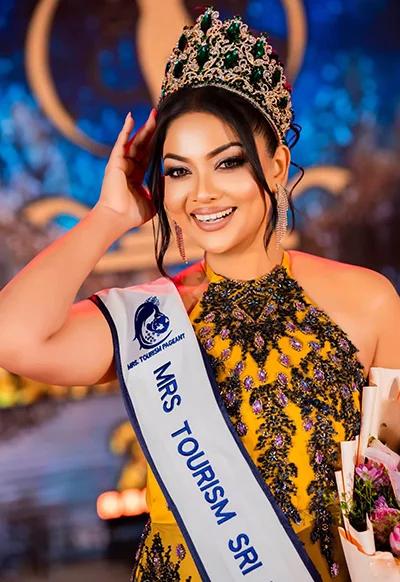
Nimesha Premachandra: Mrs. Tourism Sri Lanka 2026
01. How would you describe yourself?
I am a passionate, disciplined, and people-oriented person. I love learning, performing, and guiding others, especially young minds, through education.
02. If you could change one thing about yourself, what would it be?
I would probably try to be less self-critical and allow myself to celebrate achievements more often.
03. If you could change one thing about your family, what would it be?
Nothing major. I am grateful for my family’s love and support, which has shaped who I am today.
04. Is Mrs. Tourism Sri Lanka your very first pageant?
No. I have been part of pageants before, but Mrs. Tourism Sri Lanka is very special because it represents purpose, culture, and global representation.
05. What made you take part in this contest?
I wanted to represent Sri Lanka internationally and use this platform to promote tourism, culture, and women’s empowerment.
06. Obviously, you must be excited about participating in the grand finale, in Vietnam; any special plans for this big event?
Yes, I am extremely excited. My focus is to showcase Sri Lankan elegance, hospitality, and authenticity, while building meaningful connections with participants from around the world.
07. How do you intend promoting tourism, in Sri Lanka, during your rein?
I plan to highlight Sri Lanka’s diverse experiences in culture, heritage, wellness, nature, and local hospitality through media appearances, digital storytelling, and tourism collaborations.
08. School?
Kaluthara Balika. School life played a big role in shaping me. I actively participated in sports and performing arts, which later helped me build confidence as an actress and presenter.
09. Happiest moment?
Being crowned Mrs. Tourism Sri Lanka 2026 and seeing the pride in my family’s eyes – definitely one of my happiest moments.
10. What is your idea of perfect happiness?
Peace of mind, good health, and being surrounded by the people I love while doing work that has meaning.
11. Which living person do you most admire?
I most admire Angelina Jolie because she beautifully balances her work as an actress with meaningful humanitarian efforts. She uses her global platform to support refugees, advocate for human rights, and inspire women to be strong, compassionate, and independent.
12. Which is your most treasured possession?
My memories and experiences because they remind me how far I’ve come, and keep me grounded.
13. Your most embarrassing moment?
Like everyone, I’ve had small on-stage mishaps, but they always taught me to laugh at myself and move forward confidently.
14. Done anything daring?
Participating in pageants while balancing teaching, media work, and family life has been one of the boldest and most rewarding decisions I’ve made.

Keen to use her title to promote Sri Lanka globally
15. Your ideal vacation?
A peaceful destination surrounded by nature; somewhere I can relax, reconnect, and experience local culture.
16. What kind of music are you into?
I enjoy soft, soulful music because it helps me relax and stay inspired.
17. Favourite radio station:
I enjoy stations that blend good music with meaningful conversation and positive energy.
18. Favourite TV station:
Sri Lanka Rupavahini Corporation. It’s where it all began for me. It played a significant role in my journey as a TV presenter and helped shape my confidence and passion for media.
19 What would you like to be born as in your next life?
Someone who continues to inspire others because making a positive impact is what matters most.
20. Any major plans for the future?
I hope to expand my work in media and entrepreneurship while continuing my role as an educator and using my title to promote Sri Lanka globally.

Afternoon showers expected in the Uva and Sabaragamuwa provinces and in Hambantota, Nuwara-Eliya and Ampara districts

Trump administration launches US military operation in Ecuador

US sinks Iranian warship off Galle returning from Indian naval exercise

Justice Kumudini complains of male domination at senior levels, absence of a woman head of BASL

No qualified printer to head Government Printing Department

Wildlife Dept. fails on elephant fence management: Withanage

‘Dates have the highest sugar content to fight Coronavirus’

Sunday Island 27 December – Headlines

#SundayIsland 17th December – Headlines

Sunday Island – 28th March

Sunday Island Headlines – 21 March

Sunday Island – 21st February – Headlines
-

 Features3 days ago
Brilliant Navy officer no more
-
 Opinion6 days ago
Jamming and re-setting the world: What is the role of Donald Trump?
-
 Features6 days ago
An innocent bystander or a passive onlooker?
-

 Opinion3 days ago
Sri Lanka – world’s worst facilities for cricket fans
-

 Business6 days ago
An efficacious strategy to boost exports of Sri Lanka in medium term
-
 Features4 days ago
Overseas visits to drum up foreign assistance for Sri Lanka
-
 Features4 days ago
Sri Lanka to Host First-Ever World Congress on Snakes in Landmark Scientific Milestone
-

 Features3 days ago
A life in colour and song: Rajika Gamage’s new bird guide captures Sri Lanka’s avian soul