
Latest News
President highlights Global North’s failure in Climate Change Financing at 10th World Water Forum

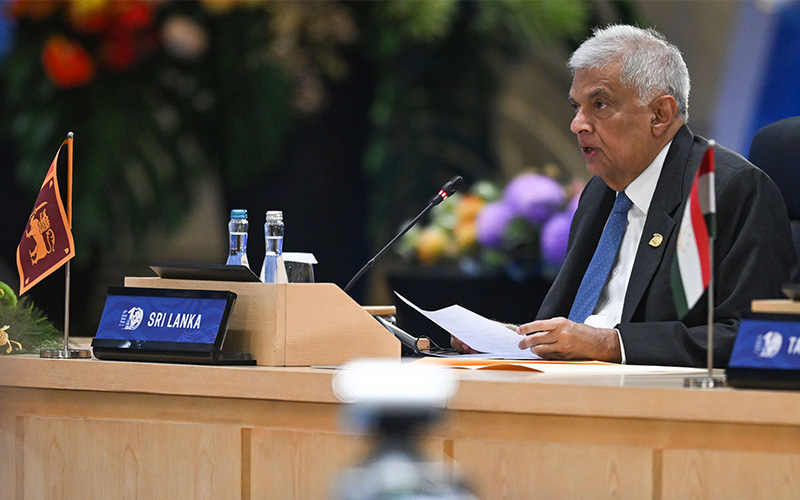
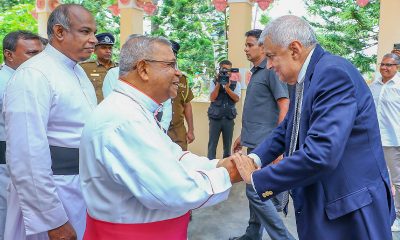
President Ranil Wickremesinghe addressing the 10th World Water Forum, held in Bali, Indonesia today (20), highlighting the stark contrast between global funding priorities, pointing out the willingness of the Global North to fund death and destruction in Ukraine while showing reluctance to finance measures to combat climate change.
Accordingly, President Wickremesinghe proposed a 10% levy on the annual profits of global tax evasion assets deposited in tax havens, estimated at $1.4 trillion annually. He suggested that funds raised through this levy could support Blended Finance projects focused on climate change adaptation and mitigation.
The World Water Summit, themed “Water for Common Prosperity,” began on May 18 in Bali, Indonesia, bringing together world leaders, experts, academics, entrepreneurs, and policymakers. The conference aims to unite nations in a collaborative effort to address global water issues.
Since its inception in 1997, the World Water Summit has been held every three years, serving as a premier platform for countries worldwide to share experiences and knowledge on best practices for water management. The summit facilitates dialogues among stakeholders on water, sanitation challenges, and sustainable development goals.
This year’s event sees the participation of key United Nations organizations, including the United Nations Economic and Social Commission for Asia and the Pacific, the United Nations Food and Agriculture Organization, the United Nations Environment Programme, the United Nations Development Programme, the United Nations Educational, Scientific and Cultural Organization, the United Nations International Children’s Fund, the United Nations Industrial Development Organization, and the United Nations Climate Change Organization.
Following is the speech delivered by President Ranil Wickremesinghe;
At the outset let me thank the President of the Republic of Indonesia, H.E. Joko Widodo for hosting the 10th World Water Forum in Bali. The theme ‘Water for shared prosperity’ focuses on collective responsibility in managing water resources, the life blood of all living beings and ecosystem services. This follows the “Sustainable Management of Lakes” Resolution proposed by Indonesia at the UNEA-5.
During the UNEA -6 held this year, the European Union together with Sri Lanka brought about the resolution “6/13 Effective and inclusive solutions for strengthening water policies to achieve sustainable development in the context of climate change, biodiversity loss and pollution”.
I also take this opportunity to congratulate the Government of Indonesia for taking the initiative during the G20 Presidency to launch the Global Blended Finance Alliance. Sri Lanka expresses its willingness to become a pioneering member.
Climate Change and water stress are two sides of the same coin. The cumulative effects of Climate Change are the main reason for what we see today as the water resource crisis. According to IPCC projected climate scenarios till 2090, Sri Lanka’s dry zone will get drier and the wet zone will get wetter in an unprecedented manner. Sea level rise will cause salt water intrusion in coastal areas resulting in salinization of land. I took this example from Sri Lanka while appreciating the fact that this is what is happening all over the world.
In global terms the solution to water stress revolves around climate mitigation and adaptation. Combating the triple planetary crisis with specific measures aiming at water. In the Nationally Determined Contributions water is classified under the adaptation sectors. On the other hand, mitigation is equally important as emissions are the root cause. Combating the threats to water resources posed by climate change requires colossal amounts of financial resources.
The Global North has failed miserably in adhering to the commitments to provide financial resources for Climate Change. There is a notable lack of political will after the euphoria of the Glasgow COP was over. Climate Change denial is gaining ground in the West.
The establishment of the Loss and Damage Fund, after a long drag, if effectively implemented can help to bridge the gap. This is a big IF. The Summit for a new Global Financing Pact will hopefully reach a conclusion by September this year. Nevertheless, the final outcome will depend on the results of the US Presidential Elections in November.
The OECD in 2021 projected the investment for global water related infrastructure at US $ 6.7 trillion for 2030 and US$ 22 trillion for 2058. The UNEP Report 2023 “Underfinanced – Underprepared” estimate the under financed gap to combat climate change at US$ 194 – 366 billion per year. The Global North is willing to fund death and destruction in the Ukraine. But there is an unwillingness to fund measures to avoid death and destruction caused by climate change.
Since money is not coming our way in anticipated amounts and at anticipated pace, to overcome the resource gap, Sri Lanka presented to COP 28 the Tropical Belt Initiative. A novel concept of harnessing commercial investments in the natural forests, mangroves, swamps, grassland water bodies and other natural resources in the Tropical Belt towards tackling the triple planetary crisis. The Tropical Belt from the time of its existence has been a ‘shield’ for the whole world. It is a catalytic accelerator of solutions to the ongoing triple planetary crisis. Investment in the tropical belt will bring in transformative changes to combat the triple planetary crisis.
In this context, the Initiative on Global Blended Finance will enable the Global South to mobilise the much needed financial resources. The US$ 9.4 billion available to commence this fund is a good example of leveraging concessional finance. The Tropical Belt Initiative will also benefit from this facility. In this context Sri Lanka proposes a 10% levy on the annual profits of global tax evasion assets deposited in tax havens. The annual profits are estimated at US$ 1.4 trillion per annum. The levy can be enforced by imposing sanctions, similar to those imposed on Russian Banks on the Banks and the Financial Institutes which fail to implement the levy. The monies raised by these levies to be made available to be utilised by the Blended Finance projects on Climate Change adaptation and mitigation.
The Global Blended Finance initiative is a supplement to the Loss and damage funds – not an alternative. These two measures must work in tandem. Therefore at this forum, let us express our appreciation for the hard work done by Indonesia in proposing this Initiative at the G20 culminating the establishment of the Alliance Secretariat.
Again, our thanks to President Joko Widodo for his contribution both in respect to the management of water resources and for bringing together the Global Blended Alliance.”








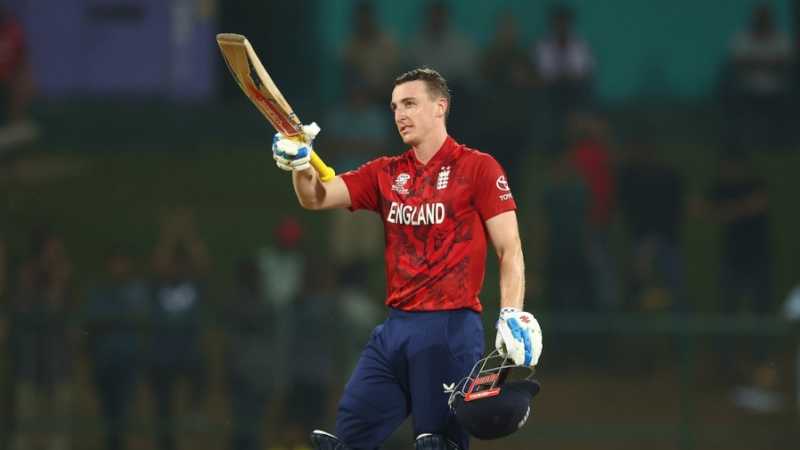
If you want a thing done well, do it yourself. Harry Brook, England’s captain, took matters into his own hands in Pallekele, promoting himself to No. 3 and blazing his maiden T20 international hundred to drag his team past Pakistan and into the semi-finals of the Men’s T20 World Cup 2026 with a game to spare, almost single-handedly.
Brook started the tournament, his first as captain, with 53 against Nepal but had been dismissed by spin for less than 20 for four innings in a row. His response was to move up two spots from No. 5 in order to bat in the powerplay, and he found himself walking out to face the second ball after Shaheen Shah Afridi – recalled by Pakistan – struck with the first ball of England’s chase.
Afridi took three wickets in the powerplay to check England’s progress, and Usman Tariq struck twice in the middle overs to reduce them to 58 for 4 and then 103 for 5. But Brook continued to flay Pakistan’s attack to all parts, reaching a 50-ball hundred by launching Afridi over cover for six and then over mid-off for four.
He was cleaned up one ball later by Afridi’s pinpoint yorker, but walked off to a standing ovation with England needing only 10 to win. They made hard work of it, gifting two wickets to Mohammad Nawaz to take the game into the 20th over, but Jofra Archer smeared Salman Mirza through midwicket as England’s dugout breathed a sigh of relief.
England’s win sealed their qualification for the semi-finals with a match to spare, and they will top the group if they can beat New Zealand in Colombo on Friday. They are yet to put a complete performance together and were shoddy in the field against Pakistan, but have now reached the semi-finals for a fifth men’s T20 World Cup in a row.
Pakistan, meanwhile, must beat Sri Lanka in their final group game and rely on other results falling their way. Despite Shahibzada Farhan’s impressive 63, they always look short on runs after they were bogged down by spin in the middle overs, with Liam Dawson’s 3 for 24 the outstanding performance among England’s attack.
Brief scores:
England 166 for 8 in 19.1 overs (Harry Brook 100, Sam Curran 16, Will Jacks 28; Shaheen Shah Afridi 4-30, Mohammad Nawaz 2-26, Usman Tarique 2-31) beat Pakistan 164 for 9 in 20 overs (Shahibzada Farhan 63, Babar Azam 25, Fakhar Zaman 25, Shadab Khan 23; Jofra Archer 2-32, Jamie Overton 2-26, Liam Dawson 3-24, Adil Rashid 1-31) by two wickets
(Cricinfo)
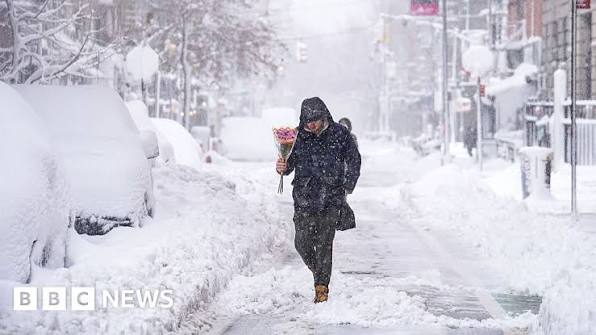
A major storm hit the US east coast on Monday, bringing record-breaking snow that caused disruptions for millions and thousands of flight cancellations.
Parts of Rhode Island and Massachusetts have seen nearly 37in (94cm) of snowfall, with more than 19in in New York City’s Central Park, the National Weather Service (NWS) said.
Weather warnings stretched from North Carolina to northern Maine, with some in place further north in parts of eastern Canada.
More than 600,000 properties on the US east coast endured power outages, while the Boston Globe – a major US newspaper – said it will not go to print for the first time in its 153-year history due to the storm.
(BBC)
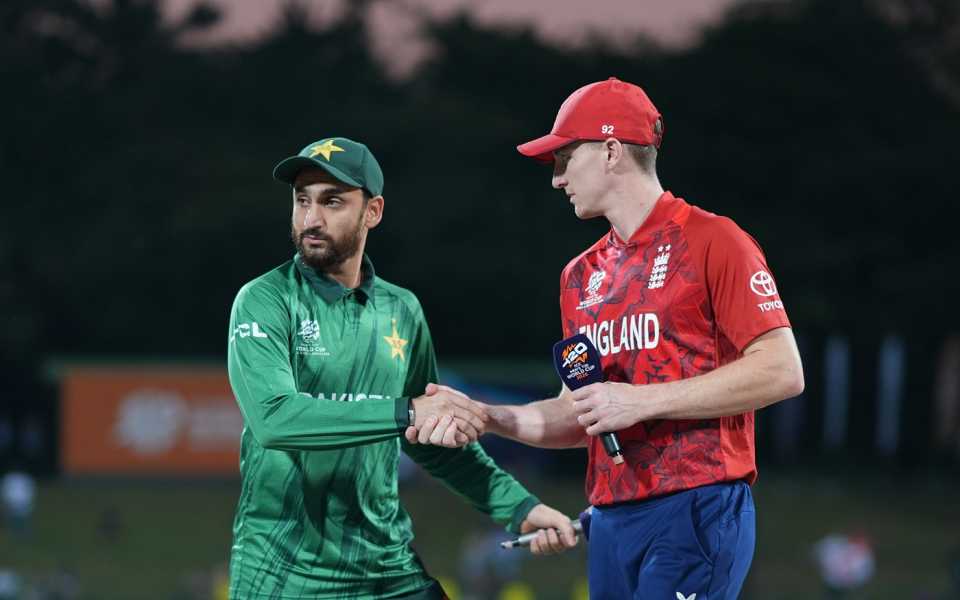
Pakistan have recalled Shaheen Shah Afridi for their Super Eight fixture against England in Pallekle at the expense of Faheem Ashraf, and will bat first after Salman Agha won the toss on a fresh pitch.
Afridi’s nine overs at the T20 World Cup have cost 101 runs and he has been left out for consecutive matches after Pakistan’s heavy defeat to India in Colombo, including their no-result against New Zealand to start the Super Eight stage. But he has been recalled to face England, perhaps due to their top order’s perceived vulnerability against left-arm seam.
Ashraf rescued Pakistan in their opening group-stage match against the Netherlands, hitting 29 not out off 11 balls to secure a three-wicket win. But he has only bowled two overs in the tournament and has been batting down the order.
“It looks like a good pitch,” Agha said at the toss. “We want to put up an above-par score and defend that total.”
England will qualify for the semi-finals if they win either of their remaining Super Eight fixtures, but Brook said that he would rather get the job done this evening than face a must-win match against New Zealand on Friday. “That would be lovely, wouldn’t it? But you never know in T20 cricket, it’s such a fickle game,” he said.
Brook said that he would have chosen to bat first if he had won the toss, but expects a better surface than the one that England played on at Pallekele two days ago in their low-scoring win over Sri Lanka. “Hopefully, it’s going to be a little bit better,” he said. “We haven’t had our perfect game yet. Hopefully, it’s just around the corner.”
England have picked the same team for the fifth consecutive match at this World Cup, and have carded their batting line-up in the same order despite some calls for Brook to be promoted from No. 5.
The fixture is a rematch of the 2022 T20 World Cup final, which England won by five wickets at the MCG, and there are nine survivors across the two teams.
England: Phil Salt, Jos Buttler (wk), Jacob Bethell, Tom Banton, Harry Brook (capt), Sam Curran, Will Jacks, Jamie Overton, Liam Dawson, Jofra Archer, Adil Rashid.
Pakistan: Sahibzada Farhan, Saim Ayub, Salman Agha (capt), Babar Azam, Fakhar Zaman, Shadab Khan, Usman Khan (wk), Mohammad Nawaz, Shaheen Shah Afridi, Salman Mirza, Usman Tariq.
(Cricinfo)

Classy Brook century puts nervy England in the semi-final

More than 5,000 flights cancelled as US east coast digs out of record snow

Pakistan bat vs unchanged England with Afridi back

Navy seize an Indian fishing boat poaching in Mannar seas

Fair weather will prevail except for showers in the Southern province and in Rathnapura, Monaragala and Kaluthara districts after 2.00 p.m

Families of those sentenced to death for killing MP Atukorale seek AKD’s intervention

‘Dates have the highest sugar content to fight Coronavirus’

Sunday Island 27 December – Headlines

#SundayIsland 17th December – Headlines

Sunday Island – 28th March

Sunday Island Headlines – 21 March

Sunday Island – 21st February – Headlines
-
 Features3 days ago
Why does the state threaten Its people with yet another anti-terror law?
-
 Features3 days ago
Reconciliation, Mood of the Nation and the NPP Government
-

 Features3 days ago
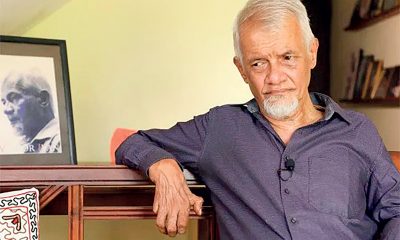
Victor Melder turns 90: Railwayman and bibliophile extraordinary
-

 Features2 days ago
LOVEABLE BUT LETHAL: When four-legged stars remind us of a silent killer
-
 Features3 days ago
Victor, the Friend of the Foreign Press
-
 Latest News4 days ago
New Zealand meet familiar opponents Pakistan at spin-friendly Premadasa
-

 Latest News4 days ago
Tariffs ruling is major blow to Trump’s second-term agenda
-

 Latest News4 days ago
ECB push back at Pakistan ‘shadow-ban’ reports ahead of Hundred auction