
Features
Poltergeist of Universities Act


 The Universities Act is back in the news – this time with the present government’s attempt to reform it through a proposed amendment (November 2025) presented by the Minister of Education, Higher Education and Vocational Education, Harini Amarasuriya, who herself is a former academic and trade unionist. The first reading of the proposed amendment has already taken place with little debate and without much attention either from the public or the university community. By all counts, the parliament and powers across political divisions seem nonchalant about the relative silence in which this amendment is making its way through the process, indicative of how low higher education has fallen among its stakeholders.
The Universities Act No. 16 of 1978 under which Sri Lankan universities are managed has generated debate, though not always loud, ever since its empowerment. Increasing politicisation of decision making in and about universities due to the deterioration of the conduct of the University Grants Commission (UGC) has been a central concern of those within the university system and without. This politicisation has been particularly acute in recent decades either as a direct result of some of the provisions in the Universities Act or the problematic interpretation of these. There has never been any doubt that the Act needs serious reform – if not a complete overhaul – to make universities more open, reflective, and productive spaces while also becoming the conscience of the nation rather than timid wastelands typified by the state of some universities and some programs.
But given the Minister’s background in what is often called progressive politics in Sri Lanka, why are many colleagues in the university system, including her own former colleagues and friends, so agitated by the present proposed amendment? The anxiety expressed by academics stem from two sources. The first concern is the presentation of the proposed amendment to parliament with no prior consultative process with academics or representative bodies on its content, and the possible urgency with which it will get pushed through parliament (if a second reading takes place as per the regular procedure) in the midst of a national crisis. The second is the content itself.
Appointment of Deans
Let me take the second point first. When it comes to the selection of deans, the existing Act states that a dean will be selected from among a faculty’s own who are heads of department. The provision was crafted this way based on the logic that a serving head of department would have administrative experience and connections that would help run a faculty in an efficient manner. Irrespective of how this worked in practice, the idea behind has merit.
By contrast, the proposed amendment suggests that a dean will be elected by the faculty from among its senior professors, professors, associate professors and senior lecturers (Grade I). In other words, a person no longer needs to be a head of department to be considered for election as a dean. While in a sense, this marks a more democratised approach to the selection, it also allows people lacking in experience to be elected by manoeuvring the electoral process within faculties.
In the existing Act, this appointment is made by the vice chancellor once a dean is elected by a given faculty. In the proposed amendment, this responsibility will shift to the university’s governing council. In the existing Act, if a dean is indisposed for a number of reasons, the vice chancellor can appoint an existing head of department to act for the necessary period of time, following on the logic outlined earlier. The new amendment would empower the vice chancellor to appoint another senior professor, professor, associate professor or senior lecturer (Grade I) from the concerned faculty in an acting capacity. Again, this appears to be a positive development.
Appointing Heads of Department
Under the current Act heads of department have been appointed from among professors, associate professors, senior lecturers or lecturers appointed by the Council upon the recommendation of the vice chancellor. The proposed amendment states the head of department should be a senior professor appointed by the Council upon the recommendation of the vice chancellor, and in the absence of a senior professor, other members of the department are to be considered. In the proposed scheme, a head of department can be removed by the Council. According to the existing Act, an acting head of department appointment can be made by the vice chancellor, while the proposed amendment shifts this responsibility to the Council, based upon the recommendation of the vice chancellor.
The amendment further states that no person should be appointed as the head of the same department for more than one term unless all other eligible people have already completed their responsibilities as heads of department. This is actually a positive development given that some individuals have managed to hang on to the head of department post for years, thereby depriving opportunities to other competent colleagues to serve in the post.
Process of amending the Universities Act
The question is, if some of the contents of the proposed amendment are positive developments, as they appear to be, why are academics anxious about its passing in parliament? This brings me to my first point, that is the way in which this amendment is being rushed through by the government. This has been clearly articulated by the Arts Faculty Teachers Association of University of Colombo. In a letter to the Minister of Education dated 9 December 2025, the Association makes two points, which have merit. First, “the bill has been drafted and tabled in Parliament for first reading without a consultative process with academics in state universities, who are this bill’s main stakeholders. We note that while the academic community may agree with its contents, the process is flawed because it is undemocratic and not transparent. There has not been adequate time for deliberation and discussion of details that may make the amendment stronger, especially in the face of the disaster situation of the country.”
Second, “AFTA’s membership also questions the urgency with which the bill is tabled in Parliament, and the subsequent unethical conduct of the UGC in requesting the postponement of dean selections and heads of department appointments in state universities in expectation of the bill’s passing in Parliament.”
These are serious concerns. No one would question the fact that the Universities Act needs to be amended. However, this must necessarily be based on a comprehensive review process. The haste to change only sections pertaining to the selection of deans and heads of department is strange, to say the least, and that too in the midst of dealing with the worst natural calamity the country has faced in living memory. To compound matters, the process also has been fast-tracked thereby compromising on the time made available to academics to make their views be known.
Similarly, the issuing of a letter by the UGC freezing all appointments of deans and heads of department, even though elections and other formalities have been carried out, is a telling instance of the government’s problematic haste and patently undemocratic process. Notably, this action comes from a government whose members, including the Education Minister herself, have stood steadfastly for sensible university reforms, before coming to power. The present process is manoeuvred in such a manner, that the proposed amendment would soon become law in the way the government requires, including all future appointments being made under this new law. Hence, the attempt to halt appointments, which were already in the pipeline, in the interim period.
It is evident that rather than undertake serious university sector reforms, the government is aiming to control universities and thereby their further politicization amenable to the present dispensation. The ostensible democratis0…..ation of the qualified pool of applicants for deanships opens up the possibilities for people lacking experience, but are proximate to the present powers that be, to hold influential positions within the university. The transfer of appointing powers to the Councils indicates the same trend. After all, Councils are partly made up of outsiders to the university, and such individuals, without exception, are political appointees. The likelihood of them adhering to the interests of the government would be very similar to the manner in which some vice chancellors appointed by the President of the country feel obligated to act.
All things considered, particularly the rushed and non-transparent process adopted thus far by the government does not show sincerity towards genuine and much needed university sector reforms. By contrast, it shows a crude intent to control universities at any cost. It is extremely regrettable that the universities in general have not taken a more proactive and principled position towards the content and the process of the proposed amendment. As I have said many times before, whatever ills that have befallen universities so far is the disastrous fallout of compromises of those within made for personal gain and greed, or the abject silence and disinterest of those within. These culprits have abandoned broader institutional development. This appears to be yet another instance of that sad process.
In this context, I have admiration for my former colleagues in the Faculty of Arts at the University of Colombo for having the ethical courage to indicate clearly the fault lines of the proposed amendment and the problems of its process. What they have asked is a postponement of the process giving them time to engage. In this context, it is indeed disappointing to see the needlessly conciliatory tone of the letter to the Education Minister by the Federation of University Teachers Association dated December 5, 2025, which sends the wrong signal.
If this government still believes it is a people’s government, the least it can do is give these academics time to engage with the proposed amendment. After all, many within the academic community helped bring the government to power. If not and if this amendment is rushed through parliament in needless haste, it will create a precedent that signals the way in which the government intends to do business in the future, abusing its parliamentary majority and denting its credibility for good.


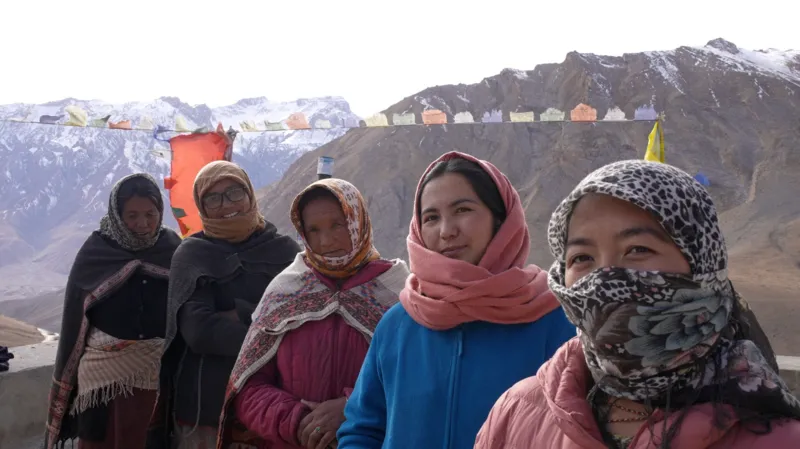
In one of India’s coldest and most remote regions, a group of women have taken on an unlikely role: protecting one of Asia’s most elusive predators, the snow leopard.
Snow leopards are found in just 12 countries across Central and South Asia. India is home to one of the world’s largest populations, with a nationwide survey in 2023 – the first comprehensive count ever carried out in the country – estimating more than 700 animals, .
One of the places they roam is around Kibber village in Himachal Pradesh state’s Spiti Valley, a stark, high-altitude cold desert along the Himalayan belt. Here, snow leopards are often called the “ghosts of the mountains”, slipping silently across rocky slopes and rarely revealing themselves.
For generations, the animals were seen largely as a threat, for attacking livestock. But attitudes in Kibber and neighbouring villages are beginning to shift, as people increasingly recognise the snow leopard’s role as a top predator in the food chain and its importance in maintaining the region’s fragile mountain ecosystem.
Nearly a dozen local women are now working alongside the Himachal Pradesh forest department and conservationists to track and protect the species, playing a growing role in conservation efforts.
Locally, the snow leopard is known as Shen and the women call their group “Shenmo”. Trained to install and monitor camera traps, they handle devices fitted with unique IDs and memory cards that automatically photograph snow leopards as they pass.
“Earlier, men used to go and install the cameras and we kept wondering why couldn’t we do it too,” says Lobzang Yangchen, a local coordinator working with a small group supported by the non-profit Nature Conservation Foundation (NCF) in collaboration with the forest department.
Yangchen was among the women who helped collect data for Himachal Pradesh’s snow leopard survey in 2024, which found that the state was home to 83 snow leopards – up from 51 in 2021.
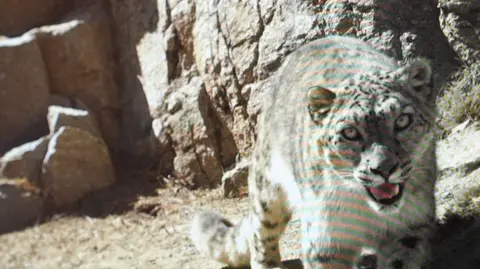
The survey documented snow leopards and 43 other species using camera traps spread across an area of nearly 26,000sq km (10,000sq miles). Individual leopards were identified by the unique rosette patterns on their fur, a standard technique used for spotted big cats. The findings are now feeding into wider conservation and habitat-management plans.
“Their contribution was critical to identifying individual animals,” says Goldy Chhabra, deputy conservator of forests with the Spiti Wildlife Division.
Collecting the data is demanding work. Most of it takes place in winter, when heavy snowfall pushes snow leopards and their prey to lower altitudes, making their routes easier to track.
On survey days, the women wake up early, finish household chores and gather at a base camp before travelling by vehicle as far as the terrain allows. From there, they trek several kilometres to reach camera sites, often at altitudes above 14,000ft (4,300m), where the thin air makes even simple movement exhausting.
The BBC accompanied the group on one such trek in December. After hours of walking in biting cold, the women suddenly stopped on a narrow trail.
Yangchen points to pugmarks in the dust: “This shows the snow leopard has been here recently. These pugmarks are fresh.”
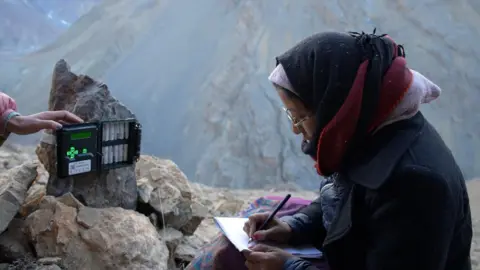
Along with pugmarks, the team looks for other signs, including scrapes and scent‑marking spots, before carefully fixing a camera to a rock along the trail.
One woman then carries out a “walk test”, crawling along the path to check whether the camera’s height and angle will capture a clear image.
The group then moves on to older sites, retrieving memory cards and replacing batteries installed weeks earlier.
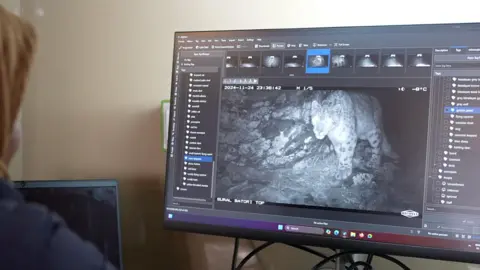
By mid-afternoon, they return to camp to log and analyse the images using specialised software – tools many had never encountered before.
“I studied only until grade five,” says Chhering Lanzom. “At first, I was scared to use the computer. But slowly, we learned how to use the keyboard and mouse.”
The women joined the camera-trapping programme in 2023. Initially, conservation was not their motivation. But winters in the Spiti Valley are long and quiet, with little agricultural work to fall back on.
“At first, this work on snow leopards didn’t interest us,” Lobzang says. “We joined because we were curious and we could earn a small income.”
The women earn between 500 ($5.46; £4) and 700 rupees a day.
But beyond the money, the work has helped transform how the community views the animal.
“Earlier, we thought the snow leopard was our enemy,” says Dolma Zangmo, a local resident. “Now we think their conservation is important.”
Alongside survey work, the women help villagers access government insurance schemes for their livestock and promote the use of predator‑proof corrals – stone or mesh enclosures that protect animals at night.
Their efforts come at a time of growing recognition for the region. Spiti Valley has recently been included in the Cold Desert Biosphere Reserve, a Unesco-recognised network aimed at conserving fragile ecosystems while supporting local livelihoods.
As climate change reshapes the fragile trans-Himalayan landscape, conservationists say such community participation will be crucial to safeguarding species like the snow leopard.
“Once communities are involved, conservation becomes more sustainable,” says Deepshikha Sharma, programme manager with NCF’s High Altitudes initiative.
“These women are not just assisting, they are becoming practitioners of wildlife conservation and monitoring,” she adds.
As for the women, their work makes them feel closer to their home, the village and the mountains that raised them, they say.
“We were born here, this is all we know,” Lobzang says. “Sometimes we feel afraid because these snow leopards are after all predatory animals, but this is where we belong.”
[BBC]
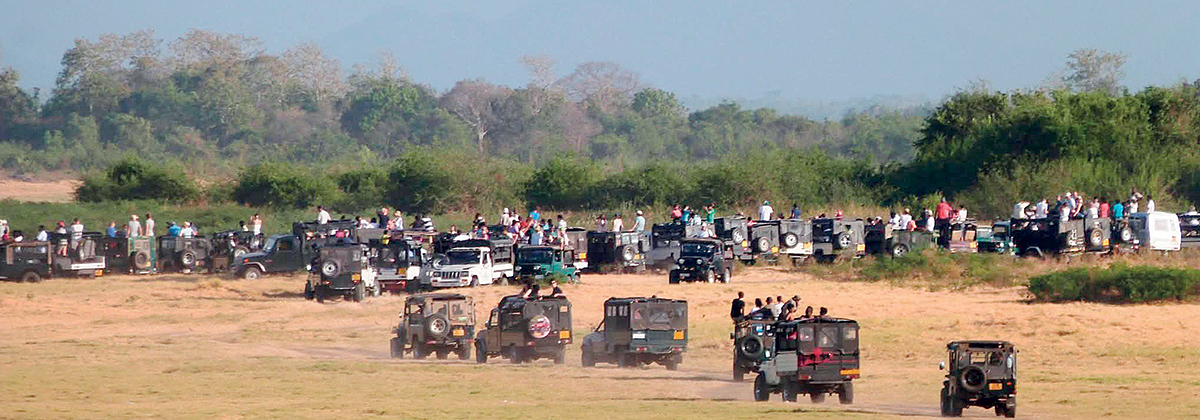
If elephants are truly to be given “freedom” in Udawalawe, the solution is not simply to open gates or redraw park boundaries. The map itself tells the real story — a story of shrinking habitats, broken corridors, and more than a decade of silent but relentless ecological destruction.
“Look at Udawalawe today and compare it with satellite maps from ten years ago,” says Sameera Weerathunga, one of Sri Lanka’s most consistent and vocal elephant conservation activists. “You don’t need complicated science. You can literally see what we have done to them.”
What we commonly describe as the human–elephant conflict (HEC) is, in reality, a land-use conflict driven by development policies that ignore ecological realities. Elephants are not invading villages; villages, farms, highways and megaprojects have steadily invaded elephant landscapes.
Udawalawe: From Landscape to Island
Udawalawe National Park was once part of a vast ecological network connecting the southern dry zone to the central highlands and eastern forests. Elephants moved freely between Udawalawe, Lunugamvehera, Bundala, Gal Oya and even parts of the Walawe river basin, following seasonal water and food availability.
Today, Udawalawe appears on the map as a shrinking green island surrounded by human settlements, monoculture plantations, reservoirs, electric fences and asphalt.
“For elephants, Udawalawe is like a prison surrounded by invisible walls,” Sameera explains. “We expect animals that evolved to roam hundreds of square nationakilometres to survive inside a box created by humans.”
Elephants are ecosystem engineers. They shape forests by dispersing seeds, opening pathways, and regulating vegetation. Their survival depends on movement — not containment. But in Udawalawa, movement is precisely what has been taken away.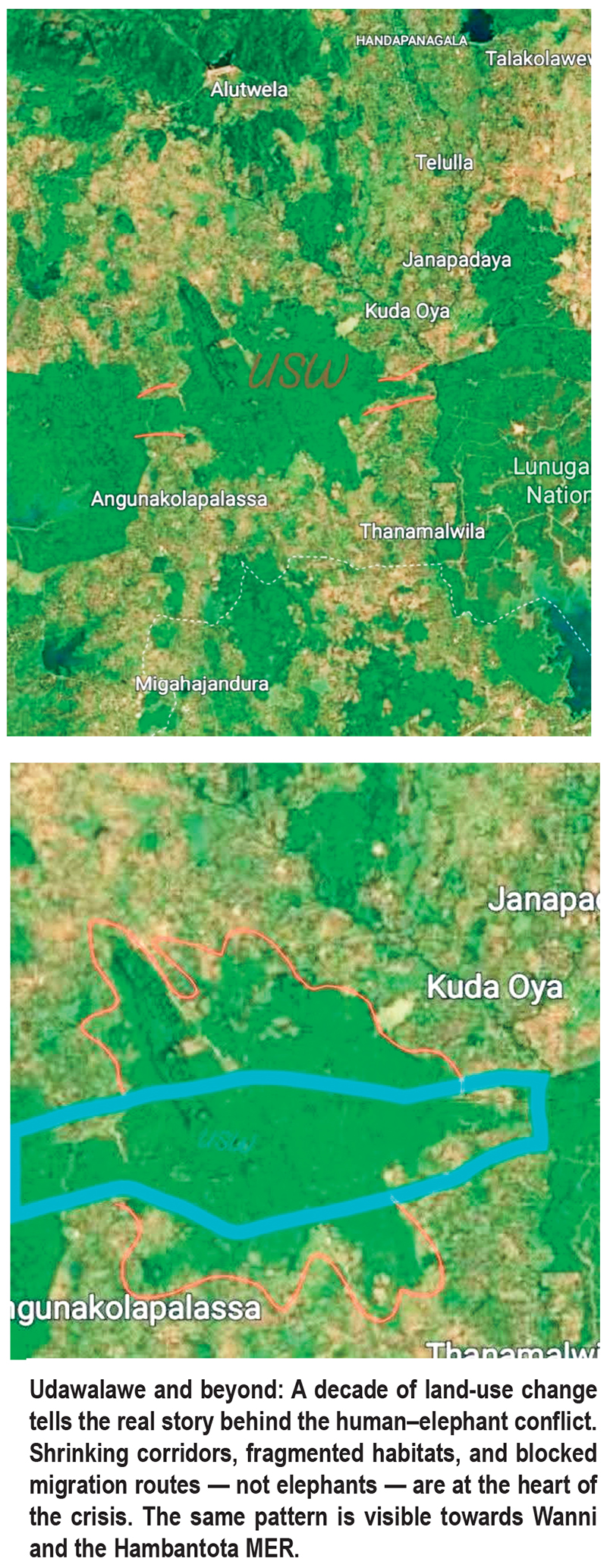
Over the past decade, ancient elephant corridors have been blocked or erased by:
Irrigation and agricultural expansion
Tourism resorts and safari infrastructure
New roads, highways and power lines
Human settlements inside former forest reserves

Sameera
“The destruction didn’t happen overnight,” Sameera says. “It happened project by project, fence by fence, without anyone looking at the cumulative impact.”
The Illusion of Protection
Sri Lanka prides itself on its protected area network. Yet most national parks function as ecological islands rather than connected systems.
“We think declaring land as a ‘national park’ is enough,” Sameera argues. “But protection without connectivity is just slow extinction.”
Udawalawe currently holds far more elephants than it can sustainably support. The result is habitat degradation inside the park, increased competition for resources, and escalating conflict along the boundaries.
“When elephants cannot move naturally, they turn to crops, tanks and villages,” Sameera says. “And then we blame the elephant for being a problem.”
The Other Side of the Map: Wanni and Hambantota
Sameera often points to the irony visible on the very same map. While elephants are squeezed into overcrowded parks in the south, large landscapes remain in the Wanni, parts of Hambantota and the eastern dry zone where elephant density is naturally lower and ecological space still exists.
“We keep talking about Udawalawe as if it’s the only place elephants exist,” he says. “But the real question is why we are not restoring and reconnecting landscapes elsewhere.”
The Hambantota MER (Managed Elephant Reserve), for instance, was originally designed as a landscape-level solution. The idea was not to trap elephants inside fences, but to manage land use so that people and elephants could coexist through zoning, seasonal access, and corridor protection.
“But what happened?” Sameera asks. “Instead of managing land, we managed elephants. We translocated them, fenced them, chased them, tranquilised them. And the conflict only got worse.”
The Failure of Translocation
For decades, Sri Lanka relied heavily on elephant translocation as a conflict management tool. Hundreds of elephants were captured from conflict zones and released into national parks like Udawalawa, Yala and Wilpattu.

Elephant deaths
The logic was simple: remove the elephant, remove the problem.
The reality was tragic.
“Most translocated elephants try to return home,” Sameera explains. “They walk hundreds of kilometres, crossing highways, railway lines and villages. Many die from exhaustion, accidents or gunshots. Others become even more aggressive.”
Scientific studies now confirm what conservationists warned from the beginning: translocation increases stress, mortality, and conflict. Displaced elephants often lose social structures, familiar landscapes, and access to traditional water sources.
“You cannot solve a spatial problem with a transport solution,” Sameera says bluntly.
In many cases, the same elephant is captured and moved multiple times — a process that only deepens trauma and behavioural change.
Freedom Is Not About Removing Fences
The popular slogan “give elephants freedom” has become emotionally powerful but scientifically misleading. Elephants do not need symbolic freedom; they need functional landscapes.
Real solutions lie in:
Restoring elephant corridors
Preventing development in key migratory routes
Creating buffer zones with elephant-friendly crops
Community-based land-use planning
Landscape-level conservation instead of park-based thinking
“We must stop treating national parks like wildlife prisons and villages like war zones,” Sameera insists. “The real battlefield is land policy.”
Electric fences, for instance, are often promoted as a solution. But fences merely shift conflict from one village to another.
“A fence does not create peace,” Sameera says. “It just moves the problem down the line.”
A Crisis Created by Humans
Sri Lanka loses more than 400 elephants and nearly 100 humans every year due to HEC — one of the highest rates globally.
Yet Sameera refuses to call it a wildlife problem.
“This is a human-created crisis,” he says. “Elephants are only responding to what we’ve done to their world.”
From expressways cutting through forests to solar farms replacing scrublands, development continues without ecological memory or long-term planning.
“We plan five-year political cycles,” Sameera notes. “Elephants plan in centuries.”
The tragedy is not just ecological. It is moral.
“We are destroying a species that is central to our culture, religion, tourism and identity,” Sameera says. “And then we act surprised when they fight back.”
The Question We Avoid Asking
If Udawalawe is overcrowded, if Yala is saturated, if Wilpattu is bursting — then the real question is not where to put elephants.
The real question is: Where have we left space for wildness in Sri Lanka?
Sameera believes the future lies not in more fences or more parks, but in reimagining land itself.
“Conservation cannot survive as an island inside a development ocean,” he says. “Either we redesign Sri Lanka to include elephants, or one day we’ll only see them in logos, statues and children’s books.”
And the map will show nothing but empty green patches — places where giants once walked, and humans chose. roads instead.
By Ifham Nizam

 SAARC or the South Asian Association for Regional Cooperation has been declared ‘dead’ by some sections in South Asia and the idea seems to be catching on. Over the years the evidence seems to have been building that this is so, but a matter that requires thorough probing is whether the media in South Asia, given the vital part it could play in fostering regional amity, has had a role too in bringing about SAARC’s apparent demise.
That South Asian governments have had a hand in the ‘SAARC debacle’ is plain to see. For example, it is beyond doubt that the India-Pakistan rivalry has invariably got in the way, particularly over the past 15 years or thereabouts, of the Indian and Pakistani governments sitting at the negotiating table and in a spirit of reconciliation resolving the vexatious issues growing out of the SAARC exercise. The inaction had a paralyzing effect on the organization.
Unfortunately the rest of South Asian governments too have not seen it to be in the collective interest of the region to explore ways of jump-starting the SAARC process and sustaining it. That is, a lack of statesmanship on the part of the SAARC Eight is clearly in evidence. Narrow national interests have been allowed to hijack and derail the cooperative process that ought to be at the heart of the SAARC initiative.
However, a dimension that has hitherto gone comparatively unaddressed is the largely negative role sections of the media in the SAARC region could play in debilitating regional cooperation and amity. We had some thought-provoking ‘takes’ on this question recently from Roman Gautam, the editor of ‘Himal Southasian’.
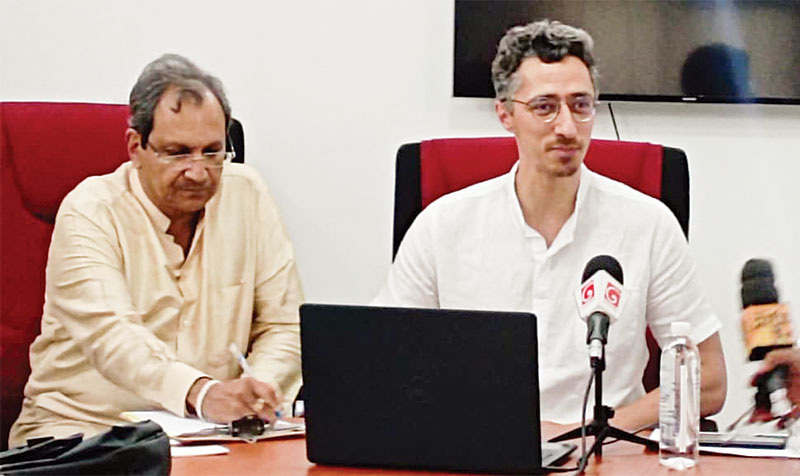
Gautam was delivering the third of talks on February 2nd in the RCSS Strategic Dialogue Series under the aegis of the Regional Centre for Strategic Studies, Colombo, at the latter’s conference hall. The forum was ably presided over by RCSS Executive Director and Ambassador (Retd.) Ravinatha Aryasinha who, among other things, ensured lively participation on the part of the attendees at the Q&A which followed the main presentation. The talk was titled, ‘Where does the media stand in connecting (or dividing) Southasia?’.
Gautam singled out those sections of the Indian media that are tamely subservient to Indian governments, including those that are professedly independent, for the glaring lack of, among other things, regionalism or collective amity within South Asia. These sections of the media, it was pointed out, pander easily to the narratives framed by the Indian centre on developments in the region and fall easy prey, as it were, to the nationalist forces that are supportive of the latter. Consequently, divisive forces within the region receive a boost which is hugely detrimental to regional cooperation.
Two cases in point, Gautam pointed out, were the recent political upheavals in Nepal and Bangladesh. In each of these cases stray opinions favorable to India voiced by a few participants in the relevant protests were clung on to by sections of the Indian media covering these trouble spots. In the case of Nepal, to consider one example, a young protester’s single comment to the effect that Nepal too needed a firm leader like Indian Prime Minister Narendra Modi was seized upon by the Indian media and fed to audiences at home in a sensational, exaggerated fashion. No effort was made by the Indian media to canvass more opinions on this matter or to extensively research the issue.
In the case of Bangladesh, widely held rumours that the Hindus in the country were being hunted and killed, pogrom fashion, and that the crisis was all about this was propagated by the relevant sections of the Indian media. This was a clear pandering to religious extremist sentiment in India. Once again, essentially hearsay stories were given prominence with hardly any effort at understanding what the crisis was really all about. There is no doubt that anti-Muslim sentiment in India would have been further fueled.
Gautam was of the view that, in the main, it is fear of victimization of the relevant sections of the media by the Indian centre and anxiety over financial reprisals and like punitive measures by the latter that prompted the media to frame their narratives in these terms. It is important to keep in mind these ‘structures’ within which the Indian media works, we were told. The issue in other words, is a question of the media completely subjugating themselves to the ruling powers.
Basically, the need for financial survival on the part of the Indian media, it was pointed out, prompted it to subscribe to the prejudices and partialities of the Indian centre. A failure to abide by the official line could spell financial ruin for the media.
A principal question that occurred to this columnist was whether the ‘Indian media’ referred to by Gautam referred to the totality of the Indian media or whether he had in mind some divisive, chauvinistic and narrow-based elements within it. If the latter is the case it would not be fair to generalize one’s comments to cover the entirety of the Indian media. Nevertheless, it is a matter for further research.
However, an overall point made by the speaker that as a result of the above referred to negative media practices South Asian regionalism has suffered badly needs to be taken. Certainly, as matters stand currently, there is a very real information gap about South Asian realities among South Asian publics and harmful media practices account considerably for such ignorance which gets in the way of South Asian cooperation and amity.
Moreover, divisive, chauvinistic media are widespread and active in South Asia. Sri Lanka has a fair share of this species of media and the latter are not doing the country any good, leave alone the region. All in all, the democratic spirit has gone well into decline all over the region.
The above is a huge problem that needs to be managed reflectively by democratic rulers and their allied publics in South Asia and the region’s more enlightened media could play a constructive role in taking up this challenge. The latter need to take the initiative to come together and deliberate on the questions at hand. To succeed in such efforts they do not need the backing of governments. What is of paramount importance is the vision and grit to go the extra mile.
-

 Business7 days ago
Hayleys Mobility ushering in a new era of premium sustainable mobility
-

 Business4 days ago
SLIM-Kantar People’s Awards 2026 to recognise Sri Lanka’s most trusted brands and personalities
-

 Business7 days ago
Advice Lab unveils new 13,000+ sqft office, marking major expansion in financial services BPO to Australia
-

 Business7 days ago
Arpico NextGen Mattress gains recognition for innovation
-

 Business6 days ago
Altair issues over 100+ title deeds post ownership change
-

 Editorial7 days ago
Govt. provoking TUs
-

 Business6 days ago
Sri Lanka opens first country pavilion at London exhibition
-

 Business5 days ago
All set for Global Synergy Awards 2026 at Waters Edge