
News
Plantation expert slams ‘politicisation of science’ by two administrations

By Sanath Nanayakkare
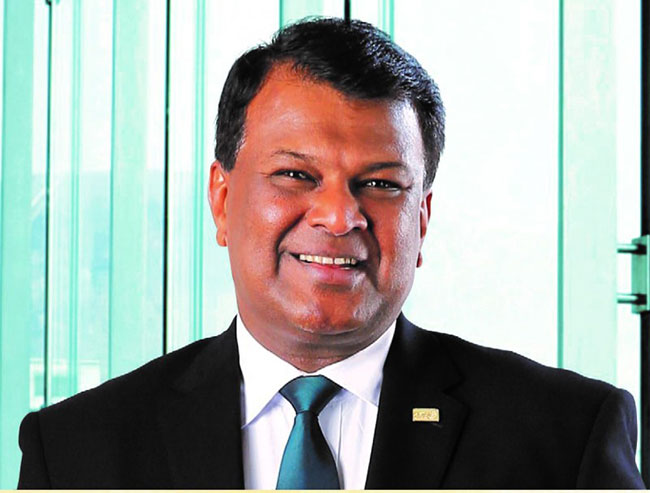
Science was a major casualty in two key agricultural policy decisions made by the previous Yahapalana and the current governments, which on both occasions brought disastrous consequences to the agriculture sector, says Dr. Roshan Rajadurai, Managing Director of the Plantation Sector of Hayleys PLC which comprise Kelani Valley Plantations, Talawakelle Tea Estates and Horana Plantations recently.
Issuing a press statement, he slammed the previous Yahapalana government’s suspension of glyphosate imports and the current government’s decision to ban the import and the use of synthetic fertilisers with a sudden passion for transforming Sri Lanka into a nation with 100% organic agriculture.
Citing the fate of Prof. Buddhi Marambe, he said: “The nation’s best agricultural experts are being ignored or sidelined and silenced because Marambe had simply stated scientific facts regarding the current agro-chemical ban. Marambe had been consistent in doing so when the occasion demanded; he had previously spoken up against the Yahapalana government’s disastrous decision to suspend glyphosate imports.”
“Suspension on glyphosate imports was a policy decision, which resulted in the rejection of Sri Lankan tea exports as a result of issues with Maximum Residue Limits (MRLs), and caused the permanent loss of extremely high value markets in Japan, and it proved costly: all without a single shred of scientific evidence being considered to assess the lasting damage it would have caused. As a result, the government of the day was compelled to back-pedal its decision, but not without irreversible damage being done,” he claimed.
Referring to the chemical fertiliser ban imposed by the current government, he said “Without any prior planning or notice, our entire sector has been coerced into blindly participating in the most unscientific experiment ever attempted in Sri Lanka’s history. Now we are all left to anticipate what the implications of an immediate, nation-wide halt to all established and essential best practices relating to plant nutrition, pest, fungus and weeds would be.”
“Almost seven months from the current government’s initial decision to ban the import and use of synthetic fertilizers and as at today, Sri Lanka’s entire agriculture and plantation economy is still frantically in search of any viable option to mitigate the threat of declining yields.” he said.
“We are told that arrangements are being made to import organic fertiliser from various, untested sources, and agreements are minted to produce organic fertiliser locally, much akin to attempting to fix the engine troubles on an airplane while it is in flight. Nevertheless, the inconvenient truth is at present, all supplies of ‘organic’ and inorganic fertiliser are in short supply.”
“Stocks which are available, have increased in price owing to supply-demand imbalances, disrupted supply chains and unprecedented increases in landed costs. Such escalating payments are making Sri Lankan tea’s already high cost of production (COP) even higher, which is placing Sri Lankan plantations under further stress. This is happening just a few months after an increase in worker wages was thrust through the Wages Board.”
” With the end of the year approaching, and the window for fertilising crops closing, it appears that the industry will be locked into at least one – if not more – growth cycles without basic nutrients of Nitrogen, Potassium, and Phosphorus, and with no ability to control pests and weeds. Without immediate solutions, the broad consensus among those with expertise is that we could see exponentially worse crop losses starting from the end of 2021, hitting approximately 40% by next year.”
“If RPCs had disregarded agronomic practices and norms in such a manner on their own volition, it would have been called ‘criminal mismanagement’. With agricultural best practices now being roundly ignored in favour of a largely undefined and unplanned strategy for transforming Sri Lanka into a nation with “100% organic agriculture”, this historic, and intentionally misinformed self-sabotage is being repackaged as visionary and progressive. Regardless of short-term political expediency, reality has a way of asserting itself,” he said.
Referring to the negative impact on employment, he said, “Spread across 14 districts, the tea industry alone provides direct employment to over 600,000 people engaged in cultivation and processing and indirect employment to a further 200,000 involved in the supply chain. The sector provides complete livelihood support for a resident population of one million in Regional Plantation Companies (RPCs) and 450,000 tea smallholders with one million dependents, hence supporting a total population of nearly 2.5 million.”
“When considering both employment and livelihood generation, it is estimated that the industry sustains more than 10% of our national population and its net foreign exchange earnings are only second to the garment industry.”
“Even if “organic” fertilliser is made available, there are still serious concerns as to whether it can provide sufficient nutrients. Hence, it appears that the writing is on the wall. With insufficient nutrients as a result of the unplanned push for organic, we anticipate a series of cascading failures stemming from a collapse in productivity. No amount of rhetoric will be able to turn back the tide of negative repercussions of such developments.”
“The only measure that could at least temporarily mitigate this dynamic is the implementation of productivity linked wages. This is a model which has the support of all RPCs, and which has been widely practiced with tremendous success by tea smallholders.”
“If there’s any resistance to it, that’s not from workers who have experience with productivity linked wages, but from Trade Unions who would lose their relevance if such models were implemented. Under the proposals made by RPCs workers could earn between Rs. 37,000 and Rs 62,000 and the model would enable workers to choose flexi-hours. Given the labour shortages prevalent across the entire tea industry, such a move would at long last incentivize workers effectively, and reward them for achieving their full individual potential, thereby significantly optimising labour productivity.
“However, without a scientific resolution to the fertiliser crisis, wage reforms can only serve as a stop gap measure. As land productivity drops, RPCs, state plantations and smallholders alike will be forced to reduce the amount of work offered, leading to a continuous decrease in worker earnings,” he said.
Dr. Roshan Rajadurai was also a former chairman of the Planters’ Association of Ceylon with 36 years of experience in the plantation sector.


By Shamindra Ferdinando
Iran has sought the Indian intervention, at the highest level, to provide lifesaving support to the crews of empty Iranian vessels stranded just outside Sri Lanka’s 12-nautical mile territorial waters off Galle.
Sources familiar with the issue said that Iran had brought the developing situation to the attention of New Delhi as the crews of almost 20 vessels, included Indian nationals. Sources stressed that the group of vessels that unloaded crude oil a couple of months back were now stranded within Sri Lanka’s Exclusive Economic Zone (EEZ).
The US Navy torpedoed an unarmed Iran frigate, returning from India, on 04 March, 2026, about 19 nautical miles off the Galle coast. The unprovoked attack killed nearly 100 Iranians.
The Iranian Embassy in Colombo has inquired from the Indian High Commission of their response to the situation, sources said. The US has issued a global warning against providing food, water, medicine and other services to the Iranian vessels. The outcome of Iran-India talks on the issue at hand was not known, though sources asserted India may not throw its weight behind Iranian efforts to address the issue.
Responding to The Island queries, sources said both Sri Lanka and India were in a dilemma due to the US warning. India couldn’t ignore the plight of the Indian crew members and the Iranian vessels in its backyard.
The Sri Lankan government remains tight-lipped about the vessels stranded in its EEZ. Our efforts to elicit a response from relevant authorities were in vain. In addition to Indians, there are Bangladeshis among the crew members. Iran has explicitly stated the responsibilities of the countries concerned to provide assistance in terms of international law.
The Iranian position was articulated by its Ambassador to Sri Lanka, Dr.Alireza Delkhosh, recently. In a special statement, Ambassador Delkhosh emphasised that in terms of the Convention on the Law of the Sea (Article 98) as well as SOLAS and SAR
Conventions, Sri Lanka couldn’t refrain from providing the needs of the Iranian vessels stranded in its EEZ.
SLMC leader Rauff Hakeem lambasted the NPP government in Parliament for failing to provide assistance to the Iranian ships. The former Minister alleged that the government was simply carrying out dictates of the US. He strongly criticised the way Foreign Minister Vijitha Herath was handling the issue.

MP Namal Rajapaksa, who is in remand custody over the controversial Airbus deal, was further remanded until October 27 by the Colombo Magistrate’s Court yesterday (13).
Colombo Chief Magistrate Asanga S. Bodaragama made the order after considering submissions by officers of the Commission to Investigate Allegations of Bribery or Corruption and lawyers representing Rajapaksa.

Sri Lanka’s economy is expected to sustain its recovery over the next two years, although growth is projected to moderate amid mounting global uncertainties, according to the International Monetary Fund’s (IMF) latest World Economic Outlook.
In its World Economic Outlook 2026: Resilience Under Strain, Urgent Choices, the IMF projects Sri Lanka’s economy to expand by 4% in 2026, slowing to 3.7% in 2027, following estimated growth of 5% in 2025.
Inflation, meanwhile, is forecast to rise to 5.3% in 2026 and 5.4% in 2027, reversing the average deflation rate of 0.5% recorded in 2025.
Unemployment is expected to remain steady at 3.9% throughout the forecast period.
The projections come amid growing pressure on the global economy from the ongoing conflict in the Middle East, elevated energy prices, geopolitical tensions and trade disruptions.
Sri Lanka’s external position is also expected to weaken, with the current account balance projected to shift from a surplus of 1.6% of gross domestic product (GDP) in 2025 to deficits of 0.5% in 2026 and 0.3% in 2027.
The IMF’s outlook points to continued economic expansion in Sri Lanka, but with slower growth, rising inflation and a narrowing external surplus giving way to current account deficits over the forecast period.

Heavy showers above 100 mm are likely at some places in the Western, Sabaragamuwa, Southern, Central, and North-western provinces and in Anuradhapura district.

Sri Lanka, India caught in US-Iran ship crisis

Namal further remanded

IMF projects Lankan economic growth to moderate amidst mounting global uncertainties

Major Gen Pushpakumara assumes command of 56 Infantry Division

Dickwella axed, Bandara earns maiden Test call up

‘Dates have the highest sugar content to fight Coronavirus’

Sunday Island 27 December – Headlines

#SundayIsland 17th December – Headlines

Sunday Island – 28th March

Sunday Island Headlines – 21 March

Sunday Island – 21st February – Headlines
-

 Features6 days ago
The Sri Lankan who made Scottish history
-

 Sports6 days ago
Nissanka absence opens door for Sri Lanka’s young guns
-

 News5 days ago
NDB fraud Rs 60mn more than reported
-

 News5 days ago
Removing monk’s robes matter for Sangha to decide: Mahanayake Theras
-

 News6 days ago
Shiranthi R remanded until 13 Oct.
-

 Features6 days ago
Future of Sri Lanka’s state university system: Should it be shut down and reopened?
-

 News3 days ago
Sri Lanka escalates anti-graft drive with Shiranthi’s jailing
-

 News4 days ago
NPP govt. reminded of its responsibilities as US warship leaves Colombo