
Midweek Review
Perpetuating myths about fertilisers

By Prof.Kirthi Tennakone,
National Institute of Fundamental Studies
(ktenna@yahoo.co.uk )
Discussions on chemical fertilisers aroused by the belief they are harmful and degrade the environment worry farmers. The crux of the confusion appears to be that many have forgotten the science learnt in the eighth grade.
At school every kid learns that plants grow when green leaves assimilate carbon as carbon dioxide from the atmosphere and roots extract essential chemical elements in the form of compounds dissolved in water from soil. Both these processes utilise energy derived from sunlight. Plants synthesise; carbohydrates, proteins and fats – the crucial components of foods eaten by humans and animals.
Chemical elements the plants require in largest quantities derived from soil are nitrogen, phosphorus and potassium; denoted N, P and K. Plant growth and metabolism also utilise substantial quantities of sulfur (S), magnesium (Mg) and calcium (Ca). The elements N, P, K, S, Mg and Ca which plants obtain from the soil are termed macronutrients. Plants also need much smaller quantities of several other elements; notably; zinc (Zn), iron (Fe), manganese (Mn), copper (Cu) and boron (B); termed micronutrients.
What is a fertiliser?
Fertilisers are substances containing plant macro and micro nutrients in chemical constitutional forms that could be absorbed by roots.
In the sense of the above dentition; carbon is not a fertiliser, because plants harvest carbon from the atmosphere.
Being suppliers of macro and micro nutrients to plants; all fertilisers are intrinsically chemical in nature and non-chemical fertilisers does not exist. The plants synthesise food for everybody, utilising air, water and inorganic macro and micro nutrients, via a series of chemical reactions.
Chemical Fertilisers
Inorganic chemical fertilisers contain concentrated quantities of macro and micro plant nutrients, generally in optimally available chemical constitutions. Nitrogen in form of nitrates, ammonium salts or urea; phosphorus as phosphates of calcium, potassium or ammonium; potassium as sulfates, chlorides or phosphates and micronutrients as inorganic salts of respective elements. These are stable sources of essential elements, mixed in appropriate proportions. Unless excessively applied, chemical fertilisers are not toxic to plants or pose no serious threats to environment or human health. Above-mentioned chemical fertilisers in their exact and ideal compositions and applied optimally are economical, healthy and least damaging to the environment compared to alternatives. Environmental damages caused by fertiliser manufacturing processes has been minimised, but cannot be avoided completely.
Problems of Commercial
Chemical Fertilisers
Some brands of commercial chemical fertilisers may be contaminated toxic heavy metals such as cadmium, arsenic and lead, as a result of their occurrence in the original precursor minerals or other substances used in the manufacturing process. Their presence can be easily detected by chemical analysis. The problem of heavy metal contamination pertains mostly to phosphate fertilizers; because some rock phosphates deposits used to produce more water-soluble fertilisers, naturally contain hazardous amounts of heavy metals. Arsenic could also be a contaminant of sulfuric acid used in beneficiation of rock phosphate (apatite) to increase the water solubility.
The other hurdles of chemical fertilisers arise as result of their excessive application- beyond amounts plants require. Excess nitrogenous and phosphate fertilisers pollute water and soil creating environmental and health issues.
Use of uncontaminated brands and educating farmers, resolve both these problems.
Fertiliser Manufacture
Until early 1930s world food production has been largely limited by availability of nitrogenous fertilisers – starvation, malnutrition and famines quite common. Nitrogenous manures used were plant and animal waste products often converted to compost and rarely naturally occurring nitrates.
Although nitrogen is abundant in the atmosphere; its chemical inertness prevents easy conversion into nitrates or ammonia. A process which does it (conversion to nitrates) once in a way is lightning – obviously insufficient to manage agriculture. Bacteria associated with leguminous plants also fix nitrogen, but insufficient to meet the demand.
The first person to fix nitrogen artificially was the British chemist Humphrey Davy. In 1807, he found small quantities of ammonia could be produced by electrolysis of nitrogen purged alkaline water.
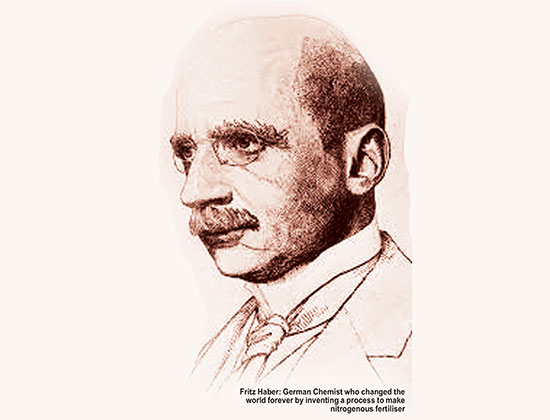
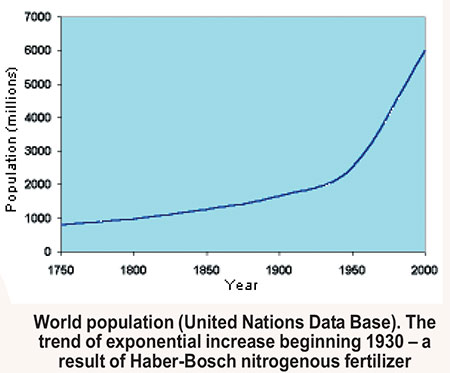
A major breakthrough by German Chemist Fritz Haber in 1807, changed the world forever. He found an efficient method of combining gaseous nitrogen and hydrogen to form ammonia activated by a catalyst. The process further improved by Carl Bosch, widely commercialised beginning 1930, provided the ample supplies of nitrogenous fertiliser, boosting agriculture and food production – greatly reducing premature deaths due to starvation and malnutrition. Demographic data clearly indicate, the trend of population expansion initiated by Haber-Bosch process (see figure above). World population limited by supply of food escalated exponentially; increasing from approximately 2 billion in 1930 to 7.7 billion today. The world can marginally sustain only about half of the present population without nitrogenous fertilisers synthesised via Haber-Bosch process. If this process was not invented; the glamorous comforts we have today and many of us would not be here.
It can be argued, the unprecedentedly aggressive COVID-19 pandemic is a consequence of the Haber –Bosch nitrogenous fertiliser production, because high population density happens to the main cause of virus propagation. Again, nitrogenous fertiliser based agriculture may irreversibly impair the environment. Can we curtail fertiliser production by Haber-Bosch process because of above reasons? Yes, but half of world’s population will faces the risk starvation and conflicts originating as result of food shortage would kill many more!
Green Revolution and Fertilisers
Haber-Bosch process opened the way for the green revolution the next step in the ladder of agricultural development. The main achievement of the green revolution initiated 1960s has been breeding high yielding varieties of crops. Cultivation of such crops using chemical fertilisers and agrochemicals, uplifted food production particularly in developing countries. These crops were bred and made to evolve under conditions of a good supply of plant nutrients applied as chemical fertilisers and their continuation require same treatment. They would not perform satisfactorily, when fed with inferior fertilisers.
Organic Fertilisers and
Bio – fertilisers
Organic fertilisers sometimes erroneously referred to as carbon fertilisers use plant or animal derived materials as sources containing nutrients. In highlighting the term ‘carbon fertiliser’ the ignorant tend to believe that plants could consume carbon in soil and grow! Organic manures contain macro and micro plant nutrients, converted to inorganic forms by denaturing and bacterial decomposition. They have the advantage as soil conditioners and retainer of nutrients, owing to presence carbonaceous substances. Microorganisms present sometimes establish symbiotic relationship with plants. However, the concentration of nutrients per unit weight of organic fertilisers turns out to be orders of magnitude smaller than that of commercial chemical fertilisers. Consequently, their storage, packaging and transport are more cumbersome and costly. If based entirely of plant or animal derived materials; organic fertilisers remain largely uncontaminated with toxic heavy metals. Nevertheless, one need to be cautious in converting domestic and city refuse to compost. In addition to vegetable and animal derived waste; garbage invariably contains metallic objects, plastics, discarded batteries and pieces of electronic components. All these non-biological things in garbage contain heavy metals and other toxic substances. Processing of organic fertiliser also degrade the environment.
Bio-fertilisers means preparations containing microbes, claimed to promote plant growth when introduced to soil. Microbes are said to establish symbiotic relationship with the plant root system, enhancing nutrient absorption and may also fix nitrogen. An open question is whether an inoculum of microbes will proliferate and survive sufficiently long in every soil associating with different crops. The literature on the subject inclines more towards advertising products rather than analysis of experiments and field trials to determine the efficacy and reproducibility. Evidence doesn’t exist to the effect that bio-fertilisers could replace conventional chemical fertilisers and deliver yields adequate to feed the world population.
Another much advertised fashion is organic farming. The concept of the organic farming imply use of only naturally occurring materials as fertilisers and agrochemicals. Although the yields of organic farming rarely compare with conventional products they are claimed to be healthier and attract the affluent. Avoiding synthetic pesticides is definitely a merit. However, the claim that organic fruits and vegetables contain no toxic heavy metals couldn’t be always true. Organic farming permits use of rocks as fertiliser components and therefore apatite as a source of phosphorous. Some apatite ores are contaminated with heavy metals, including radioactive elements.
Hydroponics
Hydroponics refers to growing plants without soil in water enriched with macro and micro plant nutrients and illuminated by sunlight or electric lights. The method minimise fertiliser wastage almost completely avoiding their seeping to soil and affords using purest chemical fertilisers, entirely free of toxic contaminants. Even if purest chemical fertilisers are adopted to grow plants in soil; they would still take-up toxic components present in soil. The cumulative accumulation heavy metals and other toxins in our bodies as we get chronologically older, adversely interfere with our health – one of the causes of biological aging. Consuming hydroponically grown vegetables may enhance human longevity. Hydroponic agriculture has many other virtues including habitation in Moon or Mars. Unfortunately, every plant cannot be grown hydroponically. We need to exploit the potential of hydroponics.
Why we cannot abandon
chemical fertilisers
Plants have existed on earth for billions year and fed humans and animals without being fertilised artificially. With the advancement of human civilisation and establishment settlement; humans began to grow preferred varieties of plants for food – birth of agriculture. The success of this effort; provided more food, increasing population further. Whenever societies encounter episodes population increase, demand for food also increase; compelling people to seek new avenues produce more food. The sequence of these events has now culminated with a global population of 7.7 billion fed by an agricultural system based high yielding crops, fertilised by effective and concentrated plant nutrients (chemical fertilisers).
If we suddenly abandon these optimised techniques and revert to older techniques (organic manure) which provided food for a much lesser population; there will be starvation, malnutrition and famines. We cannot avoid chemical fertilisers and continue to feed the existing population.
Invariably production and use of fertilisers cause some degradation of the environment. It is a consequence of an irrevocable dictum of nature, which state: The orderliness (betterment) in one
sector of a closed system cannot be achieved without bringing disorder (impairment) to another sector
of the same system and the disorder (impairment) incurred in the second system can be reversed only by obtaining necessary energy from an outside source.
Plants and animals have lived harmoniously on earth for billions of years without degrading the environment and any damages to the system restored by energy coming from the sun, now we
are beginning to exceed the limits.

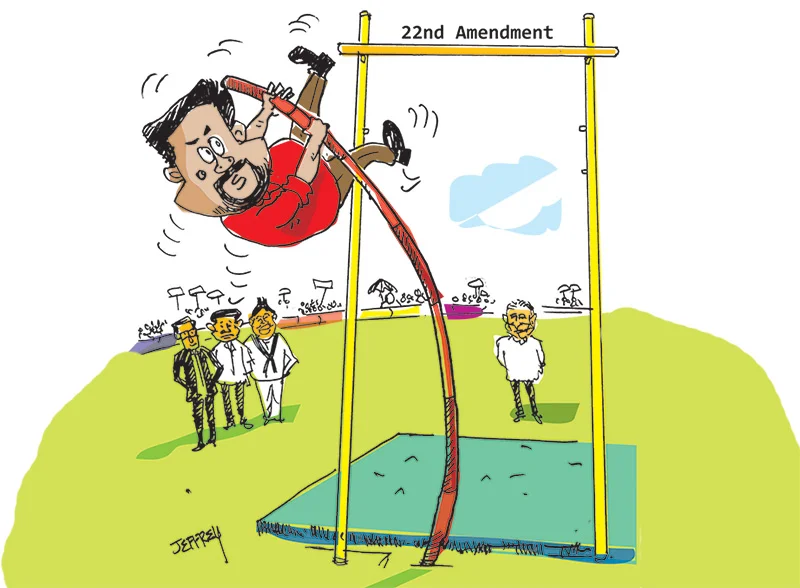
The government’s high profile project to enact the 22nd Amendment failed to secure any tangible support from anyone outside the NPP, in Parliament or outside. In a statement, the Illankai Thamil Arasu Kadchi (ITAK) noted that the proposed amendment concerned the sovereignty of the people and, therefore, required approval through a referendum. The ITAK, a key member of the six-party Political Council of Tamil-Speaking people (PCTSP) and the second largest party in the Northern and Eastern Provinces, other than the NPP, is opposed to President Dissanayake’s move. Tamil Progressive Party (TPA) leader and former Minister Mano Ganeshan, also of the PCTSP, has rejected the 22nd Amendment. The Island learns that all political parties, represented in the PCTSP, are opposed to the proposed Amendment.
The NPP obtained the most seats at the Parliamentary General Election 2024. Other parties that managed to gain seats in Parliament are the Samagi Jana Balawegaya (SJB/40 seats), Ilankai Tamil Arasu Kadchi (ITAK/8 seats), New Democratic Front (NDF/5 seats), Sri Lanka Podujana Peramuna (SLPP/3 seats), Sri Lanka Muslim Congress (SLMC/1), Sarvajana Balaya (SB/1), United National Party (UNP/1), Democratic Tamil National Alliance (DTNA/1), All Ceylon Tamil Congress (ACTC/1), All Ceylon Makkal Congress (ACMC/1), Jaffna – Independent Group 17 (IND17-1) and the Sri Lanka Labour Party (SLLP/1).
Timeline
* March 30, 2026, BASL wrote to Justice and National Integration Minister Harshana Nanayakkara seeking a meeting to discuss 22A
* May 25, 2026, BASL wrote to President Dissanayake seeking a meeting to discuss the same
* July 16, 2026, BASL wrote again to the Justice Minister underscoring the failure on his part and the President to respond to previous letters
* July 27, 2026, NPP executive committee member advocate Lal Wijenayake declared opposition to the government move
* July 29, 2026, BASL met the Justice Minister, sought a meeting with President Dissanayake
* July 31, 2026, Mahanayakes of four Chapters (Nikayas) wrote a joint letter to President Dissanayake urging him not to go ahead with the 22nd Amendment. But, the Mahanayakes refrained from releasing the letter to the media
* August 3, 2026, BASL disclosed the Mahanayakes’ letter to the President. Justice Minister Nanayakkara, accompanied by Health and Media Minister Dr. Nalinda Jayathissa, visited the Mahanayakes to explain the government stand. But, they denied receiving the crucial letter
* August 7, 2026, UN requested President Dissanayake, in no uncertain terms, to abandon the move.
* August 11, 2026, Government admitted receiving the Mahanayakes letter
* August 18, 2026, 22nd Amendment Bill presented in Parliament. Those opposed to the constitutional amendment began filing petitions. The BASL led the way. By 24 August, 21 petitions were filed.
* August 20, 2026, Catholic Bishops’ Conference urged the government not to proceed without adequate consultations.
* August 24, 2026, BASL, in a motion filed in the Supreme Court, suggested that Chief Justice Preethi Padman Surasena recuse from hearing the petitions
By Shamindra Ferdinando
In support of the ruling National People’s Power (NPP) government’s highly contentious move to enact the 22nd Amendment to the Constitution despite worldwide condemnation by eminent jurists, meant to extend the retirement ages of superior court judges, NPP leader and President Anura Kumara Dissanayake will address a series of countrywide meetings.
Dissanayake is also the leader of the Janatha Vimukthi Peramuna (JVP), the main constituent of the governing party.
Justice and National Integration Minister and Attorney-at-Law Harshana Nanayakkara, on 18 August, 2026, tabled the controversial 22nd Amendment Bill in Parliament. Nanayakkara also tabled the Judicature (Amendment) Bill on the same day. That will pave the way for the increase of the retirement ages of High Court judges to 63 years, and District Court and Magistrate Court judges to 62 years. The government wants to increase the retirement ages of Supreme Court and Court of Appeal judges to 67 and 65, respectively.
However, the government has proposed a six-year term for the Chief Justice but he/she will have to retire at the new mandatory retirement age of 67.
Health and Media Minister, as well as Cabinet spokesman Dr. Nalinda Jayathissa, recently announced the decision to launch the high profile propaganda campaign on 5 September. The NPP and JVP leader has vowed to enact the 22nd Amendment, come what may.
Dissanayake, who took over the party leadership on 2 February, 2014, at the 17th convention of the JVP, and formed the NPP in 2019, has indicated that he wouldn’t, under any circumstances, give up the 22nd Amendment. Dissanayake didn’t mince his words when he received a top level delegation of the Bar Association of Sri Lanka (BASL) at the Presidential Secretariat, on 12 August, to discuss the burning issue wracking the country. It would be pertinent to mention that the BASL raised the issue with Dissanayake, on 25 May, after Nanayakkara ignored their first request, made on 31 March.
The Supreme Court will hear over 20 petitions challenging the constitutionality of the 22nd Amendment Bill. Now that the matter is before the Supreme Court, the main opposition Samagi Jana Balawegaya (SJB) shouldn’t have sought to involve the BASL in a futile attempt to educate the NPP parliamentary group. The BASL, too, should know better. The BASL and SJB are among those who moved the Supreme Court. Against that background it would be unthinkable that the NPP parliamentary group wants to listen to BASL. Government activists, on Monday (24), organised a protest outside BASL Secretariat, NO. 153, Mihindu Mawatha, Colombo 12 demanding the resignation of BASL President Rajeev Amarasuriya.
SJB and Opposition Leader Sajith Premadasa clashed in Parliament with the leader of the House Bimal Rathnayake over his bid to bring in the BASL team to address the whole Parliament. NPP National List lawmaker Najith Indika declared on X that “the Opposition Leader couldn’t call all MPs for meetings. BASL either does not follow parliamentary procedure or knows how to manipulate public perception.”
The Supreme Court will receive petitions during two weeks, after the tabling of the Amendment. The Court should inform the Speaker of its determination within three weeks. Parliament will receive that determination ahead of President Dissanayake completing his second year in Office. The last presidential election was held on 21 September 2024.
Dissanayake won a five-year term and in November, the same year, led the party to a resounding victory at the parliamentary poll. The NPP/JVP position is that both Bills can be enacted with a 2/3 majority. With a mammoth 159 seats in Parliament, the government is confident that its political project can be easily achieved. But, the NPP operation has run into significant opposition with the United Nations, throwing its weight behind the BASL-led campaign.
Tabling of the two Bills on 18 August coincided with the 39th anniversary of the JVP grenade attack on the UNP parliamentary group, in the wake of the signing of the Indo-Lanka peace accord in 1987. Ajith Kumara, at that time a minor parliamentary employee, lobbed a hand grenade at the UNP group meeting, chaired by President J.R. Jayewardena. Prime Minister Ranasinghe Premadasa, too, was present. The then National Security Minister Lalith Athulathmudali narrowly escaped death in the attack that took place in the Committee Room 1 of Parliament. Deniyaya MP and Matara District Minister Keerthi Abeywickrema was killed. The writer covered the funeral, held on 22 August, 1987, at the playground of the Morawaka Maha Vidyalaya. Then the young Minister in charge of Youth Affairs and Employment, Ranil Wickremesinghe, was among those who represented the government at the funeral.
Kumara had been recruited as a sweeper by no less a person than the then Secretary General of Parliament, Nihal Seneviratne. Had Kumara been a member of the proscribed JVP at the time he joined the parliamentary staff or did the JVP approach him later?
The Colombo High Court acquitted Ajith Kumara on 12 October, 1990, and released him from custody on 6 August, 1993. Subsequently, the JVP accommodated Ajith Kumara on the party’s politburo and paved the way for him to contest the Sabaragamuwa Provincial Council poll on the JVP ticket. With fat hopes the JVP named him their chief ministerial candidate.
Key Opp demands
Pointing out that the matter before the Supreme Court judges related to them, the BASL requested that a bench consisting of a full court, comprising all the judges, be constituted to determine the constitutionality of the 22nd Amendment Bill. The BASL also requested the Supreme Court to determine that the Bill is inconsistent with Article 3 of the Constitution and required approval by the people at a referendum.
In the alternative, the BASL sought determination that Clause 2 of the Bill is inconsistent with Article 3 of the Constitution and required approval by the people at a referendum and Clause 3 of the Bill is inconsistent with Article 3 of the Constitution and required approval by the people at a referendum.
Essentially, all petitioners have requested for a full court, comprising all Supreme Court judges and a referendum, if ordered, it’ll be the second instance. The first referendum was held in December 1982. The UNP that won an unbeatable 5/6 majority in a 168-member Parliament, at the 1977 parliamentary election, obtained a mandate of the people to extend the life of Parliament by six years. That utterly undemocratic, unreasonable and treacherous act contributed to the overall deterioration of the country. By the time the 1989 parliamentary poll was held, the police, backed by the armed forces, were fighting the JVP in the South, and the Indian Army, deployed in the Northern and Eastern regions, in terms of the Indo-Lanka Accord.
Former External Affairs Minister Prof. G. L. Peiris, convenor of the Joint Opposition grouping, too, moved the Supreme Court against the 22nd Amendment, and General Secretary of the SJB Ranjith Maddumabandara did the same. Altogether there were nearly two dozen petitioners
Ex-Law Professor Peiris has vigorously campaigned against the government move, and the weekly media briefing. held at former President Wickremesinghe’s Flower Road Office, has become the focal point of the Opposition campaign. Peiris insists that the Supreme Court shouldn’t hear the petitions as justices were direct beneficiaries of the proposed Amendment. Therefore, determination should be made at a referendum. In case the Supreme Court decides to hear the petitions, the full court consisting of all judges should be constituted to determine the constitutionality of the 22nd Amendment Bill, the former parliamentarian has asserted.
As repeatedly stressed by Prof. Peiris, two previous determinations by the Supreme Court that the alteration of superior court judges’ retirement ages should be subject to a referendum cannot be disregarded, under any circumstances. One of the determinations is of crucial importance as former Chief Justice Murdhu Fernando (December 2024 to July 2025) served on the three-member bench that made the far reaching announcement in 2022.
But, the BASL made an unexpected move on Monday. Close on the heels of its petition against the 22nd Amendment to the Constitution, the BASL filed a motion in the Supreme Court suggesting that Chief Justice Preethi Padman Suresena recuse from hearing petitions.
Petitioners BASL President Rajeev Amarasuriya and its Secretary Nalin de Silva cited Attorney General as the respondent in a motion filed in terms of Article 121 read with Article 120 of the Constitution to determine whether the Bill, titled “Twenty Second Amendment to the Constitution,” or any part thereof, is required to be passed by a Referendum in terms of Article 83 of the Constitution.
The BASL pointed out that the first Judge of the Supreme Court, who would benefit if this Bill is enacted into law without the process of a referendum, is the Chief Justice, and further that if a referendum is mandated, then that there is a possibility that the Chief Justice may retire before its completion, and if for those reasons, the Chief Justice wished to recuse from hearing this matter, then the petitioners have requested the Chief Justice to constitute a bench comprising of all other judges in Supreme Court.
The maximum number of Supreme Court and Court of Appeal judges are 17, including the CJ and 20 judges ,including the President of the Court of Appeal, respectively. The NPP caused controversy by not filling vacancies among the superior court judges with the Opposition alleging there were four vacancies each. There’ll be another vacancy among the Court of Appeal judges in the first week of September.
The warning issued by the UN following a spate of other statements from various local and international bodies has brought tremendous pressure on the government. Having initially denied any knowledge of a joint letter, dated July 31, addressed to President Dissanayake by the Malwatta, Asgiriya, Amarapura and Ramanna chapters, the government, on 11 August, admitted the President received the letter.
However, the Catholic Bishops Conference publicly commented on this issue, only on 20 August, after all other concerned parties censured the government over the move. A section of the civil society that portrayed the 22nd Amendment as the panacea for a mountain of cases held up in courts had no option but to sing a different tune after the UN warned the NPP government over the pet project that seemed to have backfired. The UN’s position rattled the government and its backers.
18A and 20A
War-winning President Mahinda Rajapaksa enacted 18th Amendment to the Constitution in early September 2010. That despicable political project did away with a two-term time limit for the executive president and expanded presidential powers over independent commissions. That Bill received 161 votes, two more than the NPP parliamentary group. But, 18A didn’t do any good for President Rajapaksa or his party. Maithripala Sirisena, General Secretary of Mahinda Rajapaksa’s party, betrayed him, won the 2015 presidential election, and created an utterly undesirable political environment that, over a period of 10 years, ruined the country’s major political parties.
The emergence of the NPP as the dominant power should be examined taking into consideration the deterioration of the UNP, SLFP and the SLPP. The UNP and SLFP are no longer represented in Parliament while the SLPP that won a commanding 145 seats at the 2020 parliamentary poll was reduced to just three lawmakers in Parliament. SLPP’s National Organiser Namal Rajapaksa was so concerned about the transformation of the political environment he took refuge in the National List. Had he not taken that precaution, he wouldn’t be in Parliament today. While the SLPP deteriorated from 145 seats to just three, the NPP, whose 2020 parliamentary group consisted of just three, including one National List member (Dr. Harini Amarasuriya) ended up taking 159 seats, the best results achieved under the Proportional Representation system introduced in 1989.
Having handsomely won the 2019 presidential election, Gotabaya Rajapaksa brought in the 20th Amendment aimed at further consolidating his hold on power. Basil Rajapaksa, a dual citizen of Sri Lanka and the US, wanted to enter Parliament through the National List. The Rajapaksas removed a particular clause through the 19th Amendment to enable Basil Rajapaksa to enter Parliament. Subsequently, the SLPP accommodated Basil Rajapaksa in the Cabinet as the all-powerful Finance Minister. He succeeded Mahinda Rajapaksa in July 2021. But by then, the national economy had suffered irreparable damage and the 20th Amendment, meant to consolidate executive power, seemed irrelevant. Public protest campaign that received overt and covert US and Indian backing was launched in March 2022, leading to President Gotabaya Rajapaksa’s unceremonious ouster in July of same year due to India and Western backed violent protests.
The 18th Amendment and the 20th Amendment were enacted at the expense of particularly the 17th and 19th Amendments, respectively.
The Frontline Socialist Party (FSP) has alleged that the 22nd Amendment would enable the government to implement its neoliberal programme. The breakaway JVP group has asserted that the government’s sinister project is intended to remove whatever obstacles to its neoliberal strategy.
FSP’s Education Secretary Pubudu Jayagoda said: “A new Fisheries Act will divide the ocean into plots, lease the fish-rich areas to multinational corporations, and deprive local fishermen the opportunity to catch fish in the deep sea. The biggest obstacle to this is the fishermen. A Quality Assurance and Accreditation Commission Act is being drafted to grant state recognition and legality to degree mills. Three thousand schools are going to be closed, depriving children of the fundamental right to education. To do that, every pillar of the state must be brought under government control. A long list can be given: privatising hospital laboratory services, selling off state institutions, bringing forward new repressive laws like the PSTA (Protection of the State from Terrorism Act), and a new Cooperatives Act that snatches away people’s funds—many things like that. Taking the arbitrary power required to execute these into the hands of the executive is the true objective of this constitutional amendment.”

Displaying Gender-Based Issues that Resonate with Our Times
by Dr. Siri Galhenage
Psychiatrist [Retd]
In most of William Shakespeare’s plays, the protagonists are male. He created such memorable characters as Hamlet, Othello, King Lear, Macbeth, Julius Caesar, Prospero, Coriolanus, the monarchs of history plays and many others – heroes as well as villains. This was a reflection of the societal values of the time. Women were not permitted to perform on stage, and all female roles were played by young males – a practice that continued for nearly half a century after Shakespeare’s death. This was so even though Elizabeth 1, the learned female monarch of England and Ireland and a humanist, occupied the throne during most of Shakespeare’s writing life [1580–1613], and extended her patronage to his plays.
Nevertheless, compared with his contemporaries Christopher Marlowe and Ben Jonson, Shakespeare wrote a greater number of plays featuring prominent female characters that drove the narratives, providing insights into intra-psychic, interpersonal, social and moral aspects of life.
I have selected two such female characters from Shakespeare’s plays and another from one of his narrative poems to illustrate this idea, focusing primarily on gender based violence – emotional, physical and sexual – that continues to resonate in our own times. I have also chosen another female character who challenged the gender constraints that imposed by contemporary society.
DESDEMONA in Othello –
A Victim of Morbid Jealousy
A scene from As You Like It
Jealousy, as a human experience, has many nuances of meaning, ranging from the harmless to the morbid, including delusional forms, with many variations in between. The object of concern in jealousy is the suspicion of unfaithfulness or infidelity on the part of a loved one, commonly a female partner in a marital relationship. In its morbid form, accompanied by intense passion, jealousy has the potential to be destructive and even dangerous, placing the spouse at risk. It is not an uncommon presentation in clinical practice attracting the diagnosis of ‘Othello Syndrome’ although there is disagreement among clinicians about the application of the term.
Othello, a valiant soldier of African heritage in the state of Venice, had no difficulty winning the heart of Desdemona, the attractive young daughter of a prosperous senator. He took her away in defiance of her father’s wish for her to marry into the Venetian nobility. At this point, the Turks were preparing to regain Venetian-held territory in Cyprus, and Othello, recognised for his military prowess, was selected to lead the defence of the territory.
Despite the imminent Turkish attack on Cyprus, Desdemona preferred to remain with her husband rather than stay in Venice. The attack did not eventuate, however, because a violent storm dispersed and destroyed the invading Turkish fleet. The Venetian forces rejoiced, and the occasion provided an added opportunity to celebrate the marriage of Othello and Desdemona.
Casio, a close confidant of Othello, who had been recently promoted to lieutenant, was delegated to supervise the festivities. Cassio’s promotion caused great offence to Iago, who strongly believed that he was better suited to the position. He plotted to take revenge on Othello and Cassio by planting the seed of doubt in Othello’s mind through innuendo and trickery, casting suspicion on Desdemona’s fidelity and on her relationship with good-looking Cassio. Desdemona, a woman of exuberance and humour, became the unwitting focus of Iago’s manipulation.
The dissonance that arose in Othello’s mind eventually reached a climax when he accused his wife of infidelity and became convinced that she should die. Despite Desdemona’s plea for compassion, Othello strangled her to death. On finally gaining insight into the whole saga, Othello fell on his sword beside his wife.
OPHELIA in Hamlet – A Case of Manic Defence in response
to emotional abuse
Hamlet, the Prince of Denmark, takes centre stage in the play of the same name, and his mental processes have been the focus of scrutiny by successive generations of critics.
Young Prince Hamlet is faced with a complex emotional challenge following the sudden death of his father, King Hamlet, he idolised. The late king’s brother, usurper to the throne, hastily marries the widowed queen, denying the young prince his lawful right to sovereignty. Hamlet’s grief is compounded by his outrage towards his mother and his lingering doubts about the circumstances of his father’s death. He lapses into a state of melancholy.
But the impact of Hamlet’s emotional instability and the displacement of his anger onto Ophelia, to whom the prince had professed his love, receive less attention by critics, despite the significant psychological issues raised by her predicament. The episode in which Hamlet directs his anger towards Ophelia – often referred to as the ‘nunnery scene’ – is considered one of the most vicious in all Shakespeare.
Get thee to a nunnery. Why wouldst thou be a breeder of sinners?”…. “If thou dost marry, I’ll give this plague for thy dowry, be thou as chaste as ice, as pure as snow, thou shall not escape calamity. Get thee to a nunnery; go, farewell. Or if thou wilt needs marry, marry a fool, for wise men know well enough what monsters you make of them. To a nunnery go, quickly too. Farewell
Her love for Prince Hamlet was forbidden from the outset by her father, the scheming counsellor, Polonius, and by her brother Laertes; she was obedient to them. With her dignity destroyed by the very person she loved and her father killed, albeit inadvertently by the hand of her lover, she nevertheless reacted with compassion. With her brother away in France, Ophelia is bereft of any meaningful relationships.
With no one left to confide in, her mind had no alternative but to escape reality. She lapsed into a state of mania – a state of ‘fragile happiness’ with underlying deep sorrow; an unconscious defensive operation of the mind known as ‘manic defence’, as described by Melanie Klein [1882-1960], the renowned Austrian Psychoanalyst.
In this state of mind, Ophelia presents herself before the king and queen, singing snatches of song concerning love, death and betrayal. Her behaviour is totally out of character to her formerly demure self. Here are a few excerpts from her verses illustrating what might be described as a ‘flight of ideas’.
How should I your true love know/ From another one? / By his cockle hat and staff/ And his sandal shoon…”
“He is dead and gone, lady/ He is dead and gone/ At his head a grass green turf/ At his heels a stone…
They say the owl was a baker’s daughter. Lord we know what we are, but know not what we may be. God be at your table …
Hey non nonny, nonny, hey nonny/ And in his grave rained many a tear …” “You must sing ’Adown adown’ and you call him adown-a.”
Later, Queen Gertrude, Hamlet’s mother, announced that Ophelia ‘Fell in a weeping brook while making garlands from crow-flowers, nettles, daisies and long purples’, and had made no attempt to save herself. At the graveyard two gravediggers discussed whether she deserves a Christian burial as she appeared to have taken her own life.
LUCRECE – in Shakespeare’s narrative poem The Rape
of Lucrece
Reworked from a story by the Roman historian Livy, Shakespeare’s innovative narrative poem, first published in 1594, gives access to the mind of a victim of sexual assault. Set in ancient Rome, the poem gives expression to the agony of Lucrece, the gracious wife of a nobleman, following a savage attack upon her by Sextus Tarquinius, the son of the brutal king Lucius Tarquinius of Rome.
During a joyous conversation, a group of young noblemen were commenting on the virtues of their wives when Collatinus extolled the incomparable beauty and chastity of his beloved Lucrece. Aroused by the description of her elegance, young Sextus makes a covert exit, ‘borne by the trustless wings of desire’ in pursuit of his prey –the peerless dame’, ‘weakly fortressed from a world of harm.
Lucrece warmly welcomes her royal guest, who shows no inward ill or outward harm. He praises her husband’s military prowess, ‘pawning his honour to obtain his lust. During the conversation he scans her beauty and burns with sexual desire, yet ‘is madly toss’d between desire and dread. His ambivalence finally gives way to desire. ‘Desire my pilot, beauty my prize/ ‘Then who fears sinking where such treasure lies?’ This said, he advances upon her, ‘like a falcon towering in the skies, that ‘Coutcheth the fowl with his wings’ ‘So under his insulting falcon lies/ Harmless Lucretia’ shade’, trembling with fear, ‘as fowl hear falcon’s bells’. She ‘lies at the mercy of his moral sting’ and finally succumbs ‘To the rough beast that knows no gentle right/ Nor aught obey but his foul appetite’.
Lucrece is shattered, perplexed and grief-stricken by the unexpected assault on her by her honoured guest. ‘I alone must sit and pine/ Seasoning the earth with showers of silver brine’. She weeps, ‘O unseen shame, invisible disgrace/ O unfelt sore, crest wounding private scar’. Her anguish is further expressed through the image of the violated hive. ’My honey lost, and I, a drone – like bee, have no perfection of my summer left/ But robb’d and ransack’d by injurious theft./ In thy weak hive a wand’ring wasp hath kept/ And suck’d the honey which thy chaste bee kept’.
In this state of mourning, Lucrece despatches two messengers: one to her father in Rome and the other to her husband on the battlefield. On their arrival, she reveals the circumstances of her agony and names the individual responsible. She then stabs herself to death.
Their entourage carry her body through Rome and vow to avenge the death of this ‘incomparable woman of chaste’. By public acclaim the reign of Tarquins is overthrown, and the rule of Rome handed over to the consuls.
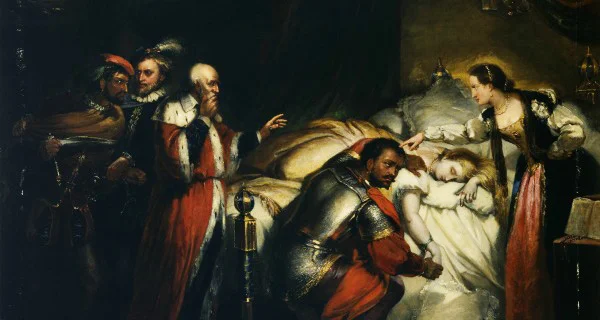
A scene from Othello
ROSALIND in ‘As You Like It’ – Challenging the Gender Constraints
One of the few female characters to play a leading role is Rosalind in ‘As You Like It’. She remains much to the liking of many a theatre goer because of her wit, wisdom and inner strength. Rosalind transcends the constraints imposed on women during the Shakespearean era – constraints that continue to resonate in certain cultures even today.
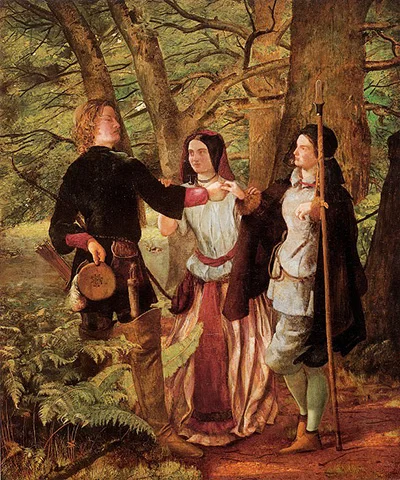
Two young women of noble birth flee the oppressive court in disguise and seek refuge in the Forest of Arden. Rosalind disguised as a young man, Ganymede, while her devoted cousin Celia adopts the name Aliena. As they depart Celia declares, “Now go we in content/ To liberty, and not to banishment.” Orlando, the object of Rosalind’s affection, also escapes to the forest to evade the hostility of his brother. Unaware of Rosalind’s disguise, he expresses his love by hanging verses in her praise upon the trees. Although Rosalind discovers these poems, she chooses to maintain her disguise, using it as an opportunity to test Orlando’s devotion and explore the nature of love, courtship, and the differing gender expectations. The play reaches a conclusion by Rosalind dropping her disguise, and the two uniting in love.
*****
Gender-based violence is recognised globally as a pervasive violation of human rights and a significant social, cultural and public health concern. Violence against women, including emotional, physical and sexual, varies across societies in form and prevalence, and is often rooted in unequal power relations and social structures that perpetuate male dominance. Gender-based violence requires collective action through education, legal protection, economic empowerment, accessible support services and changes in attitudes and cultural practices. Power and influence should not be allowed to shield the perpetrators.
Art, including dramatic and literary art, serves to illuminate human experience. It allows us to explore emotions, ideas and moral dilemmas that may otherwise remain beyond ordinary expression. Art can entertain and inspire, but it can also challenge our assumptions, evoke empathy, and offer new ways of seeing ourselves and the world around us. In this sense, art is not merely a form of aesthetic pleasure; it is a means of understanding what it means to be human.
Desdemona, Ophelia, Lucrece and Rosalind are among Shakespeare’s more prominent female characters. The first three are innocent victims of male violence in different forms, evoking our empathy and compassion; the fourth challenges the gender assumptions and constraints of the time. Together, they illuminate gender-based issues that are both universal and timeless. In this sense, Shakespeare remains ‘our contemporary’, as Jan Kott, Polish-American literary critic, famously observed.

By Lynn Ockersz
Nature’s not on any vengeance trail….
Rather, from dense forests of the West,
Now all aflame in parts as if in rage,
To South-East Asia’s savaging floods,
And Sri Lanka’s fierce dry spells,
Where man and beast are imperiled,
Nature’s signaling she’s distressed,
Over her custodian’s ravenous lust,
Which unceremoniously gobbles-up,
Her graciously bestowed riches;
‘Take warning; slow down at least now’,
She seems to be chiding her wayward son,
‘Be gentle with me and all my treasures,
And I’ll look to your continuing wellness,
But rein-in your self-destructive fire,
Lest it consumes your willful self in full,
And all I have left in your custodial care.’

Sun directly overhead Kokkuvil, Nallur, Kodikamam and Nagar Kovil at about 12.11 noon today (28)

Showers above 75 mm are likely at some places in the Western and Sabaragamuwa provinces and in Kandy, Nuwara-Eliya, Galle and Matara districts

Eight politicians in drug kingpin probe

CJ first SC judge to benefit from 22A, if enacted: BASL

Over 84,000 people adversely affected by prevailing El Niño dry weather

Rooftop solar systems over 300kW to be temporarily switched off

‘Dates have the highest sugar content to fight Coronavirus’

Sunday Island 27 December – Headlines

#SundayIsland 17th December – Headlines

Sunday Island – 28th March

Sunday Island Headlines – 21 March

Sunday Island – 21st February – Headlines
-

 Business6 days ago
SriLankan Airlines makes ShakthiSAT Mission possible for talented Sri Lankan student
-
 Latest News7 days ago
Imran Khan moved to private hospital amid deteriorating health
-
 Latest News7 days ago
Government has declared 21, 22 and 23 August 2026 as national days of mourning
-
 Features5 days ago
My secondary schooling after Royal Primary
-

 Features5 days ago
From the First to the 22nd: A short history of Amendment Politics and Reform Frustrations
-

 Latest News6 days ago
Tharanga edges out Chopra in 88m javelin battle
-

 News3 days ago
Missing doctor’s body found in Mahiyanganaya
-
 Features5 days ago
How Shelton Kodikara became first Professor of International Relations