
News
People’s Bank reboots iconic Economic Review with digital-first vision


Marking five decades of contribution to national economic dialogue, People’s Bank ceremoniously relaunched its flagship publication, the Economic Review, on July 31 at the People’s Bank Staff Training College, Colombo 05. The event commemorated the magazine’s enduring legacy while unveiling a revitalised editorial vision and expanded digital presence.
The ceremony was graced by Dr. Harshana Suriyapperuma, Secretary to the Treasury and Ministry of Finance, Planning, and Economic Development, who attended as Chief Guest. Joining him were People’s Bank Chairman, Prof. Narada Fernando, Director Bradley Emerson, CEO/General Manager Clive Fonseka, DGM – Payments & Cards / DGM (Acting) – Strategic Planning Nilmini Premalal, along with senior members of the Bank’s corporate and executive management teams, distinguished academics, and Prof. Ruwani Fernando, the newly appointed Editor-in-Chief of the magazine. The magazine was reviewed by Prof. Kaushalya Yatigammana, adding academic depth.
First published in 1975 by the Bank’s Research Department, Economic Review was envisioned as a multidisciplinary platform to promote informed, accessible, and contextually grounded discussion on key national and regional economic issues. It responded to a growing need for credible economic analysis and commentary, engaging a broad readership that includes students, academics, researchers, policymakers, and development professionals.
 The publication has remained committed to its founding mission: advancing public understanding of economic development through analytical depth, balanced perspectives, and knowledge dissemination in all three national languages—Sinhala, Tamil, and English. With a rich archival catalogue, the magazine has become a vital source for socio-economic research and policy reflection in post-independence Sri Lanka.
The relaunch marks both a moment of introspection and a forward-looking shift. As global and domestic economies undergo profound changes—from climate volatility and digital transformation to evolving monetary systems and inclusive finance—the need for a credible, interdisciplinary forum for economic thought has never been greater.
A key feature of the relaunch is the magazine’s availability in both print and digital formats. Adopting a digital-first publishing model will significantly broaden its reach, remove institutional access barriers, and ensure greater engagement across a wider spectrum of readers. The new online platform will also house a searchable archive of back issues, preserving five decades of economic insight.
The relaunched edition, themed “Unlocking SME Potential through Digital Transformation,” offers 52 pages of curated content, that examine the vital role of small and medium enterprises in Sri Lanka’s evolving digital economy.
Published biannually as a Corporate Social Responsibility (CSR) initiative by People’s Bank, Economic Review is coordinated by the Bank’s Strategic Planning, Performance Management, and Research Department. The magazine is freely accessible via the official website: www.peoplesbank.lk.

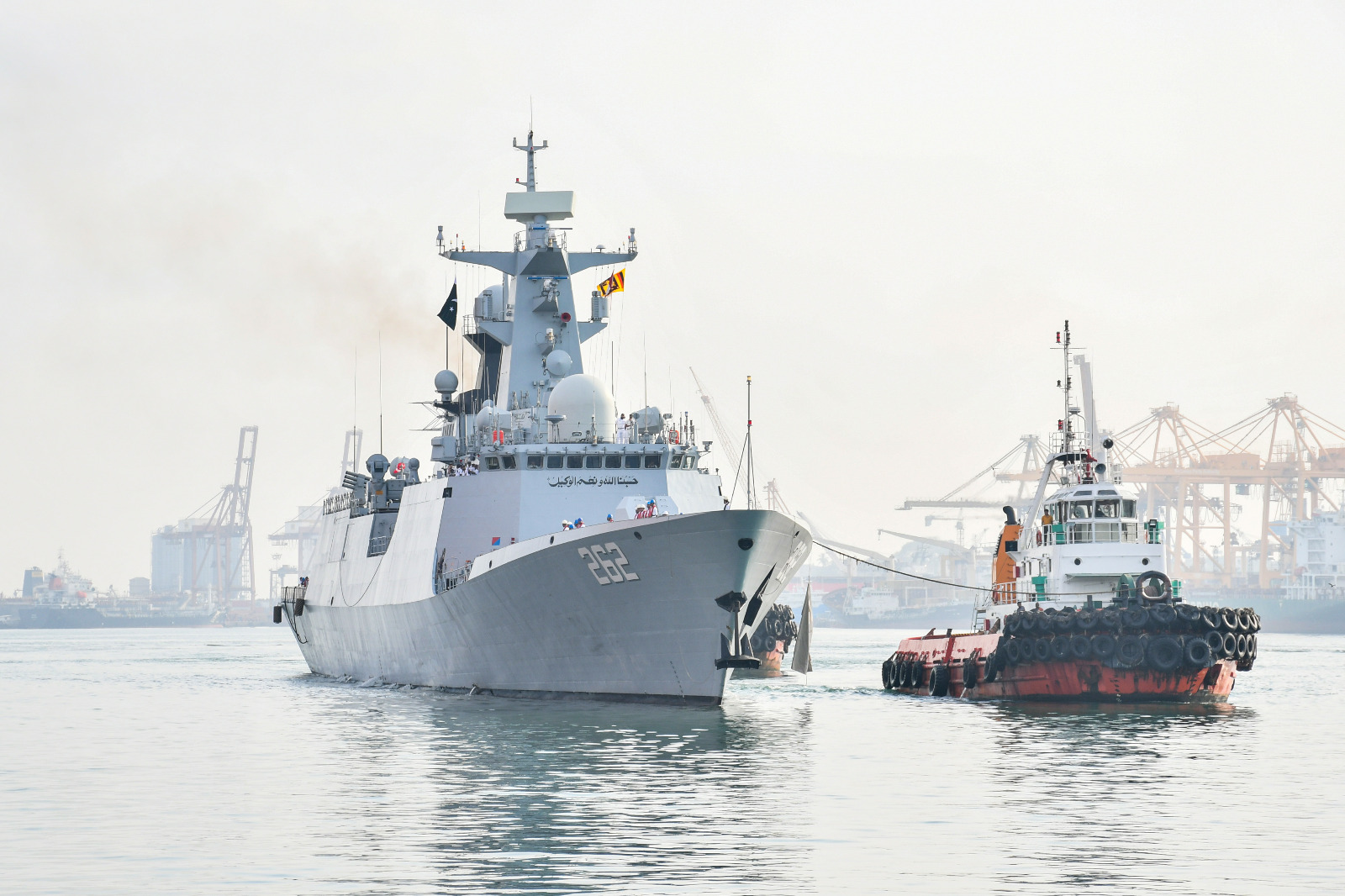
The Pakistan Navy Ship (PNS) TAIMUR and ASLAT arrived at the Port of Colombo on a goodwill visit on 12 Apr 26.
The visiting ships were welcomed by the Sri Lanka Navy in
compliance with naval traditions.
The duo of ships is commanded by Captain NIAMAT SAEED KHAN (PNS TAIMUR) and Captain NADIR MATEEN AFRIDI (PNS ASLAT).
Meanwhile, the ships are expected to conduct a Bilateral Naval Exercise LION STAR V with the Sri Lanka Navy in Colombo seas.
Latest News
Heat index likely to increase up to ‘Caution level’ at some places in the Northern, North-central, North-western, Western, Sabaragamuwa, Southern and Eastern provinces and Monaragala district


Warm Weather Advisory
Issued by the Natural Hazards Early Warning Centre at 3.30 p.m. on 11 April 2026, valid for 12 April 2026
The Heat index, the temperature felt on the human body is likely to increase up to ‘Caution level’ at some places in the Northern, North-central, North-western, Western, Sabaragamuwa, Southern and Eastern provinces and Monaragala district.
The Heat Index Forecast is calculated by using relative humidity and maximum temperature and this is the condition that is felt on your body. This is not the forecast of maximum temperature. It is generated by the Department of Meteorology for the next day period and prepared by using global numerical weather prediction model data.

Effect of the heat index on human body is mentioned in the above table and it is prepared on the advice of the Ministry of Health and Indigenous Medical Services.
ACTION REQUIRED
Job sites: Stay hydrated and takes breaks in the shade as often as possible.
Indoors: Check up on the elderly and the sick.
Vehicles: Never leave children unattended.
Outdoors: Limit strenuous outdoor activities, find shade and stay hydrated.
Dress: Wear lightweight and white or light-colored clothing.
Note: In addition, please refer to advisories issued by the Disaster Preparedness & Response Division, Ministry of Health in this regard as well. For further clarifications please contact 011-7446491.
Latest News
Sun directly overhead Cheddikulam, Kebithigollewa, Gomarankadawala and Nilaveli about 12:11 noon. today [12]

On the apparent northward relative motion of the sun, it is going to be directly over the latitudes of Sri Lanka from 05th to 15th of April in this year.
The nearest areas of Sri Lanka over which the sun is overhead today (12th) are Cheddikulam, Kebithigollewa, Gomarankadawala and Nilaveli about 12:11 noon.

PNS TAIMUR & ASLAT arrive in Colombo

Sanju Samson and Jamie Overton deliver first points for Chennai Super Kings

Arya, Prabhsimran and Shreyas help Punjab Kings ace another 200-plus chase

Beauty of Sri Lanka in focus: Global showcase blends art, diplomacy and conservation

Showers expected in the Western, Sabaragamuwa, Central, Southern, North-western and Uva provinces and in Ampara, Batticaloa and Polonnaruwa districts after 1.00 p.m.

Heat index likely to increase up to ‘Caution level’ at some places in the Northern, North-central, North-western, Western, Sabaragamuwa, Southern and Eastern provinces and Monaragala district

‘Dates have the highest sugar content to fight Coronavirus’

Sunday Island 27 December – Headlines

#SundayIsland 17th December – Headlines

Sunday Island – 28th March

Sunday Island Headlines – 21 March

Sunday Island – 21st February – Headlines
-

 News6 days ago
Lankan-origin actress Subashini found dead in India
-

 News4 days ago
AG: Coal procurement full of irregularities
-

 Business3 days ago
Israeli attack on Lebanon triggers local stock market volatility
-

 News22 hours ago
CEB orders temporary shutdown of large rooftop solar systems
-

 Business4 days ago
Hayleys Mobility introduces Premium OMODA C9 PHEV
-

 Business3 days ago
HNB Assurance marks 25 years with strategic transformation to ‘HNB Life’
-

 Sports4 days ago
DS to face St. Anthony’s in ‘Bridges of Brotherhood’ cricket encounter
-

 News6 days ago
UN Regional Director launches SL’s first Country Gender Equality Profile during official visit