
Latest News
Pentagon to ‘rush’ Patriot missiles to Ukraine in $6bn package

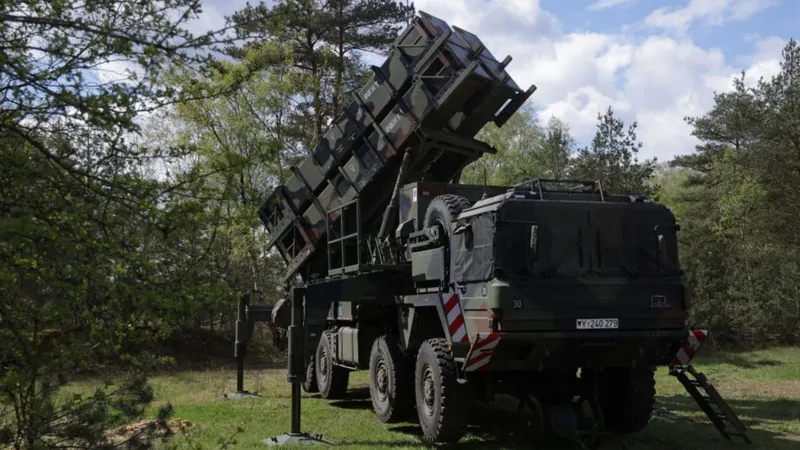
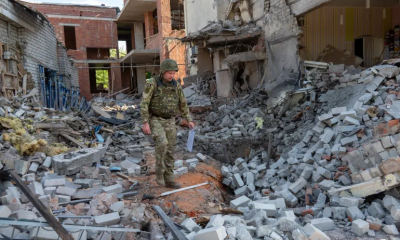
The Pentagon says it will “rush” Patriot air defence missiles and artillery ammunition to Ukraine as part of its new military aid package.
The US will utilise $6bn (£4.8bn) for this purpose, Defence Secretary Lloyd Austin revealed on Friday.
Patriot air defence batteries are not included.
Ukrainian President Volodymyr Zelensky said Patriots were “urgently” needed to face a growing Russian air threat and “can and should save lives right now”.
A source confirmed to the BBC that the $6bn was part of a $60bn aid package signed into law by US President Joe Biden on Wednesday, which also includes $1bn in more immediate aid.
Mr Austin told a news conference that the US was committing to its largest security assistance package to date and would “move immediately” to get the supplies to Ukraine.
These would include air defence munitions, counter-drone systems and artillery ammunition but not Patriots.
“It’s not just Patriots that they [the Ukrainians] need, they need other types of systems and interceptors as well,” Mr Austin said. “I would caution us all in terms of making Patriot the silver bullet.”
He added that he was confident that more of the missile systems would be made available for Kyiv soon. Conversations were ongoing with European partners, he said, to deliver additional capabilities.
The Chairman of the US Joint Chiefs of Staff, General Charles Brown, said the assistance should eliminate the Ukrainians’ need to ration shells on the frontline.
Some of the latest funding would also go to building up Ukraine’s own defence industry, so that it can start manufacturing more of the ammunition it desperately needs.
Mr Austin said Russia had already increased domestic production of artillery ammunition and other weapons – as well as being propped up by supplies from Iran and North Korea. “Understand what’s at stake for Ukraine, for Europe, and for the United States,” he said. “If Putin prevails in Ukraine – Europe would face a security threat it hasn’t seen in a lifetime. Russia will not stop in Ukraine.”
Asked whether the US aid would protect Ukrainian forces, Mr Austin said that the commitment was “material, real, and substantial” although “not instantaneous”.
“It’s going to take some time to get it in there and distribute. The Ukrainians were able to hold – with this capability, they can do a lot better.”
The defence secretary’s words come as Ukraine warned on Friday that Russia was ramping up attacks on its railways ahead of a fresh offensive.
A Ukrainian security source told the AFP news agency that Moscow wanted to damage Ukrainian railway infrastructure to “paralyse deliveries and movement of military cargo”.
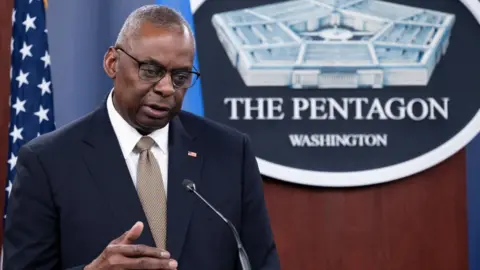
US Defence Minister Lloyd Austin said the aid package was the largest committed to Ukraine to date (BBC)
Ukraine only has a handful of Patriots to complement other Western missile defence systems and existing stocks of Soviet-era surface-to-air missiles (SAMs), such as the S-300.
They are the most capable and expensive air defence systems that Ukraine has. Each Patriot battery costs around $1bn (£800m), and each missile costs nearly $4m.
Germany has already promised an extra Patriot system – and its defence and foreign ministers appealed to their European counterparts earlier this month to respond urgently.
Greece has stocks of Patriots and S-300s but said none could be spared.
“We explained why we cannot do it,” Greek Prime Minister Kyrios Mitsotakis told Skai TV.
His said his country’s air defences were “critical systems for the protection of Greek air space”.
According to reports, Spain will supply some Patriot missiles but not a full system.
Recent months have seen Kyiv step up its calls for Western assistance as its stocks of ammunition are depleted and Russia makes steady gains.
Ukrainian officials have blamed delays in military aid from the US and other Western allies for the loss of lives and territory.
(Aljazeera)










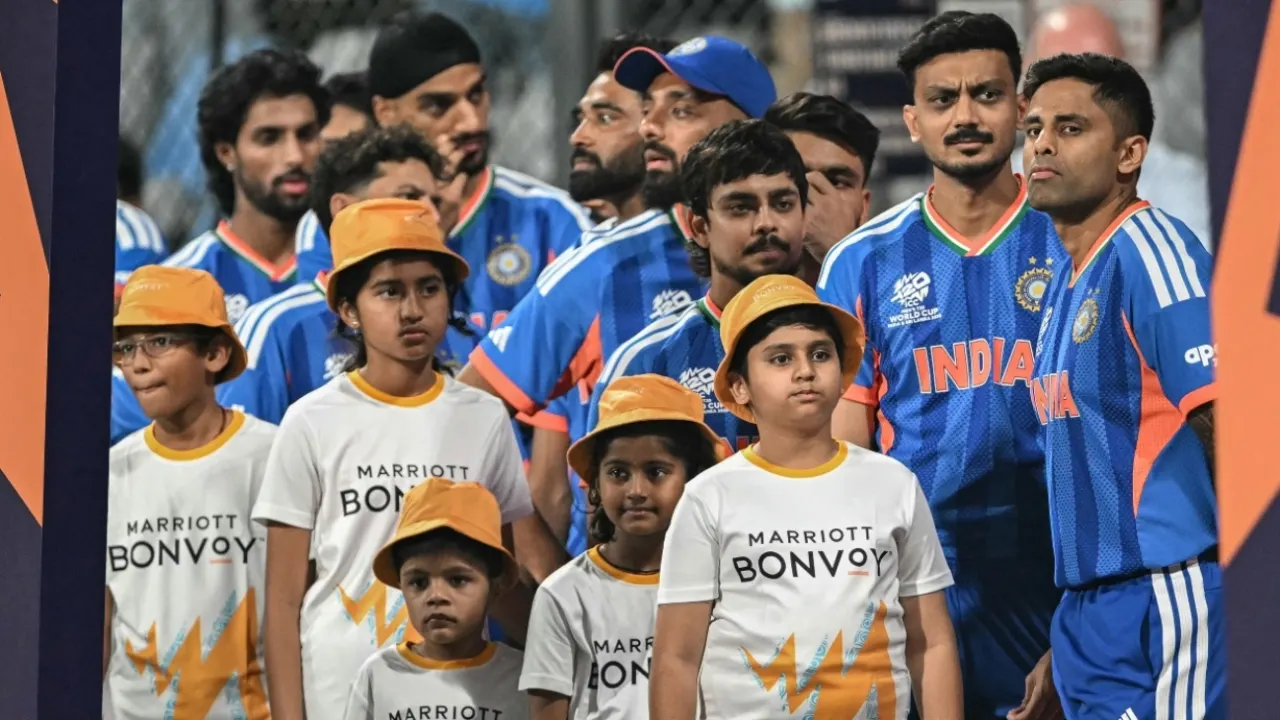
February is usually a wonderful time in Delhi, when winter starts giving way to spring, but people are already complaining of a missed spring with temperatures hitting the late 20s as early as the second week of February. Even amid the climate change of the last decade or so, there has been one pattern: a late hailstorm typically brings back another week of chilly weather. An Indian Winter, if you will, Delhi’s response to Indian Summer, which is the term the English give to a late spell of hot weather when it should be autumn.
The fans, who will sell out the Feroz Shah Kotla even with schools turning down offers for free tickets for students to non-India matches because of looming board exams, will hope for a similar storm of sixes after a dry run in India’s tournament-opener. The anticipation for 300 in the Indian media has come in for some mockery, with the pitches not turning out as flat as they are in bilaterals, but at a venue with small boundaries that has turned high-scoring in recent IPL seasons, India will hope to get back to big-scoring ways after navigating a banana peel against USA on a gripping Wankhede surface.
Against them are Namibia who managed just 156 in Delhi against Netherlands and lost quite comfortably. They might still sense a chance as India struggle with fitness and health issues around Jasprit Bumrah, Abhishek Sharama and Washington Sundar, and will themselves be gunning to go big with the bat in a World Cup. What an opportunity for Namibia to make a name for themselves by stretching the strongest-ever contenders for a T20 World Cup.
When India were struggling against USA in the unfamiliar conditions laid out by Mumbai, it was Suryakumar Yadav’s blinder that gave them a match-winning score. That wretched year of 2025, during which he didn’t score a single fifty, seems well and truly behind him now. Suryakumar now has more match awards for India than anyone, having gone past Virat Kohli’s 16.
Namibia, another Associate side that like to open the bowling with a spinner, will hope Bernard Scholtz can repeat what he did against Netherlands. In defence of a paltry 156, the left-arm spinner took out opener Max O’Dowd and conceded just 27 in his four overs.
Washington has joined the Indian squad, but they have other health troubles in the side. Bumrah missed their first match with illness, and while he seems to have recovered and bowled full-tilt at the nets on Tueday, Abhishek has been struggling with a stomach issue. He reportedly played in Mumbai with fever, and it turned worse by the time the team reached Delhi, where he was hospitalised. Tilak Varma said on Wednesday that he has been discharged, but India will take a call on his availability on the day of the match. India might want to take their time with the big names, and in the process give some game time to the reserves.
India (probable): Abhishek Sharma/Sanju Samson, Ishan Kishan (wk), Tilak Varma, Suryakumar Yadav (capt), Hardik Pandya, Rinku Singh, Shivam Dube, Axar Patel, Arshdeep Singh, Jasprit Bumrah/ Mohammed Siraj, Varun Chakravarthy.
Seventeen-year-old fast bowler Max Heingo bowled only two overs and went for 22 against Netherlands. Namibia could replace him with the more experienced Ben Shikongo.
Namibia (possible): Louren Steenkamp, Jan Frylinck, Jan Nicol Loftie-Eaton, Gerhard Erasmus (capt), JJ Smit, Zane Green (wk), Dylan Leicher, Willem Myburgh, Ruben Trumpelmann, Bernard Scholtz, Ben Shikongo.
[Cricinfo]
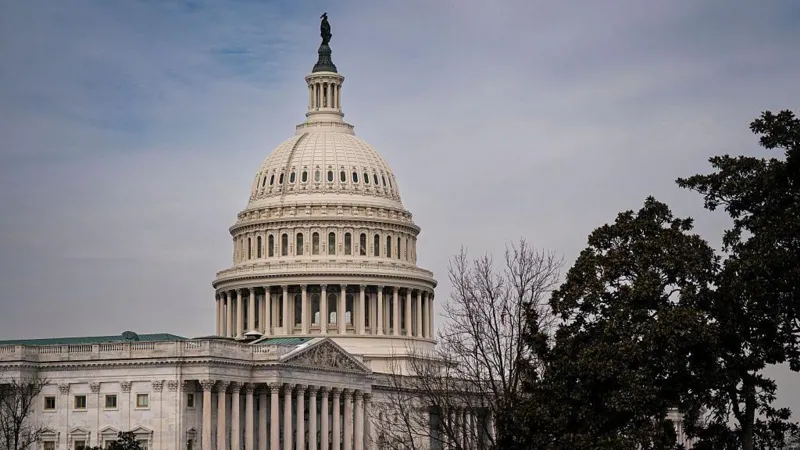
The US House of Representatives has voted to rescind US President Donald Trump’s tariffs on Canadian goods.
In a 219 to 211 vote, six Republican lawmakers joined Democrats to back a resolution that seeks to end the tariffs Trump imposed on Canada last year.
The vote is largely symbolic as it will still need to be approved by the US Senate and then approved by Trump, who is very unlikely to sign it into law.
Since his re-election, Donald Trump has imposed a series of tariffs on Canada, recently threatening a 100% import tax in response to Canada’s proposed trade deal with China.
As the vote was taking place on the House floor, Trump posted on Truth Social: “Any Republican, in the House or the Senate, that votes against TARIFFS will seriously suffer the consequences come Election time.”
“TARIFFS have given us Economic and National Security, and no Republican should be responsible for destroying this privilege,” he added.
The vote came after US House Speaker Mike Johnson, a Trump ally in Congress, unsuccessfully tried to block discussion on the chamber’s floor by lawmakers on Trump’s tariffs.
With Republicans holding a thin majority in the US House, the six Republican defections along with a near-united front from Democrats was enough to secure the votes.
The measure had been introduced by Democrat Gregory Meeks who said that Trump had “weaponized tariffs” against allies and destabilized the global economy.
“Not only have these tariffs done immense harm to our relationship with Canada, pushing them closer to China, they have driven up prices here at home,” he said before the vote.
Representative Don Bacon from Nebraska was one of the six Republicans who crossed the aisle to join Democrats in approving the measure. Before the vote, he said “tariffs have been a ‘net negative’ for the economy and are a significant tax that American consumers, manufacturers, and farmers are paying.”
The bill now heads to the US Senate where Republicans also hold the majority. Even if it cleared that hurdle, it is unlikely to be signed into law.
Separately, Trump’s tariffs are also facing legal scrutiny as the US Supreme Court is set to rule soon on a case questioning the president’s legal authority to impose the levies.
Meeks, the top Democrat on the US House Foreign Affairs committee, said the measure on Canada is the first of several bills he plans to introduce that aim to roll back Trump’s signature trade action.
“Our fight doesn’t stop here,” he said in a video posted online before the vote. “I have resolutions also to end trump’s tariffs on Mexico, on Brazil, and on his Liberation Day global tariffs.”
[BBC]
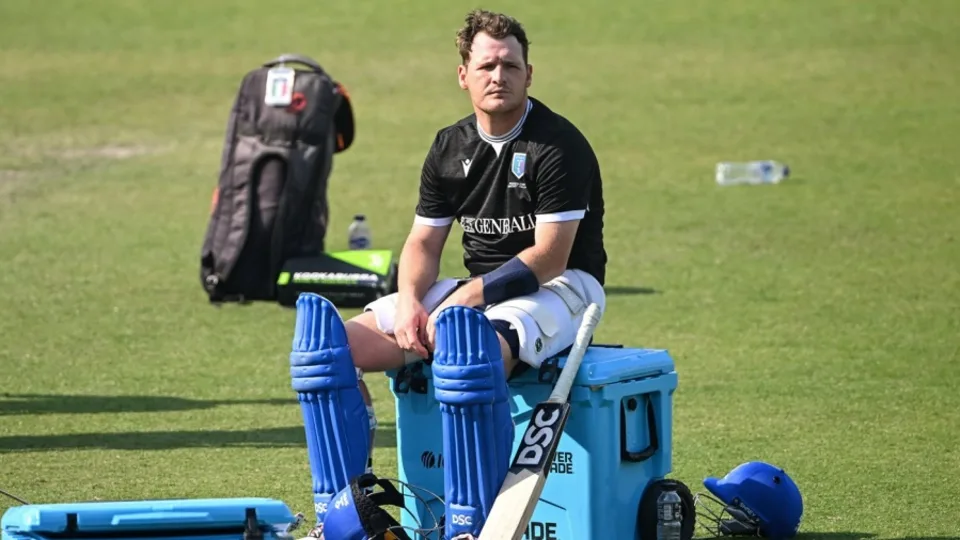
Nepal enter the contest against Italy, a team they have never faced before, on the back of falling short by just one big blow against England on Sunday. Nepal will look to bring that same brand of cricket in Mumbai again and will believe they hold the edge and momentum against their fellow Associates, who are playing their first big tournament.
Emerging from the shadows of the globetrotting legspinner Sandeep Lamichhane are batters Dipendra Singh Airee and Lokesh Bam, who all but took their side over the line in front of loud and energetic fans. But with the ball, Nepal conceded 33 runs in the last two overs of the first innings in that game, and that turned out to be the difference.
However, two points – and a possible big margin of victory – against Italy will open Nepal’s group up before they face West Indies; Nepal had betaen West Indies 2-1 last September.
Italy, meanwhile, had a tough initiation at the T20 World Cup with a 73-run defeat against Scotland. They also lost their captain Wayne Madsen to injury inside four overs of their T20 World Cup debut. He will not feature against Nepal either.
Italy coach John Davison said after the loss that the “occasion may have got big on us”. With nothing to lose and experience to gain, Italy have another chance to have fun and potentially upset some calculations, before facing stronger oppositions England and West Indies.
Batting at No. 5, Ben Maneti was one of the positives for Italy in their loss to Scotland. He started with only seven runs off seven balls, but went on to smash 52 in 31. The majority of his runs came against spinners (45 runs in 25 balls) with shots all around: behind square, through cover, and over the bowler’s head. Italy will hope Ben Manenti carries that confidence against Lamichhane and co.
Lokesh Bam threw everything he had at England when they needed 54 in 21 balls, but fell agonisingly short. Facing quality and experienced bowlers, he smacked back-to-back fours off Sam Curran and successive sixes off Jofra Archer as England searched for answers. Bam’s 39 not out was not enough on the day, but he gave solid proof of his big-hitting ability, something the format demands.
Madsen has been ruled out against Nepal, and in his absence, Harry Manenti, the younger of the two brothers, will be leading Italy. Middle-order batter Marcus Campopiano could replace Madsen in the side.
Italy (probable): Anthony Mosca, Justin Mosca, JJ Smuts, Marcus Campopiano, Harry Manenti (capt), Ben Manenti, Grant Stewart, Gian-Piero Meade (wk), Thomas Draca, Crishan Kalugamage, Ali Hasan
Nepal might look to play the same team that ran England close at the same ground on Sunday.
Nepal (probable): Aasif Sheikh (wk), Kushal Bhurtel, Rohit Paudel (capt), Dipendra Airee, Aarif Sheikh, Lokesh Bam, Gulsan Jha, Karan KC, Sandeep Lamichhane, Nandan Yadav, Sher Malla
[Cricinfo]

Namibia look to make a splash with India battling injury and illness

Powerful cyclone kills at least 31 as it tears through Madagascar port

US House votes to overturn Trump’s tariffs on Canada

Buoyed by strong support, Paudel’s Nepal search for two points against Italy

Bangladesh election 2026: Polls to open amid heavy security

Sri Lanka, minus Hasaranga, take on Oman at bogey venue

‘Dates have the highest sugar content to fight Coronavirus’

Sunday Island 27 December – Headlines

#SundayIsland 17th December – Headlines

Sunday Island – 28th March

Sunday Island Headlines – 21 March

Sunday Island – 21st February – Headlines
-

 Features4 days ago
My experience in turning around the Merchant Bank of Sri Lanka (MBSL) – Episode 3
-

 Business5 days ago
Zone24x7 enters 2026 with strong momentum, reinforcing its role as an enterprise AI and automation partner
-

 Business4 days ago
Remotely conducted Business Forum in Paris attracts reputed French companies
-
 Business4 days ago
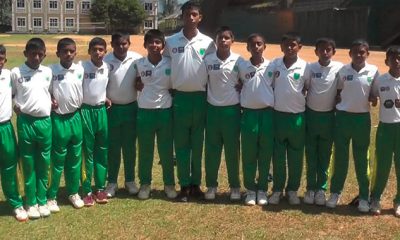
Four runs, a thousand dreams: How a small-town school bowled its way into the record books
-

 Business4 days ago
ComBank and Hayleys Mobility redefine sustainable mobility with flexible leasing solutions
-
 Business1 day ago
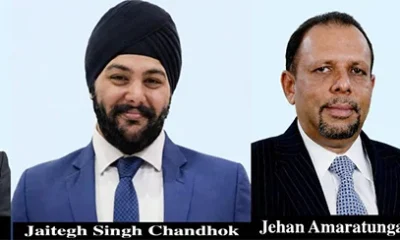
Autodoc 360 relocates to reinforce commitment to premium auto care
-

 Business5 days ago
HNB recognized among Top 10 Best Employers of 2025 at the EFC National Best Employer Awards
-

 Business5 days ago
GREAT 2025–2030: Sri Lanka’s Green ambition meets a grid reality check