
News
Patali: Ample space for genuine political movement to represent ‘silent majority’

…rules out partnership with those responsible for country’s bankruptcy
by Shamindra Ferdinando
Leader of Eksath Janaraja Peramuna (EJP) Patali Champika Ranawaka has warned that the fate of President Gotabaya Rajapaksa would befall on the next President if he failed to ensure what he called the economic independence of the people.
Referring to the public protest campaign that forced Prime Minister Mahinda Rajapaksa and President Gotabaya Rajapaksa to resign in May and July 2022, respectively, lawmaker Ranawaka said that those incapable of successfully addressing the economic woes should be prepared to face the consequences.
The former Minister said so in his keynote address at the first convention of the EJP at the Sugathadasa Indoor Stadium on Saturday (1).
Colombo District MP Ranawaka declared EJP’s readiness to discuss a workable plan with any party. However, the EJP leader ruled out the possibility of his party accommodating those responsible for the current crisis or accused of corruption.
In an obvious reference to the proposed debate between SJB leader Sajith Premadasa and JVP/JJB leader Anura Kumara Dissanayake, MP Ranawaka emphasized the importance of a feasible action plan. The lawmaker played down the importance of such debates.
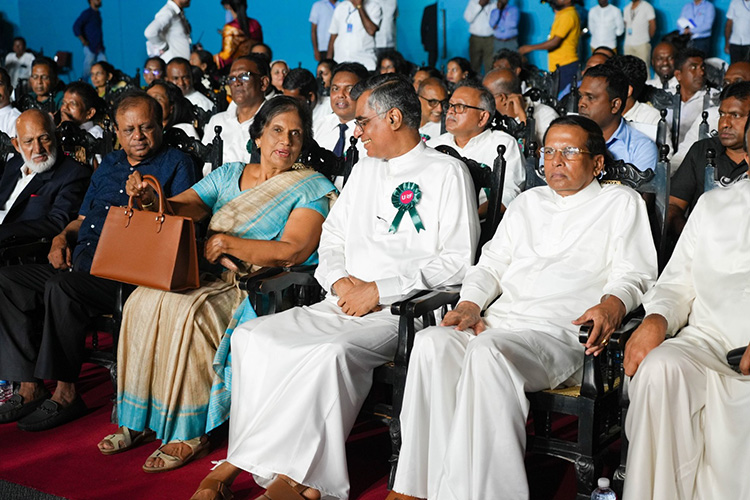
Among special invitees at the EJP convention were former Presidents, Chandrika Bandaranaike Kumaratunga and Maithripala Sirisena.
Declaring that recent surveys that had been conducted on the forthcoming presidential poll expected to be held in Sept/Oct this year were seriously flawed and lacked scientific basis, MP Ranawaka said that the EJP was ready to work with those keen to represent the interests of the silent majority. MP Ranawaka said that on the basis of the EJP’s agenda they were ready to reach a consensus on a new President, new Parliament and new Republic.
MP Ranawaka emphasised that there was ample space for a political movement that represented the interests of the silent majority. The EJP leader paid a glowing tribute to those who attended the convention without expecting any personal benefits. Having contested the last general election on the SJB ticket, MP Ranawaka formed the EJP.
Ranawaka alleged that those who sought to capture power offered simple answers to complex issues on the basis of how other bankrupt countries faced crises. Declaring that the country was in such a precarious situation it couldn’t experiment with a new system–an obvious reference to JVP/JJB, MP Ranawaka emphasized the pivotal importance of a permanent political decision to create economic independence.
Sri Lanka officially declared bankruptcy status in April 2022 during Gotabaya Rajapaksa’s presidency.
“Regardless of who becomes the next President or who controls Parliament, the country needs a viable plan to settle debt,” MP Ranawaka said.
Acknowledging that President Ranil Wickremesinghe had been able to stabilize the situation temporarily, MP Ranawaka found fault with the Wickremesinghe-Rajapaksa government for burdening the public, the vast majority of whom were unable to make ends meet. However, those responsible for the economic crisis hadn’t been punished, MP Ranawaka said, alleging that the government failed at least to collect taxes from those who owed the Treasury massive amounts of money.
MP Ranawaka explained how the growing political underworld threatened the country at every level.
General Secretary of EJP Bandula Chandrasekera said that they had been able to lay the foundation for the creation of a political movement that could really change the country.
Chandrasekera explained how they could proceed on the basis of their agenda that had been presented to the Maha Sangha, political parties and other interested groups in a bid to encourage consensus on a feasible action plan.
Declaring that the EJP had been recognized by the Election Commission, Chandrasekera said that they had carried out political work in 20 administrative districts, conducted nearly 75 meetings, in addition to 14 district conventions.
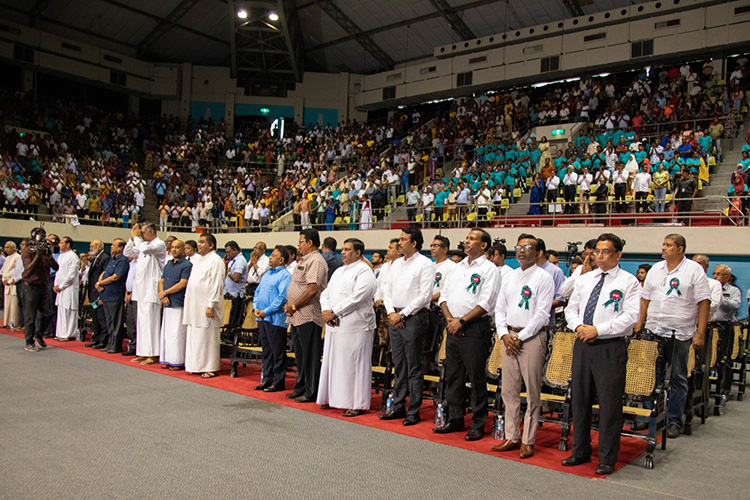
A section of the gathering at the first convention of the EJP held at the Sugathadasa Indoor Stadium (pictures courtesy the EJP)


By Shamindra Ferdinando
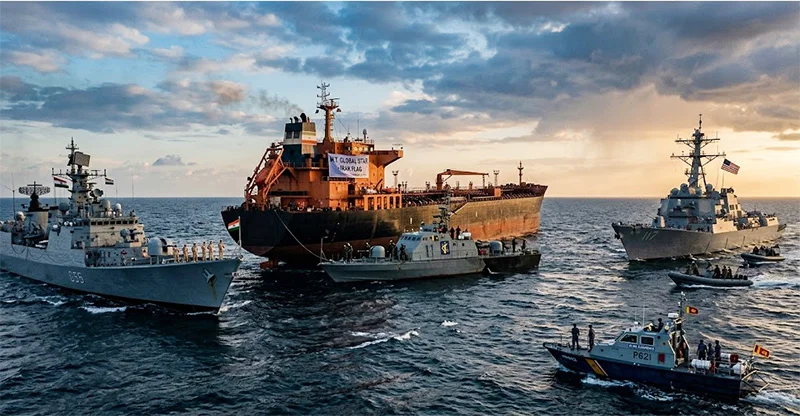
Iran has sought the Indian intervention, at the highest level, to provide lifesaving support to the crews of empty Iranian vessels stranded just outside Sri Lanka’s 12-nautical mile territorial waters off Galle.
Sources familiar with the issue said that Iran had brought the developing situation to the attention of New Delhi as the crews of almost 20 vessels, included Indian nationals. Sources stressed that the group of vessels that unloaded crude oil a couple of months back were now stranded within Sri Lanka’s Exclusive Economic Zone (EEZ).
The US Navy torpedoed an unarmed Iran frigate, returning from India, on 04 March, 2026, about 19 nautical miles off the Galle coast. The unprovoked attack killed nearly 100 Iranians.
The Iranian Embassy in Colombo has inquired from the Indian High Commission of their response to the situation, sources said. The US has issued a global warning against providing food, water, medicine and other services to the Iranian vessels. The outcome of Iran-India talks on the issue at hand was not known, though sources asserted India may not throw its weight behind Iranian efforts to address the issue.
Responding to The Island queries, sources said both Sri Lanka and India were in a dilemma due to the US warning. India couldn’t ignore the plight of the Indian crew members and the Iranian vessels in its backyard.
The Sri Lankan government remains tight-lipped about the vessels stranded in its EEZ. Our efforts to elicit a response from relevant authorities were in vain. In addition to Indians, there are Bangladeshis among the crew members. Iran has explicitly stated the responsibilities of the countries concerned to provide assistance in terms of international law.
The Iranian position was articulated by its Ambassador to Sri Lanka, Dr.Alireza Delkhosh, recently. In a special statement, Ambassador Delkhosh emphasised that in terms of the Convention on the Law of the Sea (Article 98) as well as SOLAS and SAR
Conventions, Sri Lanka couldn’t refrain from providing the needs of the Iranian vessels stranded in its EEZ.
SLMC leader Rauff Hakeem lambasted the NPP government in Parliament for failing to provide assistance to the Iranian ships. The former Minister alleged that the government was simply carrying out dictates of the US. He strongly criticised the way Foreign Minister Vijitha Herath was handling the issue.
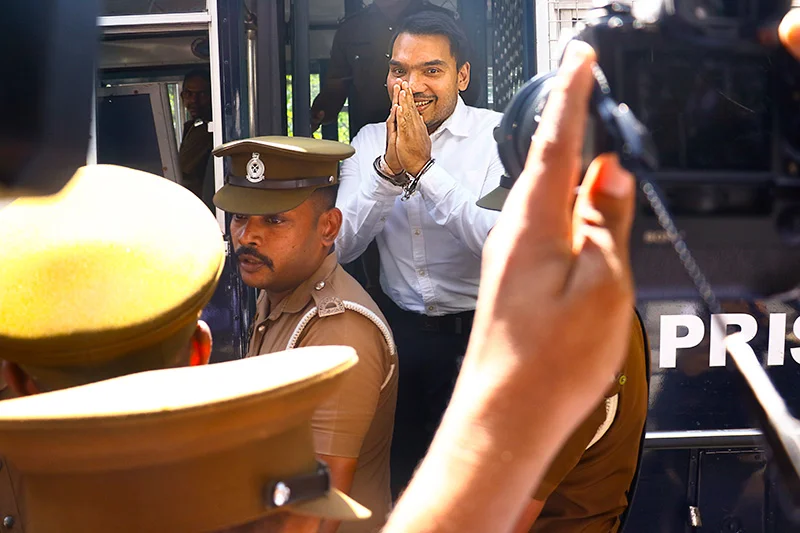
MP Namal Rajapaksa, who is in remand custody over the controversial Airbus deal, was further remanded until October 27 by the Colombo Magistrate’s Court yesterday (13).
Colombo Chief Magistrate Asanga S. Bodaragama made the order after considering submissions by officers of the Commission to Investigate Allegations of Bribery or Corruption and lawyers representing Rajapaksa.

Sri Lanka’s economy is expected to sustain its recovery over the next two years, although growth is projected to moderate amid mounting global uncertainties, according to the International Monetary Fund’s (IMF) latest World Economic Outlook.
In its World Economic Outlook 2026: Resilience Under Strain, Urgent Choices, the IMF projects Sri Lanka’s economy to expand by 4% in 2026, slowing to 3.7% in 2027, following estimated growth of 5% in 2025.
Inflation, meanwhile, is forecast to rise to 5.3% in 2026 and 5.4% in 2027, reversing the average deflation rate of 0.5% recorded in 2025.
Unemployment is expected to remain steady at 3.9% throughout the forecast period.
The projections come amid growing pressure on the global economy from the ongoing conflict in the Middle East, elevated energy prices, geopolitical tensions and trade disruptions.
Sri Lanka’s external position is also expected to weaken, with the current account balance projected to shift from a surplus of 1.6% of gross domestic product (GDP) in 2025 to deficits of 0.5% in 2026 and 0.3% in 2027.
The IMF’s outlook points to continued economic expansion in Sri Lanka, but with slower growth, rising inflation and a narrowing external surplus giving way to current account deficits over the forecast period.

Heavy showers above 100 mm are likely at some places in the Western, Sabaragamuwa, Southern, Central, and North-western provinces and in Anuradhapura district.

Sri Lanka, India caught in US-Iran ship crisis

Namal further remanded

IMF projects Lankan economic growth to moderate amidst mounting global uncertainties

Major Gen Pushpakumara assumes command of 56 Infantry Division

Dickwella axed, Bandara earns maiden Test call up

‘Dates have the highest sugar content to fight Coronavirus’

Sunday Island 27 December – Headlines

#SundayIsland 17th December – Headlines

Sunday Island – 28th March

Sunday Island Headlines – 21 March

Sunday Island – 21st February – Headlines
-

 Features6 days ago
The Sri Lankan who made Scottish history
-

 Sports6 days ago
Nissanka absence opens door for Sri Lanka’s young guns
-

 News5 days ago
NDB fraud Rs 60mn more than reported
-

 News5 days ago
Removing monk’s robes matter for Sangha to decide: Mahanayake Theras
-
 News6 days ago
Shiranthi R remanded until 13 Oct.
-

 Features6 days ago
Future of Sri Lanka’s state university system: Should it be shut down and reopened?
-

 News3 days ago
Sri Lanka escalates anti-graft drive with Shiranthi’s jailing
-
 Latest News4 days ago
Farhan, Sadaqat help Pakistan ace 183 chase to go 1-0 up