
Midweek Review
Parliament reels as Easter Sunday accusations tarnish members’ credibility

By Shamindra Ferdinando
The Parliament last week wasted two days on a much hyped debate on national security and the 2019 Easter Sunday carnage carried out by local Muslim extremists radicalized by ISIS ideology. The debate didn’t help political parties represented in Parliament to reach consensus on the post-Easter Sunday reconciliation plan.
But, the ruling ‘Pohottuwa’ party and the solitary UNP National List MP Wajira Abeywardena defended the handling of the Easter Sunday investigations, whereas those who were in the Yahapalana Cabinet, that ruled the country at the time, attacked the Wickremesinghe-Rajapaksa government over its alleged failure.
A careful consideration of speeches made on September 21 and 22 clearly reflected the fact that political parties remained committed to their original positions, though the political landscape has changed. The exchange between former President Maithripala Sirisena, MP, and war-winning Army Commander Field Marshal Sarath Fonseka, MP, on the first day of the debate, underlined the pathetic state of affairs.
Polonnaruwa District ‘Pohottuwa’ lawmaker Sirisena’s claim that the war veteran wouldn’t have received the Field Marshal’s rank without his intervention proved again he didn’t have any sense of what he was talking about. If not for Fonseka’s strategic, courageous, ruthless and relentless leadership in pursuit of his goal to destroy the Tigers, the LTTE wouldn’t have collapsed in less than three years (Aug 2006-May 2009) though the successful war effort hinged on the combined forces commitment, and leadership in their respective fields.
MP Sirisena owes an explanation as to why wartime Navy and Air Force commanders, Wasantha Karannagoda and Roshan Gunathilake, respectively, were denied honorary ranks of Admiral of the Fleet and Marshal of the Air Force when Fonseka was awarded the rank of Field Marshal in March 2015. Karannagoda and Gunathilake finally received their due honours in Sept. 2019, several months after the Easter Sunday carnage, the subject of the two-day debate that didn’t achieve anything.
Lawmaker Sirisena should be reminded that he held the public security portfolio as the then President and Commander in Chief at the time of the Easter attacks. Sirisena steadfastly refused to swear in an UNPer as Public Security Minister though he reluctantly swore in Ranil Wickremesinghe as the Premier after the Supreme Court thwarted his constitutional coup. In fact, an influential section of the Yahapalana setup wanted Fonseka appointed as the Public Security Minister, though the proposal didn’t find favour with Premier Wickremesinghe.
While Parliament debated the Easter Sunday carnage, President Ranil Wickremesinghe, who served as the Premier at the time of the near simultaneous suicide attacks, was away in Washington to attend the 78th sessions of the UN General Assembly in New York. Let me reproduce verbatim the assessment made by the Presidential Commission of Inquiry on the Easter Sunday carnage. “Upon consideration of the evidence, it is the view of the CoI that the lax approach of Mr. Wickremesinghe towards Islamic extremism, as the Prime Minister, was one of the primary reasons for the failure on the part of the then government to take proactive steps towards Islamic extremism. This facilitated the build-up of Islamic extremism to the point of the Easer Sunday attack.” (Final report, Vol
01, p 276-277).
Against the backdrop of lawmaker Sirisena seeking UN intervention following the Channel 4 allegations, based on Hanzeer Azad Maulana (ex-aide to State Minister Sivanesathurai Chandrakanthan aka Pilleyan) over claims of complicity of Maj. Gen. Suresh Sallay in the Easter Sunday plot, it would be pertinent to point out the CoI’s assessment on the then President Sirisena. “Upon consideration of evidence of facts before 4th April 2019, the CoI is of the view that President Sirisena has failed in his duties and responsibilities and that his failure transcends beyond mere civil negligence.” (Final report, Vol 01, p 263)
CoI suggested: “….based on the evidence, the CoI is of the view that there is criminal liability on his part for the acts or omissions explained above. The CoI recommends that the Attorney General consider instituting criminal proceedings against President Sirisena under any suitable provision in the Penal Code.” (Final report, Vol 01, p 265)
Supreme Court Justice Janak de Silva chaired the CoI. The other members of the CoI were Court of Appeal Judge Bandula Karunaratne, retired Court of Appeal Judge Sunil Rajapaksa, retired High Court Judge Bandula Atapattu and retired Justice Ministry Secretary W.M.M.R. Adikari. The CoI commenced its hearings on Oct. 31, 2019 and sat on 214 days in total, holding 640 sittings and interviewing 451 witnesses.
The ‘Pohottuwa’ caused suspicions among the Catholics by appointing a six-member team to study the report prepared by such an eminent group. The group, headed by Chamal Rajapaksa, and included Johnston Fernando, Udaya Gammanpila, Ramesh Pathirana, Prasanna Ranatunga and Rohitha Abeygunawardena, was named on Feb. 19, 2021. President Gotabaya Rajapaksa received the report on Feb 01, 2021.
The Catholic Church repeatedly pointed out that none of the recommendations made by the CoI had been implemented.
Retired AVM doubts C4 claims
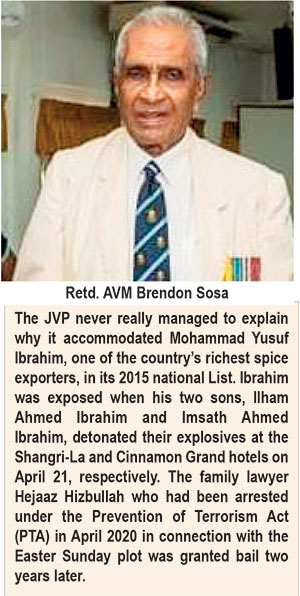 Air Vice Marshal [retired] A.B. Sosa V S V, psc, emphasized the pivotal importance of what he called maximum possible legal punitive action against those responsible for the attacks and security failure at all levels.
The former coordinating Officer of the Hambantota District at the height of the JVP-inspired insurgency (1987/88) and Mahiyanganaya in 1989 where the JVP declared a curfew to sabotage President Ranasinghe Premadasa’s Gam Udawa project explained how various interested parties exploited the developing situation to their advantage.
Declaring that the Easter Sunday carnage is a crime against humanity, Sosa examined the sequence of events as presented by C4, based on Hanzeer Azad Maulana, ex-CID Officer Nishantha Silva, who sought political asylum in Switzerland a week after Gotabaya Rajapaksa’s election as the President in Nov. 2019, and an anonymous Sri Lankan Government Official.
C4 accusations pertained to the period about four years prior to the Easter bombings. They rely on the accusations of Maulana and Nishantha Silva. C4 dealt with circumstances Pilleyan’s involvement in the murder of a sitting Member of Parliament Joseph Pararajasingham while attending holy mass on Christmas day 2005. That killing took place in Batticaloa.
One-time LTTEer and sidekick of Karuna Amman who served Mahinda Rajapaksa’s parliamentary group had been entrusted with the task of eliminating those opposed to the Rajapaksas, according to Moulana, who lucidly explained the role played by his former boss over the years.
Sosa questioned Moulana’s claim that Pilleyan’s group had been accommodated at the former Tripoli market premises and was named the ‘Tripoli Platoon.’ The former Director of Operations and Training declared: “This is an outrageous claim. As there had been an Army detachment therein, a motley crowd of civilians couldn’t have been positioned there under any circumstances. Such a situation is not possible in any disciplined military organization.”
Reiterating his concerns over the failure on the part of successive governments to punish those responsible for the assassination of Sunday Leader Editor Lasantha Wickrematunga in January 2009, the Air Force veteran said that Moulana’s claim that the wartime Defence Secretary Gotabaya Rajapaksa directed the so-called Tripoli ‘platoon’ to eliminate the eminent journalist is nothing but a blatant lie.
Sosa said that the ex-CID officer’s unsubstantiated claims regarding the Wickrematunga assassination and his removal from the investigation should be examined against the backdrop of his failure to produce any documents or incriminating tapes. The retired AVM emphasized decisions couldn’t be made or consensus reached merely on a statement. Reference was made to an unprecedented Swiss Embassy ‘drama’ that followed the CID officer leaving the country along with his family.
During his career, Sosa, who had received training in the UK and Pakistan, held several command appointments, including as the Commander of the Katunayake Air Force Base.
Commenting on the alleged meeting arranged by Moulana between Sallay and the would-be Easter Sunday suicide bombers in a coconut estate called Lactowatta in the Puttalam district in Feb. 2018, Sosa emphasized this allegation should be examined taking into consideration the officer concerned was based in Malaysia as Sri Lanka’s Minister Counsellor. Sallay is on record as having said that he never left Malaysia in 2018 to visit Sri Lanka or any other country. Sosa stressed that Sallay, who had served as head of the Directorate of Military Intelligence (DMI) at the time of the 2015 presidential election, was removed and sent out of the country. Malaysia could help Sri Lanka and other interested parties to establish/ascertain the then Minister Counsellor’s movements. Sosa said: “Sallay could not have been simultaneously in two countries.”
The retired AVM also disputed C4 claim that Moulana had received instructions from Sallay on April 19, 2019, over the phone on the basis the officer was on a National Defence College, India, course. The government and other interested parties could easily verify this with Indian authorities, Sosa said, pointing out that both Malaysia and India must have examined claims.
The retired officer said: “In such circumstances, it is obvious that some ill-considered notions had been accepted by C4. Did C4 engage in a deliberate project to discredit Sri Lanka? I hold no brief for anyone. I have never met those who had been interviewed by C4 or persons mentioned, including Maj. Gen. Suresh Sallay. There is absolutely no doubt that the heinous Easter Sunday attacks and other allegations must be thoroughly investigated and perpetrators punished. However, it is necessary to sift out red herrings such as the farcical so-called C 4 hatchet job meant to discredit Sri Lanka. Perhaps, C4 is among those who pursued a different agenda as they couldn’t stomach our victory over terrorism.”
Sosa retired in Aug. 1990 on reaching the mandatory 55 years, several weeks after the eruption of Eelam War 11. Having successfully met the JVP challenge in the hotbed of subversive activities, where he served as CO for a year, Sosa received appointment as Base Commander, Karunayake, even though the Security Council wanted him appointed as CO, Kegalle. Sosa recalled how President Ranasinghe Premadasa, having succeeded JRJ, sent him to Mahiyangana to neutralise the JVP threat to facilitate the holding of Gam Udawa there. “Immediately after I took over security at Mahiyangana, President Premadasa met me there. We had a very cordial one-to-one meeting. The President told me to ensure that power supply was not interrupted and normalcy restored. The JVP had sabotaged the entire fleet of around 30 buses in the depot. I flew down motor fitters and mechanics from Katunayake air base who got the buses going by cleaning the sand spiked gear boxes and oil tanks. Army troops were placed on 24-hour patrols to ensure the power pylons were not destroyed by the JVP. These troops had to be maintained by helicopters as the area was not accessible by road. During the Gam Udawa period, President Premadasa met me every morning. The Gam Udawa drew a large crowd and everything went off well except for a minor incident after closing time on one occasion. When leaving in the morning after the final day the President said “Thank you, see me in Colombo.” Sosa said that he opted to get back to Katunayake air base and remained there until retirement.
The Thileepan affair
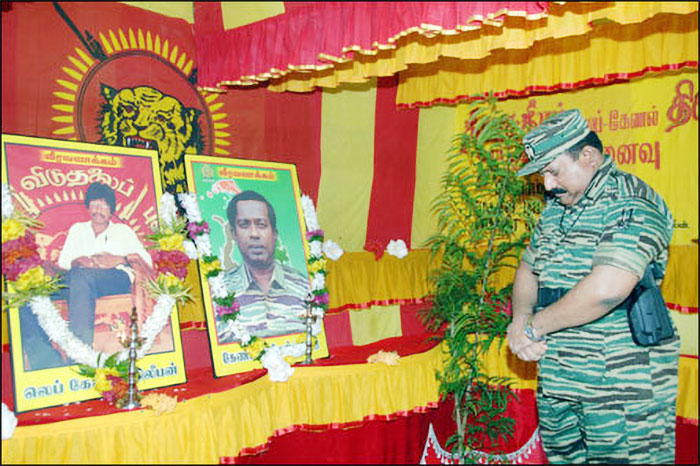
Amidst the ongoing controversy over the Easter Sunday carnage and ahead of the two-day debate in Parliament, a vehicle carrying a portrait of Thileepan was attacked by villagers at Shardhapura, Uppuveli.
Thileepan died of a hunger strike at Nallur Kandasamy Kovil on Sept. 26, 1987. His fast lasted 11 days. A section of the media reported that National List MP Selvarajah Kajendran (a member of the Gajendrakumar Ponnambalam led Ahila Illankai Thamil Congress) accompanying the vehicle was also attacked. It would be pertinent to mention that Kajendran first entered Parliament in 2004 on the Tamil National Alliance (TNA) ticket. The one-time President of the Jaffna University Students Union received the backing of the LTTE at that election in the wake of the TNA recognizing Velupillai Prabhakaran as the sole representative of the Tamil speaking people, amidst the shocking split caused by then LTTE Eastern Commander Vinayagamoorthy Muralitharan aka Karuna Amman defecting to the government.
The portrait-carrying vehicle began its journey at Pottuvil and was on its way to the Jaffna peninsula, where the final remembrance was to be held. A section of the media depicted Thileepan as a person who died for the rights of the Tamil speaking people.
Let us examine the circumstances 26-year-old Thileepan died following the 11-day fast after Velupillai Prabhakaran ‘deployed’ him as a suicide bomber. Actually, Thileepan’s fast unto death was meant to cause mayhem in the Jaffna peninsula. The LTTE mounted its first suicide attack on July 05, 1987, on the Nelliady Army detachment.
Former LTTE terrorist Niromi de Soyza (adopted pseudonym) dealt with Thileepan’s fast unto death, in her debut as a writer. ‘Tamil Tigress’ first published two years after the Sri Lankan military decimated the LTTE’s conventional military capability, the writer, who had been 17 at the time she joined the group in 1987, discussed Thileepan’s death against the backdrop of Velupillai Prabhakaran’s decision to take on the Indian Army. Sri Lanka was forced to accept the deployment of the Indian Army in late July 1987.
The writer ‘Niromi’ questioned Velupillai Prabhakaran’s choice as Thileepan was physically fragile and too intelligent to be sanctified. She had been one of those assigned for crowd controlling duties at Nallur Kandasamy Kovil where she witnessed Thileepan being welcomed onto the makeshift podium. The LTTE’s No. 02 at the time Mahattaya had been with Thileepan at the launch of his fast. ‘Niromi’ had been at the scene of the hunger strike on many days and experienced the LTTE propagating the lie that the dying man’s wish was for the LTTE to defeat the Indian Army. Recalling the opportunity she received to get onto the podium, the writer translated four lines of a Tamil song heard about a week after Thileepan launched his much advertised action.
A sweet-smelling flower is withering
It cannot speak, it cannot walk
Will Thileepan anna’s desire be satisfied?
Won’t the foreign army flee?
The writer named Thileepan as the person who conscripted her, handed her first assault rifle as well as a cyanide capsule which the writer called kuppie.
She had been present when a doctor who examined Thileepan on Sept. 26, 1987, pronounced him dead.
‘Niromi de Soyza’ wrote: With his life Thileepan had paved the way for war (Chapter 09: There’s still time to change your mind).
Less than 10 days after Thileepan’s death, the Sri Lanka Navy intercepted a trawler carrying a group of hardcore LTTE terrorists in the northern seas. Their detention and their subsequent mass suicide in Sri Lankan custody led to the resumption of war in the second week of Oct. 1987.
Niromi de Soyza quoted Velupillai Prabhakaran as having told a group of cadres, including herself, soon after the mass suicide at Palaly, “The Indian government engineered the so-called peace process as a plot to gradually eliminate us.”
Propaganda war will continue unabated until Sri Lanka countered lies. Fifteen years after the conclusion of the war, Sri Lanka is still struggling to counter various narratives. There cannot be a better example than the bid to exploit deliberately caused Thileepan’s death to launch a fresh rift between the Sinhalese and Tamil speaking people. The vehicle convoy that had been launched from Pottuvil was meant to cause maximum harm to these yet fragile relations. Unless the government takes tangible measures against such exploiting tactics to create fresh wounds between the two communities, the day the country erupts again is not far off.



After assassinating the foremost Sri Lankan Tamil political leader and one-time Opposition leader Appapillai Amirthalingam and ex-Jaffna MP Vettivelu Yogeswaran, in July 1989, in Colombo, the LTTE declared those who stepped out of line, thereby deviated from policy of separate state, would be killed. Ex-Nallur MP Murugesu Sivasithamparam was shot and wounded in the same incident. In 1994, the LTTE ordered the boycott of the general election but EPDP leader Douglas Devananda contested. His party won nine seats in the Jaffna peninsula.
The LTTE also banned the singing of the national anthem and the hoisting of the national flag at government and public functions in Tamil areas. Devananda defied this ban, too.
The Eelam People’s Democratic Party (EPDP) played a significant role in Sri Lanka’s overall campaign against the Liberation Tigers of Tamil Eelam (LTTE). The EPDP threw its weight behind the war effort soon after the LTTE resumed hostilities in June 1990 after India withdrew forces deployed in terms of the Indo-Lanka Peace Accord signed on July 29, 1987, under duress, in the aftermath of the infamous uninvited ‘parippu drop’ over northern Sri Lanka by the Indian Air Force, a modern-day New Delhi version of the Western gunboat diplomacy.
India ended its military mission here in late March 1990. Having conducted an unprecedented destabilisation project against Sri Lanka, India ceased the mission with egg on her face. The monument erected near Sri Lanka Parliament for over 1,300 Indian military personnel, who made the supreme sacrifice here, is a grim reminder of the callous project.
In fact, the United National Party (UNP) government reached a consensus with the EPDP, PLOTE (People’s Liberation Organisation of Tamil Eelam), ENDLF (Eelam National Democratic Liberation Front), TELO (Tamil Eelam Liberation Organisation) and EPRLF (Eelam People’s Revolutionary Liberation Front) for their deployment. Of them, the EPDP was among three groups ready to deploy cadres against the LTTE.
The LTTE ended its honeymoon (May 1989 to June 1990) with President Ranasinghe Premadasa. Within weeks after the resumption of hostilities, the government lost the Kandy-Jaffna A9 stretch of the road between north of Vavuniya and Elephant Pass.
It would be pertinent to mention that the above-mentioned groups suffered debilitating losses in the hands of the LTTE during the then Premadasa government’s honeymoon with the LTTE. At the behest of President Premadasa, the military provided tacit support for LTTE operations. But, in the wake of resumption of hostilities by the LTTE, the other groups grabbed the opportunity to reach consensus with the government, though they knew of President Premadasa’s treacherous actions.
On the invitation of the government, anti-LTTE Tamil groups set up ‘offices’ in Colombo. The writer first met Douglas Devananda at his ‘office’ at No. 22, Siripa Lane, Thimbirigasyaya, in November, 1990. There were scores of people. Some of them carried weapons. When Kathiravelu Nythiananda Devananda, wearing a sarong and short-sleeved banian, sat across a small table, facing the writer, he kept a pistol on the table. Devananda explained the role played by his group in Colombo and in the North-East region.
The so-called office had been used by the EPDP to question suspected LTTEers apprehended in Colombo. Those who are not familiar with the situation then may not be able to comprehend the complexity of overt and covert operations conducted by the military against Tiger terrorists. The EPDP, as well as other groups, namely the PLOTE and TELO, taking part in operations against the LTTE not only apprehended suspects but subjected them to strenuous interrogation. There had been excesses.
The UNP government provided funding for these groups, as well as weapons. In terms of the Indo-Lanka Accord signed on July 29, 1987, India and Sri Lanka agreed to disarm all groups, including the LTTE.
Following is the relevant section of the agreement: 2.9 The emergency will be lifted in the Eastern and Northern Provinces by Aug. 15, 1987. A cessation of hostilities will come into effect all over the island within 48 hours of signing of this agreement. All arms presently held by militant groups will be surrendered in accordance with an agreed procedure to authorities to be designated by the Government of Sri Lanka.
Consequent to the cessation of hostilities and the surrender of arms by militant groups, the Army and other security personnel will be confined to barracks in camps as on 25 May 1987. The process of surrendering arms and the confinement of security forces personnel moving back to barracks shall be completed within 72 hours of the cessation of hostilities coming into effect.
Formation of EPDP
An ex-colleague of Devananda, now living overseas, explained the circumstances of the one-time senior EPRLF cadre, EPDP leader switched his allegiance to the Sri Lankan government. Devananda formed the EPDP in the wake of a serious rift within the top EPRLF leadership. However, Devananda, at the time he had received training in Lebanon as a result of intervention made by UK based Tamils, served the Eelam Revolutionary Organisation of Students (EROS). Subsequently, a group that included K. Padmanabah formed the General Union of Students (GUES) before the formation of the EPRLF.
The formation of the EPDP should be examined taking into consideration Devananda’s alleged involvement in Diwali-eve murder in Chennai in 1986. Devananda’s ex-colleague claimed that his friend hadn’t been at the scene of the killing but arrived there soon thereafter.
Devananda, who had also received training in India in the ’80s, served as the first commander of the EPRLF’s military wing but never achieved a major success. However, the eruption of Eelam War II, in June, 1990, gave the EPDP an unexpected opportunity to reach an agreement with the government. In return for the deployment of the EPDP in support of the military, the government ensured that it got recognised as a registered political party. The government also recognised PLOTE, EPRLF and TELO as political parties. President Premedasa hadn’t been bothered about their past or them carrying weapons or accusations ranging from extrajudicial killings to extortions and abductions.
Some of those who found fault with President Premadasa for granting political recognition for those groups conveniently forgot his directive to then Election Commissioner, the late Chandrananda de Silva, to recognise the LTTE, in early Dec. 1989.
The writer was among several local and foreign journalists, invited by the late LTTE theoretician Anton Balasingham, to the Colombo Hilton, where he made the announcement. Chain-smoking British passport holder Balasingham declared proudly that their emblem would be a Tiger in a red flag of rectangular shape. Neither Premadasa, nor the late Chandrananda de Silva, had any qualms about the PFLT (political wing of the LTTE) receiving political recognition in spite of it being armed. The LTTE received political recognition a couple of months before Velupillai Prabhakaran resumed Eelam War II.
Devananda, in his capacity as the EPDP Leader, exploited the situation to his advantage. Having left Sri Lanka for India in May 1986, about a year before the signing of the Indo-Lanka Accord, Devananda returned to the country in May 1990, a couple of months after India ended its military mission here.
Of all ex-terrorists, Devananda achieved the impossible unlike most other ex-terrorist leaders. As the leader of the EPDP and him being quite conversant in English, he served as a Cabinet Minister under several Presidents and even visited India in spite of the Madras High Court declaring him as a proclaimed offender in the Chennai murder case that happened on Nov. 1, 1986. at Choolaimedu.
Regardless of his inability to win wider public support in the northern and eastern regions, Devananda had undermined the LTTE’s efforts to portray itself as the sole representative of the Tamil speaking people. In 2001, the LTTE forced the Illankai Thamil Arasu Kadchi (ITAK)-led Tamil National Alliance (TNA) to recognise Velupillai Prabhakaran as the sole representative of the Tamil speaking people.
Whatever various people say in the final analysis, Devananda served the interests of Sri Lanka like a true loyal son, thereby risked his life on numerous occasions until the military brought the war to a successful conclusion in May 2009. Devananda’s EPDP may have not participated in high intensity battles in the northern and eastern theatres but definitely served the overall military strategy.
During the conflict and after the EPDP maintained a significant presence in Jaffna islands, the US and like-minded countries resented the EPDP as they feared the party could bring the entire northern province under its domination by manipulating parliamentary, Provincial Council and Local Government elections. The West targeted the EPDP against the backdrop of the formation of the TNA under the late R. Sampanthan’s leadership to support the LTTE’s macabre cause, both in and outside Parliament. At the onset, the TNA comprised EPRLF, TELO, PLOTE and even TULF. But, TULF pulled out sooner rather than later. The EPDP emerged as the major beneficiary of the State as the LTTE, at gun point, brought all other groups under its control.
During the honeymoon between the government and the LTTE, the writer had the opportunity to meet Mahattaya along with a group of Colombo-based Indian journalists and veteran journalist, the late Rita Sebastian, at Koliyakulam, close to Omanthai, where LTTE’s No. 02 Gopalswamy Mahendrarajah, alias Mahattaya, vowed to finish off all rival Tamil groups. That meeting took place amidst a large-scale government backed campaign against rival groups, while India was in the process of de-inducting its troops (LTTE pledges to eliminate pro-Indian Tamil groups, The Island, January 10, 1990 edition).
Devananda survives two suicide attacks
The Ceasefire Agreement (CFA) worked out by Norway in 2002, too, had a clause similar to the one in the Indo-Lanka Accord of July 1987. While the 1987 agreement envisaged the disarming of all Tamil groups, the Norwegian one was meant to disarm all groups, other than the LTTE.
Devananda’s EPDP had been especially targeted as by then it remained the main Tamil group opposed to the LTTE, though it lacked wide public support due to the conservative nature of the Tamil society to fall in line with long established parties and their leaders. A section of the Tamil Diaspora that still couldn’t stomach the LTTE’s eradication were really happy about Devananda’s recent arrest over the recovery of a weapon issued to him by the Army two decades ago ending up with the underworld. The weapon, issued to Devananda, in 2001, was later recovered following the interrogation of organised criminal figure ‘Makandure Madush’ in 2019. Devananda has been remanded till January 9 pending further investigations.
Being the leader of a militant group forever hunted by Tiger terrorists surely he must have lost count of all the weapons he received on behalf of his party to defend themselves. Surely the Army has lost quite a number of weapons and similarly so has the police, but never has an Army Commander or an IGP remanded for such losses. Is it because Devananda stood up against the most ruthless terrorist outfit that he is now being hounded to please the West? Then what about the large quantities of weapons that Premadasa foolishly gifted to the LTTE? Was anyone held responsible for those treacherous acts?
Then what action has been taken against those who took part in the sinister Aragalaya at the behest of the West to topple a duly elected President and bring the country to its knees, as were similar putsch in Pakistan, Bangladesh effected to please white masters. Were human clones like the ‘Dolly the Sheep’ also developed to successfully carry out such devious plots?
Let me remind you of two suicide attacks the LTTE planned against Devananda in July 2004 and Nov. 2007. The first attempt had been made by a woman suicide cadre later identified as Thiyagaraja Jeyarani, who detonated the explosives strapped around her waist at the Kollupitiya Police station next to the Sri Lankan Prime Minister’s official residence in Colombo killing herself and four police personnel, while injuring nine others. The woman triggered the blast soon after the Ministerial Security Division (MSD) assigned to protect the then Hindu Cultural Affairs Minister Devananda handed her over to the Kollupitiya police station on suspicion. Investigations revealed that the suicide bomber had been a servant at the Thalawathugoda residence of the son of a former UNP Minister for about one and half years and was considered by the family as an honest worker (Bomber stayed with former UNP Minister’s son, The Island, July 12, 2004).
She had been planning to assassinate Devananda at his office situated opposite the Colombo Plaza. The police identified the person who provided employment to the assassin as a defeated UNP candidate who contested Kandy district at the April 2004 parliamentary election.
The second attempt on Devananda was made at his Ministry at Narahenpita on 28 Nov. 2007. Several hours later, on the same day, the LTTE triggered a powerful blast at Nugegoda, killing 10 persons and causing injuries to 40 others. The bomb had been wrapped in a parcel and was handed over to a clothing store security counter and detonated when a policeman carelessly handled the parcel after the shop management alerted police.
Having lost control of areas it controlled in the Eastern Province to the military by July 2007, the LTTE was battling two Army formations, namely 57 Division commanded by Brigadier Jagath Dias and Task Force 1 led by Colonel Shavendra Silva on the Vanni west front. The LTTE sought to cause chaos by striking Colombo. Obviously, the LTTE felt quite confident in eliminating Devananda, though the EPDP leader survived scores of previous assassination attempts. Devananda had been the Social Welfare Minister at the time. The Minister survived, but the blast triggered in his office complex killed one and inflicted injuries on two others.
Hardcore LTTE terrorists held at the Jawatte Jail, in Kalutara attacked Devananda on June 30, 1998, made an attempt on Devananda’s life when he intervened to end a hunger strike launched by a section of the prisoners. One of Devananda’s eyes suffered permanent impairment.
Devananda loses Jaffna seat
Having served as a Jaffna District MP for over three decades, Devananda failed to retain his seat at the last parliamentary election when the National People’s Power (NPP) swept all electoral districts. The NPP, in fact, delivered a knockout blow not only to the EPDP but ITAK that always enjoyed undisputed political power in the northern and eastern regions. Devananda, now in his late 60, under the present circumstances may find it difficult to re-enter Parliament at the next parliamentary elections, four years away.
Devananda first entered Parliament at the 1994 August general election. He has been re-elected to Parliament in all subsequent elections.
The EPDP contested the 1994 poll from an independent group, securing just 10,744 votes but ended up having nine seats. The polling was low due to most areas of the Jaffna peninsula being under LTTE control. But of the 10,744 votes, 9,944 votes came from the EPDP-controlled Jaffna islands. Devananda managed to secure 2,091 preference votes. That election brought an end to the 17-year-long UNP rule. By then Devananda’s first benefactor Ranasinghe Premadasa had been killed in a suicide attack and Devananda swiftly aligned his party with that of Chandrika Bandaranaike Kumaratunga’s People’s Alliance (PA).
The LTTE mounted an attack on Devananda’s Colombo home on the night of Oct. 9, 1995. It had been one of 12 such attempts on his life
Devananda, who had survived the July 1983 Welikada Prison riot where Sinhala prisoners murdered 53 Tamils detainees. He then got transferred to Batticaloa Prison from where he escaped along with 40 others in September of the same year, received his first Cabinet position as Minister of Development, Rehabilitation and Reconstruction of the North, and Tamil Affairs, North and East following the 1994 general election. Devananda lost his Cabinet position following the PA’s defeat at the 2001 parliamentary election. Devananda entered the Cabinet as the Minister of Agriculture, Marketing Development, Hindu Education Affairs, Tamil Language & Vocational Training Centres in North following the UPFA’s victory at the 2004 general election.
Devananda further consolidated his position during Mahinda Rajapaksa’s presidency (2005 to 2015). He earned the wrath of the LTTE and Tamil Diaspora for his support for the government that eradicated the LTTE. Over the years, the EPDP’s role in overall security strategy diminished though the group maintained a presence in Jaffna islands.
There had been accusations against the EPDP. There had also been excesses on the part of the EPDP. But, Devananda and his men played an important role though not in numbers deployed against the LTTE. The EPDP proved that all Tamils didn’t follow the LTTE’s destructive path.
Three years after the eradication of the LTTE, in May 2009, President Mahinda Rajapaksa sent Devananda to the UN Human Rights Council as part of the official government delegation to Geneva.
Dr. Dayan Jayatilleka, Ambassador/ Permanent Representative of Sri Lanka to the United Nations Office in Geneva, comment on Devananda’s arrest is a must read. Devananda’s fate would have been different if he remained with the EPRLF, one of the Indian backed terrorist groups installed as the first North East Provincial Administration in which Jayatilleke served as Minister of Planning and Youth Affairs.
The EPRLF administration was brought to an unceremonious end when India ended its military mission here in 1990.
While multiple LTTE attempts to assassinate Devananda failed during the war with the last attempt made in late 2007, less than two years before the end of the conflict, obviously the EPDP leader remains a target. Those who still cannot stomach the LTTE’s humiliating defeat, seem to be jubilant over Devananda’s recent arrest over a missing weapon.
Therefore it is incumbent upon the NPP/JVP government to ensure the safety of Devananda under whatever circumstances as he has been a true patriot unlike many a bogus revolutionary in the present government from top to bottom, who are nothing more than cheap opportunists. Remember these same bogus zealots who threatened to sacrifice their lives to fight Indian threat to this country, no sooner they grabbed power became turncoats and ardent admirers of India overnight as if on a cue from Washington.
Various interested parties, including the US, relentlessly targeted the EPDP. US Embassy cable originating from Colombo quoted Stephen Sunthararaj, the then-Coordinator for the Child Protection Unit of World Vision in Jaffna directing a spate of allegations against the EPDP. In attempting to paint black the relationship between the military and the EPDP, Sunthararaj even accused the latter of child trafficking, sexual violence and running Tamil prostitution rings for soldiers.
The diplomatic cable also quoted the World Vision man as having said… because of the large number of widows in Jaffna, men associated with the EPDP, often from neighbouring villages, are used to seduce women with children, especially girls, with the promise of economic protection. After establishing a relationship, the men then take the children, sometimes by force and sometimes with the promise that they will be provided a better life.
The children are sold into slavery, usually boys to work camps and girls to prostitution rings, through EPDP’s networks in India and Malaysia.”
It would be interesting to examine whether World Vision at any time during the conflict took a stand against the use of child soldiers and indiscriminate use of women and children in high intensity battles and suicide missions by the LTTE. Did World Vision at least request the LTTE not to depend on human shields on the Vanni east front as the area under LTTE control gradually shrank? Have we ever heard of those who had been shedding crocodile tears for civilians opposing the LTTE’s despicable strategies? Never.
Against the backdrop of such accusations the non-inclusion of Devananda in some sanctioned list is surprising. Devananda, however, is receiving the treatment meted out to those Tamils who opposed the LTTE or switched allegiance to the government. Ex-LTTE Pilleyan and his one-time leader Karuna are among them. But unlike them, Devananda never served the LTTE’s despicable cause.
By Shamindra Ferdinando
Midweek Review
Historical context of politicisation of Mahavamsa, and Tamil translation of the last volume

The sixth volume of the Mahavamsa, covering the period 1978-2010 has been rendered into Tamil by N. Saravanan, a well-known Tamil journalist and activist based in Norway. The first three volumes of the Mahavamsa (including the Culavamsa) are now a part of the UNESCO world heritage. They were the work of individual scholar monks, whereas the modern volumes (V to VI) were produced through state-sponsored collective efforts [1].
Although state-sponsored writing of history has been criticised, even the first Mahavamsa, presumably written by the Thera Mahanama in the 5th CE, probably enjoyed Royal Patronage. Furthermore, while it is not at all a sacred text, it is clearly a “Buddhist chronicle” compiled for the “serene joy of the pious” rather than a History of Ceylon, as compiled by, say the University of Ceylon. The latter project was a cooperative venture modeled after the Cambridge Histories. Unlike the Mahavamsa, which is a religious and poetic chronicle, the University effort was an academic work using critical historical methods and archaeological evidence. Hence the criticism [2] leveled against the Mahavamsa editorial board for lack of “inclusivity” (e.g., lack of Muslim or Hindu scholars in the editorial board) may be beside the point. The objection should only be that the ministry of culture has not so far sponsored histories written by other ethno-religious Lankan groups presenting their perspectives. In the present case the ministry of culture is continuing a unique cultural tradition of a Pali Epic, which is some nine centuries old. There has been no such continuous tradition of cultural historiography by other ethno-religious groups on this island (or elsewhere), for the cultural ministry to support.
Consequently, there is absolutely nothing wrong in stating (as Saravanan seems to say) that the Mahavamsa has been written by Buddhists, in the Pali language, “to promote a Sinhala-Buddhist historical perspective”. There IS no such thing as unbiased history. Other viewpoints are natural and necessary in history writing, and they too should be sponsored and published if there is sufficient interest.
While this is the first translation of any of the volumes of the Mahavamsa into Tamil, there were official translations of the Mahavamsa (by Ven. Siri Sumangala and others) into Sinhalese even during British rule, commissioned by the colonial government to make the text accessible to the local people. Although the Legislative Council of the country at that time was dominated by Tamil legislators (advisors to the Governor), they showed no interest in a Tamil translation.
The disinterest of the Tamil community regarding the Mahavamsa changed dramatically after the constitutional reforms of the Donoughmore commission (1931). These reforms gave universal franchise to every adult, irrespective of ethnicity, caste, creed or gender. The Tamil legislators suddenly found that the dominant position that they enjoyed within the colonial government would change dramatically, with the Sinhalese having a majority of about 75%, while the “Ceylon Tamils” were no more than about 12%. The Tamil community, led by caste conscious orthodox members became a minority stake holder with equality granted to those they would not even come face to face, for fear of “caste pollution”.
There was a sudden need for the Tamils to establish their “ownership” of the nation vis-a-vis the Sinhalese, who had the Pali chronicles establishing their historic place in the Island. While the Mahawamsa does not present the Sinhalese as the original settlers of the Island, colonial writers like Baldeus, de Queroz, Cleghorn, Emerson Tennant, promoted the narrative that the Sinhalese were the “original inhabitants” of the Island, while Tamils were subsequent settlers who arrived mostly as invaders. This has been the dominant narrative among subsequent writers (e.g., S. G. Perera, G. C. Mendis), until it was challenged in the 1940s with the rise of Tamil nationalism. Modern historians such as Kartihesu Indrapala, or K. M. de Silva consider that Tamil-speaking people have been present in Sri Lanka since prehistoric or proto-historic times, likely arriving around the same time as the ancestors of the Sinhalese (approx. 5th century BCE). Given that Mannar was a great seaport in ancient times, all sorts of people from the Indian subcontinent and even the Levant must have settled in the Island since pre-historic times.
Although Dravidian people have lived on the land since the earliest times, they have no Epic chronicle like the Mahavamsa. The Oxford & Peradeniya Historian Dr. Jane Russell states [3] that Tamils “had no written document on the lines of the Mahavamsa to authenticate their singular and separate historical authority in Sri Lanka, a fact which Ceylon Tamil communalists found very irksome”. This lack prompted Tamil writers and politicians, such as G. G. Ponnambalam, to attack the Mahavamsa or to seek to establish their own historical narratives. Using such narratives and considerations based on wealth, social standing, etc., a 50-50 sharing of legislative power instead of universal franchise was proposed by G. G. Ponnambalam (GGP), including only about 5% of the population in the franchise, in anticipation of the Soulbury commission. Meanwhile, some Tamil writers tried to usurp the Mahavamsa story by suggesting that King Vijaya was Vijayan, and King Kashyapa was Kasi-appan, etc., while Parakramabahu was “two-thirds” Dravidian. These Tamil nationalists failed to understand that the Mahavamsa authors did not care that its kings were “Sinhalese” or “Tamil”, as long as they were Buddhists! Saravanan makes the same mistake by claiming that Vijaya’s queen from Madura was a Tamil and suggesting a “race-based” reason for Vijaya’s action. This would have had no significance to the Mahavamsa writer especially as Buddhism had not yet officially arrived in Lanka! However, it may well be that Vijaya was looking for a fair-skinned queen from the nearest source, and Vijaya knew that south Indian kings usually had fair-skinned (non-Dravidian) North Indian princesses as their consorts. In fact, even today Tamil bride grooms advertising in matrimonial columns of newspapers express a preference for fair-complexioned brides.
The 1939 Sinhala-Tamil race riot was triggered by a speech where GGP attacked the Mahavamsa and claimed that the Sinhalese were really a “mongrel race”. It was put down firmly within 24 hours by the British Raj. Meanwhile, E. L. Tambimuttu published in 1945 a book entitled Dravida: A History of the Tamils, from Pre-historic Times to A.D. 1800. It was intended to provide a historical narrative for the Tamils, to implicitly rival the Sinhalese chronicle, the Mahavamsa. SJV Chelvanayakam was deeply impressed by Tambimuttu’s work and saw in it the manifesto of a nationalist political party that would defeat Ponambalam’s Tamil congress. So, the Ilankai Tamil Arasu Kadchi, seeking a high degree of self rule for Tamils in their “exclusive traditional homelands”, saw the light of day in 1949, in the wake of Ceylon’s independence from the British.
G. G. Ponnambalam and SWRD Bandaranaike were the stridently ethno-nationalist leaders of the Tamils and Sinhalese respectively, until about 1956. After the passage of the “Sinhala only” act of SWRD, Chelvanayagam took the leadership of Tamil politics. The ensuing two decades generated immense distrust and communal clashes between Sinhalese and Tamils parties, with the latter passing the Vaddukoddai resolution (1976) that called for even taking up arms to establish an Independent Tamil state – Eelam– in the “exclusive” homelands of the Tamils. It is a historical irony that Vaddukkodai was known as “Batakotta” until almost 1900 and indicated a “garrison fort” used by Sinhalese kings to station soldiers (bhata) to prevent local chiefs from setting up local lordships with the help of south Indian kings.
The last volume of the Mahavamsa that has been translated into Tamil by N. Saravanan, covers the contentious period (1978-2010) following the Vaddukkodai resolution and the Eelam wars. This is the period regarding which a militant Tamil writer would hold strong dissenting views from militant Sinhalese. The tenor of Saravanan’s own writings emphasises what he calls the “genocidal nature” of “Sinhala-Buddhist politics” via vis the Tamils. He asserts that the Sri Lankan state used this “Mahavamsa-based ideology” to justify the Eelam War and subsequent actions he characterises as genocidal, including the alleged “Sinhalisation” of Tamil heritage sites.
We should remember that the Eelam wars spanned three decades, while many attempts to resolve the conflict via “peace talks” failed. A major sticking point was the LTTE’s position that even if it would not lay down arms. Saravanan may have forgotten that the Vaddukkodai resolution, though a political declaration, used the language of a “sacred fight” and its demand for absolute separation provided the political framework for the ensuing civil war. So, if the justification for the Eelam wars is to be found in the Mahavamsa, no mention of it was made at Vaddukkoddai. Instead, the “sacred fight” concept goes back to the sacrificial traditions of Hinduism. The concept of a “sacred” or “righteous” fight in Hinduism is known as Dharma-yuddha. While featured and justified in the Mahabharata and Ramayana, its foundational rules and legal frameworks are codified across several other ancient Indian texts. The Bhagavad Gita provides the spiritual justification for Arjuna’s participation in the Kurukshetra War, framing it as a “righteous war” where fighting is a moral obligation. The Arthashastra is a treatise that categorises warfare, distinguishing Dharmayuddha from Kutayuddha (war using deception) and Gudayuddha (covert warfare). While acknowledging Dharmayuddha as the ideal, it pragmatically advocates deception when facing an “unrighteous” enemy.
Saravanan claims that “the most controversial portion is found in the first volume of the Mahavamsa“. He highlights specific passages, such as the Dutugemunu-Elara episode, where monks allegedly tell the king that “killing thousands of Tamils” was permissible because they were “no better than beasts”. This statement is untrue as the monks did not mention Tamils.
What did the monks say to console the king? The king had said: ‘How can there be peace for me, venerable ones, when countless lives have been destroyed by my hand?’ The Theras replied: ‘By this act, there is no obstacle to your path to heaven, O ruler of men. In truth, you have slain only one and a half human beings. One of them sought refuge in the Three Jewels, and the other took the Five Precepts. The rest were unbelievers, evil men who are not to be valued higher than beasts.
This discourse does not even single out or target “Tamils”, contrary to Saravanan’s claim. It mentions unbelievers. The text is from the 5th Century CE. As a person well versed in the literature of the subcontinent, Saravanan should know how that in traditional Hindu scripture killing a Brahmin or a holy person is classified as one of the most heinous sins, ranked higher than the killing of an ordinary layman or killing a person holding onto miccātiṭṭi – (misbelief). The ranking of the severity of such sins is given in texts like the Manusmriti and Chandogya Upanishad, and align with the concepts in the Hindu Manu Dharma that dictate how “low caste” people have been treated in Jaffna society from time immemorial. Hence it is indeed surprising that Sravanan finds the discourse of the monks as something unusual and likely to be the cause of an alleged genocide of the Tamils some 16 centuries later. It was a very mild discourse for that age and in the context of Hindu religious traditions of the “sacred fight” invoked at Vaddukoddai.
Furthermore, Sarvanan should be familiar with the Mahabharat, and the justification given by Krishna for killing his opponents. In the Mahabharata, Krishna justifies the killing of his opponents by prioritising the restoration of Dharma (righteousness) over rigid adherence to conventional rules of war or personal relationships. This was exactly the sentiment contained in the statement of the monks, that “Oh king, you have greatly advanced the cause of the Buddha’s doctrine. Therefore, cast away your sorrow and be comforted.’
So, are we to conclude that Sarvanan is unaware of the cultural traditions of Hinduism, Jainism and Buddhism and the ranking of sins that exist in them, and is he now using the Human Rights concepts of modern times in trying to damn the Mahavamsa? Does he really believe that the majority of the 15 million Sinhala Buddhists have read the Mahavamsa and are activated to kill “unbelievers”? Does he not know that most of these Buddhists also frequent Hindu shrines and hardly regard Hindus beliefs as Mithyadristi? How is it that the majority of Tamils reside in Sinhalese areas peacefully if the Sinhalese are still frenzied by the words of the monks given to console King Dutugamunu 16 centuries ago?
Instead of looking at the ranking of sins found in Indian religions during the time Mahanama wrote the Mahavamsa, let us look at how unbelievers were treated in the Abrahamic religions during those times, and even into recent times. As unbelievers, infidels and even unbaptised men and women of proper faith were deemed to certainly go to hell, and killing infidels was no sin. Historical massacres were justified as divine mandates for the protection of the faith. The Hebrew Bible contains instances where God commanded the Israelites to “utterly destroy all (unbelievers) that breathed”. Medieval Christian and Islamic authorities viewed non-believers or heretics as a spiritual “infection.” Prelates like Augustine of Hippo argued for the state’s use of force to “correct” heretics or eliminate them. Some theologians argued that God being the creator of life, His command to end a life (specially of an “infidel”) is not “murder”.
In contrast, in the Mahavamsa account the king killed his enemies in battle, and the monks consoled him using the ranking of sins recognised in the Vedic, Jain and Buddhist traditions.
If looked at in proper perspective, Sarvanan’s translation of the last volume of at least the Mahavamsa is a valuable literary achievement. But his use of parts of the 5th century Mahavamsa that is not even available to the Tamil reader is nothing but hate writing. He or others who think like him should first translate the old Mahavamsa and allow Tamil-speaking people to make their own judgments about whether it is a work that would trigger genocide 16 centuries later or recognise that there is nothing in the Mahavamsa that is not taken for granted in religions of the Indian subcontinent.
References:
[1]https://www.culturaldept.gov.lk/index.php?option=com_content&view=article&id=36&Itemid=178&lang=en#:~:text=The%20Mahavamsa%20(%22Great%20Chronicle%22%20is%20the%20meticulously,epic%20poem%20written%20in%20the%20Pali%20language.
[2] https://www.jaffnamonitor.com/the-roots-of-sri-lankas-genocidal-mindset-and-anti-indian-sentiment-lie-in-the-mahavamsa-writer-n-saravanan-on-his-bold-new-translation/#:~:text=Share%20this%20post,have%20been%20silenced%20or%20overlooked.
[3] Jane Russell, Communal Politics in Ceylon under the Donoughmore Constitution, 1931-1948. Ceylon Historical Journal, vol. 36, and Tisara Publishers, Dehiwala, Sri Lanka (1982).
by Chandre Dharmawardana
chandre.dharma@yahoo.ca

The all-embracing august citadel,
Which blazed forth a new world order,
Promising to protect the earth’s peoples,
But built on the embers of big power rivalry,
Is all too soon showing signs of crumbling,
A cruel victim, it’s clear, of its own creators,
And the hour is now to save it from falling,
Lest the world revisits a brink of the forties kind.
By Lynn Ockersz

UK and France to send troops to Ukraine if peace deal agreed

Six dead and hundreds of flights cancelled as snow causes chaos across Europe

Prez seeks Harsha’s help to address CC’s concerns over appointment of AG

Govt. exploring possibility of converting EPF benefits into private sector pensions

Sajith accuses govt. of exacerbating people’s suffering to please IMF

Kelaniya Duruthu Perahera

‘Dates have the highest sugar content to fight Coronavirus’

Sunday Island 27 December – Headlines

#SundayIsland 17th December – Headlines

Sunday Island – 28th March

Sunday Island Headlines – 21 March

Sunday Island – 21st February – Headlines
-
 News1 day ago
Broad support emerges for Faiszer’s sweeping proposals on long- delayed divorce and personal law reforms
-
 News2 days ago
Private airline crew member nabbed with contraband gold
-

 News1 day ago
Interception of SL fishing craft by Seychelles: Trawler owners demand international investigation
-

 News4 days ago
Health Minister sends letter of demand for one billion rupees in damages
-

 Opinion6 days ago
Remembering Douglas Devananda on New Year’s Day 2026
-
 Features2 days ago
Pharmaceuticals, deaths, and work ethics
-
 News1 day ago
US raid on Venezuela violation of UN Charter and intl. law: Govt.
-
 Latest News2 days ago
Curran, bowlers lead Desert Vipers to maiden ILT20 title