
Features
Pandemic and emergence of variants

By Prof Kirthi Tennakone
The behaviour of the coronavirus bears resemblance to a high-speed magnified video of Darwinian evolution. The virus changes in front of our eyes and variants emerge as the fittest that survive. Genome surveillance has succeeded in reading the genetic changes accurately and sees how the genotype expresses as phenotype. Genotype being the chemical-genetic constitution and phenotype, characters as manifested in the environmental background.
Humans have sinisterly arrested the natural evolution of animals and plants; but despite scientific advancements, find it difficult to deal with a fast-evolving virus, science alone cannot resolve a social calamity. Containment of the pandemic would be difficult if our actions lag in relation to the pace of virus evolution.
Mutations: cause of biological evolution
According to Charles Darwin’s theory of evolution, life on earth continues by descent, inheriting parental characters subject to infrequent variations or mutations. After the discovery of DNA, the mechanism of inheritance and mutations was understood.
The genetic material DNA, present in all living cells, is a double-stranded structure composed of bead-like moieties pairs, known as nucleotide bases, denoted by symbols A, T, G and C. The sequence of these entities in a strand encodes genetic information analogous to a four-letter alphabet. Some viruses contain one strand referred to as RNA and encode information in the same way. When the cell or the virus replicate, most of the time, the sequence of nucleotides is copied exactly giving birth to a genetically identical cell or a virus. Rarely, copying errors creep in during replication. For example, the sequence AAGCT may be miscopied as AAGCG. This is a minor change in comparison to the entire genome, nevertheless a genetic change or a mutation. Most mutations will not lead to overriding alterations in the character of an organism. Mutations are often deleterious. Very infrequently, a change in character, owing to a mutation, turns out to be beneficial for the species to survive and procreate.
Mutants fitting the environment survive and proliferate. Paleontological findings provide ample evidence of the evolutionary process, when noticeable changes in living species manifest during, more or less, millennia. In most cellular organisms a mutation, fit to get established, takes place once in a million generations. For that reason, we do not see sporadic changes in the progenies of animals and plants. In the past there had not been significant alterations in genetically transferred characters of wild animals. The leopards we see today are not different from ones that lived during the Anuradhapura period, their hunting capabilities are similar.
The situation is different if a virus invades a population devoid of immunity. Their intrinsically fast mutation and replication rates and sheer numbers, invariably bring forth more adaptable strains in very short periods. Certainly, the same phenomenon occurred during previous epidemics and pandemics. Today it is happening at an escalated level because of high human population density, mobility and unrestrained interference in the environment.
Viruses live on cellular life, constantly interacting and following their evolution, while they themselves evolve.
Unicellular and multicellular and viruses
The first living cells or unicellular microbes seemed to have originated 3.5 billion years ago. A giant step in the advancement of life on earth has been the appearance of multicellular organisms, living systems made of assemblies of cells. A mutation in a unicellular agent around 1.5 billion years ago is believed to have cleared the way for the development of multicellular life. These individual cells, sharing similar DNA, formed colonies. Later colonies subdivided, each expressing genetic instructions differently to create complex animals, with organs performing varying functions. The above developmental pathways, leading to advanced forms of life existing today, took more than one billion years.
Viruses are distinct from cellular forms of life. The latter possesses the capacity to grow and reproduce, deriving energy and essence of structural materials from non-living substances; whereas the former needs to enter a living cell to reproduce. All cellular creatures and viruses replicate, mutate and interact with each other and the external environment and evolve.
The pandemic is just one episode of this universal phenomenon, progressing fast and tracked by humans, the concern now is the threat posed by variants.
Variants of Coronavirus (SARS-CoV-2)
A variant means a mutated version of an organism, distinct from the original in a noticeable deviation of an observable trait. For example, king coconut is a variant of coconut, the distinguishing attribute being the colour of the nut. Apart from the shade of the nut, this particular mutation had turned the tree into a dwarf, very disadvantageous for harvesting sunlight. Unable to compete with other trees, the king coconut would not survive in the wild. Attracted by the colour, humans (in Sri Lanka) have taken care of the variety and propagated it.
In the case of the Coronavirus, the important qualities distinguishing variants are higher infectivity, degree of virulence and resistance to vaccines.
The Coronavirus and other RNA viruses mutate faster than DNA based organisms. Here the probability of a viable mutation per generation (replication) exceeds 10,000 times that of a cellular life form. Furthermore, the generation time of the Coronavirus is a few hours compared to years and months in the case of animals and the total population of viruses in bodies of infected persons, during the time of the pandemics, is many billions times larger than an animal population. Consequently, Coronavirus variants popped up in durations as short as a few months, after the aggravation of the pandemic in late 2020. The longer the pandemic lasts and the greater the intensity, the more variants we encounter.
Since the emergence of COVID-19 in Wuhan, China in December 2019 and its global spread, many variants have appeared in geographically distinct regions and crossed borders. The original version of the virus which triggered the epidemic in Wuhan underwent the mutation D614G altering the spike proteins, making it more contagious. Soon the strain D614G surfaced almost everywhere initiating the pandemic. It is the common ancestor of almost all variants seen today. The World Health Organization and Center for Disease Control, United States, have classified Coronavirus variants into three categories.
Variants of Concern
: They have increased transmissibility, detrimental alteration in epidemiology, enhanced virulence, decrease effectiveness in public health measures or available vaccines and diagnostics. The Alpha variant detected in the United Kingdom, September 2020; Beta in South Africa, May 2020; Gamma in Brazil November 2020; Delta in India October 2020 falls into this category.
Variants of Interest
: These are strains of the Coronavirus genetically distinguished by sequencing with potentialities of higher transmissibility, disease severity, and immunity resistance. They could pose threats in the future and need to be watched. Variants; Eta, Iota, Kappa, Lambda and Mu recently detected in Colombia are classified as variants of interest.
Variants of high consequence
: These are variants that would largely escape known control measures. Fortunately, at the moment, no candidates come under this category.
How Coronavirus variants originate
A variant begins as a mutation of one single virus in an infected person somewhere. It is very unlikely it would enter someone else and cause the disease. The variant requires to breed sufficiently in the individual in whom it was created. Again, in order to procreate and proliferate, it will have to compete with the parent strain, initially dominant in the patient. The variant will succeed in competing if it replicates faster and more effectively invades cells. As expected, all variants of concern possess the above qualities. Similarly, if the mutant had acquired the trait of evading host immunity, it could overshoot the parent strain.
Variants possibly originate and breed in immunosuppressed persons chronically infected with COVID-19. They carry large viral loads for prolonged durations, a pathology conducive to the birth and growth of variants. A wide range of mutants have been detected in such patients.
Characteristics of variants
Variants of concern spread faster in contrast to the parent strain. A pertinent question is, what changes in the virus provide this facility? For the virus to invade the human system, it must attach to a cell in the respiratory tract and transfer genetic material to the interior of the cell. The virus does this with a special protein in the spikes, binding selectively to a receptor in human cells named ACE2. In variants, the chemistry and architecture of the spikes are redesigned to enhance attachment. Thereafter, the migration of the replicating viruses to adjacent cells is also facilitated by the same process. The host antibodies drive the immune response by attacking spikes to suppress their bondage to the receptors. Mutagenic alterations in the spikes also help the variants to escape host immunity.
Most contagious Delta variant
The delta variant first identified in India, October 2020, resulted in an aggressive epidemic there and rapidly diffused. Several mutations in the spike proteins facilitated its fast spread. While retaining the common ancestral mutation D614G, the Delta carries three other mutations named P681R, L452R and D950N. The mutation D614G increases the number of spikes on the viral envelope. Production of higher viral loads in Delta-infected patients is believed to be a character manifested by the P681R mutation. Their respiratory tracts carry 1000 times more virus particles. The L452R mutation seems to protect spikes from antibodies helping immunity evasion. An ability of the Delta variant to attack a wider group of cells probably originates from a trait induced by D950N mutation. Mainly because of the changes in the spike proteins, the Delta variant reproduces faster by cell-to-cell invasion. Consequently, once this brand of Coronavirus enters a susceptible person, the symptoms appear in a shorter period of four to five days, compared to about a week for the alpha variant.
The Delta variant is 60 percent more transmissible than the alpha which stands 50 percent higher than the ancestral strain. A parameter defining the transmissibility of an infectious disease is the average number of cases reproduced by one carrier of the pathogen, the basic reproduction number (R0). An infection reaches epidemic proportions if R0 exceeds unity. When the pandemic originated in China, the value of R0 was about 2.5. The estimated value of R0 for the delta variant is somewhere between six and nine, an enormous increase in transmissibility relative to the previous strains.
Virus variants compete, whenever the Delta entered new territory, it out-competed other strains.
Vaccinations and Delta Variant
Except for a partial immunity evasion of the Delta variant, vaccines are effective against both variants. Vaccines lower the probability of catching the infection, more importantly greatly reduce serious complications and death. Some statistical assessments conclude that breakthrough infections (re-infections) are higher for the Delta variant compared to Alpha.
The discrepancies reported could also be indications of the fact that the Delta variant is far more contagious than previous strains. Here, the statistically meaningful epidemiological parameters are the number of different categories of infected persons (vaccinated, the severity of infection as determined by hospitalizations and mortality) as a percentage of the total number of infected individuals, recorded temporally. It is extremely difficult to keep track of these quantities when the disease spreads fast. Even the total number of people infected cannot be ascertained reliably. Under such circumstances, the anomalies reported as lesser effectiveness of vaccines in the case of the Delta variant, could also entail errors in data interpretation, arising from the fact that the Delta variant spreads fast.
There are also reports to the effect that more unvaccinated younger adults and children are hospitalized after the arrival of the Delta variant, reflecting the severity of symptoms. Theories have been put forward to explain the apparent anomaly. However, because of faster transmission of the Delta variant, proportionately younger patients may seek hospitalization.
As the dominant strain infecting a large proportion of people; the Delta variant will continue to mutate and evolve. Few mutational changes have already been noticed and named Delta pluses, but there is no evidence to conclude they are more dangerous.
Doomsday variant
News spreads like viruses. Just as mutations, inadvertent or deliberate distortions and exaggerations happen in reproducing news. Versions with more sensational twists disseminate faster.
In May 2021 a new variant carrying mutations suggestive of fast transmission and immunity resistance was identified in South Africa. Months later a reputed epidemiologist tweeted that the variant could be an imminent danger, prompting media to name it a doomsday variant. The ensuing panic was the result of premature unconfirmed assertion. The World Health Organization announced that this variant is not propagating as fast as the Delta.
Stories of pathogens spreading exceedingly fast, evading immunity, are common in science fiction. There is no evidence for such, even at times when preventive measures were completely unknown. Attributes encoded in different mutations do not add arithmetically. If one virus has a trait that allows it to spread fast and another to evade immunity, these two qualities will not necessarily be pronounced, to the same extent, in a third virus endowed with both mutations. Fear-mongering concerning doomsday viruses is most unlikely to persist.
Herd immunity and Delta variant
When the percentage of subjects acquiring immunity (either by vaccination or contracting the illness) exceeds a threshold, epidemics wane and disappear. The point at which this transpires depends on the value of the basic reproduction number R0; determined on the assumption there were no immune individuals, at the time the pathogen initiated the epidemic. As the immunity of the community increases, the reproduction number decreases proportionate to the fraction of people remaining susceptible and the rate of transmission is determined by an effective reproduction number RE. If N is the total population and M the number among them immune, the fraction susceptible is 1- M/N. Therefore the reproduction number reduces to the effective value RE = R0 (1 – M/N). Once RE reaches a value less than unity, the epidemic ceases to continue and the threshold corresponding to RE = 1, occurs when M/N = 1 -1/R0. At the beginning of the pandemic, the value of R0 was approximately 2.5 and the above formula yields M/N = 0.6, so that herd immunity threshold is 60 percent. For the highly transmissible Delta variant, a mean value of R0 is 7.5 and the same formula gives a herd immunity threshold of 87 percent. As vaccinated persons sometimes get re-infected, the actual threshold may exceed the above number, suggesting herd immunity is virtually beyond reach. Fortunately, R0 can be reduced by preventive measures such as social distancing, wearing masks and hand sanitization, thereby lowering the threshold.
Are we sufficiently disciplined to follow preventive measures stringently? The virus will continue to evolve via random mutations and their selection may be influenced by our behaviour. Will it turn more deadly or less deadly? These questions are too complex and unpredictable.
Fortunately, vaccines answer satisfactorily and redesigning and improvements are within reach. Preventive measures dampen transmission significantly. Every individual needs to follow these two strategies confidently, without resorting to unproven practices and myth.


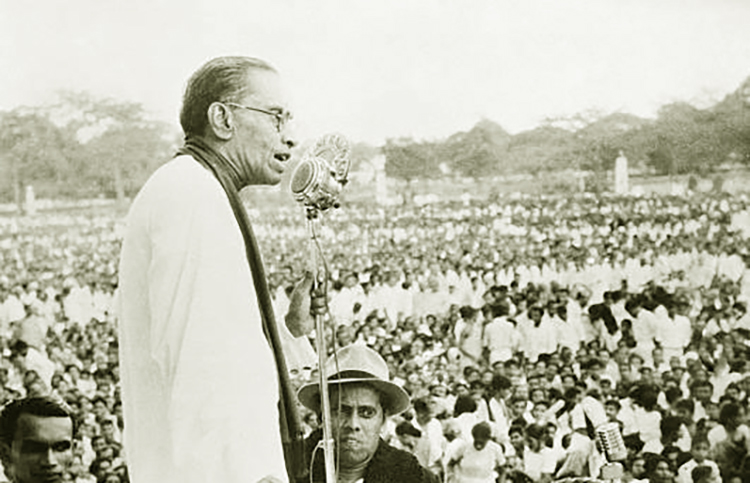
The S.J.V. Chelvanayakam KC Memorial Lecture delivered on 26 April, at Jaffna Central College, by Professor G.L. Peiris, an academic with outstanding credentials, was published, under the title, “Federalism and paths to constitutional reform,” in The Island of 27 April, 2026.
In Part II of the publication, titled “Advocacy of Federalism: Origins and Context,” Professor Peiris states: “At the core of political convictions he held sacrosanct was his unremitting commitment to federalism…”. Contrary to popular belief, however, federalism in our country had its origins in issues which were not connected with ethnicity. At the inception, this had to do with aspirations, not of the Tamils but of the Kandyan Sinhalese. The Kandyan National Assembly, in its representations to the Donoughmore Commission in 1927, declared: “Ours is not a communal claim or a claim for the aggrandizement of a few. It is the claim of a nation to live its own life and realise its own destiny”.
Commenting on S.W.R.D. Bandaranaike’s views, Professor Peiris states: “Soon after his return from Oxford, as a prominent member of the Ceylon National Congress, was an advocate of federalism. He went so far as to characterise federalism as ‘the only solution to our political problems”.
THE COMMON THREAD
The thread that is common to the sources cited above is that while their focus was on the political framework, there is not even a hint as to the territorial units to which the political framework of federalism is to apply. With time the Tamil “nation” claimed that their federal State was to be the Northern and Eastern Provinces of Sri Lanka. However, the Kandyan “nation” was silent on this issue. Since Britain annexed the Kandyan Kingdom and the unified, then Ceylon in 1815, for all intents and purposes it would be reasonable to assume that the claim of the Kandyan “nation” was to be the region under the last Kandyan King, leaving the Western and Southern coastal regions for the Rest of the “nation”.
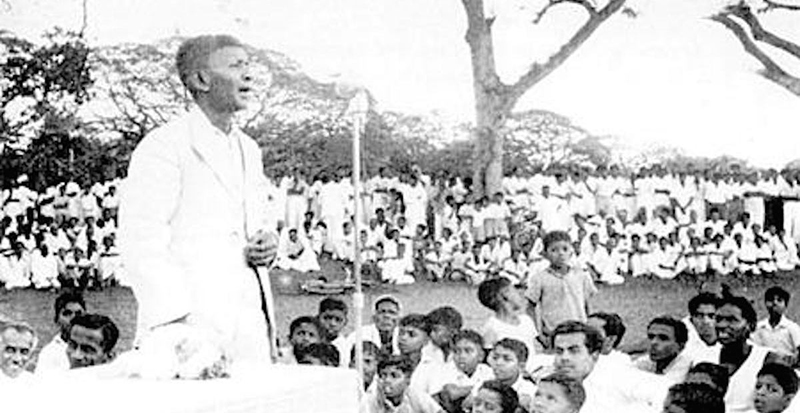
Chelvanayakam
Sri Lanka, while being a colony under the British, was not interested in political frameworks. Instead, the British were interested in structural arrangements that facilitated Administration. It is evident from the evolutionary processes explored by the British that subdivided units of a State are critical not only for effective Administration but also for the political framework that ensures political stability. Federalism, advocated by the Tamil and Kandyan Leaderships for territorial units, as claimed by them, would inevitably lead to political instability. The lesson to be learnt is not to start with political frameworks, such as Federalism, but to first decide on the territorial units, within which a State functions, to ensure stability, and then frame political aspirations of the People belonging to such a State, in order to ensure political and structural stability.
LESSONS of HISTORY
Material from an article, dated 16 June, 2016
“When the British took control of the Dutch possessions in former Sri Lanka, in 1796, the Kandyan Kingdom was independent and separate from the Maritime region. The Kandyan Kingdom consisted of the “central highlands with the eastern and southeastern coastal strips”. It was after ceding of the Kingdom, at the Kandyan Convention of 1815, and after the rebellion of 1817-1818, that the two regions were merged. However, despite the merger, the administration of the two regions remained divorced from each other, with the Kandyan region being divided into 11 Districts, and the Maritime region into five, creating a total of 16 Districts for the administration of the whole country (Sir Charles Collins, Public Administration of Ceylon, 1951, p. 49).
“The above arrangements continued until the recommendations of the Colebrook – Cameron Commission. In 1832, the recommendations of the Commission were accepted , “… and the separate administrative system for the Kandyan provinces was abolished and amalgamated with the territories on the littoral acquired from the V.O.C. in a single unified administration structure for the whole island. The existing provincial boundaries within the two administrative divisions – the Kandyan and maritime provinces – were redrawn, and a new set of five provincial units, of which only one – the Central Province – was Kandyan pure and simple, was established. The new provincial boundaries cut across the traditional divisions and placed many Kandyan regions under the administrative control of the old maritime provinces” (K.M.de Silva, A History of Sri Lanka, 1981, p. 263), continued until as late as 1889, resulting in nine Provinces for the sole purpose of facilitating the Colonial administration. In point of fact, the Province never functioned as the administrative unit. Instead, the administrative unit was essentially the District, and the situation has remained so throughout the Colonial period and into this day. According to Sir Charles Collins cited above: “Most provinces were divided into districts, each Government Agent having charge of his own district, with general supervision over the whole province. The districts not in the direct charge of Government Agents were under the control of assistant Government Agents”. (Ibid, p. 62.)
PRIORITISING POLITICS OVER STABILITY
The lesson learnt by the British was that if a Colony is to be Administered effectively, the Colonizer had to choose the most appropriate unit of administration. Similarly, to an Independent Sovereign State, Territorial Stability should be its foremost priority. This means deciding on the most structurally secure territorial unit within which political power sharing should operate and not prioritise political frameworks, such as Federalism, at the expense of the structural stability of the State. Political instability would have been inevitable had Sri Lanka succumbed to pressures from the Tamil and Kandyan Leaderships.
Although Britain was not concerned with territorial stability, they recognised that the District was the most effective unit for effective administration. In fact, the 1977 Constitution describes the Territory of Sri Lanka in terms of Administrative Districts. Despite this, it was the Indo-Lanka Accord that first recognised the Northern and Eastern Provinces as political units. Following this, the 13th Amendment of 1987 extended this recognition to all Provinces.
The adoption of the Province as the political unit may not have had an impact on the territorial integrity of the Sri Lanka State, except for the Northern and Eastern Provinces, judging from the events that followed over three-plus brutal decades. The transformation of the territory of Sri Lanka, from Administrative Districts to Provinces and Provincial Councils, is the direct result of prioritising politics over territorial stability. For India to be the handmaiden of this transformation is beyond comprehension because instability in Sri Lanka, in whatever form, would impact on India’s own territorial integrity. This serious blunder cannot be ignored any further for the sake of both Sri Lanka and India. It is imperative that measures are taken to engage in a course correction through Constitutional Reform.
PROPOSED CONSTITUTIONAL REFORMS
The path to Constitutional Reform should start with the territorial subdivision of the Sri Lankan State into Districts, not only to ensure the territorial integrity of the State but also to improve administrative and development efficiencies coupled with Local Government units; a lesson learnt from the British. Any political powers devolved/decentralised to Districts should be the responsibility of District Councils, elected by representatives to Local Governments within each District.
Political power at the Centre should reflect the commitment to a single Sri Lankan Nation, through an elected Legislature, with Executive Powers being shared by a President/Prime Minister, with a Cabinet made up of all communities, in the ratio represented in Parliament. An attempt to share Executive Power with all communities, in an inclusive Cabinet, has not been the practice in the past, and under the present government, as well, despite its strident calls for unity and reconciliation. Consequently, the tendency for minority communities is to seek peripheral power to the maximum extent possible.
CONCLUSION
The approach to Constitutional making has been how best to accommodate political power in the form of Federalism, first by the Kandyan “nation” and later by the Tamil “nation”. The claim by the Tamil Leadership morphed from Federalism to a Separate State resulting in tragedies of an unimaginable order, to the point of threatening the very existence of the Sri Lankan State.
The current arrangement is based on Power being devolved to Provinces, in the form of Provincial Councils, with no regard the Province, makes to the territorial durability of the Sri Lanka State. How successive Governments hope to prevent threats to territorial vulnerabilities is to curtail the operation of sensitive provisions of devolved powers. This is being disingenuous.
On the other hand, the more direct and forthright approach to Constitutional Reform is to make the District the unit of peripheral power in order to ensure territorial stability and effective peripheral development and share Executive Power with communities in the ratio of their representation in the Legislature. The first could be achieved through a referendum and the second by the President/Prime Minister of any government. This approach prioritises territorial stability over political power; a change that has eluded policymakers. Therefore, it is imperative that territorial stability is given the foremost place in Constitutional Reform processes for the sake of not only Sri Lanka but also for India, for reasons of connectivity.
by Neville Ladduwahetty
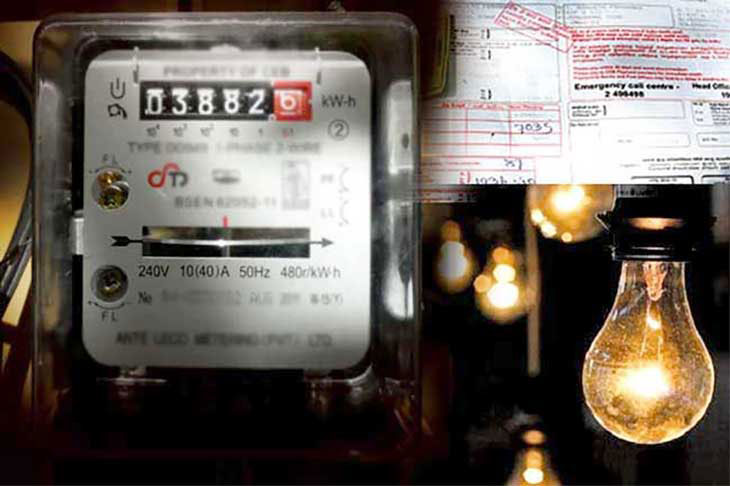
The power cuts are already here. Perhaps, even before the date predicted by the Public Utilities Commision of Sri Lanka (PUCSL. The peak load has gone well past the threshold they indicated as the tipping point of 3030 MW of peak load. It is now will past 3100 MW and growing, perhaps triggered by the continued heatwave making the use of air conditioners and fans more frequent and by a wider group of consumers. The government insists there is no intention of power cuts but each of us have experienced some form of power outage, without notice, at some time or other.
It is in this scenario that the Ceylon Electricty Board (CEB), or whatever it is called now, had directed all roof top solar projects, over 300 MW capacity, to shut down for the period 10th April to 20th April.
This is in addition to the curtailment of all ground mounted solar and wind projects, and even mini hydro projects, without compensation, going on for some months.
One year of inaction by CEB with the problem staring in the face
If will be recalled that the same demand was made in April, 2025, after the debacle of the countrywide blackout on 9th February, 2025, whether caused by a monkey or otherwise.
The question to be raised is what steps have been taken by the then CEB, or the Ministry to anticipate the situation this year, too, and to try and mitigate the same.
The easy answer is absolutely nothing. If at all what has been done is unilaterally prevent any further addition of Roof Top Solar PV, under the provisions of the Surya Bala Sangramaya (SBS), is, undoubtedly, the only short term and economical means to add low cost renewable electrical energy to the grid.
The architect of the SBS, the Sustainable Energy Authority is deafening by their silence, when their signature project of prime national importance has been sabotaged, and now even the performance of the already installed systems are being curtailed.
This action is totally unbelievable when the use of expensive oil-based generation will continue unabated, even during the day, when there is so much solar energy already installed. Of course, the age-old excuse will be trotted out, of the non-firm nature of Solar and Wind and problems of grid stability, etc.
Many useful and practical solutions to face the growing issue of how to integrate the essential low cost but variable resources of solar and wind to the grid as an aftermath of the blackout were discussed over a year ago.
But nothing seems to have even been attempted. The most prominent among these was the proposal to add 300 MW of grid scale batteries, as indicated in the already-approved Long Term Electricity Generation Plan ( LTEGP 2024 – 2044,) of which 100 MW should have been in use by 2026. The tender for the addition of 16 X 10 MW battery storage at selected grid substations was called over a year ago. Some expectation of sanity
It is under these circumstances that the PUCSL called for a stakeholder consultation on the 10th April, 2026, after circulating a concept note, which was well attended. It was a breath of fresh air, in view of the downhill slide of the entire electricity sector in the recent months compounded by the raging controversy of the coal scam and the rapidly increased use of expensive diesel, in addition to the other fossil fuels, just to keep up the generation to match the demand. The double whammy of the doubling of the fuel prices , exacerbated the hit on not only the consumer’s monthly bill, but the national economy and balance of payments.
Therefore, it was most encouraging to note from the PUCSL’s concept note that sanity has prevailed at last. We have been demandin–g some concrete strategies and time based targets to rid at least the electricity sector from the use of expensive, polluting fossil fuels, commencing with oil. This is the only means by which the utility could hope to achieve some degree of economic and financial viability. They have continued to burden the consumer and the country by continually jacking up the consumer tariff, while ignoring any prudent means to clean up their Act. As a matter of interest, the CEB’s own data of 2023 shows that it is possible to save some Rs 113 Billion annually by replacing all oil-based generation using renewables. The country could have saved over $ 700 Million in Foreign Exchange and the Consumer Tariff could have been lowered by Rs 7.00 per Unit across all segments of consumers.
Therefore, the PUCSL concept paper out lines, some credible measures to eliminate the use of all of forms of oil for power generation in stages. The three tier of approach, outlined as option 1 to 3, reproduced here, should be commended for adopting a pragmatic approach, with very good chance of success.
Proposed options by PUCSL
(See Options 1 Peak Shaving Approach by 2027 and Option 2: Eliminating 2.06 GWh/day of diesel-based generation)
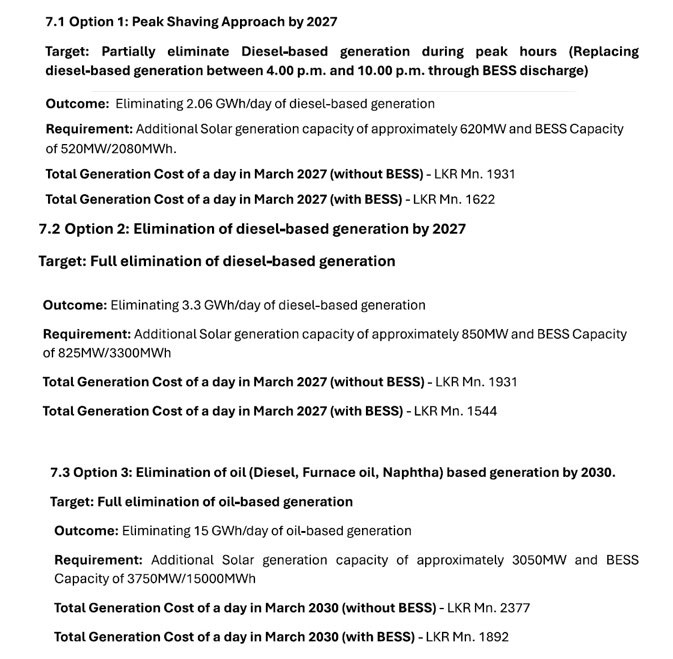
Considering even the recent past when we achieved a status of zero oil use, as compared to the present sorry status, this is not an extremely difficult task. We will have to substitute Solar PV to bridge the gap of reduced Hydro during dry months.
(See diagram 1)
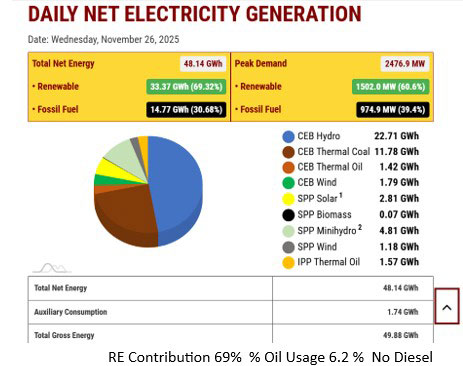
RE Contribution 69% % Oil Usage 6.2 % No Diesel
(See diagram 2)
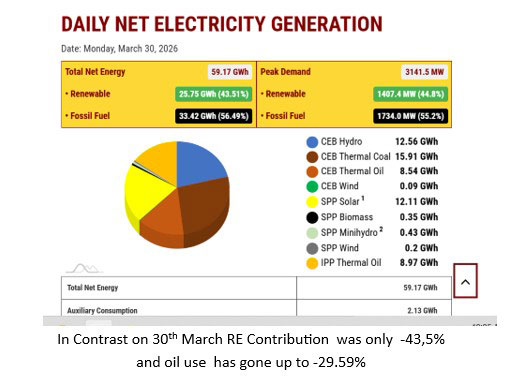
In Contrast on 30th March RE Contribution was only -43,5%
and oil use has gone up to -29.59%
However, as outlined in the introductory paragraphs of the concept paper, the driving force to promote this change is the early declaration of appropriately worked out tariffs for installation of storage batteries and delivery of the stored energy to the grid.
With the total lack of progress of proposals in the LTEGP 2025-2044 by the state institutions, it is prudent to assume any future initiatives can only come from private sector participation.
Using the power granted by the recently ratified Electricity Act NO, 36 (As amended) the PUCSL has moved with commendable speed to develop the Feed in Tariff declarations needed to enable the achievement of the above objectives and a further stakeholder consultation was held on the 24th of April when more detailed proposals were put forward.
However, although the responsibility of publishing the tariff remains with the PUCSL, unless the National System Operator ( NSO ), tasked with the planning and implementation of Electricity Sector developments , takes urgent action to implement the desired changes as a highest priority task, nothing will be gained to help the country to get out of this quagmire.
The Consumer Continues to be Burdened.
Further, as the time table proposed by the PUCSL itself indicates, even the first of the options can be implemented only in 2027, with the others following up to the year 2030.
These are very encouraging time targets and the consumers will eagerly await their achievement.
However, the threat of power cuts, as well as continuing increase in consumer tariff to fuel the use of diesel for power generation, is real and current. A further tariff increase of 18% has been demanded by the NSO, on top of the 15% granted on 1st April, 2026.
The Immediate Options Available to Consumers.
a) The CEB now refuses to provide any grid connection for integration of any rooftop solar PV systems under the Surya Bala Sangraamaya.
b) The only way available to the consumers is to install Off grid roof top solar systems with adequate batteries to be none dependent on the grid. Use the grid only during the off peak hours.
c) During most periods of the year, even under cloudy conditions there is some solar generation. To ensure the daily consumption is more than covered by the solar input and any surplus is used to charge the battery, to the level adequate to manage the evening and peak hour demand, the capacity of the solar panels and battery have to be determined.
d) It is to be noted that although only the relatively high-end domestic consumers could find the proposed scheme financially feasible under the present cost regimes, which will improve further when the second tariff increase is announced shortly, to those consuming over 250 Units/Month, their engagement has a sector wise positive implication which is beneficial to all levels of consumers.
e) The scheme will operate in an off grid mode, without exports to the grid at any time. Therefore, they will not contribute to the often voiced worries of over voltage, instability and variability in the national grid.
f) Once the PUCSL announces the required FIT and the NSO or the Distribution Companies institutes the necessary facilities, such as smart meters, such consumers, too, can further assist the grid by export of any excess they generate.
Proposal to Avoid Power Cuts Implementable by Domestic Consumers
There are several drivers which will attract the potential ” Prosumers” to adopt this option without delay.
* The consumer tariff will continue to rise
* Even the former Roof Top Solar Systems, without batteries, does not provide power during the power cuts or blackouts
* At present day prices, the investment is financially feasible, based on the savings of the current level of monthly electricity bill. A substantial bank loan can be comfortably settled from the savings
* Now cooking with electricity is no longer a financial burden but can save one from the cost and danger of LPG shortages and queues
* What you, do based on your economic ability, will be a service to all consumers as the resultant reduction of Peak Demand means the use of Diesel can be gradually reduced and the lower end consumers, too, will benefit.
* You will enhance your green credentials with your own financial benefits.
The overall benefit to the grid and other consumers
If the element of exorbitant cost of diesel-based generation is removed then there is no need for the increase of consumer tariff for all consumers.
What is more important is that trimming the peak load would drastically reduce the need for any power shredding that is happening on the sly now and thereby benefit all consumers,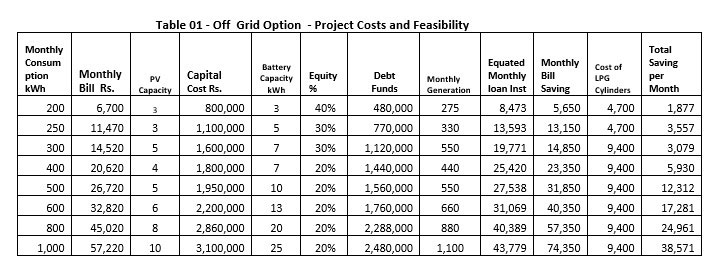
The summary of Financial Analysis illustrating the viability based on currently available data is given here. This will improve drastically if a further increase in consumer tariff is granted, which appears inevitable. (See Table 01 – The basic data used for this analysis is available on request.)
by Eng Parakrama Jayasinghe
parajayasinghe@gmail.com

In a striking symbol of the global energy transition, vast stretches of once-abandoned coal mines in China have been reborn, not as relics of an industrial past, but as shimmering hubs of renewable energy.
What were once scarred landscapes, destabilised by years of mining, and later submerged by landslides and floods, have now been transformed into expansive artificial lakes.
Floating atop these waters are some of the world’s largest solar power installations, quietly generating clean electricity on a massive scale.
Among the most notable are the Fuyang Floating Solar Farm and the Huainan Floating Solar Farm. Together, they represent a remarkable engineering and environmental achievement.
The Fuyang facility boasts an installed capacity of 650 megawatts, producing approximately 700 million kilowatt-hours of electricity annually. Even more impressive, the Huainan project reaches a staggering 1 gigawatt capacity, generating nearly 1.8 billion kilowatt-hours each year. Combined, these floating giants produce enough electricity to power millions of homes without burning a single lump of coal.
A former General Manager of the Ceylon Electricity Board (CEB), a veteran electrical engineer, described the development as “a glimpse into the future of energy systems.”
“What China has demonstrated is not just technological capability, but strategic foresight. Turning environmentally degraded land into clean energy assets is the kind of thinking countries like Sri Lanka must begin to adopt,” he said.
Why solar on water?
Floating solar, or “floatovoltaics,” offers a range of advantages that traditional land-based solar farms cannot easily match.
Water naturally cools solar panels, improving their efficiency by an estimated 10 to 15 percent. In hot climates, this cooling effect can significantly boost electricity generation.
Additionally, the panels reduce water evaporation, a crucial benefit in regions facing water stress. By limiting sunlight penetration, they also help suppress algae growth, improving water quality.
Perhaps, most importantly, floating solar eliminates the need for large tracts of land. In densely populated or agriculture-dependent countries, this is a game changer.
A dual economy: Fish and power
In an innovative twist, some of these floating solar farms incorporate aquaculture beneath the panels. Known as the “fisheries + solar” model, it allows communities to cultivate fish in the shaded waters below, creating a dual-income system, energy production above, food production below.
This integrated approach not only maximises resource use but also supports local livelihoods, blending sustainability with economic resilience.
Environmental dividends
The environmental benefits are substantial. The Fuyang project alone reduces carbon dioxide emissions by an estimated 580,000 tons annually, while the Huainan facility cuts emissions by around 1.6 million tons each year.
Beyond emissions, these projects reclaim landscapes once deemed unusable—areas heavily damaged by coal extraction. In doing so, they rewrite the narrative of industrial decline into one of ecological restoration and innovation.
Sri Lanka: A nation poised for floating solar For Sri Lanka, the implications are profound.
Unlike China’s abandoned coal pits, Sri Lanka possesses thousands of irrigation tanks, reservoirs, and hydropower catchments that could serve as ideal platforms for floating solar. From the ancient tank systems of the dry zone to major reservoirs like Victoria Dam and Randenigala Reservoir, the country holds untapped potential to generate clean electricity without sacrificing precious land.
The country’s reliance on thermal power, particularly during drought periods when hydropower declines—has long been a challenge. Floating solar could provide a stabilising solution, reducing dependence on costly fossil fuels while complementing existing hydroelectric infrastructure.
Energy analysts note that integrating floating solar with hydropower reservoirs can create a hybrid system: solar power during the day, hydropower balancing supply at night. This synergy enhances grid stability and reduces overall generation costs.
The former CEB official stressed the urgency:
“Sri Lanka cannot afford to delay. With rising energy demand and climate pressures, we must explore every viable renewable option. Floating solar on our reservoirs is one of the most practical and scalable solutions available.”
Challenges and the road ahead
However, experts caution that careful planning is essential. Environmental assessments, grid integration, and financing mechanisms must be properly addressed. Community engagement, especially where fisheries are involved—will also be key.
Yet the blueprint already exists.
China’s transformation of submerged coal mines into renewable energy hubs offers more than inspiration—it provides a working model. For Sri Lanka, adapting that model to its own geography could mark a decisive step toward energy independence.
China’s floating solar farms stand today as one of the clearest symbols of a world in transition—from fossil fuels to renewables, from environmental degradation to restoration.
For Sri Lanka, the message is equally clear: the future of energy may not lie on land alone—but on water, where sunlight meets innovation.
If harnessed wisely, Sri Lanka’s vast network of reservoirs could one day mirror that transformation, turning calm waters into engines of sustainable growth.
by Ifham Nizam

PM participated in ’Swarnabhivandana 2026,’ Sacred Relic Veneration Ceremony

Holder and Washington star in Gujarat Titans’ nervy last-over win

Varun and Narine push Sunrisers Hyderabad’s off switch

Aaron Hardie owns big stage to help Peshawar Zalmi lift second PSL title

Showers expected in the the Western, Sabaragamuwa, Central, North-western and Eastern provinces and in Polonnaruwa, Galle and Matara districts after 2.00 pm.

Heat Index at Caution Level in the Northern, North-central, Eastern, Sabaragamuwa and North-western provinces and in Colombo, Gampaha, Hambantota and Monaragala districts during the day time

‘Dates have the highest sugar content to fight Coronavirus’

Sunday Island 27 December – Headlines

#SundayIsland 17th December – Headlines

Sunday Island – 28th March

Sunday Island Headlines – 21 March

Sunday Island – 21st February – Headlines
-

 News5 days ago
Treasury chief’s citizenship details sought from Australia
-

 News4 days ago
Rooftop Solar at Crossroads as Sri Lanka Shifts to Distributed Energy Future
-
 News6 days ago
Govt. assures UN of readiness to introduce ‘vetting process’ for troops on overseas missions
-

 News3 days ago
“Three-in-one blood pressure pill can significantly reduce risk of recurrent strokes”
-
 Business6 days ago
ADB-backed grid upgrade tender signals next phase of Sri Lanka’s energy transition
-

 News5 days ago
Central Province one before last in AL results
-

 Sports5 days ago
Well done AKD!
-

 Business6 days ago
Update on independent forensic review