
Foreign News
Pakistan elections 2024: Count under way after controversial election

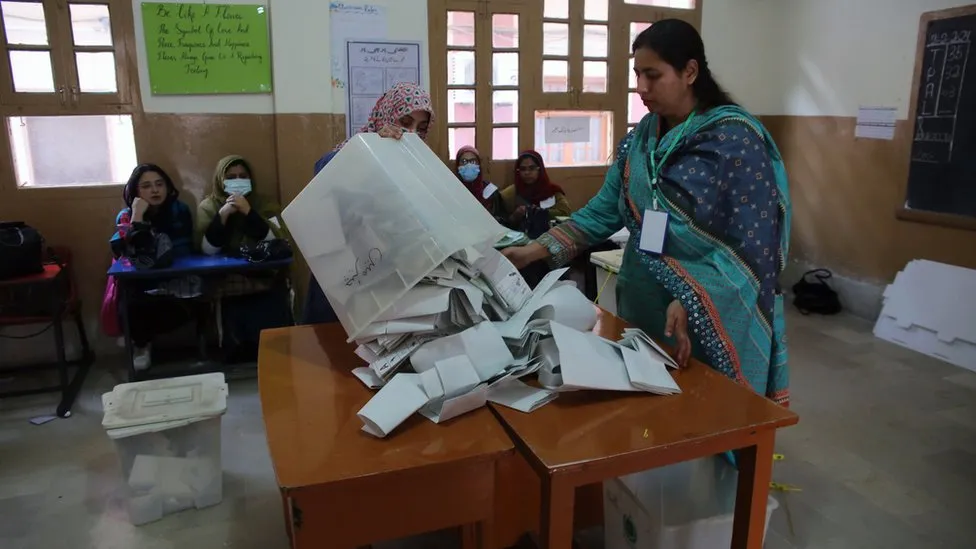
Votes are being counted in Pakistan after Thursday’s general election which was marred by the suspension of mobile phone services and violent unrest.
Results have been slow to come out, prompting election officials to warn local officials to speed up the process.
The party of disqualified and jailed ex-PM Imran Khan says the delay is a sign of vote-rigging. Unofficial results on TV channels suggest Khan’s allies are in the lead.
Jailed on corruption charges last year, Khan was barred from standing in Thursday’s election and his party, Pakistan Tehreek-e-Insaf (PTI), had to field its candidates as independents.
They were challenging the party of another former Prime Minister, Nawaz Sharif, whose younger brother Shehbaz, president of his Pakistan Muslim League Nawaz party (PML-N), replaced Khan two years ago when he was ousted in a no-confidence vote.
As many as 128 million people were registered to cast their votes, almost half of whom were under the age of 35. More than 5,000 candidates – of whom just 313 are women – contested 266 directly elected seats in the 336-member National Assembly.
Millions have been hit hard by the country’s economic woes, which were exacerbated by devastating floods in 2022. Inflation is soaring, and people are struggling to pay their bills. Violence is also on the rise.
Projected results have been unusually slow in coming in, Reuters news agency notes. In previous elections, there was a clearer picture about which party was in the lead by midnight local time (19:00 GMT) on election day, it said.
Zafar Iqbal, special secretary at the Election Commission of Pakistan, blamed an “internet issue” for the delay, speaking after he announced the first official results for a constituency.
Despite the delay, PTI leaders said they were heading for victory based on early returns while Bilawal Bhutto Zardari, son of assassinated ex-Prime Minister Benazir Bhutto, said early results for his Pakistan People’s Party (PPP) “were very encouraging”.

Earlier, the government said mobile services had been suspended because of attacks aimed at disrupting the vote which, the military says, left at least nine people dead.
Both calls and data services were cut just 10 minutes before voting started on Thursday although wifi networks still appeared to be working. Many voters in the city of Lahore told the BBC that the internet blackout meant it had not been possible to book taxis to go and vote, while others said they had been unable to chat to other family members to co-ordinate when to head to polling stations.
The PTI, called the internet cut a “cowardly act” as voters struggled to find their polling stations and the shutdown was also criticised by Bilawal Bhutto Zardari, who called for services to be restored “immediately”.
The country has in the past cut internet services to control the flow of information – though a shutdown of this extent is unprecedented, especially during an election.
Pakistan has a history of militant attacks but over voting day there were only isolated incidents of violence. In the worst, in Dera Ismail Khan in the north, four police officials were killed in a bomb attack on their vehicle.
PML-N and the PPP were considered the two major parties going into the vote. Picking out candidates from Khan’s PTI was more difficult, after it was banned from using the cricket bat symbol under which all its candidates run.
The move forced PTI-backed candidates, who were running as independents, to use other symbols instead, including calculators, electric heaters and dice. Electoral symbols play a key role in a country where more than 40% are unable to read.

The PTI allege other tactics were also used to prevent their candidates from campaigning for and winning seats, including locking up PTI members and supporters and banning them from holding rallies, effectively forcing them underground.
Imran Khan is serving at least 14 years in prison, having been sentenced in three separate cases in the space of five days last week. The PTI alleges interference by Pakistan’s powerful military, with whom Khan is said to have fallen out before his ousting and imprisonment.
But people were able to vote for Nawaz Sharif, the PML-N leader who at the time of the last election was beginning a sentence for corruption.
Mr Sharif was ousted in a 1999 military coup and had a third term as prime minister cut short in 2017 but he recently returned from self-imposed exile.
He had his lifetime ban on holding office overturned and also got his criminal record wiped clean at the end of last year, allowing him to stand for what would be a record fourth term.








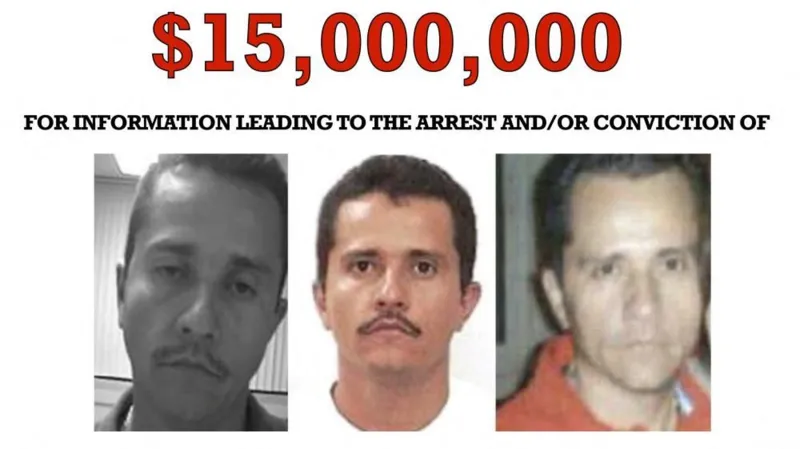
Mexico’s most wanted man and the leader of the feared Jalisco New Generation (CJNG) drug cartel has been killed during a security operation to arrest him, the defence ministry has said.
Nemesio Oseguera Cervantes, known as “El Mencho”, died on Sunday as he was being taken to the capital Mexico City, after being seriously injured in clashes between his supporters and the army.
Four CJNG members were killed in the town of Tapalpa, the central-western Jalisco state. Three army personnel were also injured. The US had given Mexico with information that assisted the operation.
CJNG retaliated by setting cars alight, building roadblocks and attacking security forces in eight states.
Mexico’s President Claudia Sheinbaum Pardo later urged people to remain “calm”.
In a post on X, she wrote that “in most parts of the country, activities are proceeding normally”.
The CJNG cartel – which had its original power base in Jalisco – is now present across Mexico.
El Mencho, a 59-year-old former police officer, ran a vast criminal organisation responsible for trafficking huge quantities of cocaine, methamphetamine and fentanyl into the US.
It had offered a $15m (£11.1m) reward for information leading to El Mencho’s capture.
In a statement, the Mexican defence ministry said the operation was “planned and executed” by the country’s special forces.
Aircraft from the Mexican Air Force and the National Guard were also deployed.
It also said that several armoured vehicles and weapons – including rocket launchers – were seized during the operation.
The US had been providing information to Mexico that assisted its operation, the statement said.
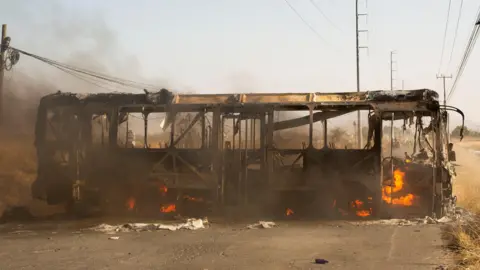
Eyewitnesses have filmed plumes of smoke rising over several cities including Guadalajara – one of the host cities of the forthcoming Fifa World Cup.
In the tourist hotspot of Puerto Vallarta, on the Jalisco coast, potentially thousands of tourists are trapped in the resort around the fighting.
Throughout Sunday, there were reports of gunmen on the streets in Jalisco and elsewhere.
The governor of Jalisco, Pablo Lemus Navarro, on social media advised residents of the state to adhere to a code red warning and avoid leaving their homes.
He also said that public transport was suspended in the state.
The US Department of State issued a shelter-in-place warning for US citizens in the states of Jalisco, Tamaulipas, as well as some areas in Michoacan, Guerrero and Nuevo Leon.
Former US ambassador to Mexico and Deputy Secretary of State Christopher Landau described El Mencho on social media as “one of the bloodiest and most ruthless drug kingpins.”
He added that El Mencho’s death was “a great development for Mexico, the US, Latin America, and the world”.
The killing of El Mencho represents a victory for the Mexican president in her fight against the country’s drug cartels.
It also could strengthen her relationship with US President Trump, who often has demanded more progress on security in Mexico.
However, if the security forces can’t bring the situation under control quickly, the Mexican administration’s victory may be overshadowed by the cartel’s violent response.
The Jalisco cartel has gained notoriety since it was formed in about 2010 for a series of attacks on security forces and public officials.
It has downed an army helicopter with a rocket-propelled grenade, killed dozens of state officials, and has even been known to hang the bodies of its victims from bridges to intimidate its rivals.
[BBC]
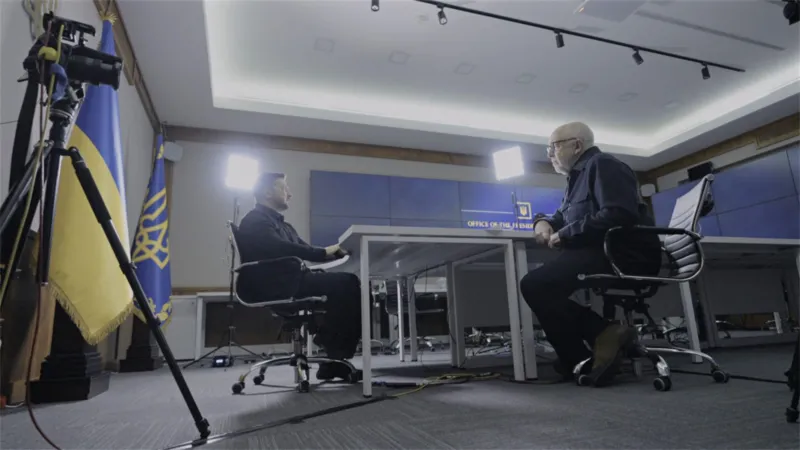
Ukraine’s President Volodymyr Zelensky continues to send out a firm message of defiance.
When we met this weekend in the government headquarters in Kyiv, he said that far from losing, Ukraine would end the war victorious. He was firmly against paying the price for a ceasefire deal demanded by President Vladimir Putin, which is withdrawing from strategic ground that Russia has failed to capture despite sacrificing tens of thousands of soldiers.
Putin, Zelensky said, has already started World War Three, and the only answer was intense military and economic pressure to force him to step back.
“I believe that Putin has already started it. The question is how much territory he will be able to seize and how to stop him… Russia wants to impose on the world a different way of life and change the lives people have chosen for themselves.”
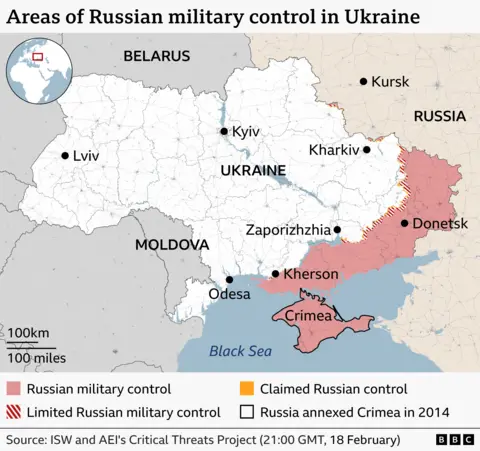
What about Russia’s demand for Ukraine to hand over the 20% of the eastern region of Donetsk that it still holds – a line of towns Ukraine calls “fortress cities” – as well as more land in the southern regions of Kherson and Zaporizhzhia? Isn’t that, I asked, a reasonable request if it produces a ceasefire?
“I see this differently. I don’t look at it simply as land. I see it as abandonment – weakening our positions, abandoning hundreds of thousands of our people who live there. That is how I see it. And I am sure that this ‘withdrawal’ would divide our society.”
But isn’t it a good price to pay if that satisfies President Putin? Do you think it would satisfy him?
“It would probably satisfy him for a while… he needs a pause… but once he recovers, our European partners say it could take three to five years. In my opinion, he could recover in no more than a couple of years. Where would he go next? We do not know, but that he would want to continue the war is a fact.”
I met Volodymyr Zelensky in a conference room inside the heavily-guarded government enclave in a well-to-do corner of central Kyiv. In the interview he spoke mostly in Ukrainian.
You get a sense of the weight of leadership carried by Zelensky from the diligence of his security guards.
Visiting any head of state requires rigorous checks. But entering the presidential buildings in Kyiv takes the process to a level I have rarely experienced before.
It is not surprising in a country at war, with a president who has already been targeted by Russia.
Despite all that, the man who started as an entertainer, who won the Ukrainian version of Strictly Come Dancing in 2006, and played the role of an unexpected president of Ukraine in a TV comedy, before becoming the real-life president of Ukraine, seems to be remarkably resilient.
US President Donald Trump said on the eve of the most recent ceasefire talks in Geneva that “Ukraine better come to the table fast”.
He continues to default to putting more pressure on Ukraine than on Russia.
Western diplomats have indicated since last summer that Trump agrees with Putin that territorial concessions from Ukraine to Russia are the key to the ceasefire Trump wants, ideally before this coming summer.
Plenty of analysts outside the White House also judge that Ukraine cannot win the war and, without making concessions to Moscow, will lose it.
I asked Zelensky whether Trump and the others had a point.
“Where are you now?” Zelensky asked in return. “Today you are in Kyiv, you are in the capital of our homeland, you are in Ukraine. I am very grateful for this. Will we lose? Of course not, because we are fighting for Ukraine’s independence.”
Zelensky has often said that Ukraine can win, but what would victory look like?
Of course, he said, victory meant restoring normal lives for Ukrainians and ending the killing. But the wider view of victory he presented was all about a global threat that he says comes from Putin.
“I believe that stopping Putin today and preventing him from occupying Ukraine is a victory for the whole world. Because Putin will not stop at Ukraine.”
You are not saying that victory is getting all the land back, are you?
“We’ll do it. That is absolutely clear. It is only a matter of time. To do it today would mean losing a huge number of people – millions of people – because the [Russian] army is large, and we understand the cost of such steps. You would not have enough people, you would be losing them. And what is land without people? Honestly, nothing.”
“And we also don’t have enough weapons. That depends not just on us, but on our partners. So as of now that’s not possible but returning to the just borders of 1991 [the year Ukraine declared its independence, precipitating the final collapse of the Soviet Union] without a doubt, is not only a victory, it’s justice. Ukraine’s victory is the preservation of our independence, and a victory of justice for the whole world is the return of all our lands.”
A year ago, Zelensky visited the White House and received a reception one senior Western diplomat described to me as a pre-planned public “diplomatic mugging” from Donald Trump and his Vice-President, JD Vance.
Their argument, in the presence of the world’s media, was watched by millions around the world.
Trump, just inaugurated as president for the second time, was sending the strongest possible signal that the era of support Zelensky and Ukraine had relied on from President Joe Biden was over. Nato members were already on notice from the new administration. Vance had just got back from shattering Western European illusions about the strength of the trans-Atlantic alliance.
Since then, reportedly coached by Britain’s National Security Adviser Jonathan Powell among others, Zelensky has avoided public confrontations with Trump.
The US president has stopped almost all shipments of military aid to Ukraine. But the US still provides vital intelligence, and European countries are spending billions buying weapons from the Americans to give to Ukraine.
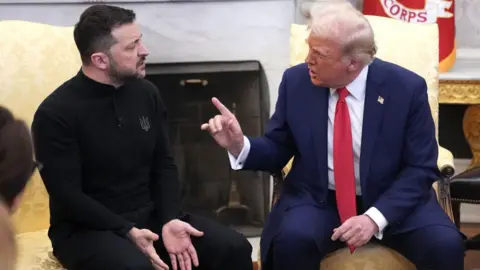
I asked Ukraine’s president about Trump’s often contradictory statements, recalling that among the untruths he has uttered is the accusation that Zelensky is a dictator who started the war – a precise echo of claims made by Vladimir Putin.
Zelensky laughed.
“I am not a dictator, and I didn’t start the war, that’s it.”
But can you trust President Trump? If you extract a security guarantee from him, I asked, would he keep his word? He is after all a man who changes his mind.
“It is not only President Trump, we’re talking about America. We are all presidents for the appropriate terms. We want guarantees for 30 years for example. Political elites will change, leaders will change.”
He meant that US security guarantees needed approval from Congress in Washington DC to make them watertight.
“They will be voted on in Congress for a reason. It’s not just presidents. Congress is needed. Because the presidents change, but institutions stay.”
In other words, Donald Trump might be unreliable, but he will not be there for ever.
Zelensky says those security guarantees would have to be in place before he could consider another American demand – the US demand for Ukraine to hold a general election by the summer, echoing another Russian talking point that Zelensky is an illegitimate president. Trump has not demanded elections in Russia, where Putin became leader for the first time on the last day of the 20th Century.
Zelensky said he had not decided whether to stand again, whenever an election is held: “I might run and might not.”
Elections were due in 2024, but they could not be held under martial law that was introduced after Russia’s full-scale invasion.
Holding postponed elections, Zelensky said, was technically possible if they had time to change the law to allow them to happen. But he needed security guarantees for Ukraine first.
He went on to raise so many potential problems about holding an election with millions of Ukrainians abroad as refugees and significant tracts of the country occupied by Russia that I suggested that in reality he was against the idea.
“If this is a condition for ending the war, let’s do it. I said, ‘honestly, you constantly raise the issue of elections’. I told the partners, ‘you need to decide one thing: you want to get rid of me or you want to hold elections? If you want to hold elections, (even if you are not ready to tell me honestly even now), then hold these elections honestly. Hold them in a way that the Ukrainian people will recognise, first of all. And you yourself must recognise that these are legitimate elections'”.
Volodymyr Zelensky has opponents and harsh critics here in Ukraine.
His government was rocked last autumn by a corruption scandal that led to the departure of his closest adviser.
But Zelensky, with a new team, still commands approval ratings that most leaders in Western Europe can only dream about.
He has irritated his allies at times with constant demands for more and better equipment. One of the accusations directed at him in the Oval Office by Trump and Vance a year ago was that he was not sufficiently grateful.
The latest item on his list is permission to manufacture American weapons under licence, including Patriot air defence missiles.
“Today the issue is air defence. This is the most difficult problem. Unfortunately, our partners still do not grant licenses for us to produce systems ourselves, for example, Patriot systems, or even missiles for the systems we already have. So far, we have not achieved success in this.”
Why won’t they do that?
“I don’t know. I have no answer.”
At the end of the interview, he switched from Ukrainian to English.
Given everything he had said, I asked him whether we needed to get ready for an even longer war in Ukraine.
“No, no, no, it’s two parallel tracks… you are playing chess with a lot of leaders, not with Russia. There is not one right way. You have to choose a lot of parallel steps, parallel directions. And one of these parallel ways will, I think, bring success. For us, success is to stop Putin.”
But Vladimir Putin isn’t going to end this war, is he? Unless he’s under massive pressure and he doesn’t seem to be.
“Yes and no. We will see. Yes and no. He doesn’t want, but doesn’t want doesn’t mean he will not. God bless. God bless, we will be successful. Thank you.”
And with that, he posed for photographs, shook hands with the BBC team, and strode out of the room.
[BBC]

A total of 1,557 Venezuelan political prisoners have applied for amnesty under a new law introduced on Thursday, the country’s National Assembly President has said.
Jorge Rodríguez, brother of Venezuelan interim President Delcy Rodríguez and an ally of former President Nicolás Maduro, also said “hundreds” of prisoners had already been released.
Among them is politician Juan Pablo Guanipa, one of several opposition voices to have criticised the law for excluding certain prisoners.
The US has urged Venezuela to speed up its release of political prisoners since US forces seized Maduro in a raid on 3 January. Venezuela’s socialist government has always denied holding political prisoners.
At a news conference on Saturday Jorge Rodríguez said 1,557 release requests were being addressed “immediately” and ultimately the legislation would extend to 11,000 prisoners.
The government first announced days after Maduro’s capture, on 8 January, that “a significant number” of prisoners would be freed as a goodwill gesture.
Opposition and human rights groups have said the government under Maduro used detentions of political prisoners to stamp out dissent and silence critics for years.
These groups have also criticised the new law. One frequently cited criticism is that it would not extend amnesty to those who called for foreign armed intervention in Venezuela, BBC Latin America specialist Luis Fajardo says.
He noted that law professor Juan Carlos Apitz, of the Central University of Venezuela, told CNN Español that that part of the amnesty law “has a name and surname”. “That paragraph is the Maria Corina Machado paragraph.”
It is not clear if the amnesty would actually cover Machado, who won last year’s Nobel Peace Prize, Fajardo said.
He added that other controversial aspects of the law include the apparent exclusion from amnesty benefits of dozens of military officers involved in rebellions against the Maduro administration over the years.
On Saturday, Rodríguez said it is “releases from Zona Seven of El Helicoide that they’re handling first”.
Those jailed at the infamous prison in Caracas would be released “over the next few hours”, he added.
Activists say some family members of those imprisoned in the facility have gone on hunger strike to demand the release of their relatives.
US President Donald Trump said that El Helicoide would be closed after Maduro’s capture.
Maduro is awaiting trial in custody in the US alongside his wife Cilia Flores and has pleaded not guilty to drugs and weapons charges, saying that he is a “prisoner of war”.
[BBC]

High stakes for a rare West Indies-Zimbabwe clash

Mexico’s most wanted drug lord ‘El Mencho’ killed in military operation

Zelensky tells BBC Putin has started World War 3 and must be stopped

All-round South Africa hammer India in Ahmedabad

Will Jacks stars again as England dismantle Sri Lanka

England limp to 146-9 against Sri Lanka

‘Dates have the highest sugar content to fight Coronavirus’

Sunday Island 27 December – Headlines

#SundayIsland 17th December – Headlines

Sunday Island – 28th March

Sunday Island Headlines – 21 March

Sunday Island – 21st February – Headlines
-
 Features24 hours ago
Why does the state threaten Its people with yet another anti-terror law?
-

 Business7 days ago
Ministry of Brands to launch Sri Lanka’s first off-price retail destination
-

 Features24 hours ago
Victor Melder turns 90: Railwayman and bibliophile extraordinary
-
 Features24 hours ago
Reconciliation, Mood of the Nation and the NPP Government
-
 Latest News2 days ago
New Zealand meet familiar opponents Pakistan at spin-friendly Premadasa
-
 Features24 hours ago
Victor, the Friend of the Foreign Press
-
 Latest News2 days ago
Tariffs ruling is major blow to Trump’s second-term agenda
-

 Latest News2 days ago
ECB push back at Pakistan ‘shadow-ban’ reports ahead of Hundred auction