
News
PAFFREL: Ranil offers to strengthen PCs, having postponed elections to them

By Rathindra Kuruwita
It was ironic to see President Ranil Wickremesinghe, who had done everything in his power to postpone provincial council polls indefinitely, pledging to strengthen the same councils, in his policy statement presented to Parliament on 07 January, Executive Director of People’s Action for Free and Fair Elections (PAFFREL), Rohana Hettiarachchi told The Island yesterday (09).
In the policy statement, President Wickremesinghe said “efforts are underway to bolster the economies of all nine provinces, with delegated powers related to sectors like vocational education and agriculture given to provincial councils under the third list of provincial council powers in the Constitution. This decentralization aims to accelerate economic growth in each province, fostering healthy economic competition among them.”
Hettiarachchi said that a few days earlier the Cabinet-of-Ministers agreed to allocate 10 billion rupees for both the presidential and general elections. The Cabinet also said “those provisions have to be managed for covering the expenditure of the presidential election and general election.
“So the government decides on when to hold elections and sets the financial parameters that they should be held. Deciding on when to hold elections is not the responsibility of the executive.”
Hettiarachchi said that putting a cap on expenses for holding an election has several negative impacts. The Elections Commission is entrusted with holding free and fair elections and this endeavour is a costly one.
“The Commission needs adequate staff; they have to train a large number of people; the Commission needs the support of the police and that alone costs a few billion rupees. The Commission also pays a lot of money to the Ceylon Electricity Board, the postal department and the government printer. So, out of that 10 billion allocation, a significant amount of money goes back to various government institutions.”
Hettiarachchi said Artificial Intelligence could be used in the coming elections for political campaigns. Social media will be rife with misinformation, misinterpretations and fake news.
“The Elections Commission will need to invest in new technologies, and they will need the services of many experts. Also, don’t forget that the next election would be held under a campaign finance law. The Commission needs to establish a monitoring mechanism for this and that will also entail additional expenditure. What will happen if the Elections Commission has to cut down on the above mentioned expenses?” he asked.
Hettiarachchi said that the Cabinet decision also shows that the government has no plans to hold provincial or local council elections in 2024. Those are two elections that should be held before the presidential or general elections.
“If those in power care about the people’s franchise they should have held the local council election in 2023. They should have held provincial council elections in 2017.”
Hettiarachchi said that an amendment to the laws that govern provincial councils, brought during the Yahapalana administration, is a reason why the country has not been able to hold provincial council elections. Ranil Wickremesinghe was the Prime Minister of that government, too.
“Now the powers of the provincial councils are wielded by the governor who is appointed by the President. This is why the promise to increase the powers of provincial councils, made during the policy statement on Wednesday, is absurd.”
Hettiarachchi said the Elections Commission is already taking necessary steps to hold any election in 2024. The voter registry is already being updated.
“Police and other state institutions must support the Elections Commission during an election. This is in the Constitution. Not extending the necessary assistance to the Commission is a punishable act. Even the President is bound by the constitution to support the Elections Commission.”
The PAFFREL Executive Director said that recently he came across two interesting circulars. One was issued on 24 January 2024 by the Presidential Secretariat. There is another issued on 29 December 2023 by the Finance Ministry. Both are institutions under President Ranil Wickremesinghe.
“The circular in December says that projects approved by the 2024 Budget must be completed by 31 July 2024. The one in January is about an initiative called ‘Kandukara Dashakaya,’ which is a 10-year plan on rural development. It also says that all initiatives, under this programme for 2024, must be completed by 31 July 2024. I have never seen such circulars before. What is going on here? On one hand, it’s an indication that the government is getting ready for an election. The other is that, if the presidential election is to be held before 17 October, the electoral process must start in July. It’s obvious that the government is trying to finish these projects by July end to get an advantage,” he said.




News
Cabinet approval has been granted to several proposals and policies related to the new Education Reforms – Prime Minister

[Prime Minister’s Media Division]
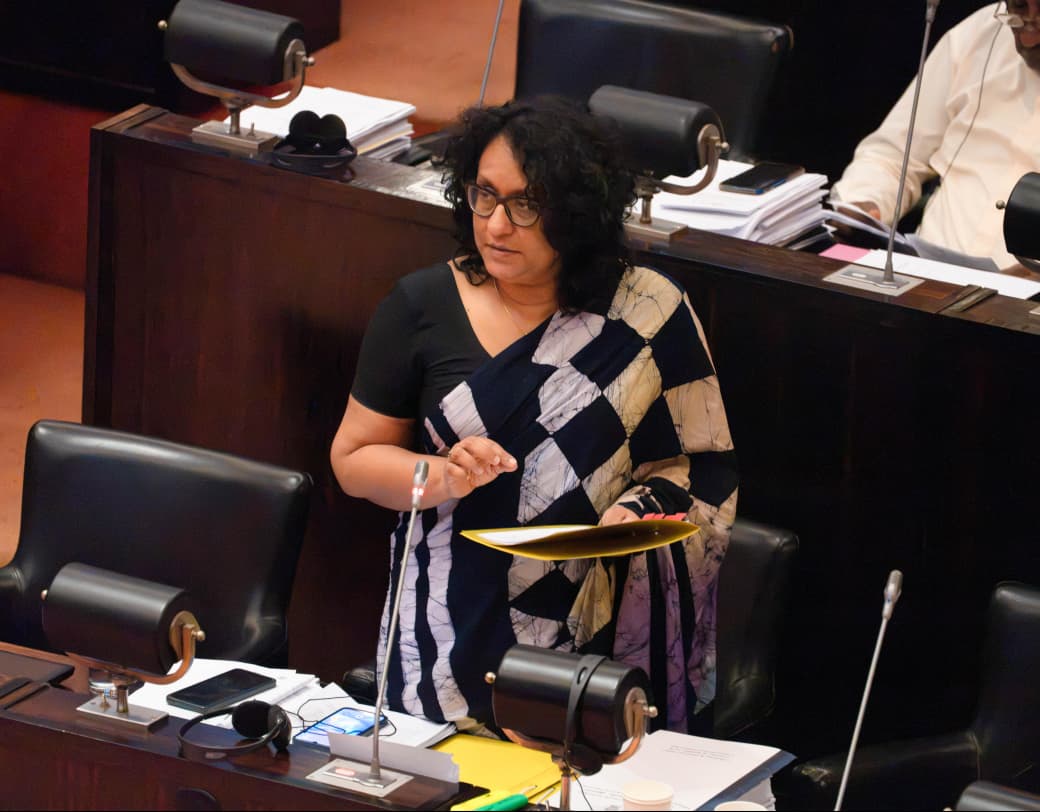
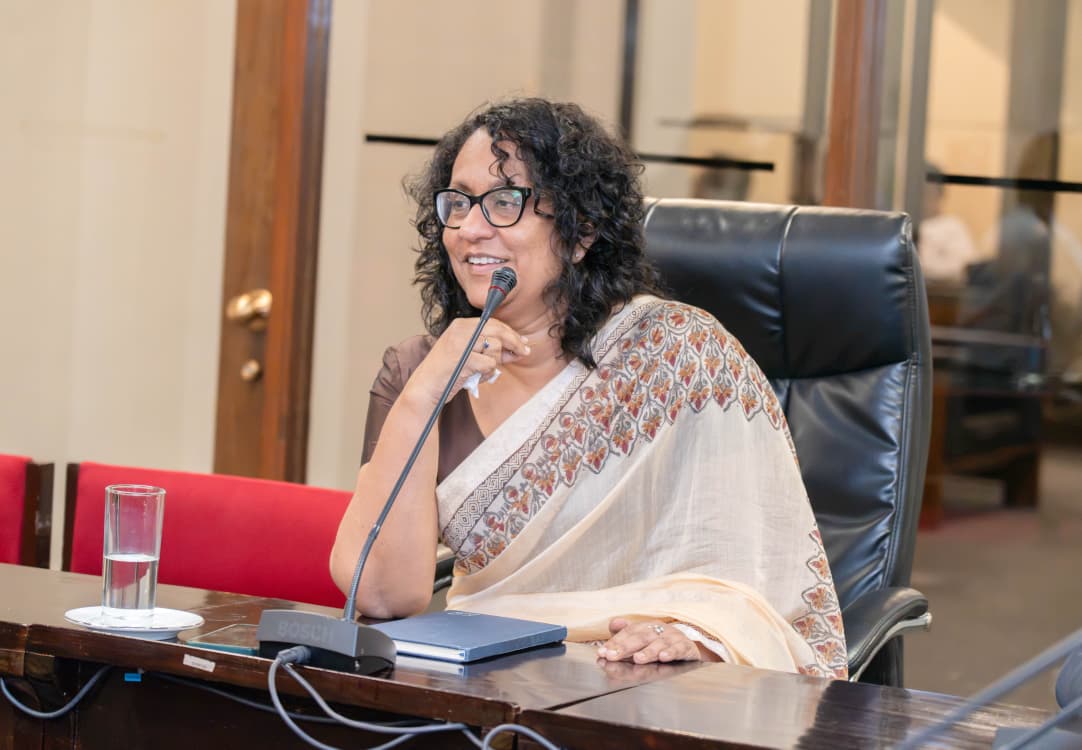
Prime Minister Dr. Harini Amarasuriya emphasised in Parliament that the Government has taken steps to amend the Anti-Corruption Act not to weaken its objectives, but to further strengthen the anti-corruption process by addressing practical, institutional and human resource challenges identified during its implementation.
The Prime Minister made these remarks during the parliamentary debate on the Anti-Corruption (Amendment) Bill held on Thursday [8 October]. The Prime Minister pointed out that although discussions on anti-corruption laws and institutions had been ongoing since 1994, those institutions had existed largely in name only, without the necessary human resources, financial allocations, resources and infrastructure required for their effective functioning. She further noted that although the new Anti-Corruption Act was introduced in 2023, the practical challenges associated with its implementation became apparent only after it began to be actively enforced in 2025.
Accordingly, the current amendments have been proposed to facilitate the recruitment of the required human resources, rectify inconsistencies between the Sinhala and English versions of the Act, and resolve practical difficulties encountered in its implementation. She also noted that discussions had taken place regarding the need to consider the privacy of public officials and all other parties connected with the State in relation to asset and liability declarations made under the Anti-Corruption Act.
However, neither the original Act nor the current amendments had, at any point, exempted elected representatives from these obligations. “The Opposition’s statements clearly reveal its agitation and discomfort regarding the establishment of an anti-corruption culture in the country and its effective implementation,” the Prime Minister stated.
Recalling that one of the key demands of the people’s struggle was not merely to punish those who had misappropriated public funds, but also to recover those funds for the State, the Prime Minister stated that the current amendments also seek to strengthen mechanisms for achieving this objective. She pointed out that, in addition to ensuring that individuals involved in corruption are brought to justice, another objective of the amendments is to strengthen the mechanisms necessary to recover losses incurred by the State.
“This is not an attempt to weaken the anti-corruption process. It is an effort to resolve the practical, institutional and human resource challenges that arise in its implementation. We have nothing to gain by abandoning the fight against corruption. If we were to abandon it, that would be our defeat,” the Prime Minister emphasised. The Prime Minister further stated that it was deeply regrettable that, in a country where a significant protest of people had taken place against corruption, the Opposition was attempting to mislead the public by presenting false arguments. She noted that such actions only served to demonstrate that the Opposition was once again attempting to protect a corrupt political culture.
[Prime Minister’s Media Division]

Sri Lankan professionals trained in India under the Indian Technical and Economic Cooperation (ITEC) programme have formed a national alumni association. The Sri Lanka ITEC Alumni Association was formally launched at its inaugural meeting on Thursday, 8 October 2026, at the Grand Crystal Ballroom of Hotel Taj Samudra, Colombo.
The Association is a unique initiative of the Education Wing of the High Commission of India in Sri Lanka. The Wing oversees India’s education and scholarship programmes for Sri Lanka, including the ITEC programme. The initiative was led by Sandeep Chaudhary, First Secretary (Education), High Commission of India. His vision and support were key to bringing Sri Lanka’s ITEC alumni together under one platform for the first time.
The Government of India launched ITEC in 1964, and it has since become one of the cornerstones of India’s development partnership with countries of the Global South. The programme is fully funded by the Government of India and offers civilian training in a wide range of fields, including public administration, finance, information technology, engineering, management, agriculture, health and the environment. Courses are delivered at leading Indian institutions. Over six decades, ITEC has trained officials and professionals from more than 160 partner countries. Sri Lanka has been one of its most active participants, and thousands of Sri Lankan public servants and professionals have benefited from the programme.
The new Association brings these alumni together from government, semi-government and private sector institutions. Its aims are to foster professional networking, knowledge sharing, capacity development and community service. It will also encourage collaboration among alumni and guide and support future Sri Lankan participants in ITEC programmes. In doing so, the Association seeks to deepen the long-standing friendship and people-to-people ties between Sri Lanka and India.
At the meeting, members elected an Executive Committee to lead the Association. Ms. Gayathri Suveendran was elected President. The other office-bearers are:
Vice Presidents: P.B. Hasith Sandaruwan and Leo Darshan
General Secretary: Anupa Weerarathne
Assistant Secretary: Vimukthi Dushantha
Treasurer: S. Rubadharshan
Assistant Treasurer: I. Ravikumar
Four sectoral committees will carry the Association’s work forward:
Establishment, Administration and Finance: Prof. M.I.M. Mujahid Hilal, M. Farwis, Milroy Aluthwatta, W.P. Suraweera, M.S. Thayaraj and Asinsala Senevirathne.
ICT, Digital Transformation and Innovation: Sujah Ameer, Danushka Diunugala, T.M.M. Perera, Tharanga, M.K.H.P. De Silva, Pubuditha Madushan and Arulkumaran Mahalingam.
Coordination, Organising and Legal Affairs: T. Srirajeevan, Theja Jayathilaka, Eng. A. Lingeswaran, Chaminda K. Uda, Kumuduni, S. Sinthujan and Ananda Arasu.
Media, Public Relations and Publications: Rahul Samantha Hettiarachchi, Dr. Gayani Kaushalya, Anandi Premarathne, Vimukthi Dushantha, R. Suhanthan and Shyam Nuwan Ganewatta.
The founding of the Association marks a significant milestone for the ITEC community in Sri Lanka. It turns individual training experiences in India into a shared national resource, and it adds a new professional dimension to the enduring partnership between the two neighbours.

‘Time for Ukraine to get new president,’ says Trump after Zelensky condemns diesel deal

Cabinet approval has been granted to several proposals and policies related to the new Education Reforms – Prime Minister

The Anti-Corruption Act is being amended to strengthen It, not to weaken it – PM

Renshaw 190 lifts Australia to 390 before Hazlewood strikes

Pope says death penalty ‘inadmissible’ as US plans to livestream execution

Attack on airport in Saudi capital, Riyadh, leaves several injured

‘Dates have the highest sugar content to fight Coronavirus’

Sunday Island 27 December – Headlines

#SundayIsland 17th December – Headlines

Sunday Island – 28th March

Sunday Island Headlines – 21 March

Sunday Island – 21st February – Headlines
-

 News6 days ago
Geneva takes up Sallay’s case and govt. ignores opportunity to answer accusations
-

 Features7 days ago
The first woman in the foreign service or Ceylon Overseas Service it was then called
-

 News7 days ago
Nearly 20 Iranian tankers stranded off Lanka amid US sanctions
-

 Features5 days ago
Preventing grievances from becoming communal
-

 Sports3 days ago
Nissanka absence opens door for Sri Lanka’s young guns
-

 News4 days ago
Gnansara Thera to be assigned to prison printing section: Officials
-

 Features6 days ago
Sri Lanka Cricket Bill: Governance reform is not yet a cricket strategy
-

 Features3 days ago
The Sri Lankan who made Scottish history