
Latest News
Over 150 dead in Myanmar and Thailand after huge earthquake

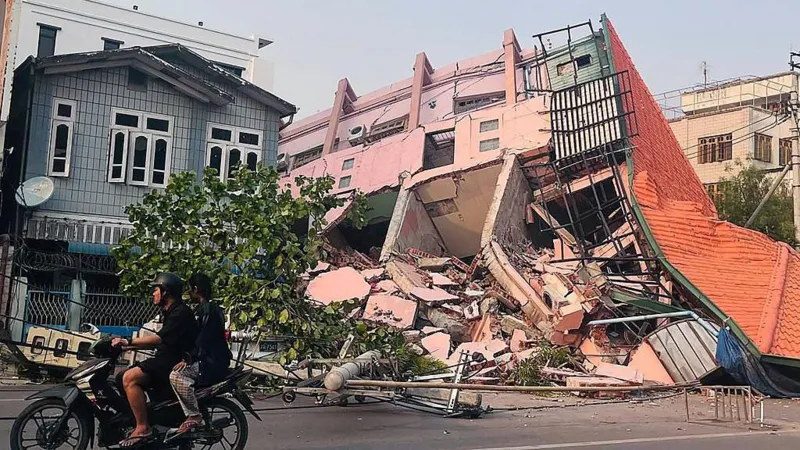
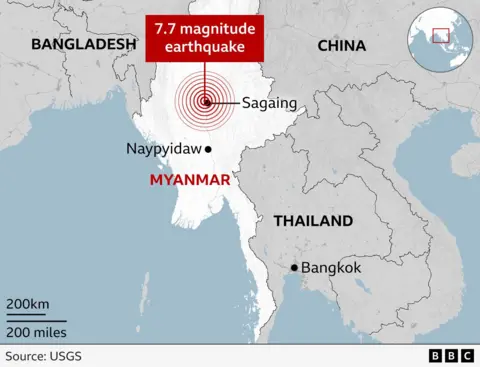
A huge 7.7 magnitude earthquake has hit central Myanmar, according to the United States Geological Survey (USGS).
At least 144 people have died and 732 have been injured so far in the country, Myanmar military leader Min Aung Hlaing said.
The epicentre was 16km (10 miles) north-west of the city of Sagaing, sending strong tremors that were felt as far as south-west China and Thailand.
Meanwhile, around 100 construction workers are missing after an unfinished high-rise building collapsed hundreds of miles away in Bangkok, according to Thailand’s deputy prime minister.
At least seven people have died at the site in Thailand, according to the Bangkok Metropolitan Administration.
A rescuer in Mandalay, Myanmar’s second-largest city, told the BBC the damage is “enormous”.
The total number of people killed and injured by the earthquake are expected to rise in the coming days.
There have been reports of roads buckling in the capital of Nay Pyi Taw, and the country’s military government has declared a state of emergency in six regions.
The earthquake struck near Mandalay, which has a population of about 1.5 million people.
A second quake struck 12 minutes after the first, according to the USGS, with a magnitude of 6.4 and its epicentre was 18km (11.1 miles) south of Sagaing.
Myanmar, formerly known as Burma, gained independence from Britain in 1948, but its recent history has been marked by unrest and conflict.
The military seized power in 2021, ten years after agreeing to hand over control to a civilian government. Since then, the junta has cracked down hard on dissent, executing democracy activists and jailing journalists. The state controls almost all local radio, television, print and online media, and Internet use is restricted in the country, which often makes access to information difficult.
According to a recent BBC data project, the country is now controlled by a patchwork of groups, making relief and recovery efforts more challenging.
It is even harder to find accurate information about what is going on in rebel-held areas of the country.
The junta made a rare call for international assistance in the wake of the earthquake.
However, the complex situation on the ground is likely to hamper search and rescue operations as well as the free flow of aid into the country.
Rescue workers operating in villages near Mandalay have told the BBC they do not have access to the heavy machinery needed to reach people trapped under the rubble. “We’re digging people out with our bare hands,” one man said.
The earthquake has added pressure to an already dire humanitarian situation in the country, where 3.5m people are estimated to have been displaced by fighting.
The Sagaing region, near the epicentre of the quake, is a volatile key battleground in the civil war.
Charities and opposition parties working in the country have raised concerns about the “politicisation” of aid in the coming days.
Montse Ferrer, the deputy director of East and Southeast Asia and the Pacific at Amnesty International, told the BBC the junta has “a history of denying aid” to areas where resistance forces are active.
The tremors were felt hundreds of miles away in Thailand’s capital of Bangkok, where rescue teams worked through the night to free the construction workers trapped beneath the rubble.
Buildings across the city were evacuated, including a hospital holding patients in acute need of medical attention. A woman gave birth on the street amid the commotion, lying on a stretcher surrounded by hospital staff.
Bui Thu, a BBC journalist who lives in Bangkok, told the BBC World Service’s Newsday programme that she was at home cooking when the initial quake happened. “I was very nervous, I was very panicked,” she said.
“Buildings in Bangkok are not engineered for earthquakes, so I think that’s why I think there’s going to be big damage.”
Thailand’s Prime Minister Paetongtarn Shinawatra visited the site of the collapsed building on Friday afternoon.
Search and rescue teams using drones, sniffer dogs and diggers have been mobilised and disaster centres set up to help with the rescue operation.


US President Donald Trump has signed an executive order threatening to impose additional tariffs on countries that continue to trade with Iran.
The order, issued on Friday, does not specify the rate that could be imposed, but uses 25% as an example. It says the tariff could apply to goods imported into the US from any nation that “directly or indirectly purchases, imports, or otherwise acquires any goods or services from Iran”.
Trump has not directly commented on the order but reiterated “no nuclear weapons” for Iran when speaking from Air Force One on Friday night.
It comes as talks continue between senior US and Iranian officials in Oman, following several weeks of threats from both sides.
Trump threatened a 25% tariff of countries doing business with Iran earlier this year, in a post to Truth Social.
On 12 January, he wrote: “Effective immediately, any country doing business with the Islamic Republic of Iran will pay a tariff of 25% on any and all business being done with the United States of America.”
At the time, no further detail was provided on how the tariffs would work in practice.
[BBC]
Latest News
Advisory for Severe Lightning for the Western and Sabaragamuwa provinces and Galle and Matara districts

Advisory for Severe Lightning
Issued by the Natural Hazards Early Warning Centre at 12.00 noon 07 February 2026 valid for the period until 11.00 p.m. 07 February 2026
Thundershowers accompanied with severe lightning are likely to occur at some places in the Western and Sabaragamuwa province and in Galle and Matara districts.
There may be temporary localized strong winds during thundershowers.
The general public is kindly requested to take adequate precautions to minimize damages caused by lightning activity.
ACTION REQUIRED:
The Department of Meteorology advises that people should:
Seek shelter, preferably indoors and never under trees.
Avoid open areas such as paddy fields, tea plantations and open water bodies during thunderstorms.
Avoid using wired telephones and connected electric appliances during thunderstorms.
Avoid using open vehicles, such as bicycles, tractors and boats etc.
Beware of fallen trees and power lines.
For emergency assistance contact the local disaster management authorities.
Latest News
Decisions and judgments of the Supreme Court are a reflection of justice in the country – PM

Prime Minister Dr. Harini Amarasuriya stated that the decisions and judgments delivered within the Supreme Court complex serve as a mirror that clearly reflects the justice, democracy, and the rule of law in Sri Lanka.
The Prime Minister made these remarks while participating in the ceremony to handover the refurbished Supreme Court complex for judicial proceedings, following its modernization with assistance from the Government of China.
The renovation project was carried out in accordance with an agreement between the Ministry of Commerce of the People’s Republic of China, the Ministry of Justice of Sri Lanka, and the China International Development Cooperation Agency.
While preserving the original appearance and structural integrity of the Supreme Court building, the complex has been upgraded with modern technology. The renovations include seven new court court rooms equipped with single-judge, three-judge, five-judge, and seven-judge benches; 20 new official chambers for judges; staff facilities; elevators; a modern library; a case records room; an auditorium; and a control room with an automated camera system covering all areas of the complex.
Addressing the gathering, the Prime Minister noted,
“The complex, originally constructed in 1988 with the support of the Government of China, has now been modernized in line with contemporary needs after more than three decades, marking a significant step forward.
The investment in judicial infrastructure is, in essence, an investment in public trust. A secure and efficient environment strengthens the independence and dignity of the judiciary”.
The Prime Minister expressed appreciation for the continuous support extended to Sri Lanka by the Government of China, including President Xi Jinping and expressed that these modern facilities would serve as a strong foundation in fulfilling the public’s expectation that justice will be delivered equally to all.
The event was attended by Minister of Justice Harshana Nanayakkara, Chief Justice Padman Surasena, Ambassador of China to Sri Lanka Qi Zhenhong, Attorney General Parinda Ranasinghe, as well as several judges of the Supreme Court and the Court of Appeal.
[Prime Minister’s Media Division]

Trump threatens tariffs for countries trading with Iran

Advisory for Severe Lightning for the Western and Sabaragamuwa provinces and Galle and Matara districts

Decisions and judgments of the Supreme Court are a reflection of justice in the country – PM

INS GHARIAL departs island

Pakistan ask Netherlands to bat in T20 World Cup opener

Stop the collection of funds from parents at school level for Smart Boards — PM

‘Dates have the highest sugar content to fight Coronavirus’

Sunday Island 27 December – Headlines

#SundayIsland 17th December – Headlines

Sunday Island – 28th March

Sunday Island Headlines – 21 March

Sunday Island – 21st February – Headlines
-

 Business4 days ago
SLIM-Kantar People’s Awards 2026 to recognise Sri Lanka’s most trusted brands and personalities
-
 Business6 days ago
Altair issues over 100+ title deeds post ownership change
-

 Business6 days ago
Sri Lanka opens first country pavilion at London exhibition
-

 Business5 days ago
All set for Global Synergy Awards 2026 at Waters Edge
-
 Business4 days ago
API-first card issuing and processing platform for Pan Asia Bank
-
 Business6 days ago
ESOFT UNI Kandy leads the charge in promoting rugby among private universities
-

 Editorial2 days ago
All’s not well that ends well?
-

 Features2 days ago
Phew! The heat …