
Opinion
Online Safety Bill and Anti-Terror Bill – Law making to End Democracy and Fundamental Rights of Sri Lankan Citizens

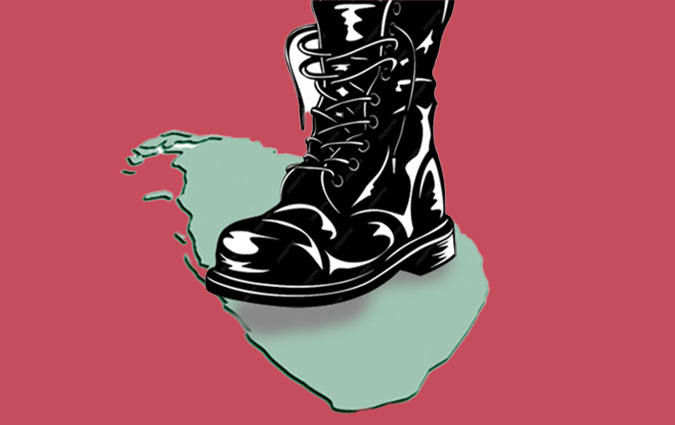
The government has included two Bills titled ‘The Online Safety Act’ (OSA) and the ‘Anti-Terror Act’ (ATA) in the Parliamentary Order Paper dated 3rd October 2023. Both Bills have sweeping provisions to seriously. curtail and even violate the freedoms of expression, free speech, right to information, assembly and association. Both present fatal threats to democracy and fundamental rights in this country.
The OSA proposes to create an ‘Online Safety Commission’ appointed by the President and dismissed at his will and pleasure, which is given sweeping powers to determine if a statement is a ‘false statement’ and take measures to ‘prohibit’ it from circulation. The Commission has powers to issue directives to persons and online service providers to remove or block content, sites and locations. If its directives are not complied with, penal sanctions including prison sentences and fines can be imposed. The OSA will embed a culture of state harassment of online journalists and activists, artists, scholars, writers, Trade Unions Civil Society Organisations, including Women’s Groups, Human Rights defenders, professional organisations, and any citizen who dares to criticize government and disagree with its policies and governance.
Not only the Fundamental Rights of speech, expression and access to information, but the right to claim them through the connected rights of freedom of protest and association will be curtailed and destroyed by the State. The inevitable self-censorship of citizens and communities that can follow, will embed authoritarian and dictatorial governance that has no respect for the Sovereignty of the Sri Lankan people that is a foundational value in our Constitution. The lack of accountability and corruption in governance that we see today will become a permanent aspect of governance. The impact on the life of a Sri Lankan citizen and another generation will be far reaching and hard to reverse. This will complete Sri Lanka’s transformation into a complete Orwellian State where what the ‘truth’ is will be determined and imposed exclusively by the State.
The ATA will be a reinvention of the of the draconian Prevention of Terrorism Act (PTA), which it claims to repeal. Under the ATA the definition of what comprises ‘terrorism’ is so vast and vague that any act can become an act of terror if the State deems it so. Any protest or strike can become an act of terror. Any instance of free speech can be deemed as inciting ‘terrorism’. Any organisation can be proscribed as a ‘terrorist’ association. Any publication can be deemed a ‘terrorist’ publication.
Anyone associated with ‘terrorist’ suspects, by virtue of association and knowledge, can be punished. Detentions will be made through executive orders and the military has been given powers to arrest and detain, powers which it did not have even under the PTA. The ATA will create a permanent state of emergency where Sri Lanka will effectively become a military state functioning under the exclusive dictate of the Executive. Repealing the PTA has been a promise made to the nation and the global community of nations represented at the United Nations. What this bill does however is to increase the power of the State to repress citizens and deny the Constitutionally guaranteed Fundamental Rights of the People.
The proposed laws are a clear indication that the government fears that its indifference to the grave hardships of the people in this economic crisis will not be tolerated, and will be resisted. The Citizens of this country were not responsible for this man-made crisis. Instead of taking the responsibility for the crisis, the government is making use of debt restructuring to make laws that encourage governance that is not accountable to the people and tries to legalise misuse of state power.
Under the guise of domestic debt restructuring savings of the working people are being stolen. Under the guise of labour law reforms proposals are being pushed to bring an end to the right to unionise and exploit women’s labour. Women’s groups and activists have made an important contribution to ensuring that our laws and policies on women’s work conform to international ILO and other standards, and our Constitution. The proposed labour laws target women disproportionately, and will eliminate all these gains, embedding and encouraging exploitation of their labour. Even criticism of the transformation will be prevented by these repressive laws.
We are still suffering the impact of repressive laws of the past, enacted in the name of national defence, stability, economic growth and development. What Government needs to do, is to learn from the past and engage in enlightened law making. That agenda must repeal repressive laws and respond to embedded corruption, foster national unity and equitable economic growth that benefits all citizens in our plural society. The government’s intention in passing laws that violate the basic values of democratic governance in our Constitution, shows that they want to change course, and establish a political dictatorship. The pretext is debt restructuring and economic recovery from bankruptcy.
We as Women’s groups and other Civil Society groups and concerned citizens call upon the government to withdraw ALL these Bills from Parliament. Government must engage in a process of consultative law making, that we saw when the Right to Information Bill was passed. That law has received praise for strengthening accountable governance in local and international reviews of governance in our country. MPs, whether or not they are unelected by the people, and come to Parliament from a national list, take an oath of office that must respect the responsibilities of office under the basic law of our country the Constitution. According to the Preamble to that document THEIR DUTY IS:
“to humbly acknowledge (their) obligation to ratify the immutable republican principle of representative democracy, assuring to all people Freedom Equality Justice Fundamental Human Rights and the Independence of the judiciary”. (PREAMBLE Constitution 1978)
We call upon the govt to WITHDRAW ALL these bills, and engage in a public conversation with qualified persons and citizens on public policy in these important areas. We call upon ALL Members of Parliament to fulfill the above stated Constitutional mandate and VOTE AGAINST these repressive laws.
Individual Signatories:
A. C. Fathima Husna (Attorney at Law)
A. Rose (Community Activist)
Aakiya Aman (Entrepreneur)
Ambika Satkunanathan (Former Human Rights Commissioner)
Ameena Hussein – Writer
Anberiya Haniffa – Director, Muslim Women’s Research and Action Forum, Development Consultant
Aneesa Firthous (Women’s rights Activist)
Annie Kurien – Director Centre for Social Concern
Anuratha Rajaretnam (Coordinator Suriya)
Ashila Dandeniya (Labour Rights Activist)
Balarasa Ratneswary (Women’s Rights Activist)
Balasingam Sukitha (Women’s Rights Activist)
Bisliya Bhutto (Former Local Authority Member)
Chamila Thushari (Women’s Labour Rights Activist)
Chandani Herath (Chairperson Sunila Women and Children Development Foundation)
Chriten jeyaseelan Augustalima (Social Media Activist- Mannar )
Deepika Udagama – Professor of Law University of Peradeniya Former Chairperson Human Rights Commission of Sri Lanka
Dr Tush Wickramanayaka (Child Rights Activist)
Dr. Chulani Kodikara – Polity Editorial Collective, Former Member of National Committee on Women
Dr. Radhika Coomaraswamy –Fellow International Centre for Ethnic Studies
Dr. Ramani Jayasundera, Board Member Centre for Women’s Research
Dr. Selvi Thiruchandran – Former Member RTI Commission and Executive Director Women’s’ Education and Research Centre
Dr. Sepali Kottegoda – Director Programmes and Research, Women and Media Collective
Dr. Thiloma Munasinghe – Public Health Consultant
Dr. Thiyagaraja Waradas – Human Rights Activist
Duleep de Chickera, former Bishop, Anglican Church of SL
Ermiza Tegal – Attorney at Law
Faizun Zakeriya, Co- Founder & Director, Muslim Women’s Research and Action Forum
Fathima Ilma (Former Local Authority Member)
Geethika Dharmasinghe – Senior Lecturer University of Colombo
Geoffrey Alagaratnam – PC Former President of the Bar Association of Sri Lanka.
Hamthun Jumana – Women’s Rights Activist Mullaitheevu
J.R.A Dorin – Community Activist
Janakie Seneviratne – Women’s Rights Activist
Jayanthi Kuru-Utumpala (Women’s Rights Activist )
Jegatheeswaran Thayalini (Women’s Rights Activist)
Jegatheeswaran Varayalini (Women’s Rights Activist)
Jezima Ismail – Educationist, Former member Human Rights Commission of Sri Lanka Co-founder Muslim Women’s Research and Action Forum
Justice Rohini Marasinge – Former Chairperson Human Rights Commission of Sri Lanka
Juwairiya Mohideen (Women’s Rights Activist)
K. Nihal Ahamed (Social Activist- Ampara)
K.Yogeshwary (General Secretary Working Women Front – Katugastota)
Kanaka Abeygunawardana (Independent Consultant)
Kanthaiyah Kalaivani (Political Activist)
Karuppaiya Saththiyaseelan (Women’s Rights Activist)
Kathirkamanathan Hemalarha (Women’s Rights Activist)
Kiruthika Thurairajah – Independent Consultant
Kunaraja Ajitha (Women’s Rights Activist)
Laxman Rajani (Social Worker)
M,Y. Minnathul Suheera (Attorney at Law)
M.Noorul Ismiya (Community Mobiliser)
Mahaluxmy Kurushanthan (Human Rights Defender – Mannar)
Mahendiran Nirmalathevi (Women’s Rights Activist)
Maithreyi Rajasingam – Director – Vilithu
Manjula Krishnamoorthy (Former Local Authority Member)
Mansoor Mafahira (Social Mobiliser – Mannar)
Marisa de Silva (Social Media and Community Activist)
Mohamed Majeed Jansila (Women’s Rights Activist – Mullaitheevu)
Mujeeba Mujeeb (Former Local Authority Member)
Nabeela Iqbal (Sisterhood Initiative)
Nadaraja Sumathy (CSO Activist- Ampara)
Nadhiha Abbas (Attorney at Law)
Nalini Rathnarajah (Women Human Rights Defender)
Nelum Gunesekera – Consultant – Gender and Social Inclusion.
Nirmalan Arththigan (Women’s Rights Activist)
P. Renukathevi (Program manager ESDF- Batticaloa)
Padma Pushpakanthi (Social Activist)
Padmini Weerasuriya (Executive Director)
Prema Gamage – Gender and Development Consultant.
Priyanthi Fernando- Former Executive Director Centre for Poverty Analysis Sri Lanka and International Women’s Rights Action Watch Asia Pacific.
Prof Gameela Samarasinghe, University of Colombo
Prof Harendra de Silva (Emeritus Professor of Paediatrics University of Colombo and Former Chairperson National Child Protection )
Prof Savithri Goonesekere – Emeritus Professor of Law, Former Vice Chancellor University of Colombo
Prof. Camena Gunaratne, Open University
Rajabdeen Rasika (Women’s Rights Activist Mullaitheevu)
Rajany Rajeshwary (Feminist- Jaffna)
Ramani Mutthetuwegama (Attorney at Law)
Ranitha Gnanarajah (Attorney at Law)
Ravinthiran Kounthini ( Women’s Rights Activist)
Rev. Dr. Jayasiri T Peiris Former General Secretary of the National Christian Council of Sri Lanka and Former Principal, Theological College of Lanka
Rev. S D P Selvan
Rifa Mohamed Musthafa (Social Activist- Ampara)
Rifsana Fiqry (Entrepreneur)
Rizani Hamin (Women’s Rights Activist)
S. Janeeta (Social Activist- Ampara)
Safana Gul Begum (Attorney at Law)
Sakuntala Kadirgamar – Executive Director, Law and Society Trust
Saliya Peries – PC Former President of the Bar Association of Sri Lanka.
Sarala Emanuel – Independent Researcher
Saratha Thevi (Psychosocial Counselor)
Saththiyaseelan Niththis (Women’s Rights Activist
Selvanathan Tharsan (Women’s Rights Activist)
Selvarasa Jeyantha (Women’s Rights Activist – Mannar)
Selvarasa Thileepan (Women’s Rights Activist)
Shafinaz Hassendeen, Retired International Labour Organisation Official, Director, Muslim Women’s Research and Action Forum
Shareefa Ameer (Entrepreneur)
Shiranee Mills –Executive Director, Women’s Education and Research Centre.
Shireen Samarasuriya – Director, Voice of Women
Shreen Saroor (Human Rights Activist)
Shyama Salgado – Retired Official International Labour Organisation
Shyamala Gomez (Women’s Rights Activist)
Shyamala Sivagurunathan (Independent Consultant)
Shydha Zaara (Scoal Activist)
Sirany Thevakumar (Women Human Rights Defender)
Sithravel Ethayarani (Women’s Rights Activist)
Sitraleka Maunaguru –Independent Feminist Researcher – Batticaloa
Siva Mariyarosalin (Women’s Rights Activist
Sri Easwaray (Women’s Rights Activist)
Sri Kopika (Women’s Rights Activist)
Sulochana Peiris (Independent Writer and Documentary Maker
Sumika Perera- Director, Women’s Resource Centre, Kurunegala
Suntharalingam Saththiya (Women’s Rights Activist)
Suntharampillai Suganthi (Women’s Rights Activist)
Surendran Thamilini (Women’s Rights Activist- Mannar
Suresh Jayawardhane (Freelance Consultant and CSO Activist
Swasthika Arulingham (President Commercial Industrial Workers’ Union)
Thadchanamoorthy Navajothy (Women Human Rights Defender -Batticaloa)
Tharanga de Silva – Women and Media Collective
Vanie Simon (Women’s Rights Activist)
Vibooshi Balakrishnan (Human Rights Activist)
Vijayatheva Sasikala (Former Municipal Council Member – Batticaloa)
Vijitha Ehamparanathan (Women’s Rights Activist- Trincomalee)
Vipulan Shamini (Women’s Rights Activist)
Vivekananth Sinthuka (Women’s Rights Activist)
Y. Rinoza (Social Activist- Ampara)
Organizations and Collectives:
Affected Women’s Forum
Alliance for Minorities
Ampara District Alliance for Land Right (ADALR)
Cantre for Women’s Research
Centre for Equality and Justice
Centre for Social Concerns
Community Welfare Fund Sri Lanka
Dabindu Collective
Forum of Women Human Rights Defenders, Eastern Province
Human Elevation Organization (HEO)
Law and Society Trust
Liberation Movement
Malarum Mottukal Collective – Mannar
Mannar Women’s Development Federation
Muslim Women’s Development Trust
Muslim Women’s Research and Action Forum
Network of Women in local politics, Eastern Province
Network of Women with disabilities, Batticaloa district
Puttalam District Women’s Self Employment Reconciliation Forum
Rainbow Pillars for Creativity (Batticaloa)
Rural Development Foundation
Savisthri National Women’s Movement
Sri Vimukthi Fisher Women’s Organisation (Negombo)
Stand Up Movement Lanka
Suriya Women’s Development Centre
Vallamai-Movement for Social Change
VILUTHU
Voice of Women
Women Actions for Independent Development -WOMEN AID
Women and Media Collective
Women Development innovators
Women’s Action for Social Justice
Women’s Centre Sri Lanka
Women’s Action Network
Women’s Education and Research Centre
Women’s Resource Centre, Kurunegala
Working Women’s Front

by Sena Thoradeniya
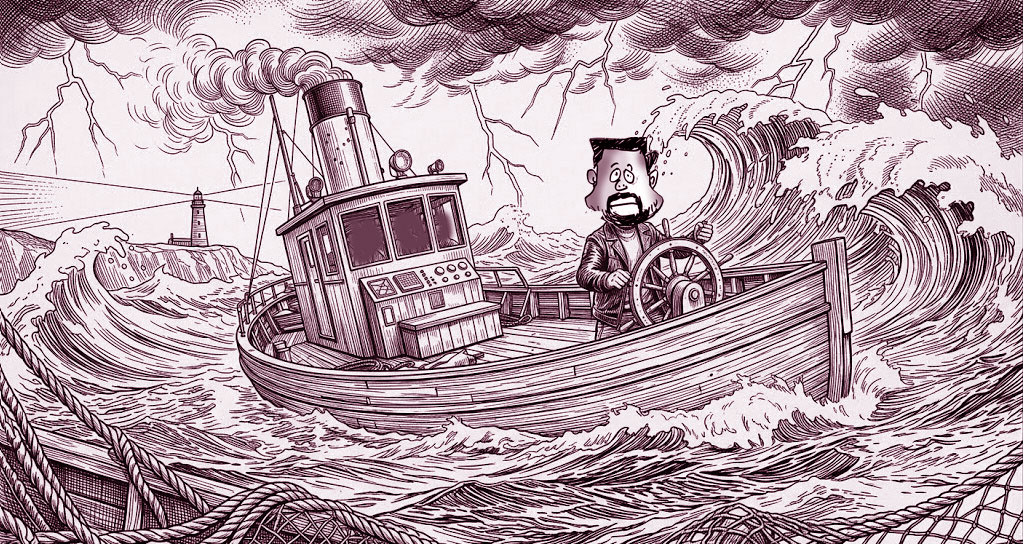
I Refer to the article published under the above title in The Island of 14 Sept. It was written by Dr. Uswatte-aratchi, whose insights into art, literature, and culture have long resonated with mine. In those domains, we have shared similar views; yet in matters of political theory, political leadership, and governance, our perspectives have not converged.
I do not intend to discuss the entire article by Dr. Uswatte, for he is entitled to his views on our politicians, even to the point of publicly attacking them when opportunity arises. I am neither an apologist nor an agent of any among those he has named. My concern here is solely to highlight Uswatte’s curious attribution of his knowledge of mathematics and physics to a person who, in his public addresses, has revealed no trace of intellectual capacity.
Dr. Uswatte says: “Unlike the earlier rulers Dissanayake (referring to the President) attended government schools in Tambuttegama and Kelaniya University. He studied science and mathematics. He can differentiate an equation for you and speak intelligently about Paul Dirac and Higgs Boson with the same felicity as accusations against former politicians”.
We are waiting for a theoretical or scientific publication by the current President that might justify such a claim. To ascribe scholarly depth to one whose record is not noticeable is absurd. It is a gesture that compliments without foundation and confers laurels where none have been earned.
This is what Dr. Uswatte says about the Prime Minister: “There is a Prime Minister who can talk to you impromptu about Auguste Comte and Claude LéviStrauss”.
A person who is said to have studied sociology should be knowledgeable about Comte, regarded as the father of sociology and the founder of positivism, and Claude Lévi-Strauss, a leading figure in structural anthropology; yet we remain uncertain whether she speaks of them with genuine familiarity and scholarly understanding, or is merely name-dropping them in an impromptu fashion. What on earth is she saying about these men on public platforms?
Since I possess no knowledge of either physics or mathematics, it was sheer curiosity that led me to consult AI only to discover what a marvelous President we have!
Paul Dirac was a pioneering English physicist, who helped establish quantum mechanics, co-founder of quantum electrodynamics and contributed to quantum field theory. In 1933, he shared the Nobel Prize in Physics. The Higgs boson is a fundamental particle discovered in 2012 that explains how particles acquire mass, solving a central mystery in physics. Peter Higgs, a British theoretical physicist won the Nobel prize for physics in 2013, decades after Anura Kumara obtained his degree.
Trying to rediscover theoretical physicists among ordinary science graduates who left university decades ago is indeed a futile exercise, like looking for a needle in a haystack. Theoretical physics thrives on continuity, requiring sustained engagement with evolving mathematics, new theories and experimental findings, and is a discipline that demands lifelong intellectual engagement.
Dr. Uswatte should listen to speeches made by his new found friends at public meetings and see the reaction of social media activists. As Chairman Mao observed, theory divorced from reality is useless. “No investigation, no right to speak (“Preface and Postscript to Rural Surveys” -1941).
For the time being, I refrain from commenting on some of the President’s promises, such as ‘producing graphite from graphene’ (which ought, of course, to be the reverse), producing sulphuric acid using seawater, fortifying the stem of the banana through advanced research, devising lifesaving remedies for cancer, or unveiling the world’s first app for locating shoals of fish. The list is too long to reproduce here. An exaggerated parade of claims and the sheer implausibility of such boasts are not the stuff of theoretical physics.

by Jehan Perera
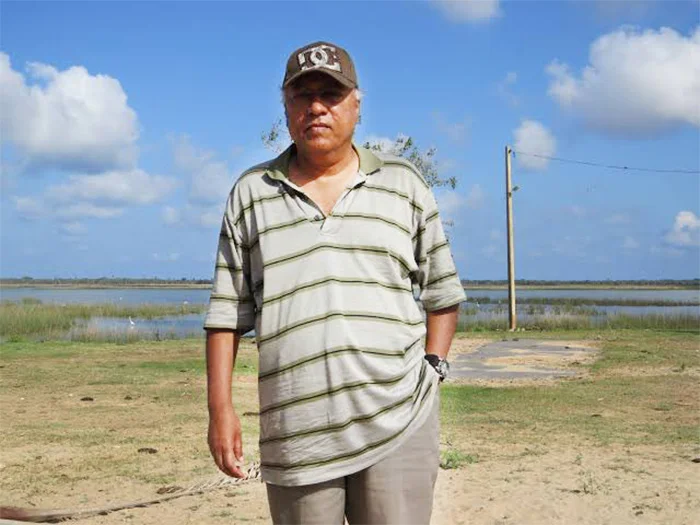
There are some journalists whose work we read and then move on. And there are others whose writing makes us stop, think and look at the country differently. D. B. S. Jeyaraj who passed away on 17 May 2026 was one of them. Whenever I saw an article by DBS, as he was widely known, appear in a newspaper, it was the first I read. He was primarily a columnist and political analyst, with a deep knowledge of the history of Sri Lanka’s ethnic conflict. But his columns were not simply analysis or opinion. They were rooted in what was happening in Sri Lanka and in what people involved in those developments were saying. We could see this in his frequent references to first-hand comments from people he had spoken to. He did this both when he lived in Sri Lanka and later, when he was living in Canada. That was no easy task.
In a 2013 interview, after returning to Sri Lanka for the first time in 25 years, DBS described how he had continued to report on Sri Lanka from Canada by maintaining contacts at home. He said that he broke his rest daily to communicate with contacts in Sri Lanka and that this dual existence of living physically in Canada and mentally in Sri Lanka took a heavy toll on his health and finances. But that commitment mattered and allowed him to write about Sri Lanka from afar without losing touch with what was happening on the ground. His writings gave readers a sense of what was happening in the north and east, as well as of politics more generally in Sri Lanka.
Speaking at the commemoration and book launch organised by the Tamil Media Alliance last week, Vijitha Yapa, the founding editor of The Island and Sunday Times, under whom DBS worked, captured an important quality of his journalism when he said, “DBS had no venom. That was his greatness.” He also recalled how DBS stood up to pressure and threats and continued writing about the Tamil community while insisting on fair play irrespective of race or religion. M. A. Sumanthiran, General Secretary of the ITAK, put another aspect of DBS’s contribution even more directly: “Truth is the first casualty of war. DBS fought to keep the truth alive.” He recalled that DBS always cross-checked his news and noted that even those who hated him read his columns to find the truth.
These observations capture two qualities that made DBS special. The first was his commitment to truth and, second, was his ability to write about a deeply divisive subject without venom. DBS was a Tamil writing about the north and east and the Tamil national question in a deeply polarised environment. Yet he wrote for the mainstream English-language press and was widely read not only by Tamils but also by people from other communities. His writing helped make the concerns, political aspirations and historical experiences of the Tamil community accessible to readers beyond it. His importance was not limited to his being a Tamil journalist. His writing mattered because it addressed the country as a whole. Issues and perspectives that might otherwise have remained within particular communities could become part of a wider national debate.
Another noteworthy feature of DBS was his ability to be realistic in his assessments. With his wide knowledge of history, he understood that each side in the national conflict had its own history, fears and perceptions of threat. He recognised that the conflict could not be properly understood through the narrative of one side alone. He understood that there could be no unilateral solution imposed by one side or the other. That realism is particularly important in a country where political positions have often been presented as if the concerns of one community could be resolved without addressing those of another. A journalist who understands this complexity needs to do more than simply take sides. He or she can help readers understand why the conflict has endured, why trust has been so difficult to establish, and why lasting peace requires more than one dominant story.
There was also something revealing about DBS’s return to Sri Lanka in 2013. In the interview he gave during that visit, he said he deliberately avoided politics. He wanted to experience the country from the perspective of an ordinary person rather than through the views of politicians or political associates. He observed a disconnect between the needs of the people and those of the political class. In retrospect, that observation was remarkably prescient. The disconnect he identified in 2013 would become dramatically visible in the Aragalaya of 2022.
In the same interview, he offered an observation that deserves to be remembered. A journalist may not be able to write all that he or she wants because of external constraints, he said. But no journalist should write what he or she does not want to write because of external pressure. His commitment to independent journalism came at a considerable personal cost. He was arrested and detained by the Sri Lankan Police in 1987 after his reporting on the war in Jaffna, and in 1993, while living in Canada, he was brutally assaulted by LTTE supporters who fractured both his legs.
For all these reasons, I consider DBS to have been a mentor of mine. I never said so to him. Mentors are not always people who formally teach us or with whom we have a close personal relationship. Sometimes they are people whose work we follow, whose judgement we respect and whose example helps shape our own understanding of what we should strive to do. DBS was such a person for me. His passing has left a gap. His journalism was informed by history but connected to the present, rooted in facts but open to interpretation, and concerned with the realities of all communities.
The collection of his writings launched in his memory by the Tamil Media Alliance is therefore more than a record of an important period in Sri Lanka’s history. It is also a reminder of what journalism can be at its best. DBS showed that a journalist could understand one community without becoming confined to it, analyse conflict without being partisan, and take a position without losing sight of complexity. Above all, he showed the value of journalism that seeks to keep the truth alive. For those who read him regularly, the greatest reminder of his absence is the absence of his next column.
by N. A. de S. Amaratunga
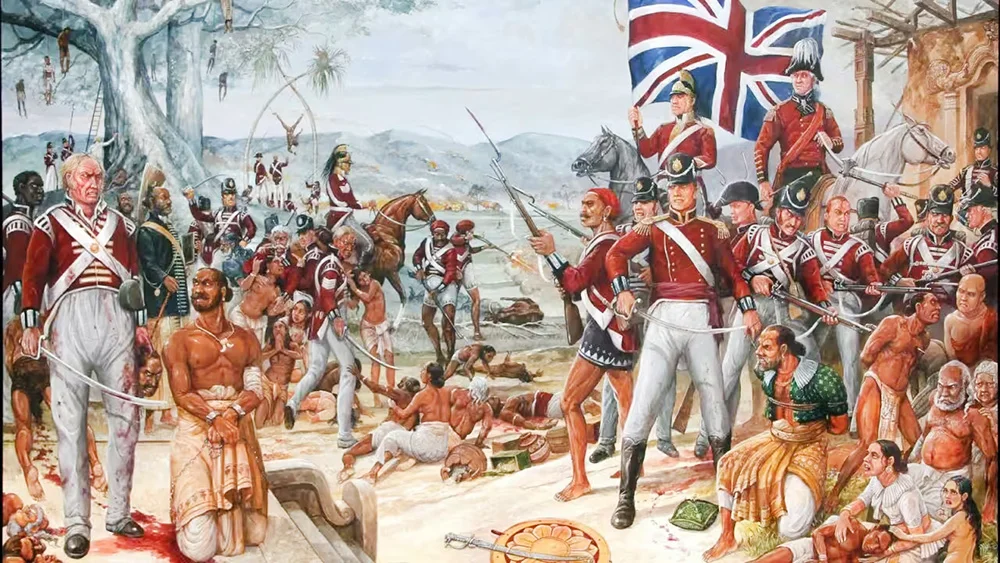
At a time when the word genocide is used with political motive and defensive war misconstrued as genocide, and a brutal genocide is taking place on a global scale with impunity, one should reflect on genocide committed by those who falsely accuse the Sri Lankan armed forces and the government for such crimes. The British who systematically annihilated people including “babies suckling”, in Uva-Wellassa in 1818 and the LTTE, which carried out numerous massacres to drive away the Sinhalese and Muslims in the so-called border villages are now shamelessly levelling unsubstantiated allegations of genocide against the Sri Lankan military. The British, jointly with the US, massacred about a million people, including children, in Iraq on a fabricated charge of possessing weapons of mass destruction. The British helped the LTTE continue their genocide of the Sinhalese and Muslims in the North and the East in an attempt to drive them away and grab their lands, and such crimes constitute genocide according to 1948 Genocide Convention.
“Slaughter every man, woman and child”
“Slaughter every man, woman, and child (including babies suckling at the breast)” was the order given by Governor Robert Brownrigg (3rd British Governor of Ceylon from 1813 – 1820) to Maj. Gen. Hay MacDowell in 1818. The British left the entire Uva-Wellassa region in a state of famine and starvation. The British used the scorched earth policy including mass murder and genocide of Sinhala civilians to crush the rebellion. British human rights campaigners now pointing accusing fingers at Sri Lanka have forgotten the Madulla Massacre, which led to razing and annihilating entire villages. In the entire Uva region members of the male population above the age of 18 were killed in revenge for resisting British imperial occupation under Governor Brownrigg.
Britain at present is leading a core group at the UNHRC Geneva, which bashes Sri Lanka for alleged human rights violations. Britain seems to have no remorse about its genocidal violence in Sri Lanka and happily leads the way in castigating Sri Lanka on unsubstantiated allegations of human right violations during the war against the LTTE. The US, which is the biggest war criminal in the world, is supporting these neo-colonial strategies to control and exploit the poor countries.
The Chemmani mass grave
The Chemmani mass grave has become a political tool liberally used by the pro-LTTE groups and their supporters in the West and also their local agents to pressure the government to take action against the war winning armed forces. Let the government be urged to get to the bottom of the mass graves found in the North and elsewhere. People of this country owe it to the armed forces who saved their country to ensure that the name of the national military is cleared. And if there are any war criminals among them, punish them after conviction. Sri Lanka is not Israel, the US or the UK.
The Genocide Convention was conceived largely in response to World War II, which saw atrocities such as the Holocaust that lacked an adequate description or legal definition. Polish-Jewish lawyer Raphael Lemkin, who coined the term genocide in 1944 to describe Nazi policies in occupied Europe and the Armenian genocide, campaigned for its recognition as a crime under international law. Lemkin also linked colonialism with genocide, mentioning colonial genocides outside of Europe in his writings. The Convention defines genocide as any of five “acts committed with intent to destroy, in whole or in part, a national, ethnic, racial or religious group.” These five acts include killing members of the group, causing them serious bodily or mental harm, imposing living conditions intended to destroy the group, preventing births, and forcibly transferring children out of the group. Victims are targeted because of their real or perceived membership of a group, not randomly.
Genocide in Gaza
However, Israel in collaboration with the United States, which has the worst record in genocidal warfare, has violated this Convention with impunity in Gaza, knowing that the rest of the world cannot act against it except condemn its actions. The UN has miserably failed to take any action against Israel, though it has the necessary tools like the Convention mentioned above. Its Commissioner for Human Rights Volker Turk visited the Chemmani mass grave and issued a strongly-worded statement calling for investigation under international supervision. He has not visited the place where genocide is currently taking place in broad daylight. Neither has the UNHRC made any worthwhile response in respect of Iraq, Syria, Libya and other parts of the world, where the US and Europe have been engaged in genocidal warfare. This type of double standards will further erode the credibility of the UNHRC, and if countries tend to ignore its writ, it has itself to blame.
We still don’t know the identities of the people whose skeletal remains have been found in the Chemmani mass grave. It was a prolonged war situation that created these graves. There were allegations of killings, including civilians, by both parties to the war.
The Office of Missing Persons has received about 10,000 complaints about missing persons from the north and east and investigations into these complaints are ongoing (source – reports of the OMP). Apart from verbal complaints there is very little incriminating evidence, if at all, against the armed forces. A few isolated incidents where excesses were committed have been investigated and action is being taken against the suspects.
Campaign by Pro-LTTE groups
Pro-LTTE groups are trying their utmost to connect the missing persons with the mass graves. They claim that the people who went missing were buried in the Chemmani mass grave. The Island journalist Shamindra Ferdinando dealt with this matter comprehensively in the Midweek Review on 9 September. He shows that the narrative built up by the pro-LTTE groups and the Western imperialists regarding the alleged disappearances could be more myth than fact.
The LTTE massacred hundreds of civilians in cold blood in many places, such as Sri Maha Bodhi, Aluth Oya, Aranthalawa (where the victims were Buddhist monks), Kattankudy mosque, Palliyagodella, Eravur, Gonagala and Kebethigollewa. Most of those killings, committed outside the war zone, were aimed at terrorising the ordinary people, and that amounts to genocide according to 1948 Genocide Convention. The LTTE carried out many bomb attacks on civilian targets, such as the Central Bus Station in Pettah, the Central Bank, crowded trains and buses. In the eastern villages people were bludgeoned and slashed to death so that ammunition could be saved.
Apart from killing and injuring, the LTTE chased away Muslims and Sinhalese from the Northern province, which amounted to ethnic cleansing, an act of genocide according to the above mentioned Convention. The people who were chased away have not yet returned to their homes and property, perhaps because of the memory of terror they had experienced in the North. Aren’t these acts of genocide ? The 1948 Convention defines genocide as any of five “acts committed with intent to destroy, in whole or in part, a national, ethnic, racial or religious group.”
Attacks on centres of worship like temples and mosques and killing of priests are unpardonable acts of terror aimed at destroying religious groups. Similarly murdering surrendered police officers is butchery of the worst kind. It was such acts of naked terrorism and insane mass murder that made the FBI label the LTTE “the most brutal terrorist organization in the world”.
Silence of UNHRC
Isn’t the UNHRC keen to ensure that justice is done for the victims of genocide committed by the LTTE? Perhaps, we should not make such a request to an organisation that keeps mum while genocide is rampant in the contemporary world ? Palestinians are being systematically murdered and driven away from their country with the UNHCR doing nothing to protect them. The US President is threatening the countries which support the Palestinians.
Sri Lanka must call for an international investigation into genocide committed by the LTTE.

Advisory for strong winds and rough seas for Multi-day boats in the Bay of Bengal

Showers in the Western, Sabaragamuwa and North-western provinces and in Galle, Matara, Kandy and Nuwara-Eliya Districts

Some NPP manifesto promises may be difficult to fulfil – CIABOC DG

Yoshitha and ex-Navy chief Karannagoda’s case fixed for PTC

Court orders probe into Wimal’s rally speech

Court to rule on Dilith’s writ petition on September 30

‘Dates have the highest sugar content to fight Coronavirus’

Sunday Island 27 December – Headlines

#SundayIsland 17th December – Headlines

Sunday Island – 28th March

Sunday Island Headlines – 21 March

Sunday Island – 21st February – Headlines
-

 News7 days ago
Gnanasara Thero absconding after SC ruling
-

 Opinion6 days ago
From Galkissa (Mount Lavinia) to Tambuttegama
-

 Business7 days ago
HNB Finance strengthens Board with four independent directors
-

 News3 days ago
US embassy won’t comment on IGP’s probe into joint drug raid
-
 Sports7 days ago
Culture within cricket team worrying authorities
-

 Features6 days ago
Sri Lanka’s university crisis: Brain drain and union action demand urgent reform
-
 Features5 days ago
The emptying university: why are academics leaving?
-

 News7 days ago
House to debate 22A, Judicature Bill next week