
Business
Ogilvy Group wins big at Campaign Asia’s Agency of the Year Awards 2020

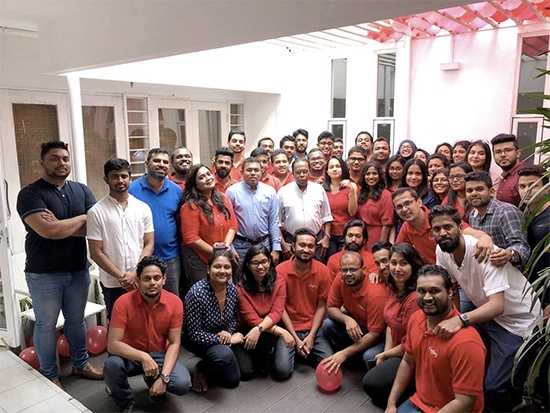
The Phoenix Ogilvy Group has once again received international acclaim, bagging two highly coveted awards at the 27th edition of Campaign Asia’s Agency of the Year Awards 2020.
Ogilvy Digital became the only Sri Lankan digital agency to be recognized at this year’s event, winning Silver for the ‘Rest of South Asia Digital Agency of the Year’ award, while Ogilvy Media walked away with the ‘Rest of South Asia Media Agency of the Year’ Bronze Award for a record third consecutive year.
Campaign Asia-Pacific’s Agency of the Year Awards celebrate the people, the work and the businesses achieving outstanding success in media, marketing and advertising. The awards highlight strong leadership, creativity and innovation, stellar new business performance, the development of talent, and contribution to the industry; and is open to agencies from across the South Asia region.
Speaking on the wins Irvin Weerackody, chairman, Phoenix Ogilvy Group Sri Lanka attributed the achievement to the steadfast commitment of the teams and strategic business management during the pandemic situation. “2020 was doubtless one of the most challenging years for businesses globally, and doubly so in Sri Lanka that had just begun its recovery from the terrorist attacks in April 2019. In the past year, we were able to achieve outstanding results as a company, and support our clients in achieving their communication and business goals; thanks to steadfast decisions made during the pandemic by these two companies, and dedicated teams that crafted innovative campaigns under the most trying and unprecedented circumstances,” he stated.
Ogilvy Digital won the highest award in the category this year, for working to expand its footprint amidst the challenges of the past year. Ogilvy Digital leaned on its excellent technical and organizational infrastructure and human capital, to deliver superlative results through premium services, which was welcomed by clients.
Ogilvy Media meanwhile was recognized with its Bronze ‘Rest of South Asia Media Agency of the Year’ award for offering innovative and diverse media solutions, as it strategically navigated through the pandemic to help clients during this challenging period, whilst retaining all accounts.
“Success at Ogilvy has always been about its people”, said Lalith Sumanasiri, Managing Director of Ogilvy Media and Ogilvy Digital. “Facing two major challenges in back to back years, our focus was on staff wellbeing. We knew that aligning our business goals with providing an excellent platform for our people to thrive and grow, will be good for us. None of our staff were laid off due to the COVID-19 pandemic, and we enabled them to thrive in the “working from home” environment until health restrictions were minimized, and they in turn have turned in superior work that has kept the Ogilvy flag flying high,” he added.



The Planters’ Association of Ceylon (PA), the apex body of Sri Lanka’s plantation industry, expressed growing concern over rising prices and limited availability of fertilizer amid the escalation of the crisis in the Middle East.
With the closure of the Strait of Hormuz, shipping traffic through the region is reported to have dropped by 90%. Given that an estimated one-third of global trade in raw materials for production of fertilizer flows through the Strait, these interruptions are already disrupting fertilizer supply chains around the world.
After Russia, Egypt and Saudi Arabia, Iran is the fourth-largest global supplier of urea, the most widely used fertilizer ingredient.
Given the dire implications on domestic agricultural production, the PA commended the Government’s primary focus on safeguarding national food security, and welcomed the fertilizer subsidy for additional crops being increased up to Rs. 18,000. Such measures are part of a broader effort to support the agricultural sector during this period of volatility.
However, the PA cautioned that the implications of another fertilizer crisis extend well beyond direct agricultural impact. Importantly, the next two to four months will have a significant impact on the annual crop yields of the industry. The Association warned that these dynamics could significantly affect balance of payments, inflation, and purchasing power for critical resources like fuel.
The current fertilizer crisis echoes the challenges faced during the 2021 ban, which caused a calamity in the plantation sector. Even after the ban was lifted, it took four years to recover, and just as progress was being made, the current fertilizer issue has emerged.
The PA also highlighted the stress on Regional Plantation Companies (RPCs) and smallholders in particular, noting that the industry was already under significant pressure as result of rising cost of production.
Moreover, the PA noted that only a limited number of companies are authorized to distribute fertilizer, and the PA calls on the government to mitigate these challenges.
Throughout the COVID-19 pandemic, the plantation sector played a crucial role in generating foreign exchange to support the economy, and it is essential that the industry continues to contribute to macroeconomic stability during this crisis.
In a recent news article senior Professor Buddhi Marambe from the University of Peradeniya noted that with paddy cultivation alone needing approximately 98,800 metric tonnes for the Yala season, current stocks cover only about 60% of the total national requirement.
The PA also emphasized the entire plantation industry’s vital role in upholding the economy, particularly in generating foreign exchange via export revenue, and in supporting rural livelihoods.
According to an analysis published on 15 March 2026 by the FAO Chief Economist’s Office, the Gulf region accounts for roughly 30 to 35% of global urea exports, supply chains that have been severely disrupted since the conflict began.
The study found that the farming systems most exposed are those combining high fertiliser application rates with significant dependence on Gulf supply chains, a profile that applies across South Asia, East Africa and parts of Latin America. The FAO analysis projects global fertiliser prices averaging 15 to 20% higher across the first half of 2026 if the disruptions persist, with yield consequences materialising in harvests later in the year and into 2027.(PA)
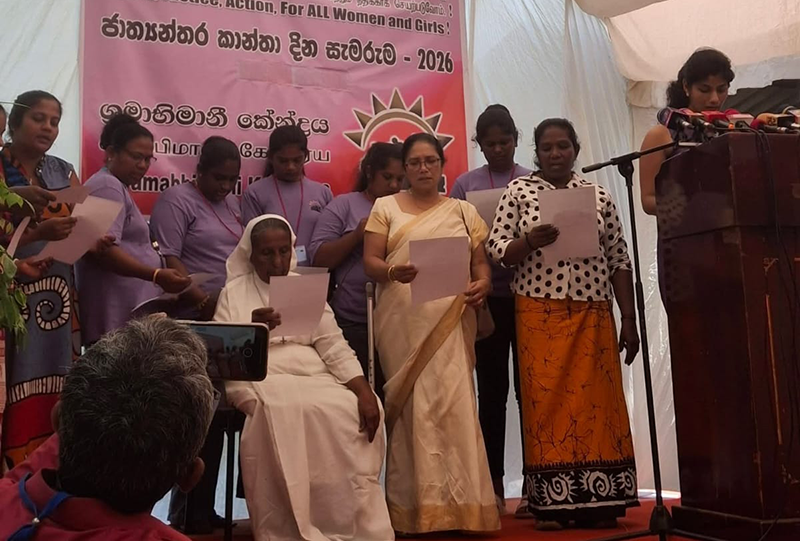
Women workers who gathered at the Shramabimani Centre in Seeduwa to mark World Women’s Day on March 29 demanded a living wage that matches the rising cost of living, decent working conditions, safety of workers, better healthcare facilities and limiting the extensive working hours, from the government and employers.
Free Trade Zone (FTZ) workers urged the lawmakers and their employers to understand the silent tears shed amid the sound of machines.
“We face frequent humiliation and insults within and outside work which a woman cannot bear but we go through them to feed our children, parents and other dependents in our homes, said Shriani Fernando, an employee of a garment factory at the Katunayake FTZ.
Many such sad stories were narrated on the appalling living and working conditions of female workers who have left behind their families, kith and kin to keep the wolf from the door.
“There is no privacy in a ten by ten room shared with other workers who have to walk back to their rooms late night through lonely streets, said Indrani Weerasinghe, a mother who has to feed five mouths with the little wage she earns as a factory employee.
Female workers who are compelled to leave the safety of their homes at a very tender age to support the family fall prey to men seeking opportunities to satisfy their carnal desires.
The predator could either be the employer, landlord, a friend, the partner or a sympathizer with ulterior motives.
“While walking back to our rooms men ask us whether they could give us a lift. When we refuse the offer they pass disgusting remarks, a young worker said.
Speech and hearing impaired workers said that they too are capable of doing any work as others.
They said we have eyes, a good brain, hands and feet to work. We need to be treated like all others instead of attracting verbal sympathies.
Many workers who are victims of sexual exploitation and harassment keep silent to safeguard their jobs.
“We know the outcome if we speak against the unfair treatment by our bosses. If we lose our jobs who will feed our children, said Susumali Dissanayake, a mother of four employed at a garment factory in Gampaha.
What is saddening and gruesome is the act of some workers compensating the low wage or income by offering themselves to fulfill the insatiable sexual appetite of certain men.
Women garment workers in FTZs face severe exploitation, including 16-hour workdays, unachievable production targets, sexual harassment, and hazardous conditions. Many endure poverty, wage theft, and lack of basic facilities, often resulting in Urinary Tract Infections (UTIs) due to poor sanitation and limited bathroom access
Landless female workers in the Gampaha District urged the present authorities to bring an end to their homeless state by fulfilling a fundamental right to live in a house of their own in a decent way.
“The manner in which we are treated sometimes by our landlords is similar to being a slave. Shifting houses each year or two is nothing short of being refugees who have no status and dignity, said A.Shridevi from Walana, Katunayaka.
“We have been living like gypsies moving from one house to another without a permanent address for a long time. What we ask from the government is to give us the title deeds to the houses we are in now so that we have some status and respect, said Shandani Fernando, a member of the Association of Homeless Families in Gampaha.
Unpleasant language
“When we fail to pay the rent by one day we hear so unpleasant language from the landlords and some of us have broken family relations due to misunderstanding while sharing the same house with the siblings, she said.
Rev.Sr Noel Christine Fernando, a prominent rights activist who leads the Sramabimani Kendraya (or Shramabimani Centre) in Seeduwa, a rights group focusing on worker solidarity, particularly within the free trade zones said the battle to secure the rights of workers will go on whichever government is in power.
“It was never a smooth sailing for the Sharmaabimani centre since its start in 1994. However, it waded through high tides, rough waters and stood through thick and thin to be what it is today branching out for every worker to take rest and shelter, Sister Fernando said.
She said it’s these worker’s toil and tears that bring the much needed foreign exchange to the country. We believe this government that came to power through the ballot of the landless people will heed their cry and provide them a permanent house.
Rev. Fr. Sarath Iddamalgoda, core founder and director of Shramaabimani Centre said under whatever condition ‘we musn’t forget the vision and the mission that we are called to ensure justice for the oppressed and the marginalized people’
He said the condition of the landless community in the Gampaha district and in the rest of the country is similar to the estate community who have been living for over 200 years without proper status which reveals the extent of social inequality and discrimination in a nation that is signatory to many UN conventions on right to life and decent living.
“A bottom-top discussion and collaboration with a people-friendly and people-centred administrative mechanism is critical to address the persisting issue of the ‘unknown poor’ in the country whose call for a permanent house has gone unheeded for many decades, he said.
According to the UN an increasing number of people are driven from their homes by crises such as conflict, political instability, climate change, and economic hardship. A record number of people are forcibly displaced and – in an increasingly urbanizing world – displacement is becoming an urban phenomenon.
Meanwhile poverty in Sri Lanka has been rising since the economic crisis in 2022 where many households in the ‘middle income’ bracket have been pushed down to the ‘poor’ segment.
According to the World Bank poverty continued to increase in 2021, and doubled between 2021 and 2022, from 13.1 to 25.0 percent ($3.65 per capita, 2017 PPP) adding 2.5 million people into poverty in 2022.
Eradicating extreme poverty for all people everywhere by 2030 is a pivotal goal of the 2030 Agenda for Sustainable Development.
By Lalin Fernandopulle

Aitken Spence Travels has once again reaffirmed its leadership in Sri Lanka’s tourism sector, being recognised as a Category Winner in the Hospitality & Tourism Services sector at the CPM (Chartered Professional Management) Best Management Practices Company Awards 2026 for the third successive year. Achieving a significant milestone, the company was also listed among Sri Lanka’s Top 40 companies for the first time, underscoring its continued commitment to excellence and innovation.
As Sri Lanka’s leading destination management company, Aitken Spence Travels has consistently demonstrated best in class management practices, earning recognition at the CPM awards, which celebrate organisations that uphold high standards of corporate performance, governance, and sustainability.
This year’s recognition reflects the company’s strategic focus on regenerative tourism, an approach that goes beyond sustainability to actively restore and enhance the environmental, cultural, and socioeconomic landscapes in which it operates. By designing travel experiences that create meaningful value for local communities while preserving natural ecosystems, Aitken Spence Travels continues to redefine the role of tourism in a rapidly evolving global context.
Aitken Spence Travels Managing Director Nalin Jayasundera stated, “At ASTL, sustainability is not a standalone initiative, it is central to our strategic direction and governance framework.” This commitment is driven by the continued leadership and dedication of both the Managing Director and the Aitken Spence Group, with the company’s sustainability initiatives closely aligned with Group level policies that ensure strong governance, accountability, and oversight. Notably, Aitken Spence Travels stands as the only destination management company in Sri Lanka to be certified by Travelife and the Global Sustainable Tourism Council (GSTC), in addition to holding ISO certifications, further reinforcing its leadership in responsible and regenerative tourism.
Commenting on this achievement, Chairperson/Chairman of Aitken Spence PLC, Stasshani Jayawardena added “Aitken Spence Travels reflects the broader Aitken Spence Group ethos, where sustainability is embedded into governance and strategic direction rather than as stand-alone projects. This has been an integral part of how our businesses operate, ensuring accountability, consistency, and responsible growth across all our sectors, including travel and tourism.”

INS NIREEKSHAK makes port call in Colombo

Advisory for Severe Lightning issued to the Western, Sabaragamuwa, Central, North-western, North-central, Southern, Uva provinces, and Mannar, Vavuniya, Ampara, Batticaloa districts

US, Iran exchange threats as fragile ceasefire set to expire

Six Foreign Envoys Present Credentials to President Dissanayake

Tilak ends Mumbai Indian’s losing streak with 45-ball century

Showers or thundershowers will occur at most places of the island after 1.00 pm

‘Dates have the highest sugar content to fight Coronavirus’

Sunday Island 27 December – Headlines

#SundayIsland 17th December – Headlines

Sunday Island – 28th March

Sunday Island Headlines – 21 March

Sunday Island – 21st February – Headlines
-

 Business4 days ago
Harnessing nature’s wisdom: Experts highlight “Resist–Align” path to resilience
-

 News6 days ago
PNS TAIMUR & ASLAT set sail from Colombo
-

 News4 days ago
Gratiaen Trust announces longlist for the 33rd Annual Gratiaen Prize
-

 News3 days ago
From Nuwara Eliya to Dubai: Isha Holdings markets Agri products abroad
-

 News17 hours ago
Rs 13 bn NDB fraud: Int’l forensic audit ordered
-

 Opinion2 days ago
Shutting roof top solar panels – a crime
-

 News4 days ago
Heroin haul transported on 50-million-rupee contract
-

 Latest News5 days ago
Singapore Zoo’s first Sri Lankan leopard cubs make their public debut