
Sports
Novak Djokovic back on top Down Under, win Australian Open


MELBOURNE, Australia — Novak Djokovic found this trip to Australia far less complicated, and far more successful, than that of a year ago.
Unable to enter his best event in 2022 after being deported from the country because he was not vaccinated against COVID-19, Djokovic accomplished all he could have wanted in his return: He resumed his winning ways at Melbourne Park and made it back to the top of tennis.
Only briefly challenged in the final on Sunday night, Djokovic was simply better at the most crucial moments and beat Stefanos Tsitsipas 6-3, 7-6 (4), 7-6 (5) for a record-extending 10th Australian Open championship and record-tying 22nd Grand Slam title overall. As a bonus, Djokovic will vault from No. 5 to No. 1 in the ATP rankings, a spot he already has held for more weeks than any other man.
“He’s the greatest that has ever held a tennis racket,” Tsitsipas said.
Djokovic stretched his unbeaten streak in Melbourne to 28 matches, the longest run at the tournament for a man in the Open era, which dates to 1968. He adds trophy No. 10 there to the seven from Wimbledon, three from the U.S. Open — where he also was absent last year because of no coronavirus shots — and two at the French Open, to match rival Rafael Nadal for the most by a man in tennis history.
Margaret Court, with 24, Serena Williams, with 23, and Steffi Graf, with 22, have the most among women.This was also the 93rd ATP tour-level title for Djokovic, allowing the 35-year-old from Serbia to break a tie with Nadal for the fourth-most. Jimmy Connors holds that mark, at 109.
Djokovic was participating in his 33rd major final, Tsitsipas in his second — and the 24-year-old from Greece’s other one also ended in a loss to Djokovic, at the 2021 French Open.
He was superior throughout against Tsitsipas, but especially so in the two tiebreakers. He took a 4-1 lead in the first and after it was 4-all, pulled off three points in a row. He led 5-0 in the closing tiebreaker and, when it finished, he pointed to his temple then climbed into the stands, pumped his fist and jumped with his coach, Goran Ivanisevic, and other members of the entourage, and collapsed, crying.
Little doubt this is of no solace to Tsitsipas, but there is no shame in failing to defeat Djokovic in Melbourne. Challenging his dominion on those blue hard courts is every bit the monumental task that taking on Nadal on the red clay at Roland Garros is.
Perhaps surprisingly, Tsitsipas was willing to engage in the kind of leg-wearying, lung-searing back-and-forths upon which Djokovic has built his superlative career. How did that work out? Of points lasting at least five strokes, Djokovic won 43, Tsitsipas 30,
Then again, on those rare occasions that Tsitsipas did charge the net, he likely regretted the choice, because Djokovic often conjured up a passing shot that was too tough to handle.
One of Djokovic’s many other strengths is his return game, and he accumulated three break points within 17 minutes, converting the last for a quick 3-1 lead when Tsitsipas double-faulted.
The trophy for which they were playing was displayed on a pedestal near a corner of the court, and both men would get within reach of it whenever wandering over to towel off between points at that end.So close, yes, but for Tsitsipas, never truly close enough.
It’s not as though Tsitsipas played all that poorly, other than a rash of early miscues that seemed to be more a product of tension than anything.
It’s that Djokovic was, put simply, too good. Too accurate with his strokes — making merely 22 unforced errors, 20 fewer than his foe — and anticipation. Too speedy and flexible chasing shots (other than on one second-set point, when, running to his left, Djokovic took a tumble). Too dangerous with his returns and damaging enough with his serves.
Djokovic pushes and pushes and pushes some more, until it’s the opponent who is something less than perfect on one shot, either missing or providing an opening to pounce.There has been more than forehands and backhands on Djokovic’s mind over the past two weeks.
There was the not-so-small matter of last year’s legal saga — he has alternately acknowledged the whole thing served as a form of motivation but also said the other day, “I’m over it” — and curiosity about the sort of reception he would get.He heard a ton of loud support, but also dealt with some persistent heckling while competing, including applause after the faults Sunday.
There was the sore left hamstring that has been heavily bandaged for every match — until the final, that is, when only a single piece of beige athletic tape was visible — and had worried him at the beginning of Week 1, prompting him to turn to what he said was “a lot” of pain-killing pills and other treatments he didn’t detail.
And then there was the more complicated matter of his father, Srdjan, being filmed with a group of people with Russian flags — one with an image of Vladimir Putin — after Djokovic’s quarterfinal victory. The tournament banned spectators from bringing in flags of Russia or Belarus, saying they would cause disruption because of the ongoing invasion of Ukraine. Both Djokovic and his father said it was a misunderstanding, based on Srdjan thinking he was with a group of Serbian fans.
Because of that episode, Srdjan Djokovic did not attend his son’s semifinal victory over Tommy Paul on Friday, and was not seen in the Djokovic guest box on Sunday.No matter any of it, Djokovic managed to excel as he so often does, winning 17 sets in a row after ceding one in the second round last week.
(ESPN)



Chennai Super Kings left the bottom of the table and joined four other teams on four points by achieving two successive wins for the first time in exactly two years. Despite losing the toss and bowling in heavy dew, CSK kept Kolkata Knight Riders winless this season by sealing a 32-run victory at Chepauk.
Sanju Samson, Dewald Brevis and Ayush Mhatre got CSK to 192 on a surface that was not easy to dominate on outside the powerplay, and then Anshul Kamboj and Khaleel Ahmed got the big wickets of Finn Allen and Sunil Narine inside the powerplay. Having scored double of KKR’s 36 in the first six overs, CSK slammed the door with their spinners bowling eight overs for 47 runs and four wickets.
Facing early elimination now, KKR’s bowling improved with the return of Varun Chakravarthy, but their batting continued to be lightweight for the modern T20 game even though they pushed Narine up to open the batting.
It was perhaps a blessing in disguise that CSK’s struggling captain Ruturaj Gaikwad didn’t hang around for too long, allowing Samson and Mhatre use of the field restrictions. Both of them hit Vaibhav Arora for a hat-trick of fours each to go with Mhatre’s successive sixes off Cameron Green, who opened the bowling, got some shape but couldn’t stick to plans. Arora came back to bounce Mhatre out at the end of the powerplay, but his 16-ball 38 had done the damage already. Both teams practically cancelled each other out on runs outside the powerplay, but CSK’s 72 to KKR’s 36 in the first six overs proved decisive.
Sunil Narine led the middle-overs slowdown as Samson decided to see him out without taking risks. Varun started well with only one boundary in his first two overs, but the surprise package was the high pace of Kartik Tyagi, who not only bowled Samson just short of his fifty but also possibly delayed the arrival of Shivam Dube, who could have likely broken up overs of spin. Narine, Anukul Roy and Varun continued to deny batters freedom as just 70 came in nine overs after the powerplay.
Struggling for fluency, Brevis managed to get the better of Arora in the 16th over, which went for 20 runs, but Narine and Tyagi again denied CSK a finishing kick. Narine conceded one boundary in the 17th, and Tyagi bowled overs 18 and 20 for just 14 runs, giving KKR hope as they went into the chase.
KKR finally opened with the ideal combination, but Khaleel and Kamboj got just enough movement off the pitch to frustrate Allen and Narine. Playing his fifth match, Allen was yet to make it out of the powerplay as he edged Kamboj to cover-point. Narine managed to hit two sixes and two fours, but Khaleel frustrated him with wide lines and the round-the-wicket angle. Khaleel eventually had him caught at short third, moments after he had been dropped off Kamboj.
Raghuvanshi and Rahane are not the most dynamic duo in T20 cricket, and CSK snuck in overs of fingerspin and rookie Gurjapneet Singh while they were in the middle. Two catches went down off Hosein before he finally had Raghuvanshi caught for 27 off 19. Despite hitting two sixes off Gurjapneet, Rahane managed just 28 off 22.
Rahane eventually fell to a wrong’un from Noor Ahmad, who had been held back for the more threatening KKR batters: Rovman Powell, Green and Rinku Singh. He followed it up by bowling Green for a golden duck with his quick stock ball. Noor went on to add Rinku to his haul as the asking rate went beyond reach. He ended up with 3 for 21 in his four to go with Hosein’s 1 for 26 collected in an unbroken spell of four overs. By the time the two were done, the game was all but over with KKR needing 86 off the last five overs.
Brief scores:
Chennai Super Kings 192 for 5 in 20 overs (Sanju Samson 48, Ayush Mhatre 38, Dewald Brevis 41, Sarfaraz Khan 23, Shivam Dube 13*; Vaibhav Arora 1-55, Anukul Roi 1-21, Kartik Tyagi 2-35) beat Kolkata Knight Riders 160 for 7 in 20 overs (Sunil Narine 24, Ajinkya Rahane 28, Angkrish Raghuvansi 27, Rovman Powell 31*, Ramandeep Singh 35; Khaleel Ahmed 1-24, Anshul Kamboj 2-32, Akeal Hosein 1-26, Noor Ahmed 3-21) by 32 runs
[Cricinfo]
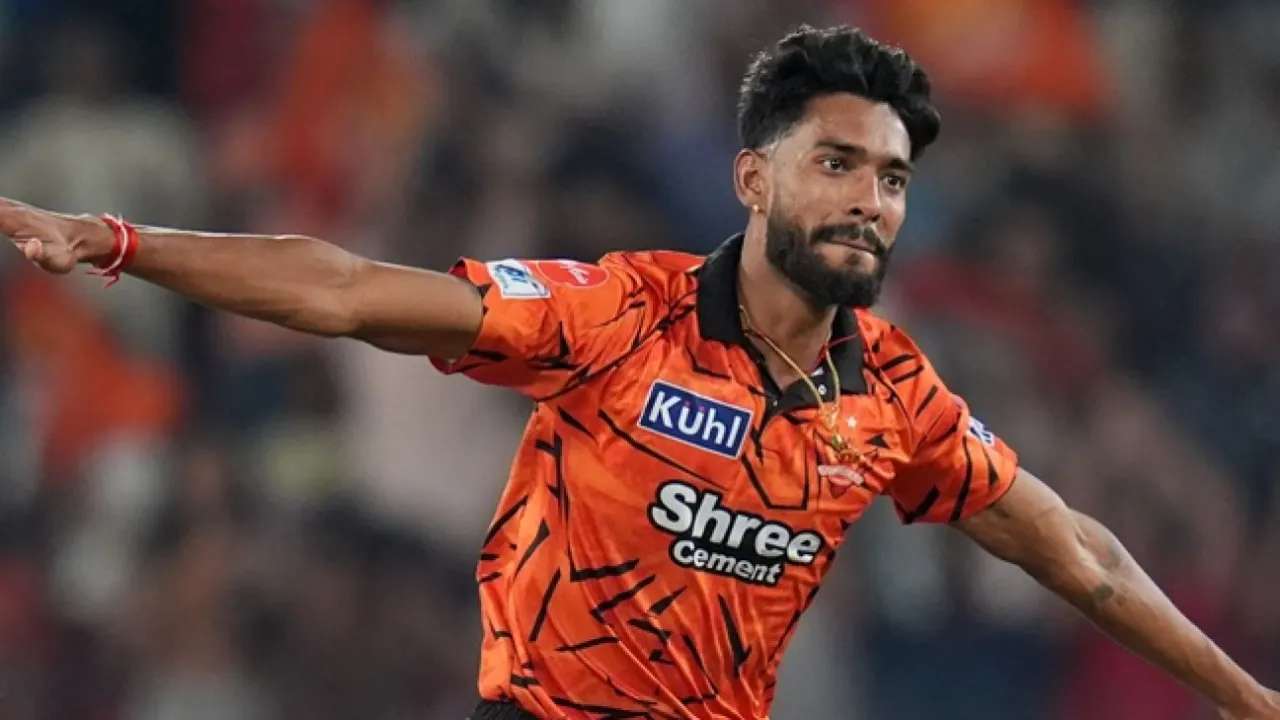
Vidarbha’s Praful Hinge, 24, etched his name into the IPL record books on debut, striking three times in his very first over – the only instance of a bowler achieving this in the league’s 18-year history – as Sunrisers Hyderabad [SRH] stunned table-toppers Rajasthan Royals [RR] at home to snap a two-match losing streak.
SRH had piled up 216 on the back of Ishan Kishan’s 91, an effort that would’ve headlined most nights if not for Hinge’s sensational opening over, which included the wicket of Vaibhav Sooryavanshi for a golden duck.
But Hinge wasn’t the only one to mark his arrival onto the big stage with a grandstand beginning. Another debutant, Bihar’s Sakib Hussain, struck at the other end as well, causing RR to crash to 5 for 4, and then 9 for 5. The game was effectively sealed right there. The two debutants finished with combined figures of 8 for 58.
In some ways, it felt destined. Hinge was set to debut in SRH’s previous game, against Punjab Kings, after being named at the toss, only for the team management to have a late change of heart and sub in Jaydev Unadkat instead. A game later, Hinge had a moment he would cherish forever.
Jasprit Bumrah and Josh Hazlewood weren’t spared, but Hinge didn’t carry any baggage. A hard-length delivery into the pitch had Vaibhav Sooryavanshi top-edge a pull to wicketkeeper Salil Arora for a golden duck. One ball later, Hinge had the in-form Dhruv Jurel chop on, and then capped off the first over by having Lhuan-dre Pretorius, who replaced Shimron Hetmyer, flick one straight to long leg.
At the other end was Sakib, who also celebrated a special moment when he sent Yashasvi Jaiswal back by having him ramp a short ball straight to deep third, leaving the score at an eye-popping 2 for 4. That soon became 9 for 5 when Hinge had Riyan Parag caught at slip after he had been whipped through midwicket for four. Sakib added three more wickets to his kitty, all off slower variations, to finish with 4 for 24. That included strikes off consecutive deliveries to dismiss Jofra Archer and Ravi Bishnoi late in the innings.
Just before Sakib capped off a dream night, RR’s sixth-wicket pair brought up their fifty-run partnership off 35 deliveries, ensuring they didn’t lose any further wickets until the half-way mark. There was a visible shift in their approach from that point on, with the next four overs going for 50 runs. Even so, the ask was a steep one, with RR needing 97 off the last six overs. That pressure finally told, as both Donovan Ferreira and Ravindra Jadeja fell in consecutive overs before SRH sealed victory.
But while he was at the crease, Ferreira gave a good account of himself, particularly in his handling of spinners. Quick to get to the pitch or rock back to pull, he was severe on both Shivang Kumar and Harsh Dubey as he raised a maiden IPL fifty off 31 balls. But his dismissal, followed by Jadeja’s, opened the floodgates for Sakib.
Sunrisers Hyderabad 216 for 6 in 20 overs (Travis Head 18, Ishan Kishan 91, Heinrich Klaasen 40, Nitish Kumar Reddy 28, Salil Arora 24*; Jofra Archer 2-37, Sandeep Sharma 1-52, Tushar Deshpande 1-55, Riyan Parag 1-05) beat Rajasthan Royals 159 in 19 overs (Donovan Ferreira 69, Ravindra Jadeja 45, Tushar Deshpande 25; Sakib Hussain 4-24, Praful Hinge 4-34, Eshan Malinga 2-31) by 57 runs
[Cricinfo]

The toss is crucial in night matches at Wankhede Stadium with a true flat pitch and dew giving the chasing side a significant advantage. Defending champions Royal Challengers Bengaluru lost that toss. Then went ahead and did what you need to do: score the highest IPL score at the ground, 240, and defended it with considerable ease.
Phil Salt and Rajat Patidar set RCB up with knocks of 78 off 36 and 53 off 20, Patidar’s fastest fifty. The duo hit a hat-trick of sixes once each with Salt also taking three fours in a row. A total of 11 sixes and 10 fours flew off their bats, resulting in RCB chants at Mumbai Indians’ home ground. Between them they compensated for Virat Kohli, who himself didn’t seem too pleased with his 50 off 38 even as the other end kept producing big runs.
Off the field during the second half of the match, Kohli didn’t need to fret much from the sidelines as the spinners Suyash Sharma and KrunalPandya expertly shut the chase down. Suyash did so with the wickets of the rampaging Ryan Rickelton and Tilak Varma in his first over while Krunal bowled four overs for just 26 runs, signing off with just reward in form of Suryakumar Yadav’s scalp. The RCB spinners bowled eight overs for 73 runs and three big wickets as against MI’s two spinners conceding 83 in six overs.
Kohli registered the first boundary of the innings with a six in the first over, but it was Salt who kept on the assault, scoring 47 off 22 in the powerplay. This involved welcoming Mitchell Santner, a reluctant powerplay bowler, with three sixes and a four. MI were forced to bowl Jasprit Bumrah for two overs inside the powerplay; still RCB got to 71.
The next key moment for RCB was the introduction of legspin with a right-hand heavy batting line-up, but that didn’t matter at all with Mayank Markande extracting little turn in either direction. Salt stayed back to hit three consecutive fours off his flatter lengths, and was waiting to hit a six the moment he gave it a hint of air.
When all else failed for MI, Shardul Thakur, bowling for the first time as late as the 11th over, executed wide yorkers to tie Kohli down and take the wicket of Salt caught at extra cover.
With 25 and a wicket off the last 17 balls, MI were hoping for a way back into the contest when RCB captain Patidar walked out. For some reason, Thakur gave up his death bowling and went searching, letting Patidar get off with a chipped four over mid-off first ball.
The return of Markande proved disastrous for MI as Patidar toyed around with him, hitting three back-to-back sixes, including one reverse-sweep. From 22 off 4, the likely direction Patidar’s strike rate could travel was down, but he made sure it wasn’t a long way down.
In his second over, Thakur completely went to pieces with his wide yorkers not landing and slower short balls travelling over the head on a red-soil bouncy surface. The 10-ball over went for 23 as RCB moved to 167 for 1 in 13 overs.
RCB had a big opportunity to put matters past any plausible chase, but Kohli couldn’t get the boundaries despite trying to hit hard. Missing the reverse-sweep in his arsenal, he couldn’t take the clever Santner down, who eventually ended up with the wicket of Patidar.
Even though Bumrah’s two overs at the death were excellent, keeping him at just 35 in four overs, he has now gone five straight IPL matches without a wicket if you count the Qualifier that MI lost last year. With his 34 off 16, Tim David did enough to keep them at an even two a ball.
Rickelton got the chase off to a flying start, MI racing away to 39 for 0 in three overs and 48 for 0 in four, which promised a close match. However, Krunal’s introduction began to raise the asking rate. Only eight came off his first over with Impact Player Rasikh Dar conceding just 15 in his two overs inside the powerplay.
Rohit Sharma went off with what seemed like a hamstring injury, and at 72 for 0 in seven overs, MI were already looking at 13 an over to win. Rickelton had no time to get a sighter at Suyash, who started off with a wide wrong’un and a top edge on the slog sweep. Later in the over, he went outside leg with a wrong’un to Tilak, getting him caught at short fine leg.
Hardik walked in and hit a six first ball, but the asking rate went higher than it was at the start of the over.
MI needed 120 off 46 balls when Suryakumar got out. The asking rate soon went past three a ball, and Sherfane Rutherford’s 71 off 31 only serving to control the net-run-rate damage to MI.
Brief scores:
Royal Challengers Bengaluru 240 for 4 in 20 overs (Phil Salt 78, Patidar 53, Virat Kohli 50, Rajat Patidar 53, Tim David 34*, Jitesh Shqrma 10; Trent Boult 1-50, Hardik Pandya 1-39, Mitchell Santner 1-43, Shardul Thakur 1-32) beat Mumbai Indians 222 for 5 in 20 overs (Ryan Rickelton 37, Rohit Sharma 19, Suryakumar Yadav 33, Sherfane Rutherford 71*, Hardik Pandya 40; Jacob Duffy 1-38, Krunal Pandya 1-26, Rasikh Salam 1-23, Suyash Sharma 2-47) by 18 runs
[Cricinfo]

Heat Index at Caution Level in the Northern, North-central, North-western, Western, Sabaragamuwa, Eastern and Southern provinces and in Monaragala district

Pakistani army chief in Tehran amid bid to restart US talks

Sri Lanka repatriates 238 Iranian sailors stranded after US torpedo attack

Indonesian Navy Sailing Ship KRI BIMA SUCI – 945 makes port call in Colombo

PM initiates children into learning at the auspicious time while observing New Year traditional customs and rituals

Navy seize an Indian fishing boat poaching in seas north of Mannar

‘Dates have the highest sugar content to fight Coronavirus’

Sunday Island 27 December – Headlines

#SundayIsland 17th December – Headlines

Sunday Island – 28th March

Sunday Island Headlines – 21 March

Sunday Island – 21st February – Headlines
-

 News4 days ago
CEB orders temporary shutdown of large rooftop solar systems
-

 News7 days ago
AG: Coal procurement full of irregularities
-
 Features4 days ago
From Royal College Platoon to National Cadet Corps: 145 years of discipline, leadership, and modern challenges
-

 Business6 days ago
Israeli attack on Lebanon triggers local stock market volatility
-

 Business7 days ago
Hayleys Mobility introduces Premium OMODA C9 PHEV
-

 Business6 days ago
HNB Assurance marks 25 years with strategic transformation to ‘HNB Life’
-

 Latest News3 days ago
PNS TAIMUR & ASLAT arrive in Colombo
-

 Sports7 days ago
DS to face St. Anthony’s in ‘Bridges of Brotherhood’ cricket encounter