
News
Not sufficient focus on trafficking of women for sex trade and child labour – Prof. Gunaratne


Professor Camena Gunaratne has said that there was not enough focus in Sri Lanka on the various national plans on internal trafficking of women into working as sex workers and child labour. She said so at the Centre for Poverty Analysis (CEPA’s) open forum recently that essentially dealt with issues pertaining to victims of human trafficking.
The Asia Foundation (TAF) and the Center for Poverty Analysis (CEPA) publicly shared the findings from the study on “Optimising Screening and Support Services for Victims of Gender-Based Violence (GBV) and Trafficking in Persons (TIP)” recently via a Zoom conference.
Prof. Gunaratne discussed the legal and regulatory framework governing TIP (Trafficking in Persons) in Sri Lanka that consist of international and regional Conventions, in addition to domestic laws, regulation and policies. Professor Gunaratne further elaborated on the elements of trafficking and how it has become a complex, constantly evolving phenomenon requiring concerted, multipronged counter-efforts by both international and national actors.
The multi-country study commissioned by The Asia Foundation was carried out in India, Nepal and Sri Lanka with funding from United States Department of State, Office to Monitor and Combat Trafficking in Persons. The national level reports were compiled by the Center for Poverty Analysis (CEPA) for Sri Lanka, FXB India Suraksha for India, and Social Science Baha for Nepal while the regional study will be released in the first quarter of 2022.
A spokesperson said that the Asia Foundation hoped to engage key policymakers to integrate the research recommendations into their current efforts through evidence-based policy advocacy. As such, The Asia Foundation, Sri Lanka and CEPA will conduct several closed-door meetings with key government stakeholders in the coming months.
Chandima Arambepola (CEPA), Dr. Ramani Jayasundere (The Asia Foundation Sri Lanka) and Professor Camena Gunaratne (Open University of Sri Lanka) were present at this national convening. The national convening was attended by a diverse audience with representatives from NGOs, Civil Society Organisations (CSOs), Development Organisations, academics and other parties and stakeholders with interest in this field.
Chandima Arambepola commenced the forum by introducing the study background, methodology, the existing policy framework and the National Plan of Action to Address Gender-based Violence (GBV), conceptualising Trafficking in Persons (TIP) as a form of GBV. Ms. Arambepola further examined challenges in victim identification stemming from how service providers understand GBV and TIP which leads to gaps in service provision. She elaborated on the recommended way forward to enhance the existing support framework to provide better access to services for victims.
In the next session Dr Ramani Jayasundere explained the interplay between TIP and GBV, and how TIP is treated differently from GBV. She spoke of how GBV is based on gender inequalities in a patriarchal system and unequal power relations between men and women. TIP is also based on unequal power relations but is a complex crime driven by criminal syndicates to earn profit. Dr. Jayasundere described how TIP is one of the worst forms of GBV, and GBV is an important driver of human trafficking and a tool to control women, children and men.
The Asia Foundation is a nonprofit international development organisation committed to improving lives across a dynamic and developing Asia, The Asia Foundation works through its network of offices in 18 Asian countries. Read more about the Foundation’s work.


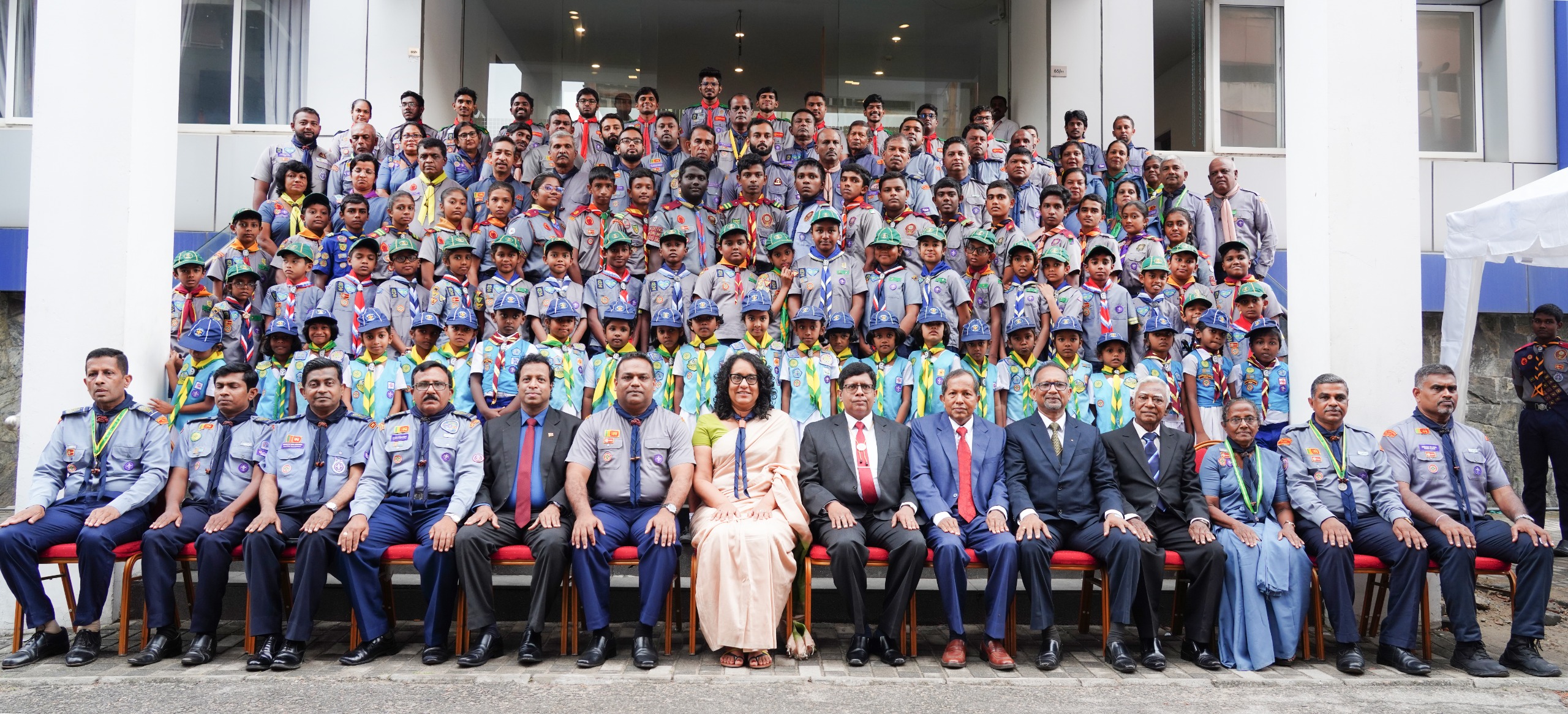
The 169th birth anniversary celebration of Lord Baden-Powell, the founder of the World Scouting Movement, and World Scout Thinking Day, was held on 22 February at the National Scout Headquarters, with the participation of Prime Minister Dr. Harini Amarasuriya.
Addressing the gathering, the Prime Minister emphasized that the Scouting Movement is not merely about holding positions, but a noble form of training that nurtures readiness to help others and to serve society while “being prepared.”
She further highlighted the importance of serving society as a disciplined and intelligent “smart” Scout who respects others while effectively using modern technology. The Prime Minister also called upon Scouts to contribute responsibly to safeguarding the nation’s future through environmentally friendly initiatives such as tree planting and the protection of water resources.
During the event, laptops were symbolically distributed to several districts under the Scout Digitalization Project, along with the provision of first-aid kits. Additionally, Chief Scout Commissioner Attorney-at-Law Manoj Nanayakkara presented the Prime Minister with a special Scout stamp collection and a commemorative cover.
The occasion was attended by the Secretary to the Prime Minister Pradeep Saputhanthri, officials of the Sri Lanka Scout Association, and a large number of Scouts from across the island.
(Prime Minister’s Media Division)


Environmental groups have raised fresh concerns over increasing levels of coal ash generated at the Norochcholai Coal Power Plant, warning of serious environmental and public health risks if proper disposal mechanisms are not urgently implemented.
Environmental scientist and Centre for Environmental Justice (CEJ) Chairman Hemantha Withanage, in a strongly-worded comment yesterday, said the growing volume of ash was being treated as a “blessing” by authorities, while, in reality, it posed a major ecological threat.
He told The Island: “More coal and more ash are being celebrated as a blessing. People around Norochcholai should get ready to apply it on their foreheads — and this will affect everyone, regardless of political affiliation.”
Norochcholai, Sri Lanka’s largest coal-fired power station, produces thousands of tonnes of fly ash and bottom ash annually. Environmentalists say a significant portion of this waste is either inadequately stored or disposed of without proper environmental safeguards.
Withanage said coal ash contains toxic heavy metals, such as mercury, arsenic, cadmium and lead, which can contaminate soil, groundwater and nearby marine ecosystems.
“Coal ash is not ordinary waste. It is a hazardous industrial material. If it leaks into the environment, it can enter food chains and drinking water sources,” he said.
He warned that communities living around Norochcholai were already exposed to air pollution from ash particles, especially during windy conditions, leading to respiratory problems and long-term health risks.
CEJ has repeatedly called for a transparent national policy on coal ash management, including safe storage facilities, independent monitoring, and exploring environmentally responsible reuse options under strict regulation.
Withanage stressed that while some countries recycle coal ash in construction materials, Sri Lanka lacks the regulatory framework and technical safeguards to do so safely.
“Without proper standards, recycling can become another pathway for toxic exposure,” he cautioned.
Environmentalists are also urging the government to accelerate the transition away from coal towards renewable energy, arguing that continued dependence on coal will only multiply waste and health burdens in the coming years.
Norochcholai supplies nearly one-third of the country’s base-load electricity, but has remained controversial, since its commissioning, due to repeated technical failures, marine pollution concerns and its long-term environmental footprint.
“With climate change and public health risks, coal is a problem we should be reducing, not normalising,” Withanage said. “Otherwise, the ash will eventually come back to all of us.”
by Ifham Nizam

The police have arrested one of the two gunmen involved in the killing of Attorney-at-Law Buddhika Mallawarachchi and his wife, at Akuregoda, on 13 February. The suspect has been identified as a legally discharged soldier.
A team of the Homagama Divisional Crime Investigation Bureau personnel apprehended the ex-soldier at Delduwa, Ambalangoda, on Saturday, around 6.20 p.m. Sources said that the suspect, identified as drug addict, had admitted that he was the one who fired the T-56 assault rifle in the attack. The other attacker used a pistol. He is still at large.
Police identified the suspect in custody as a 46-year-old resident of Baddegama. He made use of a general amnesty offered to deserters, after the conclusion of the war, to secure legal discharge. He was with a friend at Delduwa, Ambalangoda, and worked on a nearby cinnamon estate.
The suspect has been detained under PTA and the police given the power to hold him for 90 days.
The police recovered his mobile phone.
The killers arrived at Akuregoda, in a car, and fled the area after killing the couple. The ex-soldier had got off the car, near Kottawa, and then took a bus to Dehiwala, from where he proceeded to Ambalangoda.
Under interrogation, the suspect has revealed that he carried out the hit on a contract given by Karandeniye Sudda, a notorious underworld figure, who paid him Rs 1 mn and provided a quantity of heroin.
The ex-soldier is among nine persons taken into custody in connection with the ongoing investigations into the Akuregoda double murder.
Among those taken into custody are two brothers from Athurugiriya who allegedly transported one of the firearms used in the killing and provided information about the lawyer’s vehicle. Another person, identified as “Polgasowita Dila,” believed to have coordinated the Akuregoda hit, was also taken into custody during preliminary investigations.
The Police Special Task Force’s Southern Province Special Operations Unit arrested six more suspects over the weekend at Ethkandura, Kahaduwa, for aiding and abetting the double murder
Investigations have further revealed that the individual, who moved the gunman to a hotel in Pannipitiya, had fled to Thailand, via the Bandaranaike International Airport (BIA).

Prime Minister attends 169th birth anniversary celebration of Lord Robert Baden-Powell

Coal ash surge at N’cholai power plant raises fresh environmental concerns

Akuregoda double murder: Suspected gunman in custody a duly discharged ex-soldier

Those who hid under beds fearing Gotabaya, now talking big: Justice Minister

Demand for accommodating Thimphu principles in promised Constitution: ITAK says it was not party to that move

Tamil politicians tell the UK NPP govt. not fulfilling its promises

‘Dates have the highest sugar content to fight Coronavirus’

Sunday Island 27 December – Headlines

#SundayIsland 17th December – Headlines

Sunday Island – 28th March

Sunday Island Headlines – 21 March

Sunday Island – 21st February – Headlines
-
 Features1 day ago
Why does the state threaten Its people with yet another anti-terror law?
-

 Features1 day ago
Victor Melder turns 90: Railwayman and bibliophile extraordinary
-

 Features1 day ago
Reconciliation, Mood of the Nation and the NPP Government
-
 Features1 day ago
Victor, the Friend of the Foreign Press
-

 Latest News3 days ago
New Zealand meet familiar opponents Pakistan at spin-friendly Premadasa
-

 Latest News3 days ago
Tariffs ruling is major blow to Trump’s second-term agenda
-

 Latest News3 days ago
ECB push back at Pakistan ‘shadow-ban’ reports ahead of Hundred auction
-

 Features1 day ago
Barking up the wrong tree