
News
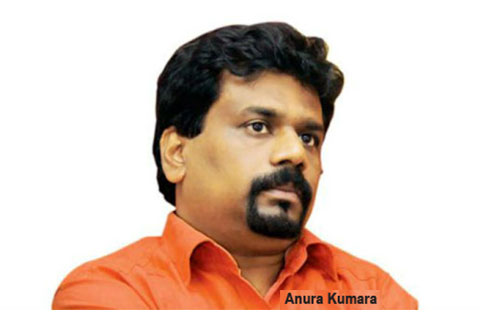
Not a single seed farm has been started in SL since 1990 — Anura Kumara Dissanayake

‘While seed mafia holds sway’
by Saman Indrajith
Successive governments in recent years have contributed towards total subjugation of the country’s agriculture seed market to the multinational corporations, JVP leader Anura Kumara Dissanayake said.
Participating in the committee stage debate on budget 2021, MP Dissanayake said: “There are three main mafias in the world – the first is the pharmaceutical mafia, the second is weapons mafia and the third is seed mafia. The seed companies such as Monsanto of the US had totally subjugated the world seed market. They have been able to set up their local agents who in turn control the local seed market for a profit.
“This is a very profitable business. When a kilo of chilli seeds unloaded at Colombo harbor its CFI value is $300 (Rs. 55,000) in rupees but sold in the market at Rs 169,000. The CFI value of a kilo of papaw is 190 dollars at the harbor (Rs. 35,150) but sold at Rs. 800,000 in the market. A kilo of seed tomato is 600 dollars in its CFI value at the harbor. That means Rs. 110,000 but sold at Rs 190,000 in the market.
“A kilo of cabbage seed is at $85 in its CIF value (Rs.15,725) but sold at Rs 400,000 in the market. These figures will help you understand what is really happening. Can we break this monopoly of the seed mafia and its local agents?
“Since 1990 not a single seed farm has been started in this country. The seed farms we had were sold. Seed farms at Pelvehera, Hingurakgoda and China farm between Thamuttagama and Talawa were sold to CIC. The Mahailuppallama seed farm today is abandoned to become a forest of ipil-ipil. There was a plan to sell that too off to a Bangladesh company in 2018.
“We in Sri Lanka had a bio-diversity rich seed culture. We had varieties of pumpkin, ladies fingers, maze etc, but none of them exist now. Those varieties were suitable for the soil, environment zone and climate of those zones. None of those varieties are seen now. We have only the products coming from the seeds provided to us by the multinational corporations.
“The loss of seed culture and the subjugation to the multinational corporations is only an outcome of the sorry state prevailing. The situation of agriculture in the country today could be seen in the way the government treats the agriculture minister. Minister Mahindananda Aluthgamage holds the agriculture portfolio.
“On Aug. 9 in a gazette allocating institutions to the ministries, four institutions namely the Agriculture Department, Agriculture and Agrarian Insurance Board, Elkaduwa Plantations Ltd and Export Agriculture Department were placed under his purview. In another gazette dated Sept. 23, the number was brought down to two. Mahindananda Aluthgamage is the first-ever agriculture Minister in the country without the Agrarian Services Board and Department of Export Agriculture under his purview. The Council for Agricultural Research Policy (CARP) is also not under his purview.
“Our nation is known since time immemorial as a civilization based on agriculture, but the contribution made by agriculture to the GDP is not sufficient today. Agriculture occupies 11 percent of lands, 25 percent of the workforce but contributes only seven percent to the GDP. Its contribution to the industries sector is 35 percent. That is the main problem of the country’s agriculture sector today.
“The second problem is the poor living conditions of the farmers. The least number of facilities in healthcare, drinking water, education, roads and housing are allocated to the farmers. They live in abject poverty as a result. They are in debt to the fertilizer shop, pesticide shop, the millers and the paddy purchasers. Their jewelry is at the pawnbrokers. They have become prey to the micro-credit companies. So the lives of farmers should not only be brought up economically but also socially if the government has any genuine intention of developing the country’s agriculture sector”.


The Sri Lanka Navy demonstrated its commitment to maritime safety by assisting to bring ashore an injured fisherman and rushing him for urgent medical attention on Thursday (28 May 2026)
The fisherman was aboard a local multiday fishing trawler off the south coast and the Maritime Rescue Coordination Centre (MRCC) Colombo coordinated the retrieval of the fisherman.
Reportedly, the multi-day fishing trawler had departed from the Kudawella Fisheries Harbour on 05th May with 06 fishermen. While engaged in fishing activities approximately 730 nautical miles off the south coast, one of the crew members suffered an injury.
Following a formal request for assistance, through MRCC Colombo, the Merchant Vessel ‘Dong Fang Wei Ye’ sailing in the nearby sea area had been informed to retrieve the patient. In a rapid response, the Navy dispatched a craft attached to the Southern Naval Command to the designated sea area where the Merchant Vessel was stationed to transfer the fisherman.
Upon transferring the injured fisherman from the Merchant Vessel, naval personnel provided essential first aid to the injured person before swiftly bringing him to the Galle Harbour And safely transferred him to the National Hospital, Galle.
News
Applications called to recruit 400 public officers as Digital Champions for the Public Impact Champions Network

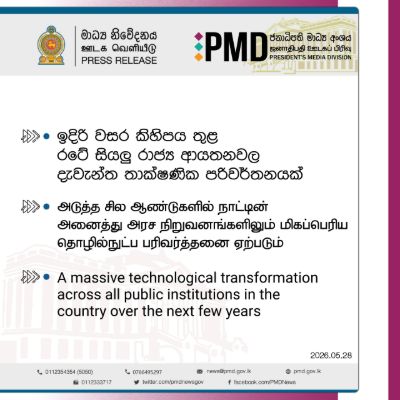
As a key component of the Government’s Digital Economy Plan aimed at enhancing the quality and efficiency of the public sector system, an awareness programme for coordinating executive officers of public institutions was held on Wednesday (27) at the Information and Communication Technology Agency of Sri Lanka (ICTA). The programme marked the first step towards establishing the “Public Impact Champions Network” (PIC-NET), an institutional pilot network intended to drive the optimisation of public services through the digitalisation of public institutions.
During the programme, heads of institutions were informed to submit applications from officers currently serving in public institutions who possess the capability and capacity to represent the “Champions Corps” in spearheading digital transformation, in accordance with Circular PS/ADA/Circular/3/2026.
Chairman of the Information and Communication Technology Agency of Sri Lanka and Senior Adviser to the President on the Digital Economy, Dr. Hans Wijayasuriya, stated that the Government aims to increase Sri Lanka’s digitally empowered economy from its current level of 3% to 12% by 2030.
He further explained that the development of the digital economy is a process aimed at improving efficiency, quality and revenue generation through the use of communication technology in economic activities.
Pointing out how the digital economy has expanded in every developed state, Dr Hans Wijayasuriya noted that the slow growth of the digital economy remains a serious challenge faced by Third World countries. However, he stated that India is currently achieving remarkable progress in digital economic development and that elevating Sri Lanka’s digital economy to a prominent level alongside such developments is one of the Government’s principal objectives.
Dr Hans Wijayasuriya also pointed out that this digital economic growth must take place simultaneously across nearly all public institutions. Accordingly, within the next three years, the coordination and management of transactions among public institutions are expected to function in a fully networked manner similar to banking operations.
He further emphasised that the support of both public institutions and the country’s citizens as a whole would be crucial for the successful implementation of this extensive technological transformation across all public institutions over the next few years.
Ranil Peiris of the Department of Information Technology at the University of Sri Jayewardenepura briefed those present on the foundation of the PIC-NET programme and its future plans.
He explained that, in the future, citizens would be able to access services such as applying for passports and renewing licences entirely online from their homes. He further pointed out that this system would eliminate the need for citizens to repeatedly provide the same information.
Representatives of KPMG also presented the future action plan relating to the selection and training of officers.
Representing the Presidential Secretariat, Sameera Wickremasinghe further briefed participants on the mechanism for calling applications.
The necessary guidance and coordination support for this public sector digitalisation programme are being provided with the support of the Presidential Secretariat, the Ministry of Digital Economy, GovTech Sri Lanka and the Asian Development Bank.
(PMD)

India’s top anti-crime agency has arrested the mother-in-law of an Indian woman whose death has sparked conflicting claims of murder and suicide.
Twisha Sharma’s parents and siblings have alleged that she was tortured by her lawyer husband, Samarth Singh, and his mother – retired judge Giribala Singh – over dowry demands and that she was murdered, allegations they have denied.
The 33-year-old model and actor had been married for just five months when she was found dead in her matrimonial home in Madhya Pradesh state’s Bhopal city on 12 May.
On Thursday, the Central Bureau of Investigation (CBI) arrested Giribala Singh after questioning her for several hours.
The Madhya Pradesh High Court had earlier cancelled her anticipatory bail, finding that a trial court had ignored key evidence and witness testimony.
Following Twisha’s death, the police had registered a case of dowry death against the Singhs. Earlier this week, the investigation was taken over by the CBI.
Twisha’s death has made national headlines and has once against brought the issue of dowry deaths into the spotlight. Every year, thousands of women are murdered for bringing in insufficient dowries, even though the practice was banned in 1961.
The case has drawn significant attention because of the family’s prominence. Twisha was a former beauty pageant winner and actor, while her husband and mother-in-law were lawyers.
Twisha’s parents allege that dowry-related harassment began soon after her marriage to Singh. They also claim that when she became pregnant, Singh and his mother accused her of infidelity and forced her to terminate the pregnancy.
The Singhs deny the allegations, saying Twisha had mental health issues and took her own life. They also contend that the decision to terminate the pregnancy was hers.
Singh is currently in police custody. He had reportedly absconded after Twisha’s death and was arrested by police in Jabalpur on 22 May.
Twisha was cremated on Sunday after a second autopsy. Her family had alleged that the first post-mortem was flawed and accused the police of a cover-up, a charge the police denied.
[BBC]

Tickner five-for wraps up innings win for New Zealand

Ambidextrous spinner Shashini Gimhani in Sri Lanka’s T20 World Cup squad

Pakistan’s famous cheerleader ‘Chacha Cricket’ to retire this year

South Africa Women’s maiden tour to Zimbabwe to feature five T20Is

Navy renders assistance to bring injured fisherman ashore

Applications called to recruit 400 public officers as Digital Champions for the Public Impact Champions Network

‘Dates have the highest sugar content to fight Coronavirus’

Sunday Island 27 December – Headlines

#SundayIsland 17th December – Headlines

Sunday Island – 28th March

Sunday Island Headlines – 21 March

Sunday Island – 21st February – Headlines
-

 News6 days ago
All-New GRAVITE launches at LKR 6.99 Mn
-

 Features6 days ago
The NPP’s pivot to the past
-
 News5 days ago
Police probe underway to ascertain links between criminals deported from UAE and local politicians
-

 News4 days ago
Easter Sunday carnage: Court told Maulana’s statement cannot be accepted without cross-examination
-

 Features6 days ago
End of Peacekeeping
-
 Opinion4 days ago
Undermining the democratic political framework
-

 News4 days ago
UK passport holder hiding here wants to have deportation order rescinded to leave without blemish
-

 News5 days ago
Dickoya double murder suspect arrested