
Latest News
Northern lights dazzle skygazers as ‘extreme’ solar storm hits Earth


The most powerful solar storm in more than 20 years has struck Earth’s atmosphere, triggering warnings over the potential disruption to power grids and satellite communications while also producing spectacular celestial light shows in some parts of the world.
The US National Oceanic and Atmospheric Administration (NOAA), which issued a rare solar storm warning, said the solar outburst reached Earth at about 16:00 GMT on Friday, hours sooner than anticipated.
The first of several coronal mass ejections (CMEs), described as the expulsions of plasma and magnetic fields from the sun, was later upgraded by the NOAA to an “extreme” geomagnetic storm.
It was the first solar storm occurrence since the Halloween storms of October 2003, which caused blackouts in Sweden and damaged power infrastructure in South Africa.
More solar expulsions are expected in the coming days, and possibly into next week, according to the NOAA.
The United States agency alerted operators of power plants and spacecraft in orbit to take precautions.
Fluctuating magnetic fields associated with geomagnetic storms induce currents in long wires, including power lines, which can potentially cause blackouts. Long pipelines can also become electrified, leading to engineering problems.
Spacecraft are at risk from high doses of radiation, although the atmosphere prevents this from reaching Earth.
Following one particularly strong peak, the NOAA’s Space Weather Prediction Center said users of high-frequency radio signals “may experience temporary degradation or complete loss of signal on much of the sunlit side of Earth”.
Unlike solar flares, which travel at the speed of light and reach Earth in about eight minutes, CMEs travel at a steadier pace, with officials putting the current average at 800km (500 miles) per second.
They said that the CMEs emanated from a massive sunspot cluster that is 17 times wider than Earth.
Even pigeons and other species that have internal biological compasses could be affected. Pigeon handlers have noted a reduction in birds coming home during geomagnetic storms, according to US space agency NASA’s Jet Propulsion Laboratory.
The most powerful geomagnetic storm in recorded history, known as the Carrington Event after British astronomer Richard Carrington, occurred in September 1859.
Social media lit up with people posting pictures of auroras from northern Europe and Australasia.
“We’ve just woken the kids to go watch the northern lights in the back garden! Clearly visible with the naked eye,” Iain Mansfield in Hertford, England, told the AFP news agency.
That sense of wonder was shared in Australia’s island state of Tasmania.
“Absolutely biblical skies in Tasmania at 4am this morning,” photographer Sean O’Riordan posted on X alongside a photo.
The storm could also produce northern lights as far south in the United States as Alabama and across northern California, according to the NOAA
But it was hard to predict and experts stressed it would not be the dramatic curtains of colour normally associated with the Northern Lights, but more like splashes of greenish hues.
“That’s really the gift from space weather – the aurora,” Rob Steenburgh, a scientist with the Space Weather Prediction Center, told The Associated Press news agency.

(Aljazeera)


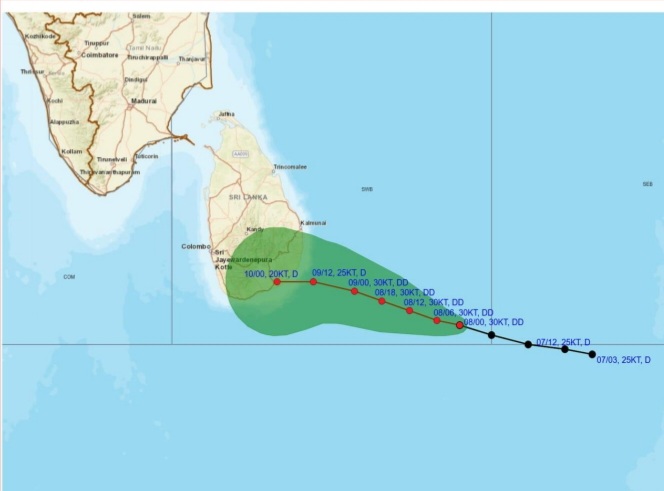
Warning for deep depression over South-east Bay of Bengal Sea area.
Issued by the Natural Hazards Early Warning Centre, Department of Meteorology at 10.30 a.m. on 08 January 2026 for the period until 10.30 a.m. 09 January 2026
The depression in the Bay of Bengal to the southeast of Sri Lanka has intensified into a deep depression and is centered near latitude 5.4°N and longitude 85.3°E, about 420 km southeast of Pottuvil at 05.30 a.m. today (08th). The above system is currently (10:00 a.m.) located about 300 km southeast of Pottuvil.
It is very likely to move west-northwestwards across the southwest Bay of Bengal and cross the Sri Lanka coast between Hambantota and Kalmunai between 5.30 p.m. to 11.30 p.m. on Friday [9th January 2026].
Hence, showery, and windy condition over the island, particularly in the Northern, NorthCentral, Eastern, Uva and Central provinces is expected to enhance from today (08th).
For the Land area:
DAMAGE EXPECTED:
• Damage to huts, temporary shelters and light structures
• Destroy the roof tops/ sheets etc.
• Damage to power and communication lines.
• Breaking of tree branches and uprooting of large avenue trees.
• Damage to paddy crops, banana, papaya trees and orchards.
• Damage to harbor yachts
• Flash flood
• Sea water inundation in low lying areas in the near coast.
Action suggested for the Land area:
• Coastal hutment dwellers are advised to move to safer places. Other people in the affected areas to remain indoors.
• People living in hilly areas (particularly landslide prone areas) and low lying areas in river basins are requested to be vigilant.
• Drivers and people using roads in the hilly areas are requested to be vigilant.
• Beware of fallen trees and power lines.
• Avoid using wired telephones and connected electric appliances during thunderstorms.
• General public is requested to be vigilant regarding impending extreme weather situation.
• For emergency assistance contact the local disaster management authorities.
• Requested to be attentive about future advisories issued by the Department of Meteorology in this regard.


Usman Khawaja could not produce a fairy-tale finish to his Test career, but Australia overcame a fright to chase down the 160-run target at SCG and record a convincing 4-1 Ashes victory.
It wasn’t quite a grandstand ending, with Australia mostly in control despite some chaotic batting that was befitting of this rather baffling Ashes series that ultimately did not live up to the hype. But there was much theatre on the final day in what proved to be the best match of the series. Australia lost five wickets for 59 runs in their second innings but Alex Carey, a star performer this series, and the under-pressure Cameron Green combined for a 40-run stand to seal a five-wicket victory.
Australia appeared to be cruising at 62 for no loss before losing three quick wickets as England sniffed an opening. On the last day of his 88-Test career, Khawaja came to the crease with Australia at 92 for 3 just after lunch and still needing 68 runs for victory on a surface playing tricks.
He received a hug from his great mate Marnus Labuschagne and walked through a guard of honour from England’s team. But Khawaja lasted just seven balls and made just 6, knocked over by Josh Tongue, who finished with 3 for 42 from 11 overs and did ensure England fought hard at the end of what has been a wretched tour.
England’s bid for a late heist were slim and made even harder with skipper Ben Stokes – who did take the field – unable to bowl after injuring his right adductor earlier in the match.
Quite typically of this series, there was mayhem at the start of Australia’s chase with three lbw shouts in the first seven deliveries. England did burn a review when Travis Head got an edge to a yorker from Brydon Carse, who shared the new ball with Tongue after Stokes lost faith in Matthew Potts after his nightmare (0 for 141) in Australia’s first innings.
After an edgy start, Head resumed his domination of England and scored quickly without much fuss until the situation exploded in the ember of this series.
England were left aggrieved when their review of an edge against Jake Weatherald on 16 was unsuccessful despite a tiny spike on Snicko. But third umpire Kumar Dharmasena decided there wasn’t enough evidence to overturn the decision as Carse engaged in a war of words with Weatherald amid heated scenes.
It loomed as a pivotal moment for Weatherald after a modest start to his Test career. Unruffled by the controversy, Weatherald and Head put the foot down as Australia sped to 57 after ten overs.
Head was in the mood to end things quickly, but on 29 he skied Tongue and was caught at midwicket. It ended Head’s remarkable series after moving up the order in Perth, finishing with 629 runs at 62.90 – the ninth-most by an Australian in an Ashes series.
Weatherald could not kick on and was caught at fine-leg off Tongue in the last over before lunch to ensure there will be plenty of debate over his position in the long break until Australia’s next Test series against Bangladesh in August.
After so much debate in the lead-up, the SCG surface did offer sharp turn in the backend of this match to revive memories of the ground’s traditional characteristics. Skipper Steven Smith was left stunned when he was bowled through the gate by a delivery that spun back sharply from offspinner Will Jacks, bringing Khawaja to the crease.
Jacks was proving a menace and Khawaja was lucky when he edged past Stokes at first slip before playing on to Tongue. Khawaja walked off after receiving another hug from Labuschagne and he performed the Sajdah on the SCG outfield before acknowledging the huge ovation from the fans.
The match suddenly sparked to life when Labuschagne, who was dropped by Jacob Bethell at backward point on 20, was run-out on 38 after a terrible mix-up with Carey. With Australia still needing 39 runs, Green came to the crease under much scrutiny but batted calmly before Carey sealed the victory with a boundary.
It ended a frenetic series that lasted just 18 days and was marred by some sloppy cricket. But Australia proved too experienced and too disciplined for an underprepared England, who did get better as the series wore on. Australia were far from blemishless through the series, with major question marks remaining over their batting order, but standout performances from Head, Carey and Mitchell Starc simply overwhelmed England.
Much like previous matches in this series, England will rue leaving first-innings runs on the table and on this occasion they didn’t capitalise on Joe Root’s brilliant 160.
Khawaja had started the day leading Australia on to the field, with an unknown if he would get the opportunity to bat again. England resumed their second innings at 302 for 8 with a lead of 119 runs as they eyed adding at least another 50 runs to make Australia nervous.
Their hopes rested on Bethell, who restarted on 142 after his magnificent display on day three when he registered his maiden first class century.
With the field well spread, Bethell manipulated the strike and cruised to 150 as Australia patiently waited for the second new ball. Bethell had an anxious moment on 151 when he was rapped on the pads by Scott Boland only to be given a reprieve by DRS when the ball tracker confirmed that it was going over the stumps.
The lead grew to 145 runs, but just when England started to get excited – like countless times this series – their hopes were crushed. Starc, of course, provided the key breakthrough when he finally removed Bethell who feathered an edge after being cramped on the cut. It was Starc’s 30th wicket for the series and the most by an Australian since Mitchell Johnson’s legendary 2013-14 Ashes series when he bagged 37 wickets.
Like several times the day before, the fans provided a rousing ovation to Bethell who trudged off extremely proud but knowing his dismissal had probably effectively ended England’s slim chances.
Having had a horrible time with the ball in his Ashes debut, Potts finally had some cheer when he swatted Boland for consecutive boundaries to get the lead over 150 runs. But Starc again snuffed out England when he removed Tongue and ensured Australia – as was later proven despite the wobbles – had a modest target to chase.
Brief scores:
Australia 567 (Travis Head 163, Steven Smith 138, Beau Webster 71*; Brydon Carse 3-130, Josh Tongue 3-97) and 161 for 5 (Marnus Labuschagne 37, Jake Weatherald 34; Josh Tongue 3-42) beat England 384 (Joe Root 160, Harry Brook 84; Michael Neser 4-60) and 342 (Jacob Bethell 154; Beau Webster 3-64, Mitchell Starc 3-72) by five wickets
[Cricinfo]

Rare mountain gorilla twins born in Africa’s oldest national park

ECB launch ‘thorough review’ in wake of 4-1 Ashes defeat

Warning for deep depression over South-east Bay of Bengal Sea area

It’s 4-1 to Australia after Carey and Green complete stuttering chase at SCG

US seizes two ‘shadow fleet’ tankers linked to Venezuelan oil

Showers above 100 mm are likely at some places in the Eastern and Uva provinces and showers about 50-75 mm in other areas

‘Dates have the highest sugar content to fight Coronavirus’

Sunday Island 27 December – Headlines

#SundayIsland 17th December – Headlines

Sunday Island – 28th March

Sunday Island Headlines – 21 March

Sunday Island – 21st February – Headlines
-

 News2 days ago
Interception of SL fishing craft by Seychelles: Trawler owners demand international investigation
-

 News2 days ago
Broad support emerges for Faiszer’s sweeping proposals on long- delayed divorce and personal law reforms
-

 News3 days ago
Private airline crew member nabbed with contraband gold
-

 News1 day ago
Prez seeks Harsha’s help to address CC’s concerns over appointment of AG
-

 News1 day ago
Govt. exploring possibility of converting EPF benefits into private sector pensions
-

 News5 days ago
Health Minister sends letter of demand for one billion rupees in damages
-

 Features2 days ago
Educational reforms under the NPP government
-

 Features3 days ago
Pharmaceuticals, deaths, and work ethics