
News
NJC asks govt. to seek compensation for IRIS Dena sinking


The National Joint Committee (NJC) has urged the government to seek compensation for the environmental damage caused by the US sinking of the unarmed Iranian Frigate IRIS Dena just outside Sri Lanka’s territorial waters and within its Exclusive Economic Zone, on 4 March.
The following is the text of the NJC statement issued jointly by Lt Gen Jagath Dias (Retd) and Dr Anula Wijesundere, co-Presidents of the outfit: Sri Lanka’s economy, political landscape and social fabric was battered for too long due to man-made and natural disasters. This include two southern insurgencies, 30 years of terrorism, tsunami, Covid- 19 pandemic, Easter Sunday terrorist attack-related political instability, 2022 economic collapse, sovereign default announcement in 2022, IMF intervention, Cyclone Ditwah, numerous external shocks, with the latest being the West Asia conflict, could be named a few.
The sinking of the Iranian warship IRIS Dena on March 4, 2026, roughly 19 to 25 nautical miles off the coast of Galle, Sri Lanka, caused severe environmental pollution, and long-term economic concerns for local communities.
Comprehensive Damage Assessment
Cost of the recovery of dead and human casualties: Out of approximately 180 personnel of the Iranian warship, the Sri Lankan Navy recovered 84-87 bodies and rescued 32 survivors, with roughly 60 sailors of the ill-fated naval vessel still missing and/or presumed dead.
As of early April 2026, the total financial damage from the IRIS Dena explosion, and sinking, off Sri Lanka’s southern coast, has not yet been fully quantified, but preliminary assessments indicate severe ecological and socio-economic risks that may have to be borne by the taxpayer.
Environmental Impact Assessments
The Marine Environment Protection Authority (MEPA) and other experts have highlighted several critical concerns:
* Toxic Spills: The vessel released thousands of tonnes of hazardous materials, including heavy fuel oil and potentially specialised military chemicals, into a highly sensitive marine ecosystem.
* Shoreline Contamination: Oil barrels and debris, including burnt parts of support craft, have washed ashore in popular coastal areas like Hikkaduwa and Dodanduwa. Laboratory tests by MEPA confirmed the presence of lubricant oil in these areas.
* Threats to Marine Life: The southern coast is a vital habitat for whales, dolphins, and vibrant coral reefs. Experts warn of a “silent” impact on ichthyoplankton (fish eggs and larvae), which are particularly vulnerable during the March-April period.
Turtle Nesting: The incident coincided with the sea turtle nesting season. Oil spills and debris are expected to increase mortality rates for sea turtle hatchlings and impact adults coming ashore to breathe and feed.
Livelihood and Socio-Economic Damage
The explosion occurred near the international maritime boundary close to Galle, a major hub for tourism and fishing:
Fisheries: Concerned local fishermen were the first to report oil patches. While no immediate mass fish deaths were initially reported, authorities warn that long-term depletion of shallow-water fish stocks is likely with some reports suggesting up to 50% depletion of shallow-water fish in the affected area.
Tourism: Contamination at Hikkaduwa—a key tourist destination—faced disruption /threatened the local hospitality industry with oil staining the shore during the peak tourism season.
Rescue and Recovery: Sri Lanka deployed naval and air force units to rescue 30 out of approximately 180 personnel aboard torpedoed Iranian vessel. The ongoing monitoring and cleanup efforts add a significant administrative and operational burden to the state.
The Damage: While some experts draw parallels to the 2021 MV X-Press Pearl disaster (which cost over $6 billion in environmental damage), the specific “total damage” figure for the IRIS Dena is still being calculated as debris continues to wash ashore
Accountability and Response
Sri Lanka was left to manage the search-and-rescue (SAR) and environmental clean-up at its own cost, sparking debates regarding liability for damages caused to neutral third parties by warring nations.
A 2021 study on the natural resource damage assessment for oil spills in Sri Lanka states that 39 oil spills occurred in Sri Lanka between 1999 and 2021, including the MV X-Press Pearl. A previous study published in 2017 on oil spill events in marine waters in Sri Lanka showed the sea around Sri Lanka being highly vulnerable to oil spills, as approximately 25% of the world’s oil transportation passes through Sri Lanka’s exclusive economic zone.
In August 2025, the Sri Lankan Supreme Court ordered owners of the MV X-Press Pearl to pay $1 billion in compensation for the 2021 sinking that caused the country’s worst maritime pollution disaster.
Applying the “polluter pays principle,” the ruling mandates payments for extensive plastic pellet contamination and ecological damage.
Some experts are of the opinion that once the origin of the current oil spill is determined and is confirmed linking to the sunken Iranian warship, those who carried out the attack should be held responsible for any environmental damage.
“This should be then handled at a diplomatic level. Considering the already ailing economy and the financial burden Sri Lankan taxpayer is likely to bear short, medium and long term:
1. N. J. C urge the government to do a thorough and a comprehensive damage assessment involving appropriate experts in each subject matter. N. J. C also urge the government to make necessary early dialogue with parties / countries responsible for the incident in order to recover damage cost/compensation.
2. In the backdrop of continued global tensions, vulnerability of sea trade and maritime activities in the Indian Ocean, N.J.C urge the government to represent / engage appropriate bilateral / multilateral and world bodies to declare Indian Ocean a zone of peace.
3. N. J. C recognizes the need for the government to take proactive measures joined by other littoral states at international level to devise/project a protective package from likely future disasters in the Indian Ocean.





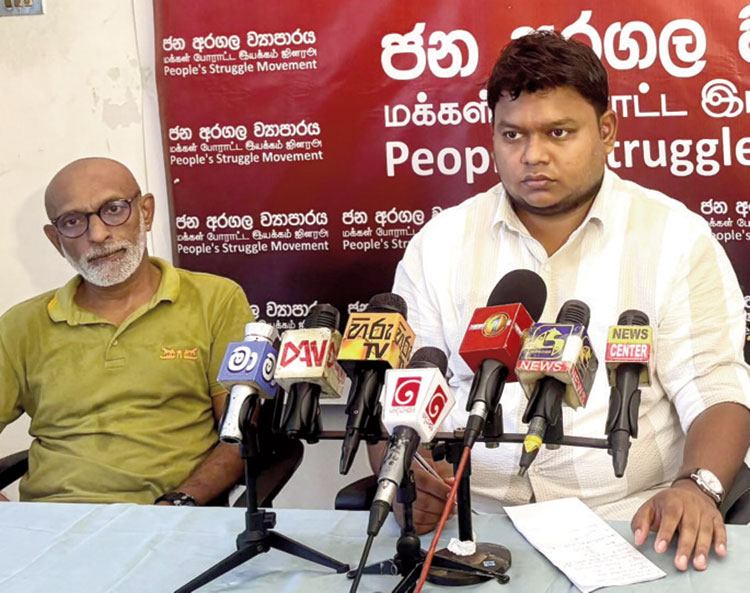
The Frontline Socialist Party-backed People’s Struggle Movement is set to stage a protest march in Colombo today (03) against what it describes as the growing tax burden on the public and the rising cost of living.
The organisers are due to commence the “Colombo March Against Unjust Taxes” at noon from Campbell Park, Borella. The FSP has also been mobilising support for the protest in Colombo and its suburbs in the run-up to the event.
People’s Struggle Movement National Executive Council member Wasantha Mudalige, speaking at a media briefing in Nugegoda yesterday (02), called on the public to join the protest, saying the movement intended to bring the tax burden faced by ordinary people to the forefront.
Mudalige alleged that successive tax measures had placed an excessive burden on households, particularly through taxes on food and educational items. He also criticised the Government over what he described as the high cost of basic food items and the difficulties faced by parents in meeting their children’s educational expenses.
He accused the Opposition of failing to adequately address the issue, claiming that opposition parties raised such concerns, mainly during election periods.
Mudalige also criticised the Government for what he described as a departure from promises made before the 2024 presidential election regarding taxes on educational equipment.
He questioned the tax burden on food items, citing figures of Rs. 100 per kilogramme on dried sprats, Rs. 310 per kilogramme on chicken and Rs. 11 per egg.
He further alleged that while ordinary people were bearing a heavy tax burden, wealthy groups were receiving tax concessions. He also criticised the Government’s economic programme and its implementation of measures associated with the International Monetary Fund (IMF).
The movement has framed today’s protest as part of a broader campaign over the cost of living and taxation. The People’s Struggle Alliance has separately announced that the Campbell Park demonstration will be the first in a series of public actions, with further protests planned in November.
Mudalige said the movement would continue to take the issue to the streets and urged the public to participate in today’s demonstration.
People’s Struggle Movement National Executive Council member Jayantha Amarasinghe also addressed the press.

The Colombo High Court yesterday postponed the trial in the case filed under the Prevention of Money Laundering Act against Yoshitha Rajapaksa, son of former President Mahinda Rajapaksa.
The case was taken up before Colombo High Court Judge Udesh Ranatunga, with Yoshitha Rajapaksa, who is currently out on bail, appearing in court.
The trial was postponed as the President’s Counsel appearing for the defence was indisposed.
The Attorney General has filed the case against Rajapaksa, alleging that he committed an offence under the Prevention of Money Laundering Act by purchasing five plots of land in Dehiwala and Ratmalana, worth more than Rs. 73 million.
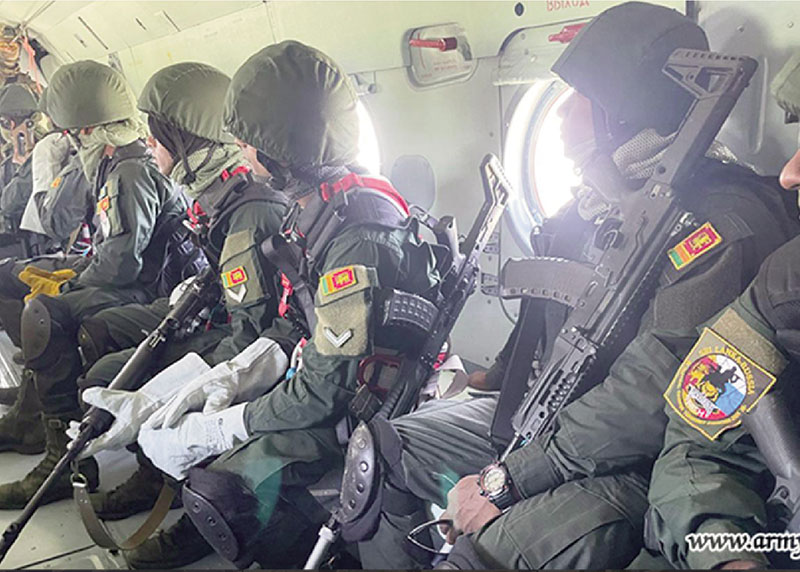
A contingent of the Sri Lanka Army, comprising 20 officers and 55 other ranks, participated in the combined military exercise ‘Wolverine Path II–2026’, conducted with the Armed Forces of the Russian Federation in Vladivostok, Russia, from September 18 to 25.
According to the Ministry of Defence, the exercise primarily focused on counter-terrorism operations and provided participating troops with training in a challenging combined operational environment.
The exercise included a range of tactical activities, including heli-rappelling, close-quarters battle (CQB), ambush operations, sniper firing, drone operations, buggy training and combat medical support.
The Ministry said the training enabled Sri Lankan troops to further develop their combat skills, tactical coordination and operational readiness.
It also provided an opportunity for the two militaries to exchange professional knowledge, operational experience and tactical expertise. Sri Lankan personnel gained exposure to training methodologies, tactical approaches and operational practices adopted by the Russian Armed Forces, the Ministry said.
The participation also enabled the Sri Lankan contingent to identify lessons from the joint training and share its own experiences with the Russian military.
The Sri Lankan contingent returned to the country following the exercise and arrived at Mattala Rajapaksa International Airport on September 28.
The Ministry said participation in the exercise contributed to enhancing the professional knowledge, tactical awareness and operational preparedness of Army personnel while promoting military-to-military cooperation, mutual understanding and professional relations between Sri Lanka and Russia.

Ten injured after car crashes into rugby supporters in Australia

Polls open in Latvia against backdrop of perceived Russia threat

Abhishek, Tilak and spinners secure gold for India at Asian Games again

Tharindu Rathnayake, bowlers secure Asian Games Bronze for Sri Lanka

G7 to release 100 million barrels of oil and diesel after Trump export ban threat

Showers above 75 mm are likely at some places in the Central, Sabaragamuwa, Western, Uva, North-western, Southern and North-central provinces and in Mannar district.

‘Dates have the highest sugar content to fight Coronavirus’

Sunday Island 27 December – Headlines

#SundayIsland 17th December – Headlines

Sunday Island – 28th March

Sunday Island Headlines – 21 March

Sunday Island – 21st February – Headlines
-

 News5 days ago
Police remove Thileepan statue in Jaffna
-

 Features5 days ago
The 22nd Amendment, constitutional recovery and illiberal slippage
-

 Features5 days ago
Of foreigners as CEOs of Lankan ventures
-

 Latest News3 days ago
Gold winner Tharanga gets brand-new Honda Vezel from SLAAJ
-

 News5 days ago
Sajith rejects Jt. Opp. protest sabotage claim; SJB TU chief demands remedial action
-

 Features4 days ago
Thailand’s biggest new global star …
-

 Features3 days ago
Why Sri Lanka needs an Inclusive Civic Nationalism – urgently
-
 News4 days ago
First cases taken up by SC after enactment of 22A dismissed