
News
Nihal Seneviratne, an exemplary Secretary-General of Parliament

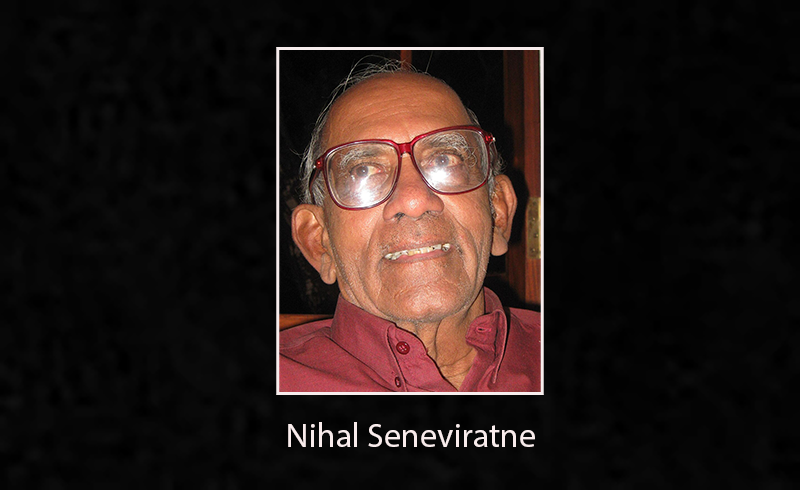
Nihal Seneviratne, who died a few days ago, was Secretary-General of the Parliament of Sri Lanka from 1981 to 1994, when the country went through one of its most difficult periods. Our existence as a democratic and united nation was under threat, with the implementation of the Sinhala Only Act. Following the brutal killings of some innocent Tamils by some racist elements in 1983 (Black July), as a reaction to killings by the LTTE, this heralded the beginning of the deadly separatist war. By then all hope of a political solution to the language problem, like the Bandaranaike–Chelvanayakam Pact, had failed. Warnings given by the LSSP leaders, like Dr. N. M. Perera, that a “sea of blood would flow through the country,” and by Dr. Colvin R. de Silva “one language two nations, two languages one nation,” were ignored. The proposals submitted by the All Party Representatives Committee (APRC), chaired by me, after 127 meetings, over three years, which was accepted by all Tamil speaking parties (other than the TNA, which boycotted it), was not put to Parliament. Parliamentary politics virtually collapsed and militancy filled the vacuum. The situation was aggravated further by the JVP violence, which peaked in 1988/89, and by the adverse impact on the functioning of Parliament by the Executive Presidency. But Nihal ensured the proper functioning of Parliament and its safety during his tenure. Thereafter, he played an important role as a member of the Dr. N. M. Perera Memorial Trust, until his death.
Nihal Seneviratne received his secondary education at one of the premier educational institutions in Sri Lanka, Royal College, Colombo. He entered the University of Peradeniya where he obtained a degree in Law, the L.L.B. He became an Advocate at the Law College, in 1961, and this enabled him to practice in the Supreme Court. However, he wanted to contribute to the highest institution in the country and joined Parliament as a public servant. He did all his duties with devotion and efficiency and rose to become the Deputy Secretary-General, and in 1981 the Secretary- General.
As Secretary-General, during his tenure he performed all his official duties efficiently, and in all matters acted impartially. I did not hear any Member of Parliament (MP) complain against him, either in the chamber or outside. Even though he did advice the Speaker on various matters, he did so according to the rules, and in a correct manner, so that all MPs accepted the decisions. He carried out his administrative functions efficiently so that the Parliament ran smoothly. As the Chief Procedural Officer he ensured that Parliamentary procedures, and the drafting of legislatures, were done properly. He ensured that the Constitution was not violated. With the establishment of the Executive Presidency, he ensured that Parliament was protected from executive overreach. He was widely regarded as an independent person who acted in a principled and fearless manner.
During the period when the Executive Presidency was being consolidated, and when the JVP insurgency and civil conflict were increasing and emergency rule was being imposed Nihal stood firmly for the supremacy of Parliament and the rule of law and the proper conduct of all procedures. He resisted all authoritarian tendencies which weakened Parliament. This led to him having to come into conflict with powerful executives and resist emergency governance practices. His principled stand ultimately led to much pressure on him and his departure from the Secretary-General post is seen by many as being due to political pressure.
Nihal is the author of a valuable book “Parliamentary Practice in Sri Lanka”, which has become a standard reference text. It is an excellent defence of the Westminister model of Parliament which has taken root in Sri Lanka getting adapted to our needs. His work is closely allied to the thinking of the LSSP. It may be said that what Dr. N. M. Perera did to consolidate that model in Sri Lanka to suit our conditions and needs has been effectively strengthened by Nihal Seneviratne.
by Prof. Tissa Vitarana, Chairman of the Dr.N M Perera Memorial Trust

Latest News
“Let us resolve, with renewed determination to overcome obstacles and build a better and more prosperous nation” -PM

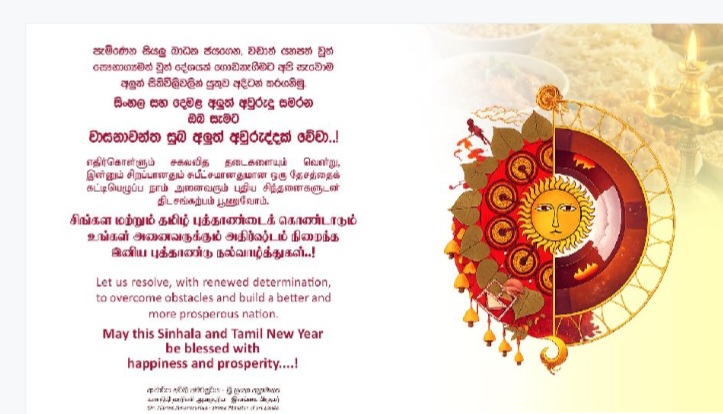
Prime Minister Dr Harini Amarasooriya in her New Year message requested every Sri Lankan to resolve, with renewed determination to overcome obstacles and build a better and more prosperous nation.
The full text of the PM’s message:
“Marking the auspicious transition of the sun from one planet to another, and the arrival of the spring season following the harvest, the Sinhala and Tamil New Year celebrated by the people of Sri Lanka since ancient times, has dawned once again.
The New Year is not merely a festive occasion; it symbolizes a renewal of prosperity, unity, coexistence, and the strengthening of mutual relationships embedded within our cultural values.
On this occasion, I extend my wishes for a peaceful and prosperous Sinhala and Tamil New Year to all Sri Lankans who celebrate this occasion with their families and loved ones, observing customs at the auspicious time.
A unique feature of Sinhala and Tamil New Year is the way an entire nation comes together through a shared set of customs. Despite the demands and challenges of daily life, this season offers a valuable opportunity to move forward with renewed hope as families, communities and a nation.
The true blessing of the New Year lies in setting aside differences and grievances, and embracing a fresh beginning in a spirit of solidarity and goodwill. Especially in the face of ongoing global challenges, the courage, compassion and resilience shown by our people in facing various natural and economic hardships in recent times stand as an example to the world. It is our responsibility to carry forward that collective strength.
At this auspicious moment, I extend my greetings to our fellow Sri Lankans working overseas, who dedicate themselves to securing a better future for their families and for the country. In particular, I extend my thoughts for the safety and well-being of those living in the Middle East during these tumultuous times.
Let us resolve, with renewed determination to overcome obstacles and build a better and more prosperous nation. As we undertake in a significant social and political transformations, we remain committed to striving tirelessly towards a better future.
May this Sinhala and Tamil New Year be blessed with happiness and prosperity!”
Latest News
Sun directly overhead Nawaladi, Paranthan, Murasumodai, Vellikkandal, Udapattukkandal, Puliyampokkanei about 12:10 noon today [14]

On the apparent northward relative motion of the sun, it is going to be directly over the latitudes of Sri Lanka from the 05th to 15th of April in this year.
The nearest areas of Sri Lanka over which the sun is overhead today (14th) are Nawaladi, Paranthan, Murasumodai, Vellikkandal, Udapattukkandal, Puliyampokkanei about 12:10 noon.
Latest News
Heat Index at Caution Level in the Northern, North-central, North-western, Western and Southern provinces and in Trincomalee district.
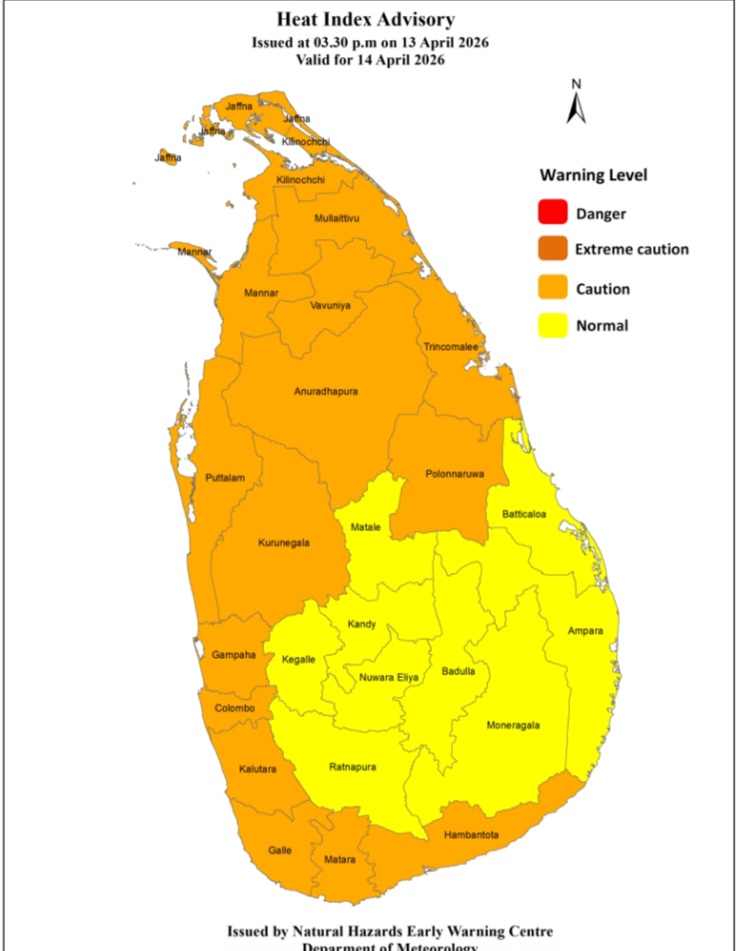
Warm Weather Advisory
Issued by the Natural Hazards Early Warning Centre
Issued at 3.30 p.m. on 13 April 2026, valid for 14 April 2026.
The Heat index, the temperature felt on human body is likely to increase up to ‘Caution level’ at some places in the Northern, North-central, North-western, Western and Southern provinces and in Trincomalee district.
The Heat Index Forecast is calculated by using relative humidity and maximum temperature and this is the condition that is felt on your body. This is not the forecast of maximum temperature. It is generated by the Department of Meteorology for the next day period and prepared by using global numerical weather prediction model data.

Effect of the heat index on human body is mentioned in the above table and it is prepared on the advice of the Ministry of Health and Indigenous Medical Services.
ACTION REQUIRED
Job sites: Stay hydrated and takes breaks in the shade as often as possible.
Indoors: Check up on the elderly and the sick.
Vehicles: Never leave children unattended.
Outdoors: Limit strenuous outdoor activities, find shade and stay hydrated.
Dress: Wear lightweight and white or light-colored clothing.
Note:
In addition, please refer to advisories issued by the Disaster Preparedness & Response Division, Ministry of Health in this regard as well. For further clarifications please contact 011-7446491.

“Let us resolve, with renewed determination to overcome obstacles and build a better and more prosperous nation” -PM

Sun directly overhead Nawaladi, Paranthan, Murasumodai, Vellikkandal, Udapattukkandal, Puliyampokkanei about 12:10 noon today [14]

Heat Index at Caution Level in the Northern, North-central, North-western, Western and Southern provinces and in Trincomalee district.

Showers or thundershowers will occur at most places of the island after 1.00 pm

Salt and Patidar power RCB past Mumbai Indians

Prasidh, Buttler set up comfortable win for Gujarat Titans

‘Dates have the highest sugar content to fight Coronavirus’

Sunday Island 27 December – Headlines

#SundayIsland 17th December – Headlines

Sunday Island – 28th March

Sunday Island Headlines – 21 March

Sunday Island – 21st February – Headlines
-

 News2 days ago
CEB orders temporary shutdown of large rooftop solar systems
-

 News5 days ago
AG: Coal procurement full of irregularities
-

 Business4 days ago
Israeli attack on Lebanon triggers local stock market volatility
-

 Business5 days ago
Hayleys Mobility introduces Premium OMODA C9 PHEV
-

 Business4 days ago
HNB Assurance marks 25 years with strategic transformation to ‘HNB Life’
-
 Features2 days ago
From Royal College Platoon to National Cadet Corps: 145 years of discipline, leadership, and modern challenges
-

 Sports5 days ago
DS to face St. Anthony’s in ‘Bridges of Brotherhood’ cricket encounter
-
 News6 days ago
AKD admits import of substandard coal, blames technicalities and supplier