
News
New political culture, altruistic leaders can save Sri Lanka: Deepika


By Sanath Nanayakkare
Now that the people have realised the need to fight for their rights, they should make a holistic effort to push lawmakers to create a political culture, where politicians were not entitled to unnecessary privileges, comforts, fancy vehicles, large security details, etc., says Former Human Rights Commission (HRCSL) Chairperson Dr. Deepika Udagama.
Dr. Udagama made said so, taking part in a political programme (Mawatha) on Sirasa TV.
“I am glad to see that eventually today’s younger generation has recognised their citizenship rights and risen against the deprivation of the people’s basic human rights where the government has not been able to make basic living needs accessible to them.
“In my view, the erosion of democracy over the years started with the advent of the all-powerful executive presidential system and then the 20th Amendment – a much uncivilized law – consolidated that trend. What we see today as an economic crisis, is the result of undermining our democracy over the years and even our food security through the recent ban on using chemical fertiliser which should have been done more methodically by listening to agricultural experts.”
“Although we have discussed democracy and human rights over the last few decades, it was difficult to convince those fundamentals to our society because they had trust that they would be able to achieve productive governance through the existing political system. As it has not happened and as the patience of the people has run out, now we see that the real citizen, that was in slumber, has eventually woken up. That is the silver lining I see in these dark clouds. I bow to the young people staging protests on the streets because they engage in these activities with restraint and in a mature way. They are not demanding the uplifting of their economic and financial wellbeing. They demand the creation of an accountable governance system for the citizens of the country.
“When people don’t have access to pharmaceutical drugs and medical treatments that is also a grave violation of a human right. When such social and economic rights were deprived and the social and political contract between the government and people was breached, they came forward to use their civil and political rights. They use the freedom of speech, take to the streets and make agitations. So, these rights need to be safeguarded or otherwise the people’s voice on those issues won’t be heard. The IMF knows very well about the ground realities in any country they fund facility programmes. So politicians should act with humility in tackling these issues. They need to be humble. They should listen to experts’ advice. I say this for both government and opposition politicians. Now, we hear the call to form an all-party interim administration. The authorities don’t seem to be responding to it.
“Although people are miserable, they have risen. They are in a rage. This, however, shows their energy, awareness and inspiration in terms of their democratic rights. We all need to get together to find solutions for this. My view is that we need to restore the economy soon or it will collapse completely, if that’s still not the case. But to resolve this in the long term, we must change the system of governance. We must create accountability of politicians to the people. For this, we must abolish the executive presidential system. We must bring in the 19th Amendment with appropriate changes because even an executive PM could turn to be adamant. The constitution needs to be changed with more democratic features.
“Leaders must listen to the young people’s voice as adults rather than mere leaders, and then we should see some degree of political discipline. Not only humble, they should be simple and altruistic. It doesn’t appear to be happening any time soon. But now we see the foundational stage for it. This momentum needs to be maintained and strengthened going forward.”

COPF final report on USD 2.5 mn cyber fraud recommends action against all responsible
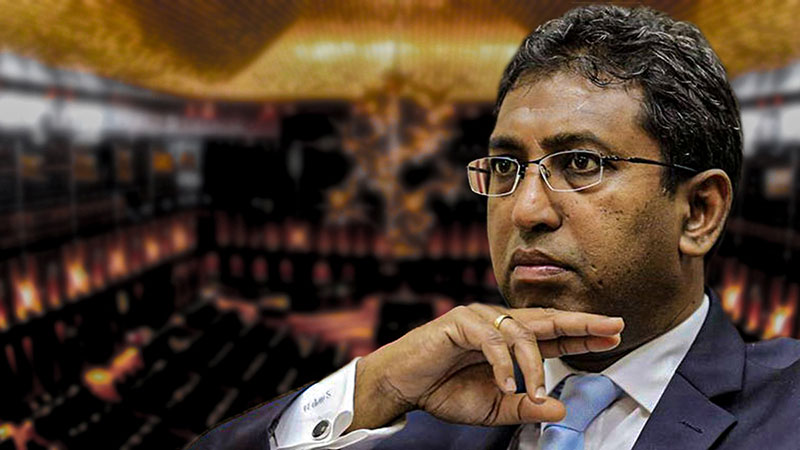
The US$2.5 million loss incurred during Sri Lanka’s foreign debt repayment to Australia was a clear case of a cybercrime and theft, Committee on Public Finance (COPF) Chairman Dr. Harsha de Silva told Parliament yesterday.
Presenting the COPF final report on the cyber fraud, Dr. de Silva said the incident amounted to a serious financial crime and called for a comprehensive investigation, by law enforcement authorities, to identify and prosecute all those responsible.
The report revealed serious governance, procedural and operational failures that enabled the fraudulent transfer of public funds, while recommending sweeping reforms to strengthen cybersecurity, financial controls and public debt management systems.
According to the report, officials of the Treasury and the Central Bank bore responsibility for governance lapses that contributed to the failures. It also highlighted the fact that the Ministry of Finance was operating an outdated Microsoft Exchange Server after security support had ended, while basic safeguards, such as multi-factor authentication, had not been implemented.
The COPF said suspicious payment instructions linked to debt repayments involving India, the United Kingdom, Germany and Belgium had also been detected, preventing further losses. However, the US$ 2.5 million fraud materialised only in the repayment transaction involving Australia.
The report has noted that officials had failed to verify lender email domains, relied on unverified email communications and lacked adequate internal controls, allowing the fraud to continue for months.
Although the investigation uncovered system-wide weaknesses across several institutions, only four mid-level Finance Ministry officials had been suspended so far, the report said.
The COPF has recommended a special audit of the foreign debt repayment process, strengthened cybersecurity measures across state institutions, updated financial regulations and improvements to public debt management systems.
by Saman Indrajith
News
Opposition signs no-confidence motion against Justice Minister for dereliction of duty over Negombo Prison deaths

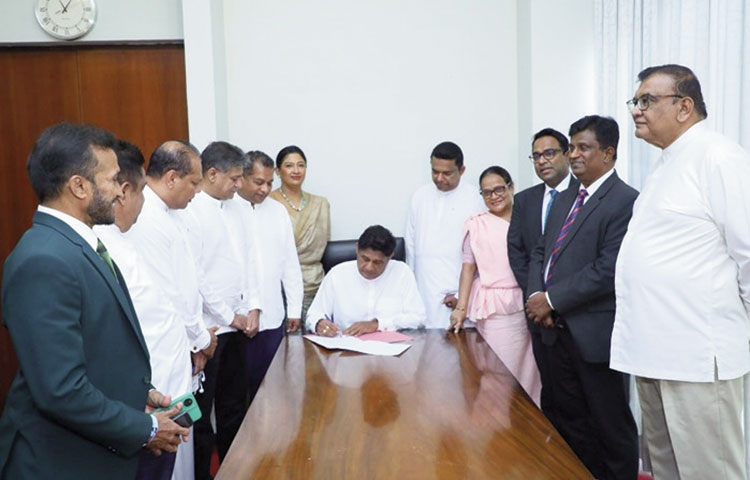
Opposition Leader Sajith Premadasa, together with Opposition MPs, yesterday signed a No-Confidence Motion (NCM) in Parliament against Justice Minister Harshana Nanayakkara.The move comes in response to the unrest at the Negombo Prison, where both prison officers and inmates were killed.
Opposition members said the Minister had failed to fulfill his responsibility and accountability regarding their safety.According to the Opposition group, the NCM seeks to hold the Minister directly accountable for lapses in ensuring protection within the prison system.

The Attorney General yesterday informed the Supreme Court that the government has decided to review the legality of agreements entered into by the previous administration to hand over the country’s electronic visa issuance operations to private companies.
Additional Solicitor General Viveka Siriwardena, appearing for the Attorney General, made the submission when the Supreme Court took up the fundamental rights petitions filed by former MPs President’s Counsel M.A. Sumanthiran, Patali Champika Ranawaka, and Rauff Hakeem, challenging the previous Cabinet’s decision to outsource the e-visa system.
The petitions were heard before a three-judge bench, comprising Chief Justice Preethi Padman Surasena and Justices Achala Wengappuli and Arjuna Obeyesekere.
The Additional Solicitor General informed court that the current Cabinet had appointed a subcommittee to examine the legality of the agreements with the private companies and requested time to report on its findings, stating that the review was still underway.
President’s Counsel Sumanthiran, appearing as one of the petitioners, told the court that although the present government had indicated its intention to cancel the transaction, the petitioners wished to proceed with the case.
He noted that members of the current Cabinet had been named as respondents in the petitions.The Supreme Court directed the petitioners to issue notice on the members of the current Cabinet, named as respondents, and fixed September 29 for further proceedings.

History takes centre stage as Mandhana, Harmanpreet fifties steer India

Spain leave it late to book semifinal date with France

Showers will occur in the Sabaragamuwa, Western and North-western provinces and in Galle, Matara, Kandy and Nuwara-Eliya districts

US$ 2.5 mn cyber heist exposes system failures

Opposition signs no-confidence motion against Justice Minister for dereliction of duty over Negombo Prison deaths

AG informs SC of e-visa agreement review

‘Dates have the highest sugar content to fight Coronavirus’

Sunday Island 27 December – Headlines

#SundayIsland 17th December – Headlines

Sunday Island – 28th March

Sunday Island Headlines – 21 March

Sunday Island – 21st February – Headlines
-

 News7 days ago
Singapore-based Buddhist monk marks nearly four decades of humanitarian service
-
 News2 days ago
Herath warns prospective migrant workers not to get fleeced by racketeers
-

 News6 days ago
AI concerned over proposed SL military deployment in Haiti
-

 Midweek Review4 days ago
Unexpected focus on ‘pieces of tin’ worn by military men
-

 Latest News5 days ago
Nyamhuri and Ngarava stun Bangladesh by defending 141
-

 News3 days ago
Negombo Prison riot: Ensuring protection of prisoners fundamental responsibility of the state – UN
-

 Features7 days ago
The NPP’s New Challenge: Balancing Easter Lawfare and Economic Welfare
-

 Editorial4 days ago
Prison riots and political battles