
News
New education reforms are not only to align education with job market demands but also to cultivate skilled youth who can contribute to the economy and provide leadership to society -Prime Minister

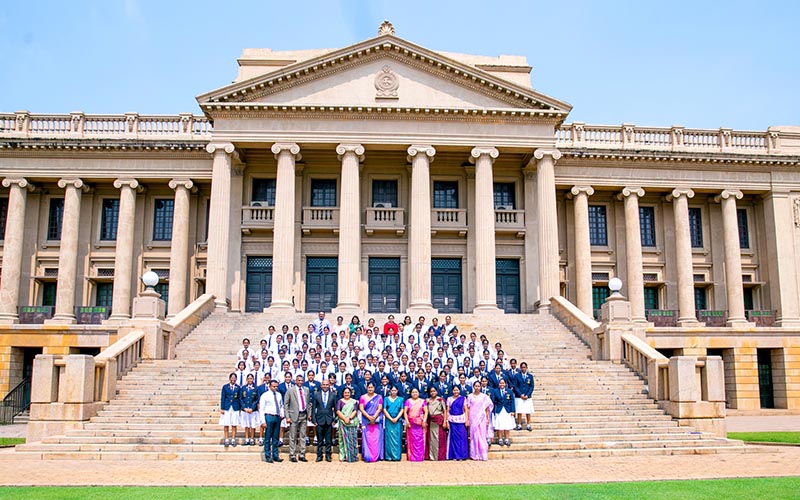
As part of the series of programmes conducted for schoolchildren by the Presidential Secretariat, the Ministry of Education and the Sri Lanka Parliament Department of Communication, a special Student Parliament session for Visakha Vidyalaya, Colombo, was held on Tuesday (25) at the Old Parliament Chamber of the Presidential Secretariat. The event was conducted under the patronage of Prime Minister Dr. Harini Amarasuriya.
During the session, the student parliament members of Visakha Vidyalaya had the opportunity to gain insights into the conceptual and practical significance of the “Clean Sri Lanka” initiative.
A special commemorative edition of the ‘Vision’ magazine, which focuses on the student Parliament initiative, was presented to the Prime Minister by Nadeeka Dangolla, Assistant Director of Parliamentary Affairs and Executive Functions.
Furthermore, the Principal of Visakha Vidyalaya, Mrs. Manomi Seneviratne, presented a special commemorative token to the Prime Minister.
Addressing the gathering, Prime Minister Dr. Harini Amarasuriya highlighted that the government’s commitment to implementing new educational reforms aimed at nurturing a generation capable of seizing economic opportunities.
The Prime Minister further stated that the government aims to prepare Sri Lankan children to acquire global knowledge while fostering a self-reliant and empowered future generation.
The Prime Minister stated that the objective of the new education reforms are not only to align education with job market demands but also to cultivate skilled youth who can contribute to the economy and provide leadership to society.
Furthermore, she underscored the government’s commitment to addressing resource disparities among schools and emphasized the significance of civic responsibility in this endeavour.
Speaker Dr. Jagath Wickramaratne:
‘Leadership must be devoid of selfishness. Selfless leaders guide both the nation and its people towards a better direction. To achieve this, skills must be enhanced. We can learn about talented leaders from both Sri Lankan history and global history. We should study as children how Chandashoka transformed into Dharmashoka and how Hitler’s regime brought devastation to the world. A nation achieves stability when leaders who prioritize minimal personal consumption and demonstrate a true dedication to their nation arise. Therefore, we must strive to cultivate leaders who can face challenges and prioritize national interests. By fostering selflessness, we can ensure a prosperous future for our people.’
Senior Presidential Media Advisor Mr. Chandana Sooriyabandara:
‘The students gathered here today are not just future leaders; they are leaders already. Leadership knows no age. Anyone who stands for a group could be consider as a leader. Those who exercise the power of the group are considered leaders. Throughout Sri Lankan history, individuals who contributed to the country through their words and actions have played leadership roles. Therefore, logical reasoning should lead the process of making decisions. Both leaders and citizens share the duty to act rationally. You all have a duty to shape a prosperous nation through logical thinking, and this obligation lies with every young person.’
The event was also attended by Deputy Speaker Dr. Rizvie Salih, Deputy Chairperson of Committees Hemali Weerasekara, Secretary-General of the Parliament Kushani Rohanadeera, Senior Additional Secretary to the President K.M.N. Kumarasinghe, Director-General of Legal Affairs to the President J.M. Wijebandara, Principal of Visakha Vidyalaya Manomi Seneviratne, along with members of the teaching staff and a group of students.

News
Establishment of an Institutional Framework to Inagurate Upper Hydro Catchment Areas Management Authority
Policy approval of the Cabinet of Ministers was granted at their meeting held on 08.06.2026 to establish the Upper Hydro Catchment Areas Management Authority for identification and
execution of a formal and long – lasting remedy to secure the central hills including the upper hydro catchment areas enabling them to sustain amidst extreme weather conditions
due to natural calamities and human activities as well as to be used for the sustainable development of the country.
Accordingly, a concept paper has been prepared including
institutional structure, activities, powers, active subject area as well as administrative and coordination mechanism for the proposed authority by an expert technical committee appointed by the Secretary to the President.
Based on the said concept paper, the Cabinet of Ministers granted approval to the resolution furnished by the President to instruct the Legal Draftsman to prepare a draft bill including legal provisions required for the establishment of Upper Hydro Catchment Areas Management Authority.
News
Introduction of Flora and Fauna (Regulation of actions of the Indigenous Community within the nominated areas) Regulations
With the objective of securing the traditional livelihood and the eco system of the indigenous community, it has been recognized the necessity of introducing a formal regulation methodology to secure their engagement in livelihood activities by being more sensitive to the existing laws.
Thereby, the Fauna and Flora (regularizing) regulations under the Fauna and Flora Protection Ordinance (Authority 469) have been prepared so that nominated activities within the prescribed area to a member of the indigenous community
who has been registered for securing the rights acquired from law or custom or usage or traditional stance to execute an act within a certain state land that is fundamental to the survival of the indigenous community permission can be granted
Accordingly, the Cabinet of Ministers granted approval to the resolution furnished by the Minister of Environment to publish the said regulations in the government gazette notification and thereby submit to the Parliament for its concurrence.
Latest News
M. M. D. J. Senarathne, appointed Director General of the Department of National Botanical Gardens
The Cabinet of Ministers approved the resolution furnished by the Minister of Environment to appoint M. M. D. J. Senarathne, who is the senior most officer in Grade I of Sri Lanka Scientific Service se

Establishment of an Institutional Framework to Inagurate Upper Hydro Catchment Areas Management Authority
Introduction of Flora and Fauna (Regulation of actions of the Indigenous Community within the nominated areas) Regulations
M. M. D. J. Senarathne, appointed Director General of the Department of National Botanical Gardens

Harmanpreet Kaur steps down as India captain

Turkiye, Pakistan agree Saudi Arabia military deployment under Mecca pact

Rumesh Tharanga among nominees announced for World Athlete of the Year 2026

‘Dates have the highest sugar content to fight Coronavirus’

Sunday Island 27 December – Headlines

#SundayIsland 17th December – Headlines

Sunday Island – 28th March

Sunday Island Headlines – 21 March

Sunday Island – 21st February – Headlines
-

 Latest News7 days ago
Gold winner Tharanga gets brand-new Honda Vezel from SLAAJ
-

 News6 days ago
US-assisted ‘Ice’ detection: NPC to examine IGP’s move to transfer drug-busting team
-

 Features7 days ago
Why Sri Lanka needs an Inclusive Civic Nationalism – urgently
-

 Editorial5 days ago
Colombo Port drug bust: The plot thickens
-

 News7 days ago
Civil society activist accuses govt. of favouring Ven. Gnanasara
-
 Midweek Review7 days ago
Dappula’s Easter Sunday ‘grand conspiracy’ claim demolished
-

 Editorial7 days ago
When crime bosses rise above law and shrines
-
Editorial6 days ago
Drug busting, transfers and trust deficit