
News
Need for multipronged reform programme stressed


Pre-budget discussion
The need for multi-pronged broad reforms to stabilise the economy and to ensure long-term policy consistency were some of the key highlights at a pre-budget discussion held on Oct 21, addressing a number of economic issues currently faced by Sri Lanka.
The discussion, titled ‘Budget 2022: Sri Lanka’s Path to Economic Stability,’ was organised by NextGenSL and the Friedrich Naumann Foundation for Freedom in Sri Lanka. Justus Lenz, Policy Advisor for Economic and Financial Affairs at the Liberal Institute, the Friedrich Naumann Foundation for Freedom’s think tank, delivered the keynote speech, in which he shared Germany’s experience in economic revival with the hope of encouraging Sri Lanka to embark on broad and meaningful reforms to revive the economy, said a joint press release issued by NextGenSL and the Friedrich Naumann Foundation.
It said: Lenz drew attention to the fact that Germany’s success was based on four primary factors — 1) Free markets, property rights, and unregulated prices 2) The rule of law, infrastructure, and social policies provided by the state 3) Abstention from direct market interventions (mostly) and 4) Free trade and the EU’s common market.
“Actual economic growth depends entirely on entrepreneurs who develop products and services. But in order to drive development and progress, entrepreneurs need a well-functioning market order which provides freedom and security,” he told the audience. “Facing enormous difficulties, West Germany implemented the Social Market Economy and placed its trust in free markets, the entrepreneurial spirit, and an open society. East Germany bet on central planning and top-down control. In the first 10 or 20 years, the race to prosperity seemed to be a close one. But the long-term effects of both free and controlled markets soon became obvious,” he said.
“A lesson that can be drawn from looking at our experience in Germany is that reforms towards a free-market order can be very successful. If one pursues this direction, it is important to consider that success can take time. The implementation time can be painful and long, as seen both after 1948 and 1989”, adding, “Of course, there is no easy recipe for implementing a free-market order such as the Social Market Economy,” he added.
Following the keynote speech, a panel discussion featuring Prof. Sirimal Abeyratne, MP Mayantha Dissanayake, Sanjaya Mohottala, Chairman, Board of Investments, and Justus Lenz took place, primarily focusing on Sri Lanka’s need for broad economic reforms. Sathya Karunarathne of the Advocata Institute moderated the discussion.
Expressing his views at the panel discussion, Prof. Sirimal Abeyratne, a veteran economist, said that Sri Lana should move away from ad-hoc changes and work towards an overall reform package. “Even measures such as the removal of price controls should have come as part of an overall reform package. Without such an approach, there is going to be an enormous impact on low-income groups,” he said, adding that Sri Lanka should not look for short-term solutions for long-term problems.
“Budget is a short-term policy plan which only focuses on a period of 12 months. But it has to be consistent with a long-term plan. The absence of such consistency has been the problem in Sri Lanka,” he explained, adding that it was important to understand that a budget could not grant relief without someone paying for it.
“We had the space to print money during the early stages of the pandemic. Now, the vaccination process has seen significant progress and Sri Lanka has done a commendable job with the vaccination drive when compared to many other developing nations. As a result, inflation and aggregate demand are increasing, limiting the Central Bank’s ability to finance the budget deficit,” he pointed out. Prof. Abeyratne was also of the opinion that the current import controls were an “easy way-out” for Sri Lankan lawmakers.
“We must first understand what hinders the growth of domestic production. There are many factors contributing to this situation, but we brush them aside and resort to import controls because that is the easy way out. As a result, the core issues will remain the same,” he explained.
Parliamentarian Mayantha Dissanayake stressed the fact that both the Government and the opposition must work together with a common agenda to revive the economy and to reach a consensus on long-term policy reforms. “There is an urgent need to restore the trust of investors in the country. For this, a clear and cohesive message should be sent out,” Dissanayake said, adding, “We must find ways to restructure the management of these loss-making SOEs. They have become a severe burden on the economy. I would like to suggest a Temasek-like model for the divestment of government stake in these SOEs. Sri Lanka must strike a fine balance between the aspects of a welfare state and the much-needed economic reforms.”
He was also of the strong view that all reforms must be done in strict adherence to democratic practices, aiming to improve the efficiency and effectiveness of these SOEs. “I am a firm believer of monitoring and evaluation processes. This is why I believe getting rid of the National Audit Commission is an undesirable move by the current administration. Sectoral Oversight Committees, another important tool to ensure accountability, should have been allowed to continue,” the MP said.
He said another pressing problem confronting Sri Lanka at the moment is brain-drain. Even during the time of war, when a number of political leaders were assassinated, we did not see a brain drain of this magnitude,” he said. “This is a serious problem the government must address through meaningful reforms.”
BOI Chairman Sanjaya Mohottala said Sri Lanka’s focus at the moment was to create a compelling environment for FDIs through consistent immediate and long-term reforms. “What we need from the budget the most is stability,” Mohottala said. “This includes better clarity, better transparency, and better consistency.” He added that the country must set the foundation to double the GDP in 10 years with the minimum inconsistencies while addressing a host of other areas and assured the audience that the current administration was working on a number of measures to address the issues faced by investments including ‘simplifying’ the system.
“We must now get out of the pandemic mindset and look for opportunities. We are currently working towards building the capacity in the legal sector to remove some of the impediments. Digitalization of the legal process is a must. Also, we are working to build infrastructure allowing the justice system to address all regulatory-related issues expeditiously,” he said, proposing a pragmatic policy on taxation that would create a better climate for the youth to work in Sri Lanka.
In his remarks at the panel discussion, Justus Lenz said every country must find its own way to address its own. “But we must not forget that good policies are not expensive. Long-term commitment to stability and free-market reforms are not expensive,” he stressed. The German expert also pointed out that it was critically important to remain optimistic and create a long-term consensus on reforms without losing clarity.

By Shamindra Ferdinando
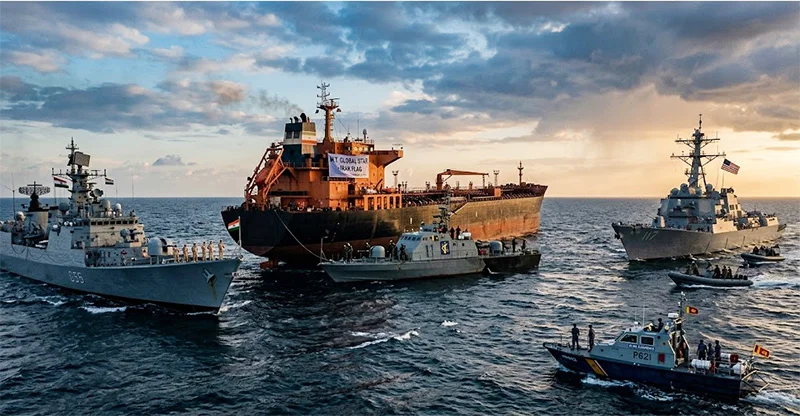
Iran has sought the Indian intervention, at the highest level, to provide lifesaving support to the crews of empty Iranian vessels stranded just outside Sri Lanka’s 12-nautical mile territorial waters off Galle.
Sources familiar with the issue said that Iran had brought the developing situation to the attention of New Delhi as the crews of almost 20 vessels, included Indian nationals. Sources stressed that the group of vessels that unloaded crude oil a couple of months back were now stranded within Sri Lanka’s Exclusive Economic Zone (EEZ).
The US Navy torpedoed an unarmed Iran frigate, returning from India, on 04 March, 2026, about 19 nautical miles off the Galle coast. The unprovoked attack killed nearly 100 Iranians.
The Iranian Embassy in Colombo has inquired from the Indian High Commission of their response to the situation, sources said. The US has issued a global warning against providing food, water, medicine and other services to the Iranian vessels. The outcome of Iran-India talks on the issue at hand was not known, though sources asserted India may not throw its weight behind Iranian efforts to address the issue.
Responding to The Island queries, sources said both Sri Lanka and India were in a dilemma due to the US warning. India couldn’t ignore the plight of the Indian crew members and the Iranian vessels in its backyard.
The Sri Lankan government remains tight-lipped about the vessels stranded in its EEZ. Our efforts to elicit a response from relevant authorities were in vain. In addition to Indians, there are Bangladeshis among the crew members. Iran has explicitly stated the responsibilities of the countries concerned to provide assistance in terms of international law.
The Iranian position was articulated by its Ambassador to Sri Lanka, Dr.Alireza Delkhosh, recently. In a special statement, Ambassador Delkhosh emphasised that in terms of the Convention on the Law of the Sea (Article 98) as well as SOLAS and SAR
Conventions, Sri Lanka couldn’t refrain from providing the needs of the Iranian vessels stranded in its EEZ.
SLMC leader Rauff Hakeem lambasted the NPP government in Parliament for failing to provide assistance to the Iranian ships. The former Minister alleged that the government was simply carrying out dictates of the US. He strongly criticised the way Foreign Minister Vijitha Herath was handling the issue.
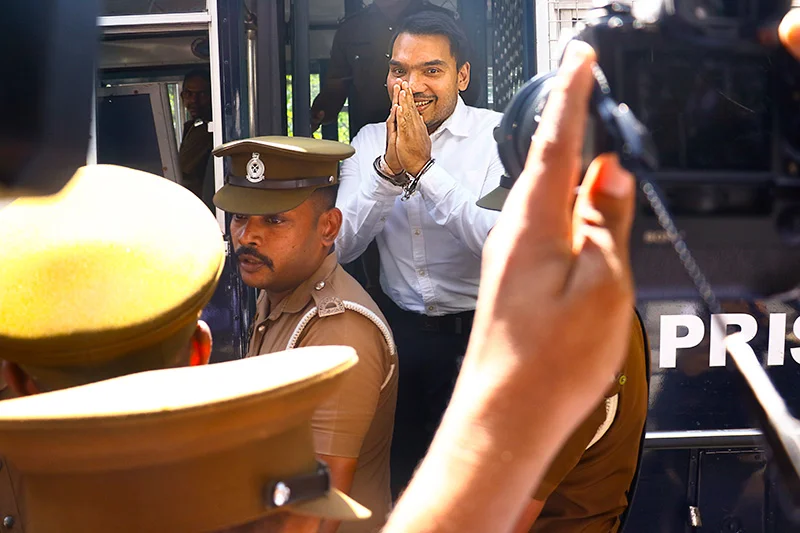
MP Namal Rajapaksa, who is in remand custody over the controversial Airbus deal, was further remanded until October 27 by the Colombo Magistrate’s Court yesterday (13).
Colombo Chief Magistrate Asanga S. Bodaragama made the order after considering submissions by officers of the Commission to Investigate Allegations of Bribery or Corruption and lawyers representing Rajapaksa.

Sri Lanka’s economy is expected to sustain its recovery over the next two years, although growth is projected to moderate amid mounting global uncertainties, according to the International Monetary Fund’s (IMF) latest World Economic Outlook.
In its World Economic Outlook 2026: Resilience Under Strain, Urgent Choices, the IMF projects Sri Lanka’s economy to expand by 4% in 2026, slowing to 3.7% in 2027, following estimated growth of 5% in 2025.
Inflation, meanwhile, is forecast to rise to 5.3% in 2026 and 5.4% in 2027, reversing the average deflation rate of 0.5% recorded in 2025.
Unemployment is expected to remain steady at 3.9% throughout the forecast period.
The projections come amid growing pressure on the global economy from the ongoing conflict in the Middle East, elevated energy prices, geopolitical tensions and trade disruptions.
Sri Lanka’s external position is also expected to weaken, with the current account balance projected to shift from a surplus of 1.6% of gross domestic product (GDP) in 2025 to deficits of 0.5% in 2026 and 0.3% in 2027.
The IMF’s outlook points to continued economic expansion in Sri Lanka, but with slower growth, rising inflation and a narrowing external surplus giving way to current account deficits over the forecast period.

Heavy showers above 100 mm are likely at some places in the Western, Sabaragamuwa, Southern, Central, and North-western provinces and in Anuradhapura district.

Sri Lanka, India caught in US-Iran ship crisis

Namal further remanded

IMF projects Lankan economic growth to moderate amidst mounting global uncertainties

Major Gen Pushpakumara assumes command of 56 Infantry Division

Dickwella axed, Bandara earns maiden Test call up

‘Dates have the highest sugar content to fight Coronavirus’

Sunday Island 27 December – Headlines

#SundayIsland 17th December – Headlines

Sunday Island – 28th March

Sunday Island Headlines – 21 March

Sunday Island – 21st February – Headlines
-

 Features6 days ago
The Sri Lankan who made Scottish history
-

 Sports6 days ago
Nissanka absence opens door for Sri Lanka’s young guns
-

 News5 days ago
NDB fraud Rs 60mn more than reported
-

 News5 days ago
Removing monk’s robes matter for Sangha to decide: Mahanayake Theras
-
 News6 days ago
Shiranthi R remanded until 13 Oct.
-

 Features6 days ago
Future of Sri Lanka’s state university system: Should it be shut down and reopened?
-

 News3 days ago
Sri Lanka escalates anti-graft drive with Shiranthi’s jailing
-
 Latest News4 days ago
Farhan, Sadaqat help Pakistan ace 183 chase to go 1-0 up