
Features
Navy’s peacetime war against insidious killer

By Admiral Ravindra C Wijegunaratne
(Retired from Sri Lanka Navy)
Former Chief of Defence Staff
If someone asked me what the senior appointment I really loved most was, my answer would be Chief of Staff of the Sri Lanka Navy (Second-in-Command of the Navy) – CoS. The CoS has all the perks—an official bungalow in Colombo 7, vehicles and staff—that the Commander is entitled to, but does not have the same responsibilities as the Commander. He has all the freedom to travel the length and breadth of the country on inspections of major bases, ships and craft. He does not have to attend all important meetings with VVIPs. Actually, the CoS runs the Navy at the ground level. So, you can work according to your own schedule, of course, with the Commander’s approval.
 I served under Admiral Jayantha Perera as his CoS for more than one year. He was happy about my frequent travel to the North and the East and looking into issues at the ground level and in situation.
As the CoS, I attended the funerals of close relatives (child, wife, father or mother) of our officers and sailors. I observed at funerals in North Central Province, where large number of naval personnel come from, parents of most of our young sailors from that part of the country died of kidney failures. A large number of them were middle-aged or in their early 50s. The disease is known as the Chronic Kidney Disease (CKD). It was sad to see the farmers who feed the country contract CKD at a relatively young age, suffer for years and die. The reason is contaminated water they use for drinking and cooking. Scientists and medical experts have cited various reasons—excessive use of fertilizer/pesticides, the contamination of groundwater and tank water—but the real cause is still not known.
The only way to prevent the disease is to make clean water available for drinking and cooking for the people in areas with a high CKD burden. Upon inquiry from Senior Health Ministry officials in 2015, we came to know that there were 30,500 CKD patients in the North Central province alone and the number was on the rise. All the patients had to undergo dialysis regularly.
As the CoS, I discussed the issue with Navy Commander Admiral Perera, and on his instructions, tasked the outstanding Marine Engineering Officer, then Commander MCP Dissanayake (Dissa) with manufacturing a low-cost water purification plant. Dissa was well known for his research and development projects he headed during the war; they were very effective and helped save many lives. He was the Command Engineering Officer in North Central Naval Command, based in Poonawa, Medawachchiya at that time. He proposed the manufacture of an RO plant (Reverse Osmosis water purification plant). The Navy has been using imported RO plants in its large ships for decades and our engineers are adept at repairing them.
 The cost of an imported RO plant with a 10-ton (10,000 litres) output a day is approximately Rs. 3.8 million. The installation of an imported plant costs approximately Rs. 5 million. Dissa’s plant cost only Rs 950,000 and the total cost including installation was Rs. 1.4 million.
The problem was funding. Every officer and every sailor contributes Rs. 30 from his/her pay every month to the ‘Social Responsibility Fund’ of the SLN. With approximately 55,000 personnel, the collection is about Rs 1,650,000 a month. We could produce one RO plant per month! Work started immediately. On 11th July 2015, Admiral Perera retired and I was appointed as 20th Commander of the Navy by then President Maithripala Sirisena.
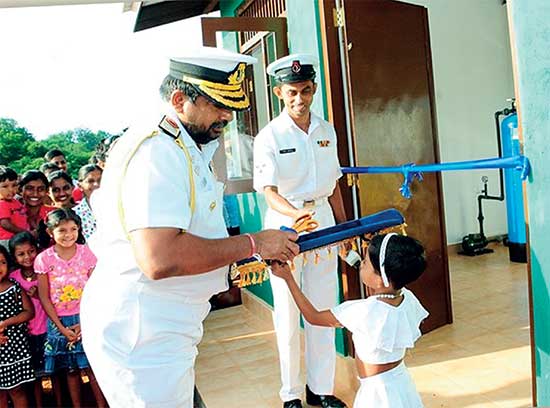
One of my tasks during my visit to North Central Naval Command was to declare open the Navy’s first RO plant on 22nd December 2015 at Kadawath Rabewa, the village of Leading Marine Engineering Mechanic Premaratne. This small village alone had 250 CKD patients.
From that day, I made use of all the fora I attended, both here and abroad, to raise funds for this worthy cause. Funds poured in, from foreigners, Sri Lankans, here and overseas and the business community and we could manufacture at least two plants a month.
Then, President Sirisena ordered the Presidential Task Force on CKD to provide sufficient funds for the Navy’s project. We started a production line in our R and D Project Factory in Welisara under the able guidance of Dissa.
In 2016, we manufactured 344 plants and installed them in various places, especially in schools, temples and churches. 344 plants were manned by 344 trained sailors. Every plant is capable of producing 10,000 litres (10 tons) of clean drinking water daily, and the quality of this water is better than bottled water you drink. That came to 3.44 million litres of clean drinking water per day to public free of charge. Three mobile service teams with vehicles were formed.
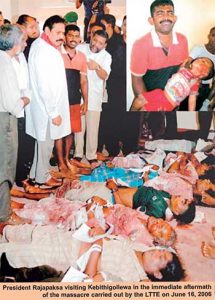
 I opened the RO plant at the Kebithigollewa Madya Maha Vidyalaya on 16 June 2016, exactly 10 years after LTTE claymore mine attack that killed 60 civilians, who travelled in a bus in Kebithigollewa. Addressing the children, who gathered in the hall, where the victims’ bodies had been kept, I said, “Our armed forces will ensure your safety. What happened 10 years back will not occur in the future. You’ll have a great responsibility to study hard now without any fear. We will fight this deadly disease of CKD with the help of our expertise. Dear children, please bring empty bottles when you come to school. Drink and carry home safe drinking water from the RO plant we have installed. Give this water to your siblings, parents, relatives and friends”. I saw tears of happiness, especially in the eyes of GCE Advanced Level students.
The schoolchildren usually carry drinking water from home to school, but the children in the North Central Province carry safe drinking water home from school! Bravo to Navy’s research engineers. Bravo Zulu, Dissa.
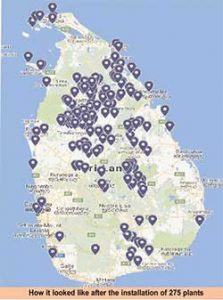
I am happy that the safe drinking water project I initiated has continued under successive Navy Commanders who have evinced a keen interest in it. We have installed more than 760 RO plants in the North and North Central Provinces. I thank the Navy and all those who have contributed to this worthy cause. The project is on, and many more people will benefit from it.
An expert in CKD/CKDu treatment process, Dr Asanga Waruna Ranasinghe, in his research article, The Incidence, prevalence and trends of Chronic Kidney Disease (CKD) and Chronic Kidney Disease of uncertain aetiology (CKDu) in North Central Province of Sri Lanka : an analysis of 30,566 patients’ on page six, refers to a decrease in the number of CKD patients. He says it is probably due to the availability of safe drinking water.
Do not forget the Navy is a silent force. No one notice what they do. Today, more than 760 plants produce 7.6 million litres of safe drinking water free to the public. The Navy went a few steps further, manufacturing two medical RO plants required for dialysis machines in Colombo and Kandy General Hospitals.
The Navy also manufactured mobile RO plant installed in a truck fur use in disaster situations.
As a result, the spreading of CKD has been controlled and most of North Central Province children want to join the Navy Engineering branch.
Some history teachers in the North Central Province have compared the Navy to King Mahasen’s Army. King Mahasen, who ruled Sri Lanka from 277 to 304 AD, constructed 16 large tanks or wewas. He was deified following the construction of the Minneriya tank and for giving water to needy people.
If our Navy is compared to King Mahasen’s Army for providing more than 7.6 million litres of clean drinking water to people daily, I compare our Engineering Officer, Captain (E) MCP Dissanayake as Commander Meghavannabaya, King’s main advisor and Chief Engineer.






 The current outbreak of anti-immigrant protests in Durban, South Africa is bound to have taken many a subscriber to value-based politics or political idealism quite by surprise. After all, this is evidence that despite the historic accomplishments of nation-builders of the stature of the late President Nelson Mandela it cannot be taken for granted that identity politics, including racism in its worst forms, is no more in South Africa.
At the time of this writing details are scarce on the substantive root causes of the protests but it could very well be that economic grievances, particularly on the part of the majority community in South Africa, are contributing considerably to the disaffection. Shrinking employment and material prospects are likely to figure majorly among the factors igniting the unrest.
Fortunately, the local authorities in Durban are losing no time in calling for peaceful co-existence among the relevant communities and are pointing to the vital importance of stepping-up national integration processes. Apparently, immigrants in sizable numbers from neighbouring countries are present in Durban. However, international TV footage of the protests quoted some local authorities as saying that the majority of the immigrants in some centres that housed them were not illegal migrants and had the documents that entitle them to be in Durban.
In the Durban protests the world has fresh proof of the socially divisive consequences of the gathering globe-wide economic disaffection, touched off particularly by the continuing crisis in West Asia. Going ahead, the world would need to brace for increasing identity-based unrest of the kind it is just witnessing in South Africa.
Considering that the material lot of ordinary people everywhere could only aggravate progressively, with the US and Iran showing no signs of negotiating an end to their confrontation any time soon, it will be left to the more democratic and progressive sections of the world community to initiate positive measures collectively to bring a measure of relief to the discontented.
The swiftness with which such relief will be provided would depend crucially on the importance those sections taking up these undertakings attach to value-based politics as opposed to Realpolitik of power politics.
Going by these yardsticks, Italy could be considered to be moving in the right direction. Recently Italy came to the fore in initiating the collective named, ‘Rome Coalition for Food Security and Access to Fertilizer’, which has as one of its aims the swift provision of fertilizer to economically weak African countries.
In a recent statement Italian Minister of Foreign Affairs and International Cooperation, Antonio Tajani, said that a principal aim of the project was to ensure that the farmers of Africa gained easy access to fertilizer, considering that food security is a growing concern among some of Africa’s economically vulnerable countries.
The statement went on to mention that some 30 countries hailing from the Mediterranean region, the Middle East, the Balkans as well as the FAO had been invited to join the coalition. The venture is far-seeing in that food security is main among the reasons for social discontent which in turn could degenerate into endemic political turmoil and bloodshed. Separatist violence and geographical fragmentation of countries wouldn’t be too far behind these developments, as Africa itself has often proved.
It is hoped that more G7 countries would take the cue from Italy and do what they could to ease the hardships of economically distressed countries, particularly of the global South. In these efforts they would need to break rank with the US, which is today brutally indifferent to the consequences of its policy of making ‘America First’, come what may.
Going by current developments, the Trump administration seems to be blithely oblivious to the wider, deleterious effects of its policy course in West Asia. Besides rendering Iran militarily and otherwise impotent nothing else seems to matter to Washington, as regards West Asia. This is policy short-sightedness of an extreme kind. After all, right now West Asia could be said to be sitting on the proverbial powder keg.
On the other hand, Iran is not giving the world the impression that it is doing anything constructive to get out of the policy straitjacket that it wove for itself decades ago. Rather than enter into a policy of ‘live and let live’ in relation to Israel in particular and initiate a process of reconciliation with the latter, it has chosen to operate within policy parameters that continue to damn Israel. This has put Israel always on the ‘defensive’ so to speak and prevented the opening up of space for meaningful dialogue.
That said, Israel is obliged to explore the possibilities of entering into a negotiatory process with the Arab-Islamic world that could lead to a de-escalation of tensions and bloodshed. It cannot continue to look at its neighbours through lenses that distort them as archetypal enemies who should be ‘wiped off completely from the face of the earth.’
In other words, the need is urgent for Realpolitik to give way to value-based politicks. Italy is beginning to prove that the latter approach could be pursued with some success. May be the EU and the UK could throw their weight behind these initiatives as well and establish that international politics could be refashioned on the basis of humane, civilized norms. The UN would need to be fully supportive of these moves and prove an organizational nucleus of the operations that follow.
In fact the time is ripe for people of conscience to collectively stand up on the side of peace and say ‘No’ to war and violence. Organizations such as the ICRC, the WHO and Medicines Sans Frontiers have already taken up this call. Referring to the widespread destruction of health facilities and their dehumanizing results these organizations have said, among other things, that ‘This is not a failure of the law. It is a failure of political will.’
True, ‘failure of political will’ among those powers that matter accounts for the runaway, uncontrollable nature of war and destruction in contemporary times, but more fundamentally it is a failure of the human conscience. It could very well be that the phenomenal levels to which violence and war have been unleashed today have had the effect of deadening consciences. This is a matter for urgent study and wide discussion.

 I would describe Indunil Kaushalya Dissanayaka as innovative and creative, and she operates under the name of Cuteefly.
Indunil always comes up with something novel to celebrate special occasions, and she does it with candles … and that’s her profession.
She was in the spotlight when she created a happening scene, with candles, for Christmas, Sinhala and Tamil New Year, and Valentine’s Day.
As lanterns light up Sri Lanka for Vesak, the Colombo-based candle maker is quietly turning wax and wick into little pieces of the festival.
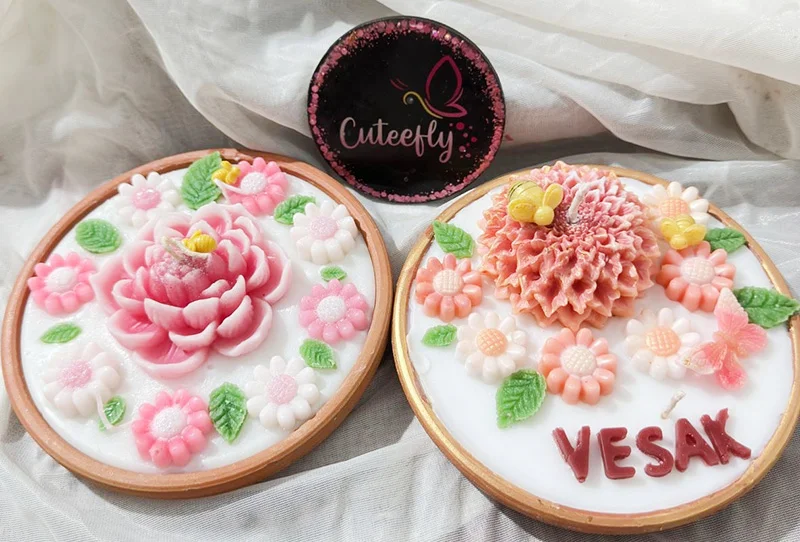
Candles reflecting Vesak themes
Her candles reflect Vesak themes – light, peace, remembrance, giving, etc., to enable you to fill your Vesak celebration with devotion and beauty.
Among her Vesak creations is a lotus-shaped soy candle, scented with sandalwood, lavender, etc., meant to burn during this Vesak Poya Day.

Indunil Kaushalya Dissanayaka: Customers
praise her for her creativity
These handcrafted Vesak candles are perfect for offering at the temple, she says.
What makes her creations so novel is that they come in different shapes, scents, themes, and all are handmade.
What’s more, her customers have heaped praise on her for her creativity.
According to Indunil, her creations are perfect as a thoughtful gift … to bring beauty, unity, and light into every moment.
Says Indunil: “Our beautifully handcrafted Unity candles are designed with premium detail and love, making them perfect for celebrations, gifts, and meaningful occasions.”
Cuteefly, says Indunil, is available online.
Readers could contact Indunil on 0778506066 for more details.
He Facebook Page is: Cuteefly.

Handmade with love

 Yes, dark spots do crop up on the skin, especially with sun exposure and, of course, as the skin ages.
However, these tips should be of immense benefit to those who are faced with dark spots.
* Lemon and Honey Glow Mask:
You will need 01 teaspoon lemon juice and 01 teaspoon honey.
Mix the lemon juice and honey well and then apply this mixture, only on the dark spots.
Leave for 10–15 minutes and then rinse with cool water.
Benefits:
Lemon helps brighten pigmentation.
Honey moisturises and heals skin.
Gives a natural glow.
* Aloe Vera Gel Treatment:
All you need is fresh aloe vera gel.
Apply the gel apply on dark spots, before going to bed.
Leave overnight and wash in the morning.
Benefits:
Reduces acne marks and pigmentation.
Soothes irritated skin.
Helps skin repair naturally.
* Turmeric and Yoghurt Paste:
You will need 01 teaspoon yoghurt and a pinch of turmeric
Mix the yoghurt and turmeric into a smooth paste and apply on affected areas.
Leave for 15 minutes and then wash gently with lukewarm water.
Benefits:
Turmeric brightens skin naturally.
Yoghurt removes dead skin cells.
Helps fade dark spots gradually.
Use these packs 02-03 times a week as results are generally seen over time.
You can also try this out: Mix a ripe papaya into a smooth paste and apply to the face, or directly on to the dark spots. Leave for 15-20 minutes and then wash with lukewarm water.

Let us all build a society valued with peace and harmony, guided by unity and solidarity beyond all differences – PM

Showers will occur at times in the Western, Sabaragamuwa and North-western provinces and in Galle, Matara, Kandy and Nuwara-Eliya districts

Rajitha calls for combined lists, denounces those unwilling to join as traitors

20 lawmakers, four officials visiting China

More Japanese funds for demining operations in the north

Clingendael Institute delegation visits Pathfinder Foundation

‘Dates have the highest sugar content to fight Coronavirus’

Sunday Island 27 December – Headlines

#SundayIsland 17th December – Headlines

Sunday Island – 28th March

Sunday Island Headlines – 21 March

Sunday Island – 21st February – Headlines
-

 Business6 days ago
Historic launch of CCWE Fashion Week & International Summit 2026
-

 News4 days ago
All-New GRAVITE launches at LKR 6.99 Mn
-
 Features4 days ago
The NPP’s pivot to the past
-
 News3 days ago
Police probe underway to ascertain links between criminals deported from UAE and local politicians
-
 News2 days ago
Easter Sunday carnage: Court told Maulana’s statement cannot be accepted without cross-examination
-

 Opinion6 days ago
The need to reform Buddhist ecclesiastical order
-
 Features4 days ago
End of Peacekeeping
-
 Opinion2 days ago
Undermining the democratic political framework