
News
National Research and Development Policy draft stakeholder awareness programme successfully concludes


The three-day stakeholder awareness programme on the Draft National Research and Development Policy, jointly organised by the Presidential Secretariat and the Ministry of Science and Technology, successfully concluded yesterday (03) at Temple Trees.
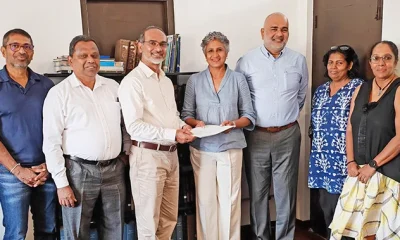
Dr. Nandika Sanath Kumanayake, Secretary to the President; G.P. Saputhanthri, Secretary to the Prime Minister; Dr. Harshana Suriyapperuma, Secretary to the Ministry of Finance; Y.L. Mohamed Nawawi, Secretary to the Ministry of Science and Technology; and Senior Advocate J.M. Wijebandara, Director General of Legal Affairs at the Presidential Secretariat, participated as invitees at this three-day programme.
This Draft National Research and Development Policy has been prepared under the guidance of Professor Gomika Udugamasooriya, Senior Presidential Advisor on Science and Technology, and Professor G.W.A. Rohan Fernando, Chairman of the National Science and Technology Commission, with the facilitation of the National Science and Technology Commission. It has received contributions from numerous local and international experts.
During this programme, Professor Gomika Udugamasooriya, Senior Presidential Advisor on Science and Technology, briefed the participants on the Draft National Research and Development Policy.
In line with the government’s policy of “A Thriving Nation – A Beautiful Life,” the objective of this programme is to secure stakeholder participation in formulating the necessary National Research and Development Policy framework to guide Sri Lanka towards a prosperous knowledge-based economy.
During the programme, ideas and suggestions from experts in the research and development field were gathered to ensure that the National Research and Development Policy, when practically implemented, aligns with national needs. Accordingly, this aims to formulate a futuristic policy to establish a centralised mechanism essential for successfully addressing current challenges in that field.
Delivering the keynote address, Professor Gomika Udugamasooriya pointed out that there is currently a visionary leadership that prioritises and values the research and development sector. He stated that economic progress, social well-being and environmental sustainability are the main objectives of formulating this national policy. He further added that according to United Nations reports, only about 60% of Sri Lanka’s human capital is utilised, and since the country has a highly intelligent population, this policy approach is crucial for properly leveraging their potential.
Professor Udugamasooriya stated that developed countries allocate between 3% and 5% of their GDP to the research and development sector, while countries like Sri Lanka have so far allocated a very small percentage to this sector. He expressed satisfaction that this situation is changing under the current government and further mentioned that investment in the research and development sector is essential for the advancement of innovation and for achieving high economic growth.
Professor G.W.A. Rohan Fernando, Chairman of the National Science and Technology Commission, in his inaugural address, stated that this Draft National Research and Development Policy proposes both a legal framework for research and an ethical framework of international standards. He further added that this is expected to strengthen Sri Lanka’s research and development sector, bringing it on par with those in countries such as India, China, Malaysia and Korea.
Accordingly, this Draft National Research and Development Policy has been prepared based on 10 objectives, including creating a conducive environment for research and innovation within the country, encouraging researchers and innovators, identifying national development priorities and establishing a broad platform for inventions and research focused on these, allocating adequate financial provisions for these research and development activities, and ensuring proper commercialisation.
This programme will be implemented with seven principles: promoting equity, effective governance, ensuring trustworthiness and transparency, embracing diversity, and inclusivity. Notably, gender considerations have also been taken into account during the drafting of this policy. The programme will be implemented as a joint initiative involving four sectors: the government, the private sector, the general public and international stakeholders.
Furthermore, the research and development sector has been categorised under 7 main themes: Agriculture and Food Security, Health, Science and Education, Technology Sector, Natural Resources, Economy and National Security and Arts and Human Development.
The concluding address of the programme was delivered by Y.L. Mohamed Nawawi, Secretary to the Ministry of Science and Technology, who stated that this programme should be implemented not individually but collectively, as a team, with collaboration and he invited all stakeholders to participate.
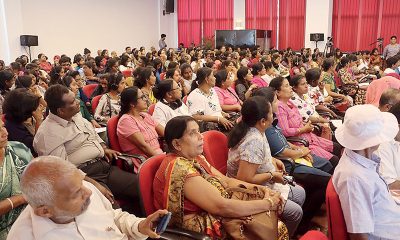
At the end of the awareness session, which was held from 2:00 PM to 4:00 PM on all three days, stakeholders were given the opportunity to present their ideas and suggestions. Professor Gomika Udugamasooriya and the panel of experts provided answers and clarifications for these.
Over 650 individuals participated in this three-day programme, including Ministry Secretaries, Heads of Departments, and other senior government officials; Vice-Chancellors, Deans, and Heads of Departments from government and private universities; representatives from public and private sector research institutions; and independent researchers.

Romania, a country that has maintained diplomatic relationship with Sri Lanka for several decades in various fields, has become an increasingly popular destination among Sri Lankan skilled and semi-skilled Labour categories, especially in the fields of construction, manufacturing, hospitality, and services sectors.
At present, the recruitment of Sri Lankan workers to Romania is carried out by licensed private employment agencies under the
supervision of the Sri Lanka Foreign Employment Bureau. However, since both parties have recognized the need of establishing a more organized and sustainable recruitment method due to increasing demand, the Cabinet of Ministers has approved the proposal presented by the Minister of Foreign Affairs, Foreign Employment, and Tourism to enter into a Memorandum of Understanding between the Government of the Democratic Socialist Republic of Sri Lanka and the Government of Romania regarding cooperation in the field of the labour sector with the following objectives.
• Establishment of proper mechanism for recruitment and management of workers.
• Promotion of ethical and transparent recruitment practices.
• Protection of rights and welfare of the migrant workers.
• Facilitation of regular discussions between the formal and relevant authorities ofboth countries.
• Improvement of technical cooperation, skills recognition, and capacity building in the labour sector.
The Cabinet of Ministers has approved the proposal presented by the President, in his capacity as the Minister of Finance,
Planning, and Economic Development to repeal Management Services Circular No. 01/2019 , dated 15-03-2019, issued regarding the implementation of development projects, and to issue a new management services circular including updated provisions instead.

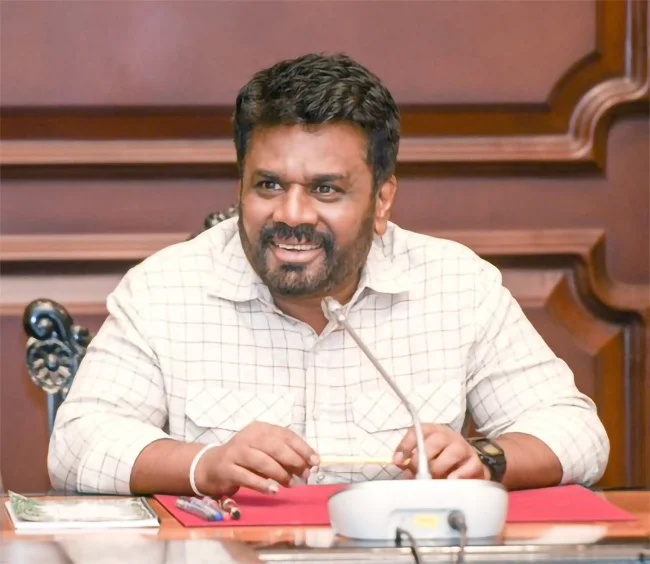
Chief Prelates of the Malwathu, Asgiriya, Amarapura and Ramanna Nikayas, in a joint letter addressed to President Anura Kumara Dissanayake, has expressed concern over the protracted delay in appointing a permanent Auditor General.
The Chief Prelates have said that the appointment of an outsider as the Head of the National Audit Office (NAO) responsible for ensuring transparency and accountability in public finances will be inappropriate.
The Chief Prelates have said that they are of the view that Dharmapala Gammanpila, a senior officer with extensive experience within the Auditor General’s Department, is the ideal candidate for the top post. They have also emphasised that his appointment will strengthen the government’s efforts to promote economic prosperity.
Chulantha Wickramaratne, who served as AG for a period of six years, retired in April 2025. Following his retirement, President Dissanayake nominated H.T.P. Chandana, an audit officer at the Ceylon Petroleum Corporation, as the AG. The CC rejected that nomination. Subsequently, President Dissanayake appointed the next senior-most official at the NAO Dharmapala Gammanpila as Acting Auditor General for a period of six months. Then, the President nominated Senior Deputy Auditor General L.S.I. Jayarathne to serve in an acting capacity, but her nomination, too, was also rejected. Many an eyebrow was raised when the President nominated O.R. Rajasinghe, the Internal Audit Director of the Sri Lanka Army for the top post. That nomination too was rejected. As a result, the vital position remains vacant since 07 December, 2025.

Vintage Markram, clinical Linde headline South Africa’s comfortable win

Cabinet nod for MOU between Sri Lanka and Romania on the cooperation in the Labour Field
New circular to replace Management Services Circular No. 01/2019

The RAPP sheet: Steve Smith, Daryl Mitchell, Umesh Yadav among over 1300 players

U19 World Cup: Pakistan overcome New Zealand by 8 wickets

U19 World Cup: Vihaan Malhotra ton headlines India’s massive win

‘Dates have the highest sugar content to fight Coronavirus’

Sunday Island 27 December – Headlines

#SundayIsland 17th December – Headlines

Sunday Island – 28th March

Sunday Island Headlines – 21 March

Sunday Island – 21st February – Headlines
-
 Business2 days ago
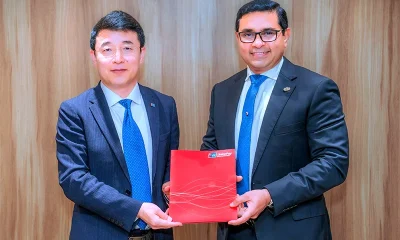
ComBank, UnionPay launch SplendorPlus Card for travelers to China
-
 Business3 days ago
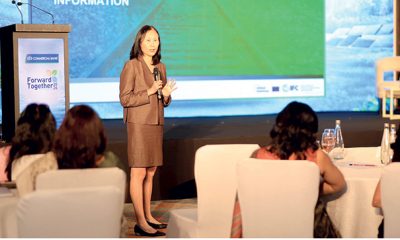
ComBank advances ForwardTogether agenda with event on sustainable business transformation
-

 Opinion6 days ago
Remembering Cedric, who helped neutralise LTTE terrorism
-
 Business6 days ago
CORALL Conservation Trust Fund – a historic first for SL
-
 Opinion3 days ago
Conference “Microfinance and Credit Regulatory Authority Bill: Neither Here, Nor There”
-

 Opinion5 days ago
A puppet show?
-
 Opinion2 days ago
Luck knocks at your door every day
-
 Features5 days ago
‘Building Blocks’ of early childhood education: Some reflections