
Features
Nadungamuwe Raja, a prisoner of culture, an ambassador of culture or rather, an ambassador of conservation?


By Manasee Weerathunga
It is no doubt that the passing away of the ceremonial tusker Nadungamuwe Raja was sorrowful news to the entire country, regardless of religions and ethnicities. It is highly unlikely that there could have been any Sri Lankan who did not love this gentle giant for his majesty and tranquility. However, the question at which everyone who loved Nadungamuwe Raja becomes divided, is on whether Nadungamuwe Raja lived a life of grandeur or a life of suffering?
Nadungamuwe Raja is best known as the ceremonial tusker, bearing the main casket of the Tooth Relic of Lord Buddha in the annual procession of Esala, in Kandy, Sri Lanka. As in ancient traditions, it is only a male tusker of remarkable physique that is eligible for bearing the casket of the Tooth Relic. It is this majesty of this beast which prompted many Sri Lankans, especially the devout Buddhists, to place Nadungamuwe Raja, up on a pedestal of sanctitude. In the eyes of devout Buddhists, Nadungamuwe Raja was not only privileged enough to bear the casket of the Tooth Relic of Lord Buddha (something which is not approachable to a layman) but also was able to gather a plethora of merit in this lifetime, for the rest of Samsara, by being in service to the Lord Buddha. However, in the eyes of animal lovers and workers for animal rights, Nadungamuwe Raja was a prisoner of culture and blind religious devoutation, having had lived a life, chained in a domestic setting with no access to the natural habitat of an elephant or its co-inhabitants.
The opulent pair of long, intersecting pair of tusks can be named as the crowning glory of Nadungamuwe Raja, not to mention that he was the tallest domestic elephant known in whole Asia. In addition to these unmistaken resplendent features of Nadungamuwe Raja, the placidity of this beast’s nature, points out some facts noteworthy about elephants. Asian elephants, the species to which Nadungamuwe Raja belongs, differ from their African elephant cousins, with respect to several features. Firstly, Asian elephants are of significantly smaller build in comparison to African elephants, which makes the height of Nadungamuwe Raja, remarkable. Secondly, unlike the African elephant, which possesses tusks in both male and female alike, tusks are a rarity found in some male Asian elephants only, ticking off another box for Nadungamuwe Raja’s exceptionality. Thirdly, domesticated African elephants are unheard of because they do not share the serene demeanor of their Asian counterparts, while Nadungamuwe Raja is only one of the many domestic Asian elephants found in several countries of Asia.
However, domestication of animals is not something which is discrete for a region of the world. The history of animal domestication spans as far as the beginning of human civilization. The pre-historic man of Stone Age was in the habit of chasing and hunting the animals they wanted to fulfill their food requirements, and then moving to a new location once he had exploited all the animals in his surrounding location. However, as the humans moved on to the farming age by growing their food in their locality and forming permanent settlements, they realized that rather than going in search of animals to hunt, holding the animals in captivity, raring them and harvesting the milk, meat and hides that they needed was an easier option. That marked the beginning of animal domestication, resulting in some animal species, such as dogs, cats and ornamental fish breeds, to become fully domesticated species by the present times. A major step in this process involved identifying animals who were passive enough to be approached, caught, and held captive and tamed. This has resulted in the evolution of most domestic animal species to have traits that would make them better suited to a domestic setting while wiping out the traits which would help them survive in the wild. For example, evolution has taken away from the dogs, the traits of aggression shown by their distant relatives, the wolves, as well as any skills of surviving in the wild by hunting and avoiding predation. Therefore, if an enthusiast of animal rights is to argue that holding a gold fish in a fish tank is a violation of its rights and that it would be better off swimming freely in a stream, it is going to be one of the most frivolous points to make because a gold fish would hardly survive in a wild stream for more than 24 hours without getting predated. That is because the ancestors of these domestic animals, running back to hundreds of generations, have not even seen a wild environment so that their genes no longer contain the traits suited for the wild.
However, we cannot say the same about Asian elephants so confidently, because elephants still do exist in the wild and therefore is not a completely domesticated animal species. While the harsher environment that African elephants inhabit has made them more aggressive and violent by their genetic makeup, Asian elephants are more approachable which has enabled many countries to domesticate Asian elephants for centuries. Therefore, a fair number of domestic Asian elephants, found in many countries, are elephants who had been born and bred in domestic settings for generations. Hence, although many activists for animals rights have been voicing out in social media platforms that Nadungamuwe Raja lived a life of suffering by being chained in a domestic setting, having been an elephant born in a domestic elephant stable in India, it is uncertain what percentage of Nadungamuwe’s Raja’s genes still retained the traits that would help him survive in the wild. Usually, several generations of inbreeding of domesticated animals result in establishment of gene combinations best suited for domestic settings and purging those suited for wild environments. Still, it is uncertain how rapidly it happens in each species. With evolutionary biologists and behavioural scientists worldwide conducting a plethora of research on the question of whether nature or nurture determines the behavioural traits of an animal, the question of whether Nadungamuwe Raja would have been happier roaming freely in the wild remains an open question, with not enough data on how much of wild traits that he retained in his genes.
Nevertheless, if we were to assume that Nadungamuwe Raja was still biologically fully capable of living in a wild environment, we should not forget that he would be living in an environment where the humans have become a major predator for elephants. Evolution being a very slow process that takes millions of years, usually the genetic makeup that currently exists in many organisms is the genetic combination that evolved to suit the environmental conditions that existed thousands of years ago. The genome of many organisms is still undergoing the process of adapting to the current environment, which has changed rapidly from what it was a few hundreds of years back. Therefore, organisms do not evolve adaptations to match the changing environmental conditions as rapidly as the environment changes. The same is true for elephants because their genetic makeup has not evolved to keep up with the rapidly changing environment and hence, lack the adaptations to survive the threats posed by their greatest predator of the current world, the human. Therefore, it is fairly agreeable if someone says that Nadungamuwe Raja could have been poached long ago for his magnificent pair of tusks or could have been killed by ‘hakka patas’ traps if it had not lived in the seclusion of a domestic environment. However, it should be noted that Nadungamuwe Raja lived the average lifespan of an Asian elephant. The most common natural cause of death for wild elephants is a mechanical cause resulting from the loss of teeth. Elephants usually have four sets of teeth during their course of life and once the last set of teeth is lost, elephants die a slow and painful death due to the inability to feed and nourish themselves. It is noteworthy that the owners of Nadungamuwe Raja took the utmost effort to preserve the last set of teeth of the elephant so that his lifespan could be prolonged, by meticulously managing the elephant’s diet and behaviour. However, whether living in a natural environment and choosing his own diet from natural sources could have prolonged the lifespan of the elephant is contentious.
The increasing rarity of tusks as sumptuous as Nadungamuwe Raja’s in Asian elephants itself signals an evolutionary trend of elephants towards adaptation to the hostility created in wild environments by humans. It is the general trend of evolution to get rid of any traits that would pose a threat to the survival and fitness of any organism. By evolution, tusks serve the purpose of attracting female mates to male elephants, while helping males with combat with other males for territory and mates as well as obtaining food. With humans as a predator of elephants in wild environments, tusks have unfortunately become the worst nightmare for the survival of elephants in the wild. It is highly probable that the tusks of Nadungamuwe Raja could have brought the same unfortunate fate on him if he had lived in the wild. Even with living a domesticated life, the tusks of Nadungamuwe Raja had been too heavy for his head to bear towards the latter part of his life, although the situation had been ameliorated by his owners by arranging a sleeping place for the elephant where he could rest his head above his body. However, it is doubtful whether the tusks of Nadungamuwe Raja would have grown to that length and weight if it had lived in the wild. If a wild elephant had tusks as long and big as that, it goes without saying that it would pose a hinderance and a danger to the movement of the animal in dense vegetation, which are the common habitats of Asian elephants. Therefore, wild elephants have the habit of wearing off their tusks by rubbing them against tree branches, while the tusks of wild elephants are subjected to breakage during combats between males. For example, Gemunu, who is a well-known tusker inhabiting the Yala National Park of Sri Lanka, had only one tusk until recently, with the other being broken off during a dual. The remaining tusk was also broken off a couple of years earlier, during a dual with Nandimitra, another male elephant of the Yala National Park. Usually, once a male elephant loses his tusks in a combat, it either dies of the wounds of the combat or lives a quiet and short life restricted of mates or food of the territory, without the advantage of tusks. Therefore, another open question remains of whether Nadungamuwe Raja would have had such a luxurious pair of tusks until the end of his lifetime, had he lived in a wild environment.
Considering all these whether Nadungamuwe Raja was a prisoner of culture or not remains a question to be answered based on each person’s own morals and judgment. But, while dividing into sides and splitting hairs to prove whether Nadungamuwe Raja lived a life of a prisoner or that of royalty, there is a fact that many forget. While limiting the discussions about Nadungamuwe Raja to decorating him as an icon of Sri Lankan culture or fighting for his rights for a free life, we forget that not only Nadungamuwe Raja but all other domestic elephants of Sri Lanka which are treated with high esteem can serve a bigger role as ambassadors of environmental conservation. Nadungamuwe Raja and all other celebrated domestic elephants of Sri Lanka such as Kataragama Wasana, Indi Raja, Miyan Raja etc. fit perfectly well to the category of Flagship Species. The concept of Flagship Species introduced by the International Union for Conservation of Nature (IUCN) includes organisms having an aesthetic importance while representing a certain habitat, issue, or environmental cause. The objective of this concept is by conserving and drawing public attention to these animals which are of aesthetic attraction, the entire habitat they represent will be conserved and the environmental issue that they are involved in would be resolved. The giant panda endemic to China is an ideal example of a flagship species being a successful ambassador in resolving a conservation issue. With the giant panda being categorized as an endangered species by the IUCN in the 1980s, a massive campaign was launched to save China’s beloved national icon. This involved not only in-situ conservation efforts such as setting up nature reserve areas habitable for pandas, but also numerous ex-situ conservation techniques such as breeding pandas in captivity and propagating public interest and awareness on these cute creatures with the use of domesticated pandas held in captivity. These pandas did their job as environmental ambassadors so perfectly that by 2016, IUCN declared that giant pandas are no longer endangered but just vulnerable.
Right now, the number of Sri Lankans who worship Nadungamuwe Raja, holding him at a highly revered position is countless. Similarly, the number of Sri Lankans who fight for animal rights pointing out that Nadungamuwe Raja spent a torturous, miserable life is also fairly high. Amidst all that clamour, the number of elephants killed each year by poachers or by ‘hakka patas’ traps, the number of elephants shot by villagers for encroaching into cultivated lands, the number elephants hit by trains, plus the number of human lives lost each year by wild elephant attacks remain escalating. This disturbing trend signals to us that right now the most serious issue regarding elephants in Sri Lanka is not the debate of whether domestic elephants are cultural icons or prisoners of culture, but the human-elephant conflict which has gone unresolved, yet escalating to an extremely unfortunate level, for the past years. Wild elephants cannot be blamed for the circumstances considering the plight they are in with the construction of motorways fragmenting natural habitats of elephants and blocking their passes, human encroachment into natural habitats limiting the availability of food, water and space for the elephants plus poaching for ivory. On the other hand, the retaliation by humans to wild elephants is also fair considering the threat to property and lives it poses and the economic and emotional turmoil it costs when living in an area of wild elephant threat. That is why Nadungamuwe Raja and his fellow domestic elephants, should be viewed as ambassadors of environmental conservation rather than either icons or prisoners of culture. While thousands of people have been coming to pay their last respects to Nadungamuwe Raja with heavy hearts, while the authorities are taking steps to preserve Nadungamuwe Raja as a national treasure, while Nadungamuwe Raja’s predecessor tusker Raja has a museum dedicated all to himself and preserved and displayed as a national treasure, and while animal rights activists are launching heated social media campaigns to free the domestic elephants from their chains, there are numerous elephants in the island who portray major conservation issues. The wild elephant Natta Kota who roams the premises of tourist hotels bordering the Yala national park, has become a scavenger on garbage of the hotels which lure him to be a tourist attraction. The elephants inhabiting the forests bordering motorways of areas such as Habarana and Buttala had fallen to the plight of mafia gangsters who don’t let vehicles pass unless they are given the ransom of food. The elephants scavenging on garbage dumps of Tissamaharama have fallen to the plight of homeless beggars, picking through trash to fill their stomachs.
It goes without saying that Nadungamuwe Raja is a national treasure because a tusker of that stature and physique is indeed an asset to any country’s natural resource chest. But the reverence shown towards this animal needs to be extended to countless other elephants in Sri Lanka who are at the risk of getting poached for ivory, or killed by traps. As good as it is that Nadungamuwe Raja’s body be preserved as a national treasure as that of Raja, by housing it in a museum as a mere icon of cultural importance, the natural homes of the wild elephants of Sri Lanka needs to be preserved as well, as elephants are assets of Sri Lanka. The activists and enthusiasts of animal rights who voice out protests on the chained life that Nadungamuwe Raja led, should extend their fighting towards winning freedom for the numerous unnamed wild elephants who cannot roam wherever they wish in their native habitats and eat as much natural food as they like. Therefore, it is high time that the authorities start hailing Nandungamuwe Raja as an icon of conservational importance, rather than as a mere national treasure of cultural importance while the worshippers of Nandungamuwe Raja and the fighters for Nandungamuwe Raja’s animal rights start portraying him as an ambassador of environmental conservation rather than an ambassador of culture or a prisoner of culture.
(The writer is a PhD Student in Evolutionary Biology, University of Florida, Gainesville, US. She thanks Gihan Athapaththu, former Naturalist at Jetwing Yala, currently Master’s student at Jeju National University, South Korea, for his contribution to this article.)








 The current outbreak of anti-immigrant protests in Durban, South Africa is bound to have taken many a subscriber to value-based politics or political idealism quite by surprise. After all, this is evidence that despite the historic accomplishments of nation-builders of the stature of the late President Nelson Mandela it cannot be taken for granted that identity politics, including racism in its worst forms, is no more in South Africa.
At the time of this writing details are scarce on the substantive root causes of the protests but it could very well be that economic grievances, particularly on the part of the majority community in South Africa, are contributing considerably to the disaffection. Shrinking employment and material prospects are likely to figure majorly among the factors igniting the unrest.
Fortunately, the local authorities in Durban are losing no time in calling for peaceful co-existence among the relevant communities and are pointing to the vital importance of stepping-up national integration processes. Apparently, immigrants in sizable numbers from neighbouring countries are present in Durban. However, international TV footage of the protests quoted some local authorities as saying that the majority of the immigrants in some centres that housed them were not illegal migrants and had the documents that entitle them to be in Durban.
In the Durban protests the world has fresh proof of the socially divisive consequences of the gathering globe-wide economic disaffection, touched off particularly by the continuing crisis in West Asia. Going ahead, the world would need to brace for increasing identity-based unrest of the kind it is just witnessing in South Africa.
Considering that the material lot of ordinary people everywhere could only aggravate progressively, with the US and Iran showing no signs of negotiating an end to their confrontation any time soon, it will be left to the more democratic and progressive sections of the world community to initiate positive measures collectively to bring a measure of relief to the discontented.
The swiftness with which such relief will be provided would depend crucially on the importance those sections taking up these undertakings attach to value-based politics as opposed to Realpolitik of power politics.
Going by these yardsticks, Italy could be considered to be moving in the right direction. Recently Italy came to the fore in initiating the collective named, ‘Rome Coalition for Food Security and Access to Fertilizer’, which has as one of its aims the swift provision of fertilizer to economically weak African countries.
In a recent statement Italian Minister of Foreign Affairs and International Cooperation, Antonio Tajani, said that a principal aim of the project was to ensure that the farmers of Africa gained easy access to fertilizer, considering that food security is a growing concern among some of Africa’s economically vulnerable countries.
The statement went on to mention that some 30 countries hailing from the Mediterranean region, the Middle East, the Balkans as well as the FAO had been invited to join the coalition. The venture is far-seeing in that food security is main among the reasons for social discontent which in turn could degenerate into endemic political turmoil and bloodshed. Separatist violence and geographical fragmentation of countries wouldn’t be too far behind these developments, as Africa itself has often proved.
It is hoped that more G7 countries would take the cue from Italy and do what they could to ease the hardships of economically distressed countries, particularly of the global South. In these efforts they would need to break rank with the US, which is today brutally indifferent to the consequences of its policy of making ‘America First’, come what may.
Going by current developments, the Trump administration seems to be blithely oblivious to the wider, deleterious effects of its policy course in West Asia. Besides rendering Iran militarily and otherwise impotent nothing else seems to matter to Washington, as regards West Asia. This is policy short-sightedness of an extreme kind. After all, right now West Asia could be said to be sitting on the proverbial powder keg.
On the other hand, Iran is not giving the world the impression that it is doing anything constructive to get out of the policy straitjacket that it wove for itself decades ago. Rather than enter into a policy of ‘live and let live’ in relation to Israel in particular and initiate a process of reconciliation with the latter, it has chosen to operate within policy parameters that continue to damn Israel. This has put Israel always on the ‘defensive’ so to speak and prevented the opening up of space for meaningful dialogue.
That said, Israel is obliged to explore the possibilities of entering into a negotiatory process with the Arab-Islamic world that could lead to a de-escalation of tensions and bloodshed. It cannot continue to look at its neighbours through lenses that distort them as archetypal enemies who should be ‘wiped off completely from the face of the earth.’
In other words, the need is urgent for Realpolitik to give way to value-based politicks. Italy is beginning to prove that the latter approach could be pursued with some success. May be the EU and the UK could throw their weight behind these initiatives as well and establish that international politics could be refashioned on the basis of humane, civilized norms. The UN would need to be fully supportive of these moves and prove an organizational nucleus of the operations that follow.
In fact the time is ripe for people of conscience to collectively stand up on the side of peace and say ‘No’ to war and violence. Organizations such as the ICRC, the WHO and Medicines Sans Frontiers have already taken up this call. Referring to the widespread destruction of health facilities and their dehumanizing results these organizations have said, among other things, that ‘This is not a failure of the law. It is a failure of political will.’
True, ‘failure of political will’ among those powers that matter accounts for the runaway, uncontrollable nature of war and destruction in contemporary times, but more fundamentally it is a failure of the human conscience. It could very well be that the phenomenal levels to which violence and war have been unleashed today have had the effect of deadening consciences. This is a matter for urgent study and wide discussion.

 I would describe Indunil Kaushalya Dissanayaka as innovative and creative, and she operates under the name of Cuteefly.
Indunil always comes up with something novel to celebrate special occasions, and she does it with candles … and that’s her profession.
She was in the spotlight when she created a happening scene, with candles, for Christmas, Sinhala and Tamil New Year, and Valentine’s Day.
As lanterns light up Sri Lanka for Vesak, the Colombo-based candle maker is quietly turning wax and wick into little pieces of the festival.
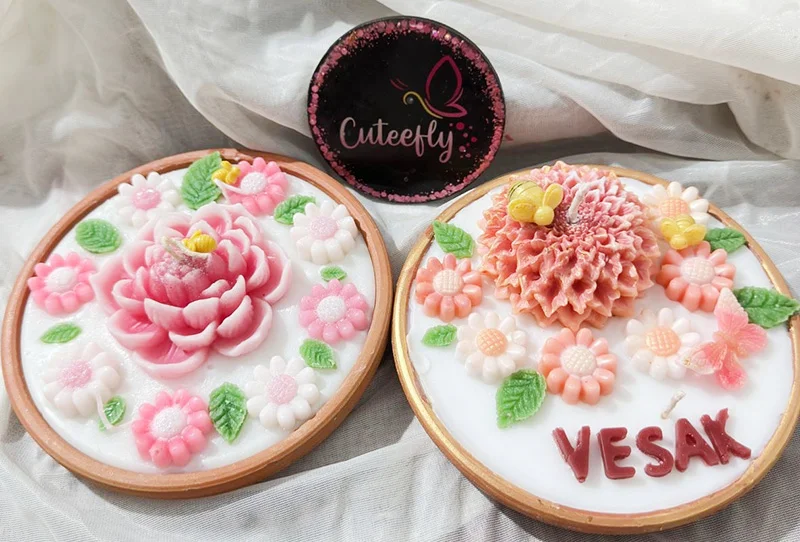
Candles reflecting Vesak themes
Her candles reflect Vesak themes – light, peace, remembrance, giving, etc., to enable you to fill your Vesak celebration with devotion and beauty.
Among her Vesak creations is a lotus-shaped soy candle, scented with sandalwood, lavender, etc., meant to burn during this Vesak Poya Day.

Indunil Kaushalya Dissanayaka: Customers
praise her for her creativity
These handcrafted Vesak candles are perfect for offering at the temple, she says.
What makes her creations so novel is that they come in different shapes, scents, themes, and all are handmade.
What’s more, her customers have heaped praise on her for her creativity.
According to Indunil, her creations are perfect as a thoughtful gift … to bring beauty, unity, and light into every moment.
Says Indunil: “Our beautifully handcrafted Unity candles are designed with premium detail and love, making them perfect for celebrations, gifts, and meaningful occasions.”
Cuteefly, says Indunil, is available online.
Readers could contact Indunil on 0778506066 for more details.
He Facebook Page is: Cuteefly.

Handmade with love

 Yes, dark spots do crop up on the skin, especially with sun exposure and, of course, as the skin ages.
However, these tips should be of immense benefit to those who are faced with dark spots.
* Lemon and Honey Glow Mask:
You will need 01 teaspoon lemon juice and 01 teaspoon honey.
Mix the lemon juice and honey well and then apply this mixture, only on the dark spots.
Leave for 10–15 minutes and then rinse with cool water.
Benefits:
Lemon helps brighten pigmentation.
Honey moisturises and heals skin.
Gives a natural glow.
* Aloe Vera Gel Treatment:
All you need is fresh aloe vera gel.
Apply the gel apply on dark spots, before going to bed.
Leave overnight and wash in the morning.
Benefits:
Reduces acne marks and pigmentation.
Soothes irritated skin.
Helps skin repair naturally.
* Turmeric and Yoghurt Paste:
You will need 01 teaspoon yoghurt and a pinch of turmeric
Mix the yoghurt and turmeric into a smooth paste and apply on affected areas.
Leave for 15 minutes and then wash gently with lukewarm water.
Benefits:
Turmeric brightens skin naturally.
Yoghurt removes dead skin cells.
Helps fade dark spots gradually.
Use these packs 02-03 times a week as results are generally seen over time.
You can also try this out: Mix a ripe papaya into a smooth paste and apply to the face, or directly on to the dark spots. Leave for 15-20 minutes and then wash with lukewarm water.

Advisory for strong winds and rough seas for the sea areas extending from Kankasanthurai to Chilaw via Mannar and from Galle to Pottuvil via Hambantota

West Indies to host Sri Lanka, New Zealand and Pakistan in 2026 home season

Hacking claims, mismatched answer-sheets: Controversies rock school exam in India

Iran says it targeted American base after fresh US strikes

Farmers Affected by the Nilwala Salinity Barrier paid Rs. 1.2 Billion in Compensation

State Vesak Festival held with the participation of the President

‘Dates have the highest sugar content to fight Coronavirus’

Sunday Island 27 December – Headlines

#SundayIsland 17th December – Headlines

Sunday Island – 28th March

Sunday Island Headlines – 21 March

Sunday Island – 21st February – Headlines
-

 Business7 days ago
Historic launch of CCWE Fashion Week & International Summit 2026
-

 News5 days ago
All-New GRAVITE launches at LKR 6.99 Mn
-

 Features5 days ago
The NPP’s pivot to the past
-
 News4 days ago
Police probe underway to ascertain links between criminals deported from UAE and local politicians
-

 News3 days ago
Easter Sunday carnage: Court told Maulana’s statement cannot be accepted without cross-examination
-

 Opinion7 days ago
The need to reform Buddhist ecclesiastical order
-

 Features5 days ago
End of Peacekeeping
-

 Opinion3 days ago
Undermining the democratic political framework