
News
MPs demand stern legal action against ex-Chairman, DG on compulsory leave

Safi Nagar sand mining scam:reiterate call for thorough probe
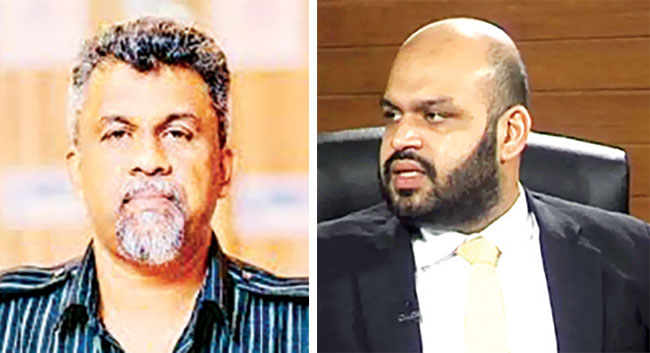
TNA MP Shanakiyan Rasamanickam (Batticaloa) and CP MP Weerasumana Weerasinghe (Matara District) yesterday (11) urged the government to initiate legal proceedings against the former Chairman of the Geological Survey and Mines Bureau (GSMB), Senarath Hewage Prasad Manjula, and Director General Sajjana de Silva, sent on compulsory leave over corruption charges.
The issues at hand couldn’t be swept under the carpet by their removal, the MPs said. Calling for a no holds barred investigation into the GSMB, lawmaker Rasamanickam alleged corruption therein seemed to be so endemic, political authorities, too, should be subjected to scrutiny.
Both MPs appreciated the stand taken by Dr. Anil Jasinghe, Secretary to the Environment Ministry, in respect of the large-scale sand mining project undertaken by sacked GSMBChairman Manjula at Safi Nagar in the Muttur electorate. Jasinghe found fault with de Silva for issuing a permit under controversial circumstances.Dr. Jasinghe yesterday told The Island that a formal inquiry would be conducted in respect of de Silva.
MPs Rasaminckam and Weerasinghe stressed that the government moved against the GSMB bosses in the wake of a scathing attack on the state enterprise carried out by TNA, JVP and SJB members.JVP leader Anura Kumara Dissanayake lambasted Environment Minister Nazeer Ahamed over corruption at the highest level to the lowest rung in this vital government institution. The JVPer questioned the circumstances Manjula as the head of a private mining company, called Uptown Ventures, had received a mining license. Manjula has received the appointment, as GSMB Chairman, in Feb. 2022, after the sacking of Prof. Anura Walpola under controversial circumstances.
MP Rasamanickam first raised the Safi Nagar issue at hand at a COPE meeting, on February 23, 2020. The Batticaloa District MP questioned the rationale behind accommodating the proprietor of a mining company as the Chairman of GSMB.JVPer Dissanayake asked why Uptown Ventures was granted a license to engage in sand mining, in state land, in a clear case of conflict of interest and regardless of a proposal made by another party.
MP Rasamanickam declared in Parliament that the GSMB Chairman was the person who secured the license to remove 100,000 cubes of sand from Safi Nagar. The MP questioned how an official, who is supposed to ensure transparency and legality in sand mining, received a license for the same? The TNA representative declared his readiness to face any legal challenge. Declaring he had the required evidence to prove his accusations, MP Rasamanickam alleged the DG, GSMB, is responsible for all corrupt activities therein.
The Parliament was told how a license obtained by Uptown Ventures for the cultivation of chilies, in 3,000 acres of land, permitted the enterprise to engage in large scale sand mining. The project received government sanction for mining of 5,000 cubes of sand, on a monthly basis (SF)






A group of Tamil Progressive Alliance (TPA) members, including its Leader Mano Ganesan, met President Anura Kumara Dissanayake on Thursday (02) morning at the Presidential Secretariat.
Extensive discussions were held on the issues faced by the Malayagam communities, particularly in relation to education, housing and land, as well as on the urgent measures required to address these concerns. The President paid special attention to all these matters.
Attention was also drawn to the recruitment of qualified Tamil-medium teachers to address the teacher shortage in estate sector schools and this too was discussed at length.
Members of Parliament P. Digambaram and V. Radhakrishnan, along with several other party members, were present at the meeting.
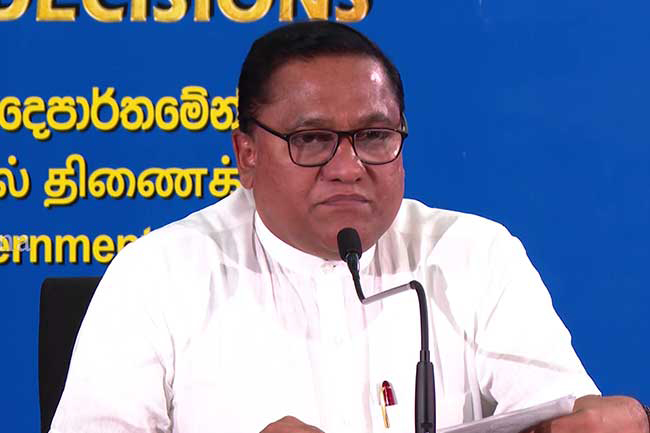
Minister of Foreign Affairs, Vijitha Herath, held talks with Deputy Foreign Minister of Russia Andrey Rudenko at the Foreign Ministry, in Colombo, on Thursday (02), with both sides reaffirming their commitment to strengthening bilateral relations.
The Sri Lanka Ministry of Foreign Affairs said the visiting Russian Deputy Minister noted that Russia regarded Sri Lanka as a long-standing friend.
Rudenko assured that Russia stood ready to support Sri Lanka when required, including in the swift supply of Russian oil to help address the current energy challenges, encouraging Russian investors to explore new opportunities in the country and promoting increased tourist arrivals.
He also expressed Russia’s readiness to provide compensation for Sri Lankan war veterans who had lost their lives in the ongoing conflict between Russia and Ukraine.
Minister Herath welcomed Russia’s willingness to assist, emphasising that Sri Lanka valued the support extended by its “old friend”, particularly at a time when the country was facing pressing energy needs.
He noted that the two countries shared nearly seven decades of diplomatic relations and said the present moment provided an opportunity to further strengthen ties, including through long-term trade agreements.
The discussions focused on enhancing cooperation in the fields of energy, investment, tourism and diplomacy, with both sides reiterating their commitment to further deepen the longstanding friendship between Sri Lanka and Russia.

Police yesterday arrested 157 foreign nationals in connection with an alleged organised online financial scam, conducted from a hotel in the Iranawila area in Chilaw.
The suspects were taken into custody during a raid carried out by the Police while they were staying at the hotel in Iranawila.
Police said the arrested group included 143 nationals from China, 13 from Bangladesh and one from Vietnam.
Investigators suspect the group had been involved in a coordinated online financial scam, targeting victims through digital platforms.
The suspects are being detained for further questioning while investigations are continuing to determine the full extent of the operation and whether additional individuals were involved.Police said further inquiries are underway.
By Norman Palihawadane

Iran executes two convicted members of banned opposition group

Afghanistan earthquake kills eight members of same family

Breakdown of the teams and groups of the FIFA World Cup in Canada, Mexico and the US after the final playoffs

365 US service members injured since start of Iran war – Pentagon

World Cup 2026: Italy’s football chief resigns after qualifying failure

Iran says it downed two US jets as search for one pilot continues

‘Dates have the highest sugar content to fight Coronavirus’

Sunday Island 27 December – Headlines

#SundayIsland 17th December – Headlines

Sunday Island – 28th March

Sunday Island Headlines – 21 March

Sunday Island – 21st February – Headlines
-

 News3 days ago
2025 GCE AL: 62% qualify for Uni entrance; results of 111 suspended
-

 News5 days ago
Tariff shock from 01 April as power costs climb across the board
-
 News6 days ago
Inquiry into female employee’s complaint: Retired HC Judge’s recommendations ignored
-
 Features7 days ago
When seabed goes dark: The Persian Gulf, cable sabotage, and race for space-based monopoly
-

 Features6 days ago
New arithmetic of conflict: How the drone revolution is inverting economics of war
-

 Editorial3 days ago
Search for Easter Sunday terror mastermind
-
 Business4 days ago
Hour of reckoning comes for SL’s power sector
-

 Sports6 days ago
Sri Lanka’s 1996 World Cup heroes to play exhibition match in Kuala Lumpur