
News
Ministry of Justice, EU, UNDP and UNICEF join hands to improve justice for all in Sri Lanka

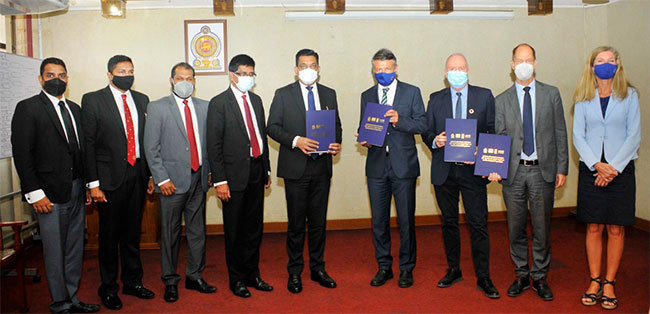
The Ministry of Justice (MoJ), the United Nations Development Programme (UNDP) and the United Nations Children’s Fund (UNICEF) in Sri Lanka have come together to launch the Justice Reform (JURE) Programme. This new initiative, funded by the EU to the tune of EUR 18 million (approx. LKR 4 billion) and the UN for EUR 1 million (approx. LKR 225 million), will be implemented during four and a half years in close partnership with all relevant actors from the justice sector.
The Programme contains a holistic package of support to strengthen inclusive access to justice, improve transparency and accountability in the sector as well as enhance quality and efficient services delivery. It will build on the ambitious justice reform agenda of the Ministry of Justice. Close attention will be paid in particular to foster access to justice for women and children, to support alternative dispute resolution mechanisms to deal with commercial matters and to maximize the potential of digital technologies to improve efficiency.
Speaking at the Justice Reform (JURE) Programme launch yesterday morning, Minister of Justice, M.U.M. Ali Sabry P.C. stated: “An efficient, inclusive and independent justice system is a core requirement for the Sri Lankan republic to move forward. We need to strengthen the administration of justice in Sri Lanka to uphold the rule of law whilst ensuring an independent judiciary. This task would be difficult to achieve without a modern mechanism and support from development partners. This programme will certainly pave the way, and I am happy that the European Union, UNDP and UNICEF are partnering with us in achieving this goal”.
Commenting on the EU engagement in the sector, Ambassador to the European Union in Sri Lanka, H.E. Denis Chaibi stated: “A modern, efficient and inclusive justice sector is critical for social cohesion and to strengthen trust between the State and its citizens. The European Union’s funding is significant and shows how crucial it considers its partnership with Sri Lanka, UNDP and UNICEF to support home-grown reforms and institutions. To enhance access to justice for all will increase the quality and efficiency of justice service delivery”.
Speaking on UNDP’s longstanding support to the justice sector in Sri Lanka as a trusted partner, Resident Representative for UNDP in Sri Lanka, Robert Juhkam stated, “The JURE Programme is designed to be catalytic to improving access to justice, putting people with needs and capabilities at the centre of policies, institutions and programmes. Crucially, UNDP will ensure that JURE provides a platform for bringing together stakeholders across the board, including sectoral state institutions, independent commissions, professional bodies, academic institutions, and civil society into supporting a national effort, without which reform progress would be fragmented. The platform will facilitate consultation, consensus and innovation in judicial reform which is consonant with international standards and best practice, thus strengthening Sri Lanka’s efforts in achieving the SDG-16 targets on peace, justice and strong institutions.”
The Justice Reform (JURE) Programme will contribute to building a modern, efficient and inclusive justice sector in Sri Lanka through innovative reforms, digital transformation and strengthened institutions, paving the way towards enhanced social cohesion and a more peaceful and just Sri Lankan society.

News
AgriConnect Sri Lanka’ to be launched on 30 October to Modernise the Agricultural Sector Through Digitalisation

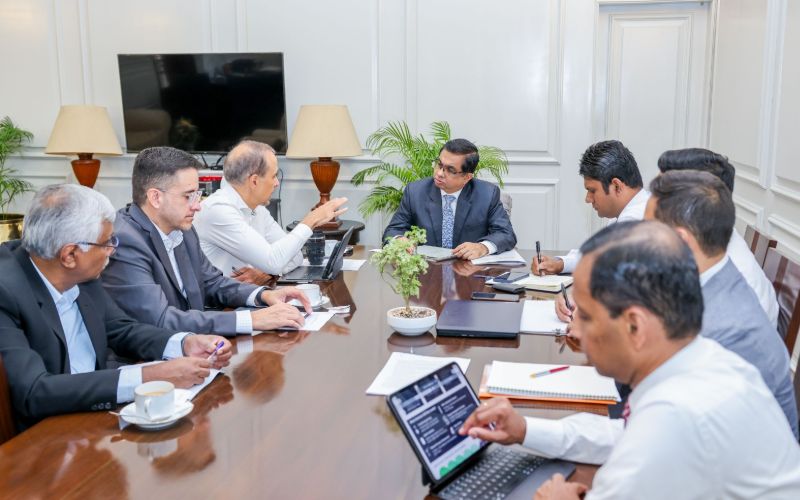
A discussion on the official launch of the ‘AgriConnect Sri Lanka’ programme was held at the Presidential Secretariat on Tuesday (13) morning between Secretary to the President Dr. Nandika Sanath Kumanayake and a delegation led by Gevorg Sargsyan, World Bank Group Manager for Sri Lanka and the Maldives.
The discussion focused on the official launch of the ‘AgriConnect Sri Lanka’ programme, scheduled to take place on 30 October at TRACE Expert City.
The World Bank delegation provided a comprehensive briefing on the programme and emphasised that Sri Lanka is set to become the first country in South Asia to join this global initiative of the World Bank Group, marking a significant milestone.
Victor Anthonypillai, Senior Country Officer of the International Finance Corporation (IFC), Tomas Ricardo Rosada Villamar Practice Manager at the World Bank, Felipe F. Dizon, Senior Economist and Athula Senaratne, Senior Agriculture Specialist, also attended the meeting. The Presidential Secretariat was represented by Senior Assistant Secretary to the President Dr Danushka Perera and Assistant Secretary to the President R. A. Ruwanpathirana.
President’s Media Division (PMD)

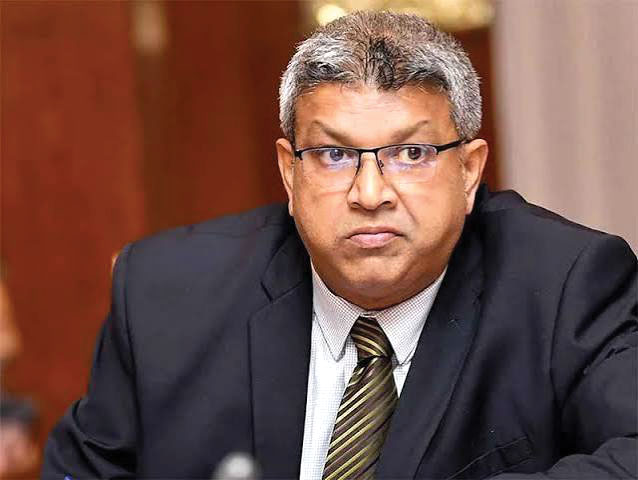
Appointment of committee eyewash, says UNP
The government is considering changes to prison regulations pertaining to the treatment of Buddhist monks serving jail terms, including their right to wear monastic robes when taken outside prison.
Justice and National Integration Minister Harshana Nanayakkara announced the proposed changes yesterday (14) following the submission of an interim report by a committee appointed to review the rules and procedures governing prisons.
The report was handed over to Secretary to the President Dr Nandika Sanath Kumanayake at the Presidential Secretariat.
One of the key recommendations is to amend Prison Standing Order 356 by introducing a new provision, 356(A). The proposed revision would require prison authorities to consult the Department of Buddhist Affairs on the removal of a monk’s robes upon admission to prison. The Commissioner of Prisons would be allowed 10 days to notify the department and take the necessary steps.
A separate amendment to Departmental Order 550 would allow Buddhist monks to wear their robes whenever they are taken outside prison, unless their respective Nikaya formally requests that the privilege be withdrawn.
The committee has also recommended extending similar arrangements, with suitable modifications, to members of other religious clergy who are imprisoned.
The proposals follow concerns raised over the treatment of Ven. Galagoda Aththe Gnanasara Thera after he was taken into custody. President Anura Kumara Dissanayake subsequently held discussions with representatives of the three main Buddhist Nikayas and appointed the committee to examine the existing legal framework.
Nanayakkara said the interim report had been forwarded to the Acting Commissioner General of Prisons, along with instructions to revise the relevant standing orders in accordance with its recommendations.
The proposed amendments have yet to be confirmed as formally implemented.
Meanwhile, the UNP yesterday criticised the government’s decision to appoint a committee to make recommendations on the attire to be worn by imprisoned Buddhist monks and other religious leaders when taken outside prison, describing the move as unnecessary.
In a statement issued yesterday (14), the UNP said the procedures governing the matter were already clearly set out in the Department of Prisons’ Standing Orders, making the appointment of a separate committee unwarranted.
The party cited remarks by Professor G.L. Peiris, Convenor of the Janathawadi Joint Opposition, who had described the committee’s appointment as a
“complete eyewash” and questioned the need for such a move.
Referring to Standing Order 550 of the Prisons Department, the UNP said convicted prisoners appearing before court for legal proceedings should not be required to wear prison uniforms.
It further stated that the regulations allowed prisoners to wear civilian clothing consistent with what they wore before imprisonment, including attire appropriate to their cultural and religious backgrounds.
The UNP accused the government of unnecessarily prolonging the issue by appointing a committee, despite the existence of regulations governing prisoners’ attire.
The party also called on the government to seek forgiveness from the Mahanayake Thera and the Sangha Council of the Kotte Sri Kalyani Samagri Dharma Maha Sangha Sabha of the Siyam Maha Nikaya over the decision concerning the religious attire of Ven. Galagoda Aththe Gnanasara Thera.
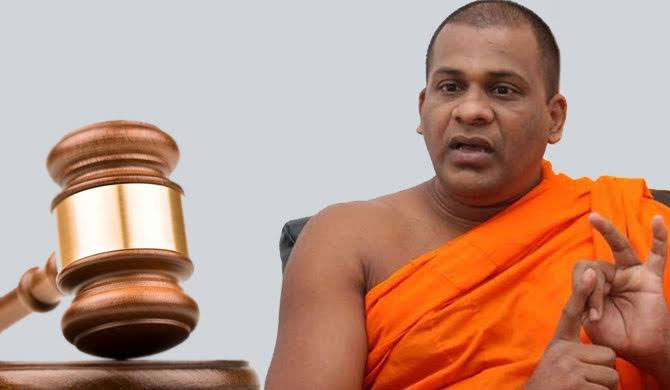
Court of Appeal President Justice Rohantha Abeysuriya yesterday withdrew from the bench hearing petitions challenging the decision by prison authorities to require Ven. Galagoda Aththe Gnanasara Thera to wear prison attire following his imprisonment.
The decision was announced when the petitions seeking to invalidate the prison authorities’ decision were taken up for consideration on October 14.
Following his withdrawal, a three-judge bench was appointed to hear the petitions.
The petitions relate to the prison authorities’ decision to require Gnanasara Thera to wear prison attire after he was taken into custody to serve the remainder of his sentence for contempt of court.
In September this year, the Supreme Court annulled the presidential pardon granted to Gnanasara Thera by former President Maithripala Sirisena in May 2019.
Following the ruling, the Court of Appeal directed the Commissioner General of Prisons to take the necessary steps to enforce the remainder of the monk’s prison sentence.
Gnanasara Thera had originally been sentenced to six years’ imprisonment for contempt of court but had served only around nine months before receiving the presidential pardon in 2019.

AgriConnect Sri Lanka’ to be launched on 30 October to Modernise the Agricultural Sector Through Digitalisation

57th Annual Saints’ Quadrangular Tournament on Saturday and Sunday

Showers or thundershowers will occur at most parts of the island

Prison rules to be revised over monks’ attire

AC President recuses himself from hearing prison attire case pertaining to Gnanasara Thera

Court orders steps to obtain INTERPOL Red Notice against Basil

‘Dates have the highest sugar content to fight Coronavirus’

Sunday Island 27 December – Headlines

#SundayIsland 17th December – Headlines

Sunday Island – 28th March

Sunday Island Headlines – 21 March

Sunday Island – 21st February – Headlines
-

 News7 days ago
NDB fraud Rs 60mn more than reported
-

 News7 days ago
Removing monk’s robes matter for Sangha to decide: Mahanayake Theras
-

 News5 days ago
Sri Lanka escalates anti-graft drive with Shiranthi’s jailing
-

 News6 days ago
NPP govt. reminded of its responsibilities as US warship leaves Colombo
-

 Latest News6 days ago
Farhan, Sadaqat help Pakistan ace 183 chase to go 1-0 up
-

 News7 days ago
BHC, Colombo: “LTTE remains a proscribed org. in the UK”
-

 Latest News4 days ago
Farhan and Sadaqat help Pakistan seal series in style
-

 News5 days ago
Iranian ships stranded, Lanka fears US sanctions